1. Most amateur gold market investors look for “road signs” that suggest gold is in a bull market or a bear market.
2. In contrast, professional bank and FOREX traders focus on price levels.
3. These levels are powerful support and resistance zones where professional investors buy weakness, sell strength, and do so very aggressively.
4. On that note, please click here now. Double-click to enlarge this important daily gold chart.
5. Investors should not waste too much time trying to discern whether gold is going to “hold” at a certain level when the price goes there.
6. When the price of gold enters a key buy or sell zone, it’s better to think less, and simply act with firm buy or sell action!
7. There were a lot of reasons why gold should have gone higher in the $1305 – $1320 area, and it did go to about $1380, but that doesn’t change the fact that $1305 – $1320 is a selling level of importance.
8. Likewise, I’m sure that most gold investors are nervous now. They likely have many reasons why the $1230 – $1200 area should not be bought.
9. Unfortunately, I don’t believe that analysing a key support zone builds any wealth. Buying it does.
10. It’s true that gold can move lower than $1200, like it moved higher than $1320, but that doesn’t change the fact that $1200 is a good buying area.
11. Please click here now. Central banks continue to buy substantial amounts of gold, and that’s generally price-supportive.
12. Next, please click here now. While most investors wonder if the dollar is beginning a new leg higher, Barron’s master analyst Shuli Ren wonders if it’s time to unwind long positions!
13. I think so, and the unwind could be the catalyst for a major gold price rally. On Friday, I sold the bulk of my long dollar/short yen position at the 110 price level.
14. To view the current key price levels for the dollar against the yen, please click here now. Double-click to enlarge.
15. For investors whose main focus is getting richer, it doesn’t matter whether the dollar is in a bull market or a bear market. What matters are key buy and sell price levels, and the dollar is at a key sell level right now against the safe haven yen.
16. RBC Bank economists turned positive on oil in the fall, and now Goldman’s heavyweight team of analysts are joining the upside prediction fun.
17. On that note, please click here now. Goldman is tactically bullish, and with good reason.
18. Oil is the largest component of most commodity indexes. The oil price has a huge effect on institutional inflation expectations.
19. RBC believes an OPEC deal with teeth is I agree. To view the price action, please click here now. Double-click to enlarge this eight hour bars oil chart.
20. Goldman’s fundamentally-oriented analysts have a $55 target now, and I’ll note that if oil can hit $55, it would take out some key highs on the chart. That should usher in substantial commodity fund buying of both gold and oil.
21. A rollover in the dollar would add to the oil price rally.
22. What about gold stocks? Well, please click here now. Double-click to enlarge this GDX daily chart.
23. GDX has arrived at the key $20 round number level. It’s done that just as gold has moved into the $1200 area buy zone. That’s significant.
24. Eager gold stock enthusiasts can be buyers here in the $20 zone. Note the action of my 14,7,7 Stochastics oscillator, at the bottom of the chart. It’s very positive right now. Also, Chinese jewellery companies are poised to begin their buying for the upcoming New Year celebratory season, and that tends to precede a great January rally for GDX. As Christmas approaches, tis the GDX season to be jolly!
Stewart Thomson of Graceland Updates, Guest Contributor to MiningFeeds.com

1. Gold is no longer vulnerable. It has entered a nice buying area.
2. The $1225 – $1200 price zone is both technically and fundamentally important. Here’s why:
3. The average cost of producing gold is now approximately $1210. Fundamentally oriented money managers of size are almost always buyers when gold dips into the cost of production zone.
4. For a look at the technical action, please click here now. Double-click to enlarge.
5. The $1225 – $1200 zone is decent support. It’s not huge support, but it’s decent. I was a modest buyer in the $1220 area this week, after being a seller at $1305 – $1320 last week.
6. I think a lot of people believed that the election of Trump would send gold skyrocketing, but I called gold “vulnerable” going into election night.
7. The bottom line is that Trump is “supportive” for gold. His economic plan will increase the size of an already out of control US government debt. His infrastructure spending plans are inflationary.
8. It’s impossible for America to grow its way out of the unfunded liabilities nightmare it faces.
9. The debt problem can’t be fixed with more taxes. It can’t be fixed with less taxes. It can’t be fixed with more growth. It certainly can’t be fixed with more debt.
10. America’s epic debt problem can’t be fixed at all. Debt needs to be paid, and it isn’t going to get paid. That’s why investors need to own gold. Simply put, in the big picture, Trump’s election is good news for gold, but in the short term, $1305 -$1320 is significant sell-side resistance.
11. As gold surged in the first half of 2016, miners engaged in significant hedging on the COMEX. With the price now near the cost of production again, they appear to be pulling off those hedges. That’s very good news.
12. Please click here now. Double-click to enlarge. That’s another look at the daily gold chart.
13. The $1218 area is a key 50% Fibonacci retracement. When the price of an asset pulls back to an important Fibonacci line, investors are not guaranteed “free money” if they buy, but if important fundamental news is at hand, it is a key buying area.
14. Given that gold is at/near the cost of production for mining companies, this particular Fibonacci retracement zone is quite important.
15. Please click here now. Double-click to enlarge. After staging a mini crash after the US election, the T-bond looks set to rally.
16. That’s more good news for gold; gold can rally if the T-bond falls against the dollar, but only if real interest rates fall (nominal rates minus the rate of inflation).
17. The violence of the T-bond’s post election price decline far exceeded the rise in inflationary expectations, and so gold was hit hard against the dollar.
18. Gold should rally from the $1225 – $1200 area, and it likely will do that. If there is no rally, the next reasonably important buying area is at modest support in the $1180 – $1160 zone.
19. Please click here now. Double-click to enlarge. Note the Stochastics indicator at the bottom of this GDX daily chart. It’s almost oversold.
20. Next, please click here now. Double-click to enlarge. That’s a second look at the GDX daily chart. The 38% Fibonacci retracement zone is now in play, in the $20 area for GDX. Light buying is recommended, mainly because gold is at the mining industry’s average cost of production.
21. I’ve laid out a “playbook” for the transition from deflation to inflation, and for the transition from America as leading empire to the rise of Chindia. In that transition, gold stocks serve as the canary in the inflationary coal mine. They sang loudly in the first half of this year.
22. To actually create that inflation, higher interest rates are required. Those higher rates incentivize banks to move money out of the government bond market and into the fractional reserve banking system. As the money is loaned out, money velocity reverses, and inflation is created.
23. Please click here now. Double-click to enlarge. This regional bank stock ETF shows where America is, in that transition. Bank stocks are surging, driven by the prospect of higher bank loan profits. Trump’s promised deregulation of the banking sector is adding rocket fuel to the rally.
24. Western gold community investors need to have a wee bit of patience. Here’s why: Bank stocks are the main theme at this point in the transition to an inflationary world. Once bank profits rise, money velocity will reverse. From there, gold stocks will begin a vastly bigger rally than the one that occurred in the first half of this year, and this one will be sustained!
Stewart Thomson of Graceland Updates, Guest Contributor to MiningFeeds.com

1. Gold is vulnerable. It’s technically overbought, and a developing top pattern is a concern.
2. Please click here now. Double-click to enlarge. The $1305 – $1320 resistance zone is significant, and in my professional opinion, the rally to the $1380 area was not big enough to turn that resistance into support.
3. I’m still a seller at $1305 – $1320. If gold reaches $1425, I’ll then be a buyer at $1320, if there is a decline into that level.
4. How vulnerable is gold right now? Well, for some further insight, please click here now. Commercial traders (aka “the banksters”) are carrying a massive short position, as the latest COT report clearly shows.
5. Also, there’s a perception that a Republican victory in today’s US election would be good for gold, but not all economists agree; some believe that a US dollar rally is more likely.
6. Please click here now. Famed investor Jim Rogers has this view, and he is followed by many money managers.
7. Of particular concern to me are the developing head and shoulder top patterns that are in play across the gold sector.
8. On that note, please click here now. Double-click to enlarge. Given the commercial trader positioning in the COT report, which includes significant mine hedging, my technical target in the $1100 area seems realistic.
9. If such a decline were to occur, gold stocks may go to new lows before the end of the year, while gold and silver bullion would likely hold well above their 2015 lows.
10. In the big picture, I’ve adamantly argued that gold stocks have been in a bear cycle against gold since 1996, because money velocity and bank loan profits have been in a bear cycle since then.
11. Most of the world has been in a deflationary vortex since 1996, and the vile QE program contributed significantly to that vortex.
12. The good news is that I’ve predicted gold enters a bull era in the summer of 2017.
13. For America, I’m on record predicting a December rate hike this year, and two more in 2017.
14. These rate hikes will end the bank loan profits bear cycle and end the money velocity bear cycle. That will create a new bull cycle in inflation.
15. Please click here now. In regards to inflation and rate hikes, some of the world’s greatest economists clearly have the same outlook that I do!
16. A fairly quick rise in US interest rates to even four percent could create significant problems for US stock market investors. As inflation rises, lenders want a higher interest rate to compensate for that inflation.
17. If inflation were to rise significantly, it’s unknown what level of interest rate would be required to stop banks from moving enormous amounts of money out of government bonds and into the fractional reserve banking system. Lenders may want vastly higher rates than they are getting now.
18. A US government bond market panic is becoming a potential event that serious money managers will need to think about very carefully. I would suggest they start thinking about it… now.
19. Silver held its ground remarkably well during yesterday’s gold price decline, and that is also likely because the winds of inflation are beginning to blow.
20. Please click here now. Double-click to enlarge. Silver’s price action on this short term chart is impressive.
21. Many silver enthusiasts are frustrated with the gold versus silver ratio. That frustration is understandable, but in a world where deflation is king, gold will always shine brighter than silver.
22. In a world where inflation is king, silver takes the leadership baton from gold.
23. Please click here now. Double-click to enlarge this GDX chart. Was the huge rally in gold stocks just a flash in a deflationary pan? I don’t think so. Fundamentals make charts, and the unfortunate truth is that Janet Yellen refused to raise rates this year, after promising four hikes. That refusal to hike has delayed the end of the bank loan profits and money velocity bear cycles, and caused the swoon in gold stocks.
24. The spectacular gold stocks rally in the first half of 2016 was likely a small taste of what is coming in 2017. That’s because inflationary winds are set to blow much harder in 2017 than they did this year, and keep blowing harder for many years after that!
Stewart Thomson of Graceland Updates, Guest Contributor to MiningFeeds.com

With 2016’s contentious US presidential election just days away now, traders are still trying to game the outcome of this tightening race. With a Hillary Clinton victory long priced in, the mounting odds Donald Trump will prevail have big implications for major markets. One critical place traders should look for clues to how Americans will vote is the stock markets. Recent stock performance really sways election results.
This assertion certainly sounds dubious. When Americans are asked what the most-important issues for determining their votes are, the stock markets wouldn’t even make the list. But interestingly a recent Pew Research poll found that the economy was the number-one issue in this election. 90% of Trump supporters, 80% of Clinton supporters, and 84% of all registered voters rated the economy at the very top.
That beat out terrorism as very important to 80% of all voters, foreign policy at 75%, health care at 74%, gun policy at 72%, and immigration at 70%. Nothing is more important to Americans than the economy. The state of it greatly affects our abilities to earn healthy incomes to support our families, our states of well-being, and our hopes for higher standards of living in the future. Americans have long voted with their wallets.
Naturally our perceptions of the state of the economy are heavily colored by our own experiences. If we are thriving and earning a good living, we tend to believe the overall US economy is strong because our personal economy is strong. But if we are struggling to make ends meet, our own financial challenges taint our perceptions of the general US economy. We extrapolate our own fortunes to a universal scale.
While professional traders have to follow major US economic data since it moves markets, it tends to be pretty technical and difficult for laymen to understand. It’s surprising how often headline economic data like jobs or gross domestic product implies one thing, but those very same reports’ internals suggest the exact opposite. An excellent example was last Friday’s highly-anticipated initial number on US Q3 GDP.
The headline read of +2.9% annualized growth easily beat the +2.5% expected, so the media trumpeted accelerating strength in the US economy. Yet the internals of that same report were very weak. Consumer spending, which accounts for over 2/3rds of all US economic activity, was cut in half from +4.3% in Q2 to just +2.1% in Q3. Fully 0.83% of that 2.9% GDP growth came from an anomalous surge in US soybean exports!
How can busy Americans just trying to live their lives expect to wade through these endless torrential data streams? The US economy is fantastically complex and interrelated with everything, and thus very challenging for anyone to understand. So Americans naturally look for a simple proxy to represent how the overall economy is faring. And not surprisingly that happens to be prevailing US stock-market levels.
To the great majority of Americans, the stock markets are the economy! Every evening the mainstream media reports briefly on whether the stock markets were up or down that day. When they have rallied, the media looks for good economic news to attribute it to like a headline-GDP beat. When stock markets sell off, any weak economic news du jour is blamed. Stock-market fortunes greatly influence economic perceptions.
Experienced traders know this gross oversimplification is misleading. Collective greed and fear moves stock markets, forcing them to overvalued or undervalued levels relative to the underlying economy. But whether using stock markets as a US-economy proxy is righteous or not is irrelevant, since perception becomes reality in people’s minds. This phenomenon makes stock markets really sway presidential elections.
The battle lines among the American electorate have long been drawn. About 40% of American voters will vote Republican no matter what, while a proportional opposing 40% will always vote Democrat. That leaves the remaining 20% of independents or swing voters to nearly always decide elections. And their collective opinions on who to support change based on their views of the US economy, and thus stock markets.
Unlike the hardcore bases of the two major political parties who knew they were going to vote for their own party’s candidate forever, independent voters often don’t make up their minds until the final weeks of a presidential race. As they tend to vote with their wallets, that makes their choices very susceptible to their latest perceptions of the US economy. And those are utterly dominated by recent stock-market fortunes.
There’s been much research on this fascinating phenomenon of stock-market action leading into US presidential elections helping decide them, with various methodologies used. But most I’ve seen are limited in scope, like only looking at the post-World-War-II period. So this week as politics dominate our collective mindshare, I decided to finally do my own deeper study on stock markets and presidential elections.
While the flagship broad-market S&P 500 is a vastly-superior stock index on every front, the venerable Dow Jones Industrial Average is probably way more important for elections. Since the mainstream media is still always reporting on stock markets in Dow terms, that’s the number most Americans follow. On top of that, the Dow’s history stretches all the way back to 1885 compared to just 1957 for the S&P 500.
So the DJIA, or Dow 30, has continuity running all the way back to the 1888 US presidential election! That grants us the greatest-possible sample size for investigating the apparent impact on voters’ choices from leading-in stock-market performance. Remember that US presidential elections are always held on the Tuesday immediately after the first Monday in November. That fixes the range at November 2nd to 8th.
I looked at leading-in stock-market performance per the Dow 30 in three separate ways. The first is how the Dow fared in the August, September, and October span leading into the early-November elections, or the final 3 calendar months. Next I cut out August and just considered the September-October span, the final 2 calendar months. Finally I looked at the precise 3 trading months running right up to election days.
The fascinating results are summarized in these tables. The first column shows the election year of the 32 US presidential elections since 1888. That’s our sample size. The next five columns show how each election played out. The incumbent political party controlling the presidency leading into each election is listed, followed by which party actually won. Next comes the election result for the incumbent party.
Then the winning president is listed color-coded for his party, along with the percentage of the electoral-college votes he received. The United States of America is thankfully a Constitutional representative republic ruled by laws, not a democracy where majority mob-rule reigns. When I started this research, I was wondering if bigger leading-in stock-market moves resulted in larger electoral-vote wins by presidents.
The last six columns show the various market performances in Dow terms for August, September, and October (ASO), September and October (SO), and the precise final 3 trading months leading right into election days (F3m). The rule is simple. If the stock markets rose in a given span and the incumbent party won the presidency, or stock markets fell and the incumbent party lost, then the rule worked in that election.
That’s the core crux of this thesis that leading-in stock-market action really sways presidential elections. If stock markets rally as independent voters are deciding how to cast their votes in the final pre-election weeks, then they feel better about the economy. So they vote for the incumbent party to maintain the status quo. If the economy seems to be improving as evidenced by stock markets, why change anything?
Conversely if the stock markets fall leading into elections these swing voters feel worse about the state of the economy. They fear their own personal economies will mirror that perceived downturn. Thus they decide to vote for a change of direction by supporting the challenging party’s bid for the presidency. So the incumbent party is kicked out of office. The hard data shows stocks do really sway US presidential elections!
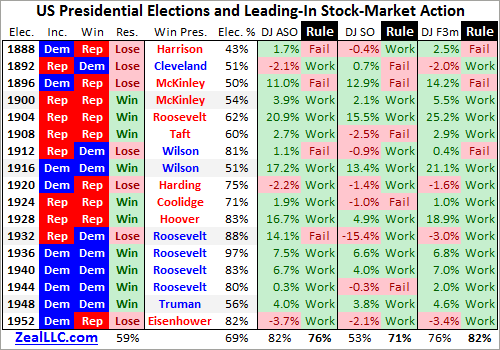
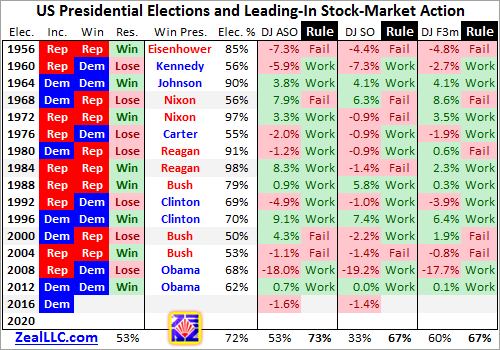
Given the long 131-year history of the Dow Jones Industrial Average, these 32 US presidential elections since 1888 are the largest-possible sample size. And the results are very compelling. The incumbent party wins the US presidency when stock markets are up leading into elections, and loses it when stocks are down, the great majority of the time. The probabilities vary slightly by rule, but are all quite high.
If the Dow 30 rises in that calendar August, September, and October span leading into early-November elections, or falls, the incumbent party indeed appropriately wins or loses the presidency fully 75% of the time! Using the September-October span, that dips modestly to a 69% chance of success for this rule. And avoiding calendar months for the precise final 3 trading months leading into election days, 75% success is again seen.
This is extraordinary, amazing, and maybe even disturbing. Out of the entire history of major US stock indexes, their performances in the final months leading into elections effectively predict the results a whopping 3/4ths of the times! All that campaigning, the billions of dollars now spent, the endless media coverage and stress presidential campaigns fuel, might all be for naught. The stock markets apparently trump all!
While the party faithful do their thing, the independent voters in the middle who determine the results are voting with their wallets. Their perceptions of US economic strength are positive when stock markets are rising, so they vote for more of the same through the incumbent party. But when stock markets fall leading into elections, they start to worry about their own economic fortunes and vote to kick out the incumbents.
This is disturbing because it is ripe for manipulation. Modern successful presidential campaigns cost well over a billion dollars to run. If an exceptionally-shrewd hedge-fund manager was given that kind of money to explicitly manipulate stock indexes, it might be possible to pull off. By strategically buying or selling highly-leveraged S&P 500 index futures at key technical breakpoints, stock markets might be herded.
So could a future presidential campaign try to briefly push stock markets higher if it held the presidency as the incumbent party, or short them lower if it was the challenger party? Maybe. A billion dollars isn’t much money in stock-market terms, and wouldn’t move stock markets for long. But with exquisite timing of futures trades and their outsized impact, and a bit of luck in the economic-news cycle, it could move the needle.
Interestingly it does look like the magnitude of stock-market move indeed affects the size of presidential wins in electoral-vote terms. The two biggest electoral-vote victories in modern times were Bill Clinton’s 70% for his second term in 1996 and Barack Obama’s 68% for his first term in 2008. Bill Clinton was the incumbent, and the stock markets rocketed higher in the final months leading into that 1996 election.
Conversely in 2008 Barack Obama was the challenger, and highly controversial due to his socialist and even Marxist policy positions. But he won a decisive victory against John McCain largely because stock markets plummeted in their first full-on panic in a century leading into that election! The American voters were understandably terrified of the US economy spiraling into a depression, so they booted the incumbent party.
And if political historians looked into the times the leading-in stock-market fortunes failed to sway if not predict the presidential-election outcomes, many would have exceptional circumstances. In 1956 for example, the stock markets plunged heading into early November. Yet popular general and war hero Dwight Eisenhower obliterated Adlai Stevenson, a former Illinois governor who had no real political base.
And a bit later in 1968, Richard Nixon beat the stock-market-forecast odds to win a narrow victory over Hubert Humphrey. He was the sitting vice president under Lyndon Johnson, who was wildly unpopular over his Vietnam war and extensive race riots. Still, challenger Nixon only won in a year stock markets soared heading into that election because third-party candidate George Wallace bled away 8.6% of the electoral vote!
All this history is fascinating, but the real question today is what are the stock markets implying about the outcome of this Tuesday’s battle between Donald Trump and Hillary Clinton? Trump is the challenger since the Democratic party is incumbent with Obama currently holding the presidency. History has shown Hillary Clinton has a 3/4ths chance of winning if stock markets rally in the final months leading in.
Unfortunately for the Democrats, that didn’t happen. The venerable Dow 30 actually fell a considerable and material 1.6% between the final trading days of July and October, and dropped a similar 1.4% in this year’s calendar September and October. And though the stock markets’ performance in the precise final 3 months leading into election day are not yet known, the Dow was way up at 18544 back at that start point.
As of this Wednesday, the data cutoff for this essay, the Dow 30 had fallen a major 3.1% since its close on August 5th exactly 3 months before election day. It’s hard to imagine such a big loss being made up in the final few trading days heading into the election, no matter what happened in this morning’s US monthly jobs report. The stock markets overwhelmingly and conclusively predict Donald Trump will win!
People like to argue that this election cycle is exceptionally wild, strange, and contentious. That may be true, but I’m skeptical. In doing the research for this essay, I studied every historical election where the stock-market rule failed. It is amazing how much social tumult there was, with serious issues ranging from wars to stock panics to depressions to political assassinations to racial unrest. 2016 feels tame in comparison.
While there has certainly been minor racial tension, this year has thankfully seen no wars, stock panics, depressions, or political assassinations. So odds are that 3/4ths historical chance that leading-in stock-market fortunes will sway this election’s outcome will hold true. The caveat is we’re only coming off all-time record stock-market highs. So maybe independents will feel like the US economy is thriving, and vote incumbent.
For weeks if not months, the financial markets have been overwhelmingly pricing in a Hillary Clinton victory on Tuesday. Polls have shown her with a commanding advantage, even though many of them are highly suspect for oversampling Democrats. Almost all the polls I’ve dug into survey Democrats on the order of 44% compared to 37% for Republicans, giving Clinton an automatic built-in lead of 7 points.
If she indeed wins as traders seem to expect, the markets aren’t likely to change much since they are already positioned for that. But if Donald Trump surprises and beats the perceived long odds to win, the markets are in for some serious repositioning trading. Provocatively we don’t even have to guess at what’s likely to happen, as a preview conveniently played out last Friday on some major poll-swinging news.
Around 1:30pm on Friday October 28th, the FBI director shocked the world by writing a letter to Congress saying the FBI found new Hillary Clinton e-mails it needs to examine for classified information. This was a huge surprise because this same FBI director had all but exonerated Clinton in that same investigation just a few months earlier. Traders were suddenly faced with surging odds of Trump actually winning!
So what happened? The lofty overvalued stock markets sold off instantly and sharply. While Trump’s lower taxes and less regulation should be very bullish for stocks over the long term, traders fear all the uncertainty a Trump Administration would bring. They think Clinton represents the Obama status quo, that nothing major will change. So a surprise Trump win Tuesday would likely unleash serious stock selling.
This can be gamed with put options in the flagship SPY SPDR S&P 500 ETF. If stock markets indeed drop on the uncertainty of a Trump win, or God forbid the far-worse uncertainty of a contested election, index puts are going to soar in value. Buying puts doesn’t seem particularly risky, as stock markets are very high and overdue for a major selloff anyway. So a Clinton win is still very unlikely to spark a major rally.
The other major market move last Friday on the FBI reopening its investigations into Hillary Clinton was gold surging. Gold tends to move counter to stock markets, so as they dropped it immediately caught a big safe-haven bid. Gold has just green lighted a major new upleg after it got hammered back in early October as futures stops were run. So traders gaming a Trump victory can also go long gold and its miners’ stocks.
The easiest way to get portfolio gold exposure is buying shares in or call options on the dominant GLD SPDR Gold Shares gold ETF. But gold’s gains will be amplified as always by the stocks of its miners, as their profits really leverage gold upside. Gold stocks conveniently happen to be screaming buys right now for other reasons, and a Trump win can be played with their leading GDX VanEck Vectors Gold Miners ETF.
While the major gold-stock ETFs will surge dramatically with gold if stock markets sell off materially for any reason, including a Trump win or contested election, their gains will be trounced by the best of the individual gold miners. A carefully-handpicked portfolio of elite individual gold and silver stocks with superior fundamentals will really amplify sector gains, dwarfing the performances of the gold-stock ETFs.
At Zeal we’ve spent literally tens of thousands of hours researching individual gold stocks and markets, so we can better decide what to trade and when. This has resulted in 851 stock trades recommended in real-time for our newsletter subscribers since 2001. Their average annualized realized gains including all losers are running way up at +24.1% as of the end of Q3! Why not put our expertise to work for you?
We’ve been super-aggressively adding gold-stock and silver-stock trades since that anomalous gold-stock plummet in early October. These great new trades are detailed in our popular weekly and monthly newsletters, and remain cheap and ripe to buy. Both newsletters draw on our vast experience, knowledge, wisdom, and ongoing research to explain what’s going on in the markets, why, and how to trade them with specific stocks. Subscribe today! For just $10 an issue, you can learn to think, trade, and thrive like a contrarian.
The bottom line is stock-market fortunes in the final few months leading into US presidential elections really sway their results. If stock markets rally into early-November voting, the incumbent party is likely to win since voters feel comfortable about the state of the economy. But if stock markets fall in that critical sentiment-shaping span, independent voters start worrying about the economy and kick out the incumbent party.
For a century and a quarter, this simple stock-market rule has had a 3/4ths chance of predicting how a presidential election will play out. And this year the materially-weak stock markets since mid-August argue strongly in favor of the incumbent party losing. That means the odds of a Trump victory are much higher than traders believe, creating the potential for big market swings if he wins and traders rush to reposition.
1. For gold investors, some days are more awesome than others, and I’ll boldly suggest that today is one of those days. Here’s why:
2. Inflation is no longer near. It’s here. Please click here now. Measured by “stuff used”, China is the world’s largest economy.
3. Producer prices there have surged steadily since the start of 2016, and the index has now crossed above the key 100 marker.
4. China is poised to become the world’s biggest exporter of a product that most analysts have forgotten about; inflation!
5. Also, gold stocks, which I call the canary in the inflationary coal mine, may be poised to start a fresh uptrend. On that note, please click here now. Double-click to enlarge this Agnico Eagle chart. The “Eagle” just staged a one day close above the key round number of $50.
6. This great company is one of my key lead indicators for the entire precious metals sector, and a three day close above $50 could indicate that a new intermediate term uptrend is underway.
7. Agnico Eagle is sometimes able to cover its entire gold mining costs just from its silver production, and it’s an important component in the GDX ETF.
8. Also, Friday is US jobs report day, and a post report rally could see Agnico Eagle stage a weekly close above that important $50 mark.
9. To view some longer term good news, please click here now. Top Islamic financial organizations have teamed up with the World Gold Council to launch the new Shari’ah Standard. It will be launched December 6, just two days after the upcoming Italian referendum.
10. The new “Standard” will allow Muslims to invest in gold in accordance with shariah law, and the World Gold Council predicts the Standard will add a whopping 500 tons to global demand, over just the next four years!
11. It’s going to become increasingly difficult for mining companies to grow their production enough to keep up with this kind of demand growth.
12. It’s becoming very clear that investors who are looking for gold price discovery “action” won’t be bored in the last few months of this year. Chinese New Year buying also begins in another month or so, and the US election is now only about a week away.
13. Please click here now. Double-click to enlarge this bitcoin chart. Bitcoin often leads gold bullion. I implore the Western gold community to view bitcoin not as a competitor with gold, but as a solid part of a diversified anti-fiat investment portfolio.
14. Gold has no competition. It’s the leader of the anti-fiat team, but not the sole player. I cover the bitcoin price action in my juniors/high risk newsletter. I own it, and I’m extremely happy with the price action.
15. Please click here now. Double-click to enlarge. A week ago, I predicted gold would rally straight to trend line resistance at $1285, and recoil from there. That’s exactly what happened. So, what now?
16. Well, it’s going to take a few days of closing above $1285 to launch a serious rally, and even that technical action won’t be enough, without fundamental news that is positive for gold.
17. The critically important jobs report will be released on Friday at 830AM, and the US election follows that just a few days later. Indian festival buying is also accelerating, which should act as good background support for a big fear trade oriented rally.
18. Please click here now. Japan has one of the world’s biggest economies, but gold demand there has never been a big factor in price discovery.
19. I’ve predicted that demand in Japan will grow surprisingly quickly, as more confidence is lost in the nation’s central bank and government. Clearly, some top Japanese economists are beginning to take that same view.
20. Please click here now. Double-click to enlarge this short term Dow chart.
21. The US stock market has a tendency to strengthen in the November to December time frame, but I would caution stock market enthusiasts from betting too heavily on that scenario this year. Seasonally, stock market crashes tend to be most likely in September and October, but the US election, a December rate hike, and the Italian referendum are all factors that may have moved the time frame for a crash to November – December.
22. The bottom line is that the danger of a US stock market crash is actually greater now than it was in September and October. If there is a crash, gold could surge straight to substantial resistance in the $1425 – $1432 price zone.
23. Silver tends to follow gold, but it can also lead gold at key turning points. Please click here now. There’s a clean upside breakout from an ascending triangle in play. There will be substantial battle at the sizable sell-side resistance at $18.50, a battle I expect to be won by the world gold community. It’s almost certain that the upcoming US election will be the catalyst that launches the battle.
24. Lastly, please click here now. Double-click to enlarge. Newcrest is the biggest gold producer in Australia. Like Agnico Eagle, I use it as a bell weather for the entire sector. The price action is extremely positive right now; there are bull wedge and inverse head and shoulders bottom breakouts in play, and a run to the $27 area highs appears imminent. The world gold community should probably fasten their seat belts now, and get ready for an end of the year upside ride!
If you would like to receive our free newsletter via email, simply enter your email address below & click subscribe.
 Follow us on Twitter
 Become our facebook fan
CONNECT WITH US
Tweets
Tweet with hash tag #miningfeeds or @miningfeeds and your tweets will be displayed across this site.
MOST ACTIVE MINING STOCKS
Daily Gainers
 CMC Metals Ltd. CMC Metals Ltd. |
CMB.V | +900.00% |
 Eden Energy Ltd Eden Energy Ltd |
EDE.AX | +200.00% |
| GoviEx Uranium Inc. |
GXU.V | +42.86% |
| Eagle Nickel Ltd. |
ENL.AX | +41.67% |
| Citigold Corp. Limited |
CTO.AX | +33.33% |
| Mount Burgess Mining NL |
MTB.AX | +33.33% |
| Exalt Resources Limited |
ERD.AX | +31.94% |
| Casa Minerals Inc. |
CASA.V | +30.00% |
| Cariboo Rose Resources Ltd |
CRB.V | +28.57% |
| Belmont Resources Inc. |
BEA.V | +28.57% |