Provenance Gold (CSE: PAU) has provided an important update on its ongoing core drilling program at the Eldorado gold project in Malheur County, Eastern Oregon. According to the company, initial drilling results from the first core hole, designated EC-01, have confirmed the presence of gold mineralization extending to greater depths than previously identified.
Provenance Gold’s Chairman, Rauno Perttu, commented in a press release: “The first core hole has already demonstrated the gold mineralization extends much deeper than the depth of approximately 120 meters we went to on holes ED-07 and ED-11 during our RC drilling program last summer. Furthermore, our field work has identified additional mineralized zones well beyond the current and historic drilling. Even though we have 242 historic holes and EC-01 is our 12th new hole, the gold system remains wide open for expansion with multiple visible gold occurrences over several intervals. We are very pleased with what we are seeing in the core at this early stage. This is an exciting time for our company.”
The first core hole, EC-01, is currently being drilled with an orientation of N10W and a -68° dip, targeting a total planned depth of 300 meters. As of the latest update, the hole has reached a depth of 207 meters, encountering highly altered and mineralized granodiorite. Most notably, visible gold has been observed at multiple horizons, specifically at depths of 30 meters, 108 meters, and 158 meters. These findings are significant as they expand the known mineralization in both vertical and horizontal directions.
The purpose of EC-01 is to test the down-dip extension of a previous reverse circulation (RC) hole, ED-07, drilled in 2023. Hole ED-07 had returned an average grade of 3.085 grams per tonne (g/t) gold over its entire length of 114 meters, ending in strong mineralization before termination. The continuation of gold mineralization in hole EC-01 supports Provenance Gold’s hypothesis that the Eldorado system could contain deeper, high-grade zones of gold.
In addition to testing the depth, EC-01 crosscuts the projected northeast trend of high-grade mineralization, offering a better understanding of the strike extent of the system. The visible gold at multiple intervals further expands the potential of the mineralization along both strike and depth. Logging and processing of the core is ongoing, and the company plans to release additional results as they become available.
The ongoing drilling in EC-01 has provided crucial information regarding the nature of the gold system at Eldorado. Three major findings have emerged from the current depth of 207 meters:
1. Gold Mineralization Not Limited to Breccia Zones: Earlier interpretations of the mineralization at Eldorado suggested that high-grade gold was primarily controlled by breccia zones. However, the core retrieved from EC-01 has revealed that high-grade gold is present in altered granodiorite with disseminated sulphides, predominantly pyrite, and visible gold grains across multiple zones. This discovery suggests that the mineralization extends beyond the previously assumed breccia zone, opening the possibility for a more extensive gold-bearing system.
2. Deeper High-Grade Gold Zones Confirmed: The mineralization encountered in EC-01 extends deeper than previously recognized, reaching 207 meters and suggesting that the gold system is larger at depth. This supports Provenance’s earlier postulation that a deeper, high-grade zone exists within the Eldorado system, providing an encouraging sign for future exploration efforts.
3. Mineralization Characteristics: The core from EC-01 is not heavily silicified, which indicates that the mineralization may result from a lower-temperature event than previously thought. This observation aligns with the company’s previous findings regarding gold recovery. Both recent and historic laboratory testing have shown excellent gold recoveries, confirming that the mineralization characteristics are conducive to successful extraction processes.
In addition to the drilling update, Provenance Gold also announced that it expects to close on the second tranche of its private placement, initially announced on June 28, 2024. The private placement is anticipated to close by October 4, 2024, and has garnered substantial interest from participants, leading to an expectation that it will be over-subscribed.
The company has expressed gratitude to all those who have shown interest in participating in the financing round. The proceeds from this private placement are expected to support Provenance’s ongoing exploration efforts at Eldorado and other projects in its portfolio.
The above references an opinion and is for information purposes only. It is not intended to be investment advice. Seek a licensed professional for investment advice. The author is not an insider or shareholder of any of the companies mentioned above.

CopperCorp Resources (TSXV:CPER) has provided a significant update regarding its diamond drilling program at the Jukes Zone target area on the Razorback Copper-Gold-REE property in western Tasmania, Australia. The company has made notable progress with the completion of its first diamond drill hole, JDD001, at the Jukes prospect and has already begun drilling a second hole, JDD002. Both are part of an exploratory effort aimed at testing the depth extensions of copper and gold mineralization in the area.
The drilling program at Jukes is targeting a specific area where previous geological work had indicated potential for high-grade copper and gold mineralization. On September 18, 2024, the first hole, JDD001, was completed to a depth of 214 meters. The second hole, JDD002, is being drilled from the same pad, with a steeper angle compared to JDD001, in order to test for the possible extension of mineralization approximately 70 meters below the initial hole and about 120 meters beneath historical underground workings.
The geological logging of JDD001 indicates the presence of zones with chlorite-magnetite alteration rock and sulphide mineralization. However, full confirmation of the extent and grade of the mineralization is pending laboratory analysis of the core samples. Samples from the priority zone of the drill core, ranging from 71 to 146 meters, have already been sent to the lab, with the remaining portion of the hole set to be sampled and dispatched shortly. CopperCorp expects to receive assay results within two to three weeks and will provide further updates as more data becomes available.
The current drilling campaign at the Jukes prospect comprises two initial diamond drill holes, totaling approximately 400 meters. These drill holes are designed to explore the depth extensions of high-grade copper and gold mineralization that was recently sampled in the historical Jukes No. 3 Main Adit. The adit, an underground passage, yielded samples with results including 31 meters at 1.48% copper and 0.83 grams per tonne (g/t) of gold, with a high-grade intercept of 9 meters at 2.92% copper and 1.79 g/t gold. CopperCorp aims to test its theory that these high-grade zones are related to NNW-trending fault structures, particularly at their intersections with the NE-trending Jukes fault.
Depending on the results of the initial drilling, CopperCorp may extend the depth of the drill holes to explore deeper parts of the Jukes system. The company currently has permits to drill up to 1,320 meters from four different drill sites in the area. Ongoing exploration work, such as geophysical data reviews and surface sampling programs, may also influence the scope of the drilling program.
The Jukes prospect is located on CopperCorp’s Razorback Copper-Gold-REE property, which lies about 10 kilometers south of the Mt Lyell copper-gold mining camp, owned by Sibanye-Stillwater. Mt Lyell is one of Australia’s most well-known copper-gold mining camps, and CopperCorp’s proximity to this area enhances the potential significance of its findings at Jukes. Recent exploration by CopperCorp, including 3D inversion modeling of magnetic and gravity data, has indicated the presence of a vertically extensive, pipe-like magnetic feature at Jukes. This feature coincides with a residual gravity anomaly, which suggests that there could be structurally controlled mineralized pipes similar to those found in the Mt Lyell system.
The magnetic and gravity anomalies observed at Jukes are positioned adjacent to large fault structures, which are considered highly favorable for hosting mineralized bodies. These types of structures at Mt Lyell have previously been associated with large orebodies like the Prince Lyell and Western Tharsis deposits. These deposits are characterized by chlorite-magnetite-apatite-biotite alteration zones, which extend to significant depths. The geological features observed at Jukes bear similarities to these well-known ore systems, making it a promising target for future exploration.
Previous exploration at the Jukes prospect in the 1970s and 1980s included limited drilling below historical underground workings, yielding results such as an intercept of 13.4 meters grading 1.6% copper and 1.6 g/t gold from a depth of 61.6 meters in drill hole JP02. CopperCorp has followed up on this earlier work with recent channel sampling of the underground adits, which resulted in strong copper and gold grades. These findings indicate the potential for significant mineralization at depth, which CopperCorp is now investigating through its current drilling program.
The copper-gold mineralization at Jukes primarily occurs in the form of chalcopyrite, with some bornite, and is associated with intense chlorite-magnetite alteration. These mineralogical characteristics closely resemble those seen at deeper levels in the Mt Lyell system, further supporting the geological potential of the Jukes prospect.
CopperCorp Resources Inc. is actively focused on the exploration and development of its copper-gold-REE projects in western Tasmania, including the Skyline, AMC, and Whisky Creek properties, in addition to Razorback. The company has secured a solid financial position, with approximately CAD $4.0 million in working capital, as reported in its August 2024 financial update.
The above references an opinion and is for information purposes only. It is not intended to be investment advice. Seek a licensed professional for investment advice. The author is not an insider or shareholder of any of the companies mentioned above.
In a recent conversation with Triple Point Resources, we explored the company’s groundbreaking approach to clean energy storage. As the world pushes toward a carbon-neutral future, Triple Point is positioning itself in the middle of this transition, with innovative solutions aiming to reshape the energy landscape. Below is the full transcript of our discussion, detailing Triple Point’s role in utilizing salt caverns for hydrogen storage, their unique location on Newfoundland’s east coast, and their plans for future development.
Can you provide an overview of Triple Point Resources and its primary focus in the clean energy storage sector?
As an organization, Triple Point Resources, Ltd. (Triple Point) is all about leading the charge in transforming the global energy landscape. Our primary focus is utilizing salt caverns for the storage of hydrogen and compressed air, which is a key component in ensuring the reliability of renewable energy sources in the transition to a sustainable energy future.
What drives us at Triple Point is a strong belief in innovation and collaboration. It’s not just about advancing technology – it’s about building meaningful partnerships with local communities and stakeholders. We’re deeply committed to sustainable development that benefits both the environment and the communities we work with.
Ultimately, our goal is to help create a more resilient and sustainable energy infrastructure that will stand the test of time and serve future generations.
How does Triple Point utilize the Fischells Salt Dome for hydrogen storage, and what are the key benefits of this approach?
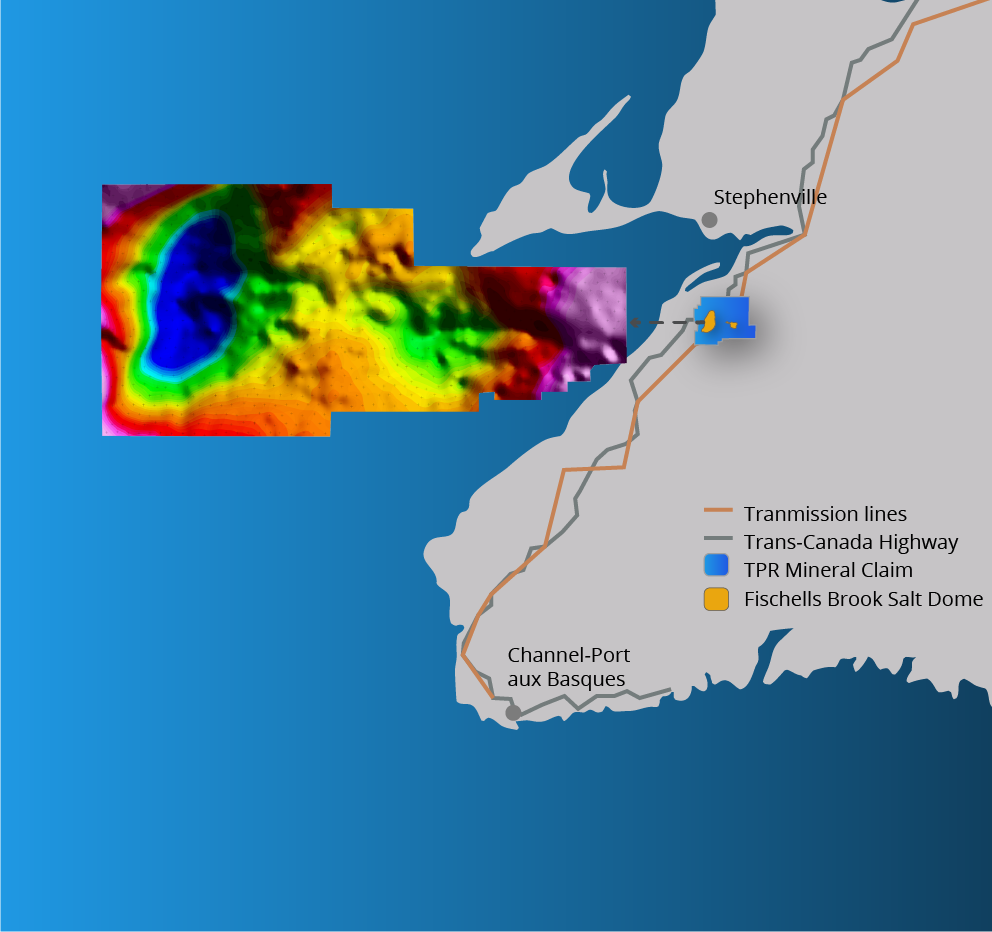
Triple Point’s flagship project, the Fischells Salt Dome, situated strategically in Newfoundland, Canada (on the east coast of North America), is poised to transform intermittent renewables into dependable, safe, and cost-effective low-carbon renewable energy on a utility and industrial scale.
By harnessing the potential of underground storage, Triple Point aims to drive the decarbonization of the energy industry, ensure a secure energy supply for industrial and grid applications, and enhance the viability of hydrogen projects worldwide.
The Fischells Salt Dome will contribute to secure energy supply when high energy demand peaks. The project is prepared to provide approximately 200,000 tonnes of hydrogen in 35 million cubic meters of cavern storage.
Salt caverns have been used since the 1960s and are the preferred choice for underground hydrogen storage for good reason. The salt’s low reactivity with hydrogen, combined with a reduced risk of leaks and lower storage costs, makes it the most efficient and secure option available today.
What are the main technological innovations behind your Compressed Air Energy Storage (CAES) project, and how does it enhance grid stability?
Compressed Air Energy Storage (CAES) is a well-established technology with over 50 years of history. In recent years, the growing focus on renewable energy storage has led to a rise in CAES projects, particularly in regions where salt caverns are present. Triple Point’s Fischells Salt Dome leverages this proven technology to enhance grid stability by providing a reliable and scalable solution for renewable energy storage.
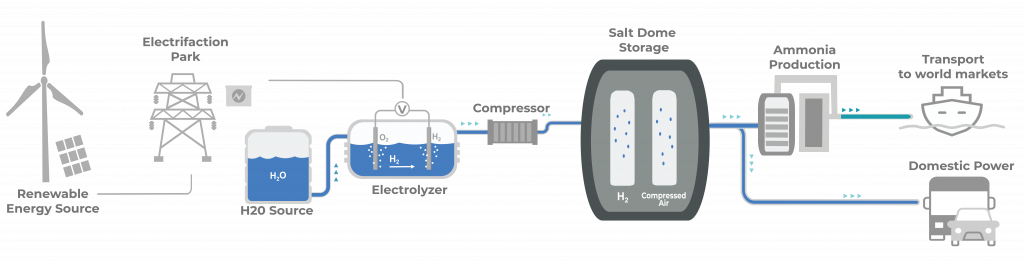
Unlike traditional battery storage or hydrogen conversion, CAES is uniquely suited to address specific needs, such as supporting peak load demands on the local energy grid. In Newfoundland and Labrador, our CAES system is designed to store excess energy during periods of low demand and release it during peak times, ensuring a stable and consistent power supply. This capability not only helps balance the grid but also maximizes the use of renewable energy sources, making it a key component in our work to support the region’s energy infrastructure.
Can you discuss the strategic importance of your location on the eastern seaboard of North America for your energy projects?
Fischells Salt Dome is located on Newfoundland and Labrador’s premier wind corridor, which has been attracting multi-billion-dollar wind farms to provide energy to produce hydrogen.
Newfoundland and Labrador have all the ingredients to be a globally recognized green energy corridor with impressive renewable energy resources, including hydroelectricity, wind resources and the massive renewable energy storage capacity of Fischells Salt Dome.
Right now, there are six wind-to-hydrogen projects in the works across the province, and we expect more to follow. Fischells Salt Dome offers tremendous capacity to safely store industrial scale volumes of hydrogen for all these projects combined. Being located on the east coast of North America allows Triple Point to reach several international markets for export with easy access to deep, ice-free, seaports, and more. Ultimately, the export of products from the Fischells Salt Dome will generate revenue for Newfoundland and Labrador, and will support global decarbonisation efforts by supplying renewable energy to export markets around the world.
What are the anticipated environmental and economic benefits of using salt caverns for hydrogen storage?
The world is on a mission to become carbon-neutral by 2050 and hydrogen is set to play a crucial role in making that happen. With more than 26 countries already rolling out national hydrogen strategies and governments investing billions of dollars to fuel the growth of a global hydrogen economy, the momentum is undeniable.
Underground storage in salt domes, like the Fischells Salt Dome, will be a game-changer for the hydrogen industry. It’s a key piece of the puzzle that will help make hydrogen more economically viable and reduce the risks associated with offtake agreements.
Additionally, the Fischells Salt Dome will spur local economic development and create new job opportunities in the energy sector, on a local level. The project’s development is expected to create numerous jobs, driving economic growth in the region. And as the project moves forward, it’s likely to attract further investment into local infrastructure and services, amplifying its positive impact even further.
How does Triple Point plan to collaborate with local communities to ensure sustainable development of the Fischells Salt Dome?
At Triple Point, we strongly believe that innovation and collaboration are key to driving positive change. As we work toward a sustainable energy future, we’re committed to partnering with local communities and stakeholders to ensure that our development practices are not only sustainable but also beneficial for everyone involved.
Our goal is to build a brighter future for the communities where we operate. We’re focused on establishing long-term relationships, supporting sustainable economic development, creating local jobs, and maximizing the opportunities that come with green energy.
What recent milestones has Triple Point achieved in its quest to support the hydrogen economy, and what are the next steps?
In June 2024, Triple Point Resources’ Fischells Salt Dome continues to prove ideal for energy storage. These results mark a significant milestone in our project development and provide important information about cavern characteristics to advance our commercial model.
To learn more about this milestone, visit: https://triplepoint.ca/triple-point-resources-fischells-salt-dome-continues-to-prove-ideal-for-energy-storage/
How do you see the role of salt caverns evolving in the global energy transition, especially in relation to hydrogen storage?
As Canada’s only salt dome, Fischells Salt Dome gives the country a unique opportunity to play a key role in the development of a new hydrogen energy network. By tapping into the power of underground storage, Triple Point is committed to driving the decarbonization of the energy industry, ensuring a secure energy supply for both industrial and grid applications, and boosting the viability of hydrogen projects on a global scale.
The Fischells Salt Dome will be crucial in maintaining energy security, especially during peak demand times and in managing supply interruptions.
What partnerships and collaborations have been crucial for Triple Point’s progress, and how do they enhance your operational capabilities?
Triple Point believes in the power of collaboration to meet the challenges our planet is facing, as they allow us to play a vital role in the renewable energy value chain. Our collaboration with leading organizations such as RESPEC and SubTerra has been instrumental in advancing our Fischells Salt Dome project, particularly in the areas of geological analysis and underground storage solutions.
In addition, our active involvement with industry associations like the Canadian Hydrogen Association (CHA) and the Energy Storage Canada (ESC) ensures that we are at the forefront of industry developments and standards. These partnerships help us influence and shape the global renewable energy value chain, ensuring that our innovations and practices are aligned around the world.
By working closely with these experts and industry leaders, we enhance our operational capabilities, stay informed of best practices, and contribute to the overall growth and sustainability of the clean energy sector.
The above references an opinion and is for information purposes only. It is not intended to be investment advice. Seek a licensed professional for investment advice. The author is not an insider or shareholder of any of the companies mentioned above.

Abitibi Metals (CSE:AMQ) has provided an update on its 16,500-metre Phase 2 drilling program at the B26 Polymetallic Deposit, located in Quebec. The project is fully funded, with $15.5 million allocated for the completion of the 2024 program, and an additional 20,000 metres of drilling planned for 2025. The results from this drilling program are intended to contribute to a Preliminary Economic Assessment as part of Abitibi’s option to acquire an 80% interest in the deposit from SOQUEM Inc.
Jonathon Deluce, CEO of Abitibi Metals, commented in a press release: “The first hole of Phase 2 has delivered exceptional observations of continuity of visual copper mineralization. This hole supports our expansion thesis of the western plunge and is the deepest intercept in the Project’s history. We are now planning on extending the zone with a wedge 50 metres from the first intersection. The LaRonde Mine (2P reserve of 2.9 Moz Au) located 62 kilometres west of Val-d’Or in Quebec extends beyond 4.0 km highlighting potential size of these deep seeded systems in the Abitibi.”
The company’s latest step-out drilling at the deposit, specifically Drillhole 1274-24-338, has yielded promising results in the western plunge extension of the deposit. The hole, initially planned to reach a depth of 1,250 metres, was extended to 1,422 metres after positive visual indicators of mineralization were observed. This hole was designed to test the extension of a high-grade mineral lens previously identified in drillhole 1274-16-236, which intercepted 5.08% copper equivalent (Cu Eq) over 7.1 metres.
Key Drilling Results and Mineralization Zones
Drillhole 1274-24-338 intercepted the copper-gold zone at a depth of 1,206 metres, extending to 1,287 metres. This intercept occurred 35 metres west of hole 1274-16-236 and 90 metres deeper. Notably, this is one of the deepest western extensions in the history of the B26 project. Continuous chalcopyrite mineralization was observed in the intercept, marking a significant development in the ongoing exploration of the deposit.
The drilling identified three distinct mineralized domains at depth:
1. Copper-Gold (Cu-Au) Zone: Located between 1,206 and 1,287 metres, this zone contained significant quartz veining and chalcopyrite stringers.
2. High-Grade Zone within the Cu-Au Zone: Spanning from 1,262 to 1,272 metres, this section exhibited semi-massive bands of chalcopyrite, with chalcopyrite making up 10% to 60% of the core volume. Quartz veining accounted for 30% of the structure.
3. Volcanogenic Massive Sulfide (VMS) Zone: Found between 1,314 and 1,344 metres, this zone contained notable concentrations of zinc (Zn), silver (Ag), copper (Cu), and lead (Pb).
The 81-metre-long Cu-Au mineralized interval (1,206 to 1,287 metres) included chalcopyrite stringers within strongly altered felsic volcanic rocks. Mineralized bands ranged from 0.4 to 4 metres in thickness, offering further indications of the potential scale of the deposit’s mineralization.
Abitibi Metals has commenced drilling a wedge from Drillhole 1274-24-338, designated as 1274-24-338 W1. This wedge hole aims to intercept the mineralized zone approximately 50 metres west of the original pilot hole, further testing the extension of the deposit at depth. The wedge was initiated at a downhole depth of 900 metres and has reached 1,407 metres, with further drilling planned.
This next phase of exploration is part of the company’s broader efforts to fully assess the potential of the B26 deposit and will inform future development plans.
Abitibi Metals entered into an option agreement on November 16, 2023, to earn up to an 80% interest in the B26 Polymetallic Deposit over a seven-year period. The B26 Deposit is situated within the Brouillan Volcanic Complex in the Abitibi Greenstone Belt, a region well-known for its base and precious metal deposits. The deposit is host to a historical resource estimate of 7.0 million tonnes (Mt) at 2.94% Cu Eq (indicated) and 4.4 Mt at 2.97% Cu Eq (inferred), according to a 2018 report by SGS Canada Inc. However, the company has clarified that this historical estimate has not been verified as current resources or reserves by a qualified person under National Instrument 43-101 standards.
SOQUEM Partnership
SOQUEM Inc., a subsidiary of Investissement Québec, retains a 20% interest in the project as part of the option agreement. SOQUEM is focused on the exploration and development of mining properties across Quebec, contributing to the province’s economic growth. SOQUEM has been a key partner in the development of the B26 project, bringing both technical expertise and local knowledge to the venture.
The above references an opinion and is for information purposes only. It is not intended to be investment advice. Seek a licensed professional for investment advice. The author is not an insider or shareholder of any of the companies mentioned above.

The above references an opinion and is for information purposes only. It is not intended to be investment advice. Seek a licensed professional for investment advice. The author is not an insider or shareholder of any of the companies mentioned above.

Giant Mining (CSE:BFG) has announced its intention to apply for the listing of common share purchase warrants on the Canadian Securities Exchange (CSE). The company will seek approval to list a total of 15,455,000 Warrants, which were issued following a private placement of units that closed on May 1, 2024.
David Greenway, CEO of Giant Mining, commented in a press release: “We are pleased with the progress of our drilling program at Majuba Hill, particularly with assays still pending and a team that is fully engaged to take the Majuba Hill Deposit to the next level. We look forward to receiving the lab results from ALS Global Services, which will further our understanding of the deposit and its potential to become a future domestic supply of copper for North America.”
Each Warrant allows the holder to acquire one common share of Giant Mining at an exercise price of $0.25 per share before May 1, 2025. The company expects the Warrants to trade under the symbol BFG.WT. Additionally, the Warrants will be governed by a warrant indenture between Giant Mining and Endeavor Trust Corporation. The listing remains subject to approval from the CSE, and the company will release further details, including the trading date and CUSIP for the Warrants, once the CSE gives conditional approval. However, the listing may not occur as anticipated or at all, as it depends on regulatory approval.
Copper Drilling Program at Majuba Hill
In tandem with its warrant listing efforts, Giant Mining continues its exploration activities at the Majuba Hill Copper Deposit in Pershing County, Nevada. The company recently completed two major drill holes, MHB-30 and MHB-31, as part of its ongoing diamond core drilling program, targeting the area’s copper potential. Hole MHB-30 reached a depth of 800 feet (244 meters), while Hole MHB-31 extended to 1,086 feet (331 meters). The samples from MHB-30 have been sent to ALS Labs for assay analysis, with results pending.
The current diamond core drilling program is part of a broader multi-phase drilling initiative at Majuba Hill, which includes a 16-hole reverse circulation (RC) drilling phase. Giant Mining’s geological team has been reviewing the mineralization controls at the site, discovering significant magmatic-hydrothermal breccias that may help explain the copper concentrations in the area. Observations made during surface traverses and in the underground workings revealed that these breccias could serve as key controls for high-grade copper deposits, particularly in zones with concentrations greater than 0.5% copper, as outlined in the company’s 2023 Block Model. Further, core drilling intersected magmatic-hydrothermal breccia bodies in both MHB-30 and MHB-31, reinforcing the company’s belief in the area’s mineral potential.
The company’s review of its drilling database, which includes nearly 25,000 meters of drill data from previous campaigns, supports an exploration target of 50,000,000 to 100,000,000 tonnes. This target aligns with estimates outlined in Giant Mining’s National Instrument 43-101 (NI 43-101) Technical Report, which provides a comprehensive assessment of the Majuba Hill Project.
Giant Mining Corp. focuses on acquiring and developing late-stage copper, silver, and gold assets to meet the growing global demand for these metals. As the world transitions toward more sustainable energy solutions, demand for copper, in particular, has increased due to its critical role in the production of electric vehicles and renewable energy infrastructure. Programs such as the Green New Deal in the United States and similar initiatives in other countries highlight the need for materials like copper to support green technology development.
Majuba Hill is Giant Mining’s flagship project and is located 156 miles outside of Reno, Nevada. The company has positioned itself to explore and develop assets in mining-friendly jurisdictions where regulatory frameworks support responsible mining activities. Giant Mining’s leadership remains focused on advancing Majuba Hill while exploring other opportunities in regions with favorable mining conditions.
The above references an opinion and is for information purposes only. It is not intended to be investment advice. Seek a licensed professional for investment advice. The author is not an insider or shareholder of any of the companies mentioned above.

Kobo Resources (TSXV:KRI) has resumed diamond drilling at its Kossou Gold Project in Côte d’Ivoire, launching a fully funded 10,000-metre drill program. The company aims to build on its previous exploration efforts at the 100%-owned site, targeting key gold zones to extend known mineralization at depth and along strike, while also testing new areas for potential gold deposits.
Edward Gosselin, CEO and Director of Kobo commented in a press release: “This is an exciting time for Kobo as we reinitiate our diamond drilling campaign on highly prospective gold targets at Kossou. We are fully funded for this program and into next year, providing us with the resources to aggressively pursue our exploration objectives. The key zones we’re targeting hold significant potential, and this new program will build on previous success by testing depth extensions and uncharted mineralized areas.” He continued: “We are also proud of our commitment to responsible exploration, highlighted by the fresh water well initiative that will benefit and support the local Bocabo community. Looking beyond Kossou, we are dedicated to advancing our regional exploration strategy, bolstered by the support of our strategic partner, Luso Global Mining. We remain focused on delivering results for our shareholders and are excited about the opportunities that lie ahead.”
The Kossou Gold Project is located approximately 20 km northwest of Yamoussoukro, Côte d’Ivoire’s capital, and lies near one of the largest gold mines in the region. The project holds significant promise due to its strategic location and the successful outcomes of prior exploration programs. Kobo Resources intends to focus its latest drilling on four major target zones: the Jagger Zone, Road Cut Zone, Kadie Zone, and Contact Zone.
Jagger Zone: Defined by a 2 km long gold-in-soil anomaly, the Jagger Zone has been trenched and drilled over a 1 km strike length, with mineralization remaining open both to the north and south. Previous drilling intercepted significant gold deposits, such as 19 meters at 2.03 g/t Au (hole KRC011). The current drill program will aim to test the extension of these mineralized structures at depths between 175 and 250 meters below the surface. Additionally, drilling will target a 350-meter untested gap where past Reverse Circulation (RC) drill results revealed 6 meters at 4.31 g/t Au (hole KRC015). A total of 3,700 meters will be drilled in 17 holes at the Jagger Zone during this campaign.
Road Cut Zone: With a 1.6 km long gold-in-soil anomaly and a 900-meter strike length, the Road Cut Zone has shown multiple mineralized shear zones in previous drilling efforts. The most recent results include 13 meters at 2.10 g/t Au (hole KRC044) and 11 meters at 1.71 g/t Au (hole KDD0012). Mineralization remains open to the south, where it may connect with gold found in the Jagger and Kadie zones. The upcoming drilling will aim to fill in gaps left by earlier efforts and test mineralization down to approximately 150 meters below the surface. The company plans to drill 3,700 meters across 18 holes in the Road Cut Zone.
Kadie Zone: Mineralization at the Kadie Zone is based on strong geochemical anomalies, but exploration here is still in its early stages, with only five diamond drill holes completed so far. Highlighted intercepts include 9 meters at 23.89 g/t Au (hole KDD005) and 7 meters at 1.91 g/t Au (hole KDD0024). The zone remains open at depth and along strike. As part of this program, Kobo plans to drill approximately 1,000 meters in seven holes.
Contact Zone: The Contact Zone Fault has emerged as a promising exploration target. This major structure is believed to have played a role in concentrating gold-bearing fluids during the area’s geological history. Gold-in-soil anomalies traceable over 2.5 km, along with nearby artisanal mining activity, suggest this area could hold significant mineralization. Kobo plans to drill 700 meters across seven holes in this zone during the upcoming campaign.
Kobo Resources has been actively exploring the Kossou Gold Project for several years, identifying numerous high-potential targets through a combination of trenching, soil sampling, and drilling. In 2023, the company conducted approximately 5,900 meters of reverse circulation drilling and 5,400 meters of trenching. Early in 2024, the company completed another 4,368 meters of diamond drilling. These efforts have delineated a 9 km-long prospective corridor containing gold mineralization in multiple zones, suggesting the presence of a large orogenic gold system.
As the company resumes its drilling program, it will look to further extend mineralization at depth and along strike at its existing targets. The results from this work will help define the potential size and scale of the gold system at Kossou.
The above references an opinion and is for information purposes only. It is not intended to be investment advice. Seek a licensed professional for investment advice. The author is not an insider or shareholder of any of the companies mentioned above.

Solaris Resources (TSX:SLS) (NYSEAmerican:SLSR) has announced drilling results from its ongoing exploration program at the Warintza Project in southeastern Ecuador. The company aims to expand mineral resources and upgrade existing ones while enhancing its infrastructure and operational efficiency. The latest update provides insight into the progress made through new assay results and a record-breaking month for drilling activity.
Solaris announced the latest results of its 2024 drilling campaign, which includes a planned total of 60,000 meters. The key findings from recent drilling operations highlight intercepts of high-grade mineralization that extend beyond the current Mineral Resource Estimate (MRE). These findings emerged from drill holes in the northwest and southeast sectors of the Warintza Project, targeting sparsely drilled zones where grades have historically been lower or less understood.
A standout result from the latest drilling includes an intercept measuring 475 meters at a copper-equivalent grade (CuEq) of 1.03%. This intercept came from near the surface and demonstrated the potential to significantly expand the existing resource base. This mineralization is essential for refining the geological model of the Warintza Project and providing a stronger basis for future resource upgrades.
The company also achieved a new drilling record in August 2024. Solaris reported that its team drilled 10 kilometers (km) in one month, surpassing a previous record set in 2021 when 12 rigs managed to drill 8 km. The current 10 km of drilling was achieved using just eight rigs, indicating considerable improvements in productivity and operational efficiency. This record sets the company on a strong trajectory toward completing its 60,000-meter drilling goal for the year, further advancing the exploration potential of Warintza.
Solaris attributes this increase in productivity to significant infrastructure investments made at the site. The company has been focusing on building out the necessary infrastructure to support its expanding exploration activities. The next phase of construction is already underway, which should further bolster their capacity to drill and process results at the site. These infrastructure developments are designed to improve access to drilling targets and enhance overall project efficiency, contributing to the record performance seen in August.
The Warintza Project remains the company’s flagship asset and has attracted attention due to its rich mineralization and potential for resource expansion. Located in Ecuador’s resource-rich southeastern region, the project has been the focus of intensive exploration and development work. Solaris continues to aim for a balance between upgrading known mineral resources and exploring for additional, high-grade mineralized zones. The latest drill results are expected to contribute to the upcoming updates in the MRE, which serves as a key metric for investors and stakeholders to evaluate the potential of the project. While the results highlight continued resource potential, Solaris has emphasized that much of the mineralization discovered lies outside of the currently defined resource estimate, suggesting room for further resource growth and exploration potential.
Highlights from the results are as follows:
Northwest Sector:
- SLS-100 (drilled southeast): 427m of 1.11% CuEq² within 475m of 1.03% CuEq² from surface
- SLS-99 (drilled southwest): 105m of 1.00% CuEq² within 246m of 0.75% CuEq² from surface
- SLS-96 (drilled southeast): 78m of 0.71% CuEq² within 288m of 0.47% CuEq² from surface
- SLS-97 (drilled west): 75m of 0.60% CuEq² within 308m of 0.36% CuEq² from surface
Holes SLS-96, SLS-97 and SLS-99 added new high-grade mineralization partially outside of the MRE while SLS-100 improved upon the modelled grade in its vicinity. These holes were located in the northwest sector where mineralization has now been extended to the contact with a tabular granodiorite that shapes the northwestern pit wall. Step-out exploration drilling is now testing the potential for mineralization within a large area of undrilled soil anomaly on the far side of this body.
Southeast Sector:
- SLSE-50 (southwest): 84m of 0.70% CuEq² within 445m of 0.53% CuEq² from surface
- SLSE-45 (drilled east): 285m of 0.63% CuEq² within 399m of 0.58% CuEq² from surface
- SLSE-47 (drilled southwest): 210m of 0.58% CuEq² within 399m of 0.42% CuEq² from surface
- SLSE-46 (drilled south): 75m of 0.73% CuEq² within 400m of 0.34% CuEq² from surface
Holes SLSE-45, SLSE-46, SLSE-47, and SLSE-50 added new high-grade mineralization partially outside of the MRE while SLSE-45 and SLSE-46 improved upon modelled grades in their vicinity. Mineralization remains open to the southeast for approximately 600m within a large 0.8km x 0.8km soil anomaly that defines the target opportunity in this direction.
Table 1 – Mineral Resource Extension, Infill and Condemnation Results
| Hole ID | Date Reported |
From (m) |
To (m) |
Interval (m) |
Cu (%) |
Mo (%) |
Au (g/t) |
CuEq² (%) |
Comments |
| SLS-100 | Sep 19, 2024 | 0 | 475 | 475 | 0.76 | 0.04 | 0.09 | 1.03 | Northwest sector – infill |
| Including | 48 | 475 | 427 | 0.84 | 0.04 | 0.09 | 1.11 | ||
| SLS-99 | 0 | 246 | 246 | 0.24 | 0.09 | 0.05 | 0.75 | Northwest sector – extensional | |
| Including | 21 | 126 | 105 | 0.49 | 0.08 | 0.09 | 1.00 | ||
| Including | 21 | 165 | 144 | 0.37 | 0.08 | 0.07 | 0.87 | ||
| SLS-98 | 24 | 159 | 135 | 0.24 | 0.00 | 0.05 | 0.28 | Northern sector – extensional | |
| Including | 54 | 81 | 27 | 0.53 | 0.00 | 0.07 | 0.59 | ||
| SLS-97 | 0 | 308 | 308 | 0.19 | 0.03 | 0.04 | 0.36 | Northwest sector – extensional | |
| Including | 51 | 126 | 75 | 0.37 | 0.04 | 0.05 | 0.60 | ||
| SLS-96 | 0 | 288 | 288 | 0.10 | 0.06 | 0.02 | 0.47 | Northwest sector – extensional | |
| Including | 0 | 210 | 210 | 0.13 | 0.06 | 0.03 | 0.50 | ||
| Including | 0 | 78 | 78 | 0.28 | 0.07 | 0.07 | 0.71 | ||
| SLS-95 | 93 | 397 | 304 | 0.17 | 0.00 | 0.06 | 0.22 | Northern sector – extensional | |
| SLS-94 | 54 | 381 | 327 | 0.28 | 0.03 | 0.03 | 0.45 | Northern sector – infill | |
| Including | 54 | 213 | 159 | 0.35 | 0.02 | 0.04 | 0.50 | ||
| Including | 54 | 90 | 36 | 0.60 | 0.01 | 0.06 | 0.69 | ||
| SLS-93 | 0 | 196 | 196 | 0.07 | 0.02 | 0.02 | 0.15 | Northwest sector – condemnation/geotechnical | |
| SLS-92 | 0 | 105 | 105 | 0.14 | 0.03 | 0.04 | 0.33 | Northern sector – infill | |
| Including | 69 | 105 | 36 | 0.32 | 0.04 | 0.03 | 0.54 | ||
| SLS-91 | 12 | 305 | 293 | 0.22 | 0.00 | 0.07 | 0.27 | Northern sector – extensional | |
| SLS-90 | 0 | 141 | 141 | 0.10 | 0.03 | 0.02 | 0.29 | Northwest sector – extensional | |
| Including | 75 | 141 | 66 | 0.18 | 0.03 | 0.02 | 0.34 | ||
| SLS-89 | 0 | 200 | 200 | 0.05 | 0.01 | 0.02 | 0.12 | Northern sector – condemnation/geotechnical | |
| SLS-88 | 24 | 84 | 60 | 0.11 | 0.01 | 0.14 | 0.24 | Northern sector – extensional | |
| SLSE-50 | 0 | 445 | 445 | 0.37 | 0.02 | 0.04 | 0.53 | Southeast sector – extensional | |
| Including | 132 | 445 | 313 | 0.42 | 0.03 | 0.04 | 0.60 | ||
| Including | 180 | 264 | 84 | 0.52 | 0.03 | 0.05 | 0.70 | ||
| SLSE-49 | 0 | 273 | 273 | 0.43 | 0.01 | 0.06 | 0.55 | Southeast sector – infill | |
| Including | 33 | 273 | 240 | 0.48 | 0.01 | 0.06 | 0.60 | ||
| SLSE-48 | 15 | 389 | 374 | 0.14 | 0.01 | 0.02 | 0.19 | Southeast sector – extensional | |
| SLSE-47 | 0 | 399 | 399 | 0.28 | 0.02 | 0.06 | 0.42 | Southeast sector – extensional | |
| Including | 57 | 267 | 210 | 0.43 | 0.02 | 0.05 | 0.58 | ||
| SLSE-46 | 0 | 400 | 400 | 0.26 | 0.01 | 0.04 | 0.34 | Southeast sector – extensional | |
| Including | 75 | 150 | 75 | 0.60 | 0.02 | 0.07 | 0.73 | ||
| SLSE-45 | 0 | 399 | 399 | 0.44 | 0.02 | 0.05 | 0.58 | Southeast sector – extensional | |
| Including | 33 | 318 | 285 | 0.50 | 0.02 | 0.06 | 0.63 | ||
| SLSE-44 | 0 | 341 | 341 | 0.11 | 0.00 | 0.02 | 0.13 | Northeast sector – condemnation/geotechnical |
Notes to Table 1: True widths are interpreted to be very close to drilled widths due to the bulk-porphyry style mineralized zones at Warintza.
Table 2 – Collar Locations
| Hole ID | Easting | Northing | Elevation (m) |
Depth (m) |
Azimuth (degrees) | Dip (degrees) |
| SLS-100 | 799568 | 9648147 | 1403 | 475 | 107 | -49 |
| SLS-99 | 799684 | 9648336 | 1373 | 246 | 200 | -60 |
| SLS-98 | 800616 | 9648398 | 1334 | 214 | 180 | -50 |
| SLS-97 | 799569 | 9648146 | 1404 | 308 | 270 | -60 |
| SLS-96 | 799683 | 9648335 | 1373 | 288 | 140 | -60 |
| SLS-95 | 800617 | 9648399 | 1334 | 397 | 45 | -60 |
| SLS-94 | 800196 | 9648470 | 1340 | 381 | 180 | -60 |
| SLS-93 | 799681 | 9648333 | 1372 | 196 | 0 | -60 |
| SLS-92 | 800200 | 9648475 | 1336 | 340 | 45 | -60 |
| SLS-91 | 800619 | 9648397 | 1332 | 305 | 90 | -60 |
| SLS-90 | 799684 | 9648331 | 1374 | 286 | 62 | -45 |
| SLS-89 | 800201 | 9648476 | 1336 | 200 | 45 | -45 |
| SLS-88 | 800620 | 9648396 | 1331 | 367 | 0 | -50 |
| SLSE-50 | 801593 | 9648138 | 1153 | 445 | 240 | -85 |
| SLSE-49 | 801528 | 9647846 | 1153 | 273 | 260 | -50 |
| SLSE-48 | 801248 | 9647968 | 1252 | 389 | 90 | -60 |
| SLSE-47 | 801529 | 9647845 | 1153 | 403 | 120 | -60 |
| SLSE-46 | 801250 | 9647967 | 1251 | 400 | 180 | -60 |
| SLSE-45 | 801530 | 9647847 | 1154 | 399 | 90 | -80 |
| SLSE-44 | 801613 | 9648465 | 1106 | 341 | 270 | -60 |
Notes to Table 2: The coordinates are in WGS84 17S Datum.
Endnotes
- Refer to the technical report entitled “Mineral Resource Estimate Update – NI 43-101 Technical Report, Warintza Project, Ecuador” with an effective date of July 1, 2024 and available on SEDAR+ under the Company’s profile at www.sedarplus.ca and on the Company’s website.
- Copper-equivalence grade calculation for reporting assumes metal prices of US$4.00/lb Cu, US$20.00/lb Mo, and US$1,850/oz Au, and recoveries of 90% Cu, 85% Mo, and 70% Au based on preliminary metallurgical testwork. CuEq formula: CuEq (%) = Cu (%) + 5.604 × Mo (%) + 0.623 × Au (g/t).
The above references an opinion and is for information purposes only. It is not intended to be investment advice. Seek a licensed professional for investment advice. The author is not an insider or shareholder of any of the companies mentioned above.

Sanatana Resources (TSXV:STA) has completed its 2024 drilling program at the Oweegee Dome Project in Northern British Columbia’s Golden Triangle. The program involved 2,359 meters of drilling across four holes, with results still pending.
Peter Miles, CEO, commented in a press release: “We are encouraged by our 2024 drill program as it has given us valuable vectoring information that will guide future drill programs. We expect that the assay results will provide further guidance. The 2024 program marks our fourth consecutive year at Oweegee Dome and we have achieved the exploration expenditure and drilling commitments that are critical to earning a majority interest in the property. We look forward to forming a joint venture with ArcWest and planning the next phase of exploration.”
Previous exploration had already identified a porphyry copper-gold system at Oweegee. The 2024 drilling aimed to better understand the location of the potassic core of this system. The program tested the Junction IP anomaly with two holes (OW24-01 and OW24-02), but these did not clarify the anomaly. Additional step-out holes (OW24-03 and OW24-04) drilled to the northwest encountered altered intrusives, suggesting a stronger alteration in this direction.
The company has met the 6,000-meter drilling and $6.6 million exploration expenditure requirements under its agreement with ArcWest. To earn a 60% interest in the property, Sanatana must pay $300,000 and issue 700,000 shares to ArcWest by December 31, 2024.
Recent drilling in the Delta Zone has expanded the known mineralized area, revealing mineralized altered intrusions and breccias. These findings will help guide future drilling efforts. The Junction IP anomaly, initially targeted in 2024, did not reveal porphyry-style mineralization but will still be evaluated further.
Highlights from the results are as follows:
Table 1. Drill hole Location NAD83 Zone 9, with other hole parameters.
| Drill hole | Easting | Northing | Total depth | Elevation | Azimuth | Dip |
| OW24-01 | 468873 | 6272685 | 606m | 1189m | 3550 | -700 |
| OW24-02 | 468935 | 6273309 | 927m | 1394m | 0500 | -700 |
| OW24-03 | 468397 | 6274050 | 453m | 1635m | 1200 | -500 |
| OW24-04 | 468397 | 6274050 | 373.3m | 1635m | 1200 | -750 |
The above references an opinion and is for information purposes only. It is not intended to be investment advice. Seek a licensed professional for investment advice. The author is not an insider or shareholder of any of the companies mentioned above.

The above references an opinion and is for information purposes only. It is not intended to be investment advice. Seek a licensed professional for investment advice. The author is not an insider or shareholder of any of the companies mentioned above.
Over the years as an advisor and investor, I’ve spoken to hundreds of mainly natural resource investors. A topic I’ve always found difficult to explain, which is vitally important to understanding a stock, is the different between ‘share price’ and ‘market capitalization’ (also known as ‘market cap’).
In this article, we’ll discuss why these two items are important and different from each other, and explore how knowing the difference will allow one to determine the true ‘price paid’ for a stock (or business). Knowing the true price of a business will provide one with a competitive edge, which is particularly important when investing in natural resource shares.
Countless times we’ve been part of investment discussions, where the question of buying a stock comes up. Invariably, the question “How much did you pay?” is asked. Ten out of ten investors will tell you, “I paid $100 per share for Apple (or Barrick Gold)”.
If we then ask, “How much did you pay for the business”? Ninety-nine out of one hundred investors will repeat themselves, and say, “I paid $100 per share.” The odd man out, or the 100th investor would instead say, “I paid $100 per share, at a market capitalization of $100 billion”. In other words, this rare fellow understands that while he paid $100 per share, he actually paid $100 billion, notionally, for the business itself.
How does this compute?
The share price represents the price of a single fractional share of a business. If we wanted to purchase the entire business, we would need to purchase every share issued by the company. If the company has issued 100 million shares (referred to as ‘shares outstanding’) – we would need to purchase all 100 million, in order to purchase the business in its entirety.
How do we calculate how much money is needed to purchase an entire business?
This is where market capitalization comes into play. Market cap is simply the total number of shares issued, multiplied by the share price.
To use our earlier example – if we bought Apple stock at $100 per share, and if (hypothetically speaking) there were 100 million shares outstanding – that would imply a market cap of $10 billion. Therefore, $10 billion would be needed to ‘notionally’ purchase the entire company.
In reality, there are other moving parts involved in purchasing an entire company, but this is a simplified explanation of ‘market cap’.
The best place to find the outstanding share count of a company is the most recent quarterly or annual report. This report can usually be found on the investor relations page of the company’s website, or through the stock exchange or regulatory filing website for the country in question.
When investing in natural resource shares, one must pay extra close attention to market capitalization and outstanding share count. The reason is that outstanding share count can change rapidly over time, and in most cases the number only grows in size.
In the natural resource and mining sector, there are four asset categories: 1. Major producers, 2. Junior producers, 3. Development stage companies, and 4. Exploration stage companies.
Most companies in the bottom three asset categories are ‘negative cash flowing.’ Meaning, they lose money from year to year just staying in business. “How can a company remain in business if it loses money?” you might ask.
Well, the approach taken for most natural resource companies is to issue more stock (shares) and sell it to investors privately in the form of a private placement, or ‘equity offering’.
(Side note: Some investors jokingly refer to profligate junior resource issuers who ‘over-issue’ shares, as “Mining the Stock Market” as opposed to mining anything from the ground.)
When the process of share issuance continues over time, it causes outstanding share count to grow, and when multiplied by the market price – causes market cap to continually grow. Therefore, while the share price of a company may remain the same or decline over time, the expansion or contraction of outstanding share count may cause the market cap (or ‘price paid for the business’) to increase or decrease.
Given that most companies in the bottom three asset classes of the natural resource space are negative cash-flowing, investors need to anticipate share count expansion over time.
The brutal fact, is that each additional share issued by the company represents a ‘slice of the pie’ taken from your plate, as the investor. Your interest in the company is diluted, unless you continue to purchase additional shares, as they are issued.
Why would a company issue more shares – isn’t that a form of theft, and are they cheating me out of my investment?
In defense of management teams, there are many ways in which a share issuance may be helpful to investors (the term we might use is ‘accretive’). For example, let’s say a management team wishes to purchase a strip of property adjacent to their own company’s operating gold mine.
If they issue shares and exchange them for the strip of property, the transaction may be deemed beneficial to shareholders, despite the share dilution. Whether or not the transaction is beneficial would be a separate set of calculations – namely, deciding what the shares exchanged are ‘worth’, and what the strip of property is worth – and whether there is a reasonable rate of return, on the ‘notional’ value spent on the property.
A company may also issue additional shares, with the intended use of funds going toward purchasing complimentary assets which may reduce the cost of operations. As an example – purchasing a fleet of vehicles or other machinery, versus leasing the same. Whether or not the transaction is beneficial would be determined by the details – comparing the value of the shares issued, versus the cost savings gained.
Quite often in the natural resource space, and nearly always by the exploration stage companies – share issuances generate funds to pay employee salaries and ‘keep the lights on’ (also known as general & administrative expense). Many exploration companies survive by continuous financings, year after year, without assurance of continued survival – throughout which, share count continually grows.
A common term for describing the rate of annual consumption of funds of negative cash flowing resource companies, is called ‘Burn Rate’. As an example, a company may have a $2 million cash balance on hand, with an expected expense or Burn Rate of $2 million per annum. Therefore, we know the company will run out of money within 12 months or less, and will need to conduct a financing.
The odds of an exploration company exploring a project on their own, funded solely by their shareholders, and discovering a Tier 1 (highly profitable) deposit, is akin to the odds of winning the lottery. When such a remote set of survival odds are combined with a negative cash flowing business model, it becomes clear, that ‘sole-funded’ exploration companies are among the riskiest market sectors on the planet.
Let’s take a look at a hypothetical example of market cap expansion, via share count:
Beaverbrook Gold Exploration Company (a fictitious company) – has an outstanding share count of 100,000,000 as of its most recent annual report. The market price is $.10 per share. If we multiply this share price against the outstanding share count, we arrive at a market cap (or price to buy the business as a whole), of $10,000,000.00.
The company has $2 million cash on hand, which they estimate will cover exploration expenditures and general & administrative expense for 1 year – a $2 million per annum Burn Rate, in other words.
With that knowledge, we know the company will need to raise additional funds within 12 months or less, and if they expect another year of $2 million in expenditures – then we know it will likely be a $2 million financing (assuming they wish to ask the market for that amount).
A common financing practice to attract investors is to offer shares at a discount to the market price. If our hypothetical company offers a $2mm share issuance, let’s assume they offer the shares at a price of $.08 per share – a 20% discount to market. This would imply issuance of an additional 25,000,000 shares, bringing the total share count up to 125,000,000 – diluting existing shareholders’ interests by 20%.
In response to seeing the offering, some shareholders decide to sell their shares, and the market price drops to $.08, matching the recent offering price. However, since the share count grew – the market cap, using the new share price of $.08 – comes out to $10,000,000 – matching precisely the prior market cap, when there were fewer shares outstanding priced at $.10.
In this circumstance the share price dropped by 20%, but the ‘price of the business’ – market cap in other words, stayed the same. This is an incredibly important dynamic to keep track of when investing in the junior resource space, or any negative cash flowing sectors for that matter. The negative cash flows, year after year, accumulate in the form of ballooning share structures (rising share counts), diluting one’s interest in the underlying company fairly quickly.
The process resembles a musical accordion, expanding to enormous proportions as the music is played:

For many ‘sole-funded’ exploration companies, the speed of annual share issuance is so rapid, that within just a few years – say 3-5 – hundreds of millions of additional shares are issued. The speed and size of share issuance may cause the ‘accordion’ share structure to bloat beyond recognition.
After blowing out the share structure, many companies carry out share consolidations (also known as ‘rollbacks’ or ‘reverse share splits’). A share consolidation might entail 10, 20, 50, or even 100 shares, being condensed and replaced by as few as 1 single post-consolidation share.
Other instances may see shareholders completely wiped out through bankruptcy or other reorganization, with subsequent launching of a new separate company under a different name (in order to shed stigma associated with the prior corporate failure).
There are however a few segments of the junior resource space that generate mildly lower speeds of share dilution. Conservatively run ‘Prospect Generator’ and ‘Optionality Deposit’ companies may meet this criterion. We will discuss ‘Prospect Generator’ model companies at a later date.
Optionality companies typically possess one or more large resource deposits that exhibit ‘leverage’ to a higher commodity price. In simple terms, this means a deposit that is not economic to extract at today’s commodity pricing but could potentially become economic should the price of a commodity such as gold, silver or copper, double or triple in price – with assumed production costs remaining the same.
The hoped for strategic intent (from an investor’s viewpoint) of optionality strategy company management teams, is to spend as little money as possible on development, and general & administrative expenses, while preserving the deposit’s good & marketable condition. Preserving capital helps preserve the share structure of the company – ie. decelerating share expansion as much as possible.
There are a few optionality companies that engage in exploratory drilling to increase the resource base of an existing deposit, advance feasibility study work, and/or acquire additional optionality deposits over time. ‘Active’ optionality deposit companies of this type will consequently produce share expansion at a faster speed.
Let’s take a look at a few examples of optionality companies, and inspect share price, share count, and market cap over time, of each.
Please note, however – this exercise is meant to observe changes over time related to share price, share count, and market cap only. The examples used here do not represent an endorsement of quality or investment ‘attraction’.
For a snapshot of corporate development changes over time, and changes to what a business is ‘worth’ from an intrinsic standpoint – that would be a separate exercise outside the scope of this article.
The following statistical displays are one of many information-gathering processes. Inspection of corporate developments over time would require review of the balance sheet, asset and resource base of the company, and income (or loss) statement.
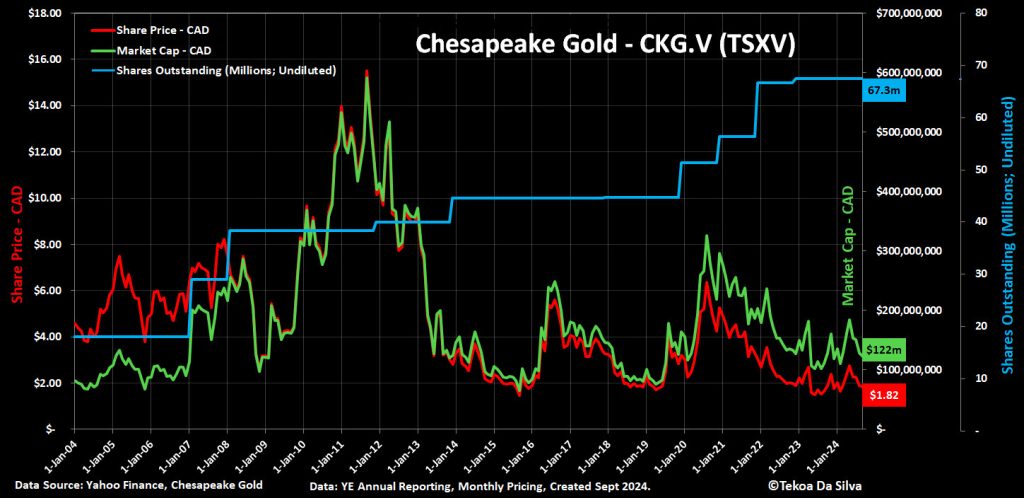
The first company we’ll look at is Chesapeake Gold. As illustrated by the red line below – the share price declined from CAD $4.60 to approximately CAD $1.82 over the last 20 year period, from January 2004 to September 2024. This is over a 50% decline:
As illustrated by the blue line above, the outstanding share count increased from about 17 million to over 67 million during the same 20 year period; nearly a 4x increase.
This resulted in a market cap (price of the business) increase, as illustrated by the green line, which over the same 20 year period grew from about CAD $81 million to over CAD $122 million – an increase of over 50%.
In this example, over the 20 year period, shareholders experienced a 50%+ share price decline, while the price of the business itself rose by over 50% – due to expansion of share count, and consequently, market cap.
The second company we’ll look at is Seabridge Gold. As illustrated by the red line below – the share price increased from CAD $4.75 to approximately CAD $23.71 over the last 20 year period, from January 2004 to September 2024. This is roughly a 5x move higher:
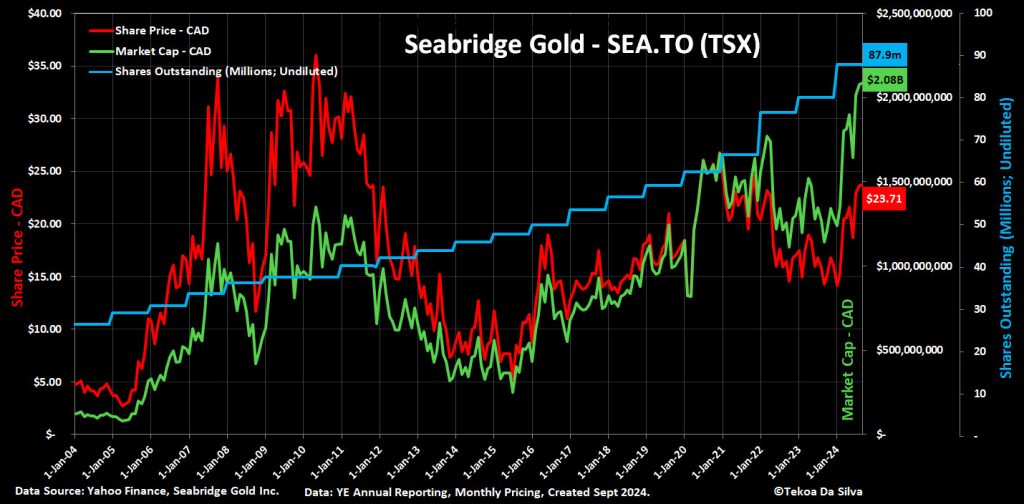
As illustrated by the blue line above, the outstanding share count increased from about 26 million to over 87 million during the same 20 year period; over a 3x increase.
This resulted in a market cap (price of the business) increase, as illustrated by the green line, which over the same 20 year period grew from about CAD $124 million to a recent high over CAD $2.08 billion – an increase of over 16x.
In this example, over the 20 year period, shareholders experienced nearly a 400% gain on their shares, while the price of the business itself rose by over 16x – due to expansion of share count, and consequently, market cap.
The last company we’ll look at is Northern Dynasty. As illustrated by the red line below – the share price decreased from USD $6.15 to approximately USD $0.35 over the last 20 year period, from January 2004 to September 2024. This is nearly a 95% decline:
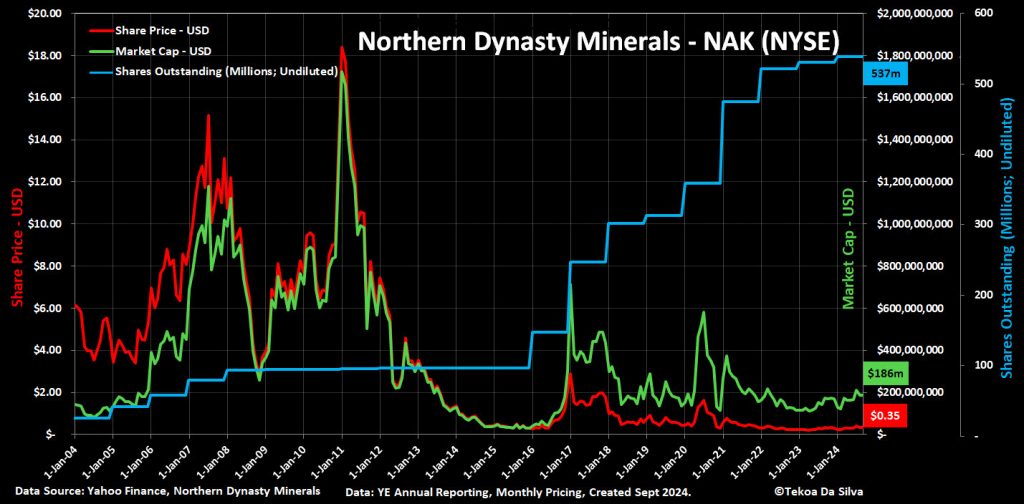
As illustrated by the blue line above, the outstanding share count increased from about 23 million to over 537 million during the same 20 year period; over a 23x increase.
This resulted in a market cap (price of the business) increase, as illustrated by the green line, which over the same 20 year period grew from about USD $143 million to over USD $186 million – an increase of over 30%.
In this example, over the 20 year period, shareholders experienced nearly a 95% share price decline, while the price of the business itself rose by over 30% – due to expansion of share count, and consequently, market cap.
To further dampen this picture – a common assumption made by nonprofessional investors when looking at a 20-year price chart of Northern Dynasty – is that the USD $18.00 per share price peak generated in 2011, as a matter of course, should be recovered during the next precious metal equity ‘bull market’. From the current USD $.35 share price this would imply a 50x move higher.
When looking at the price of the business – the 2011 market cap peaked around USD $1.7 billion. The current market cap is roughly USD $186 million. Recovering the prior market cap high from here, would imply a 9x move higher – not a 50x move. A 9x move higher in the share price and market cap from here (assuming no further expansion of share count), would imply a share price of USD $3.15 – a far cry, from the majestic heights of USD $18.00 per share, exhibited at the 2011 peak.
The reason the market cap revisitation multiple is lower than some expect is explained by the blue line in the Northern Dynasty chart above – outstanding share count ballooned by over 23x, during the 20 year period.
A counterargument for a higher Northern Dynasty (or any other company) market cap might rest in the real fact that ‘2011’ US dollars are not the same as ‘2024’ US dollars. The US dollar has weakened to the extent that in January 2011 only 1,360 US dollars were required to purchase an ounce of gold, whereas in September 2024 it takes 2,513 US dollars to purchase an ounce of gold – nearly a 50% loss of purchasing power, during the period.
If we measure Northern Dynasty’s January 2011 market cap peak in gold terms – it would indicate an approximate 1,266,705 gold ounce market cap. If Northern Dynasty today revisited that same market cap peak, in gold ounce terms – at USD $2513 per oz. gold, it would imply a USD market cap of $3.183 billion. A market cap increase to that size would imply about a 17x move higher, from here.
There is the speculative prospect of further USD devaluation, which offers the potential of driving market caps higher for all ‘hard asset’ businesses. It is up to individual investors and speculators, to decide if they wish to factor currency devaluation into their approach.
The difference between ‘share price’ and ‘market capitalization’ is stark. Without knowing the quantity and difference between the two, an investor will not know how much he or she is paying for a business.
Many investors discuss share price, but not many engage in market cap discussions. Market cap is determined by outstanding share count, which like a musical accordion, can expand and contract greatly over time.
To increase survival odds, investors and speculators should consider visiting with company financial statements over time. The statements will indicate whether share count has been expanding or contracting. It is an especially important metric to follow in the junior natural resource space.
This tool (market cap monitoring) will contribute to your competitive edge. And most investors are unaware of it.
To reach or follow the author, Tekoa Da Silva, visit:
X/Twitter: https://x.com/TekoaDasilva
YouTube: https://www.youtube.com/@TekoaDaSilva
LinkedIn: https://www.linkedin.com/in/tekoadasilva/
The above references an opinion and is for information purposes only. It is not intended to be investment advice. Seek a licensed professional for investment advice. The author is not an insider or shareholder of any of the companies mentioned above.
 **Core Assets Corp. Reports on 2024 Exploration Season**
Core Assets (CSE:CN) has released an update on its 2024 exploration activities at the Silver Lime CRD-Skarn-Porphyry Project and the central Blue Property, both located in the Atlin Mining District of northwest British Columbia.
Core Assets’ President & CEO Nick Rodway commented in a press release: “We have made significant strides in understanding and uncovering the mineralizing system at Silver Lime. The data collected thus far has greatly enhanced our confidence in the presence of a deeply buried and extensive mineralized system. Moreover, regional prospecting has uncovered exciting new prospects for future exploration. All assays from drill core and surface samples are pending, and we look forward to presenting the data as it becomes available.”
The company has completed 3,600 meters of diamond drilling over 10 holes in four target areas of the Silver Lime Project. The 2024 drilling aimed to evaluate the mineralized extent of the Sulphide City Mo-Cu Porphyry and associated skarn mineralization at depths exceeding 500 meters. The drill campaign also targeted high chargeability anomalies detected during a 2023 3D-DCIP survey.
Drilling focused on several key areas: the Sulphide City Mo-Cu Porphyry Target, the Sulphide City – Whaleback Zn-Cu-Ag Skarn Target, and two newly identified epithermal-style vein occurrences at Pike Valley and Pete’s North. These targets form a 2.6-kilometer trend of Porphyry-Skarn-Epithermal mineralization at Silver Lime.
At Pike Valley, previously known as Gally South, drilling intersected sheeted to stockwork-style quartz-carbonate base metal sulphide veining, approximately 1 km south of the Sulphide City Porphyry. In 2023, surface samples from this area returned high grades of silver, lead, zinc, copper, and gold.
Four additional drill holes were completed at the Sulphide City Porphyry Target and Pike Valley. At Sulphide City, the drills intersected widespread quartz-sericite-pyrite alteration with increased porphyry vein density and mineralization. Molybdenite and chalcopyrite-bearing zones were observed, marked by increases in biotite and k-feldspar. However, these holes were cut short due to significant deviation caused by intense faulting and veining.
At Pike Valley, two shallow holes were drilled to assess the grade potential of high-sulphidation base metal sulphide veining discovered on the surface in 2023. These holes intersected numerous centimetre-scale high-sulphidation epithermal base metal sulphide veins, associated with increased silicification and demagnetization of the intermediate intrusive host.
Geological and structural mapping conducted alongside drilling identified four main phases of the Sulphide City Mo-Cu Porphyry, including two mineralized diatreme breccia zones. Mapping also revealed a zone of strong skarn alteration surrounding the porphyry, zones of silicification and argillic alteration with low-grade gold mineralization, and moderate-to-high-grade base metal sulphide-bearing epithermal-style veins surrounding the porphyry. Additionally, a new zone of interest with quartz-arsenopyrite veins was identified about 6 km north of the main Sulphide City system.
A newly mapped mafic-to-intermediate intrusion extends over 2.0 km between the Jackie and Pike Valley targets. This intrusion, which is locally magnetic, hosts high-grade base metal sulphide veins in demagnetized zones and appears to be causative of carbonate replacement mineralization. It has been preliminarily dated as Cretaceous, suggesting two distinct generations of mineralization at the Silver Lime Project.
All drill core has been sent to the Bureau Veritas Labs in Whitehorse, Yukon, for processing. Samples undergo a 4-Acid digestion with an ICP-MS finish and a fire assay for gold, platinum, and palladium. The results will be released as they become available.
The above references an opinion and is for information purposes only. It is not intended to be investment advice. Seek a licensed professional for investment advice. The author is not an insider or shareholder of any of the companies mentioned above.
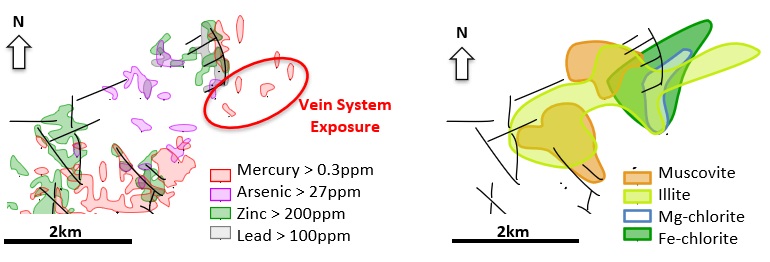
Solaris Resources (TSX:SLS)(NYSEAmerican:SLSR) has released an update on its exploration efforts at the Celestina target area, which is part of its broader district exploration program. The Celestina area is located east of the Warintza porphyry cluster and has become a focal point for the company’s search for epithermal deposits. The area is defined by a 4.5-kilometer by 3-kilometer zone of hydrothermal alteration, along with elevated levels of zinc, lead, arsenic, and mercury found in soil samples. These elements are typical indicators of potential mineralization, particularly in epithermal systems.
Highlight from the release are as follows:
- Follow-up rock chip sampling has returned high values of 16,019 g/t silver and 25.3 g/t gold, with other samples supporting the presence of an underlying silver-gold-base metals vein system
- Three parallel vein exposures were identified in creek beds within 100m on either side of the original breccia outcrop (link to release), located in a soft and chemically reactive mudstone unit that may have acted as a caprock to the hydrothermal system
- The conceptual exploration target at Celestina therefore lies in the underlying volcanic rocks that had full exposure to the hydrothermal cell while also having the properties to support robust vein and fracture formation
- Ongoing fieldwork to better define site selection for initial reconnaissance drilling
Recently, further prospecting outside of the previously identified anomalies led to the discovery of three parallel vein exposures in creek beds. These veins are located within 100 meters of the original breccia outcrop, which was reported in a press release on June 25, 2024. Follow-up sampling from these newly identified veins has returned significant results, including rock chip samples yielding up to 16,019 grams per ton (g/t) of silver and 25.3 g/t of gold. These findings have strengthened the company’s belief that there is an underlying silver-gold-base metals vein system at Celestina.
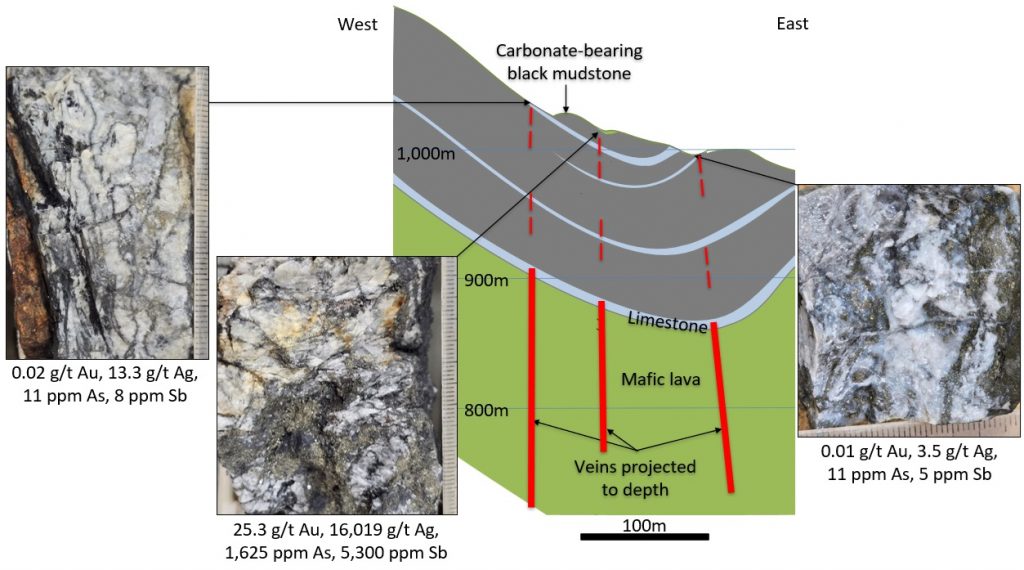
The veins identified so far have been found within a soft, chemically reactive mudstone unit. This mudstone may have acted as a caprock, potentially trapping hydrothermal fluids beneath it. As a result, the primary exploration target at Celestina is now believed to lie in the underlying volcanic rocks. These rocks would have been fully exposed to the hydrothermal system, making them more likely to host robust vein and fracture formations that could contain valuable mineralization.
Fieldwork at Celestina is ongoing, with efforts focused on locating additional vein exposures. By expanding the area covered, the team hopes to define the full extent of the vein system. More detailed mapping, sampling, and alteration studies are currently underway, aiming to better understand the zonation of the mineralization. In addition, geotechnical drilling is set to take place this month, with the goal of confirming the stratigraphic sequence of the area. These steps are essential for determining vectors that will guide the selection of sites for initial reconnaissance drilling, which will be crucial to confirming the presence of economically viable mineralization.
Solaris’ district exploration activities extend beyond Celestina. In the Caya-Mateo target area, geotechnical drilling has recently encountered evidence of epithermal clay alteration beneath overburden in a sandstone unit. This alteration is considered significant, as it indicates that hydrothermal activity occurred in the area. Drilling in the nearby Mateo area has also uncovered high-temperature alteration in volcanic rocks, further suggesting the presence of an epithermal system. The company plans to conduct additional mapping and sampling in the Mateo area, extending coverage toward the southeast where the core of the system is believed to lie.
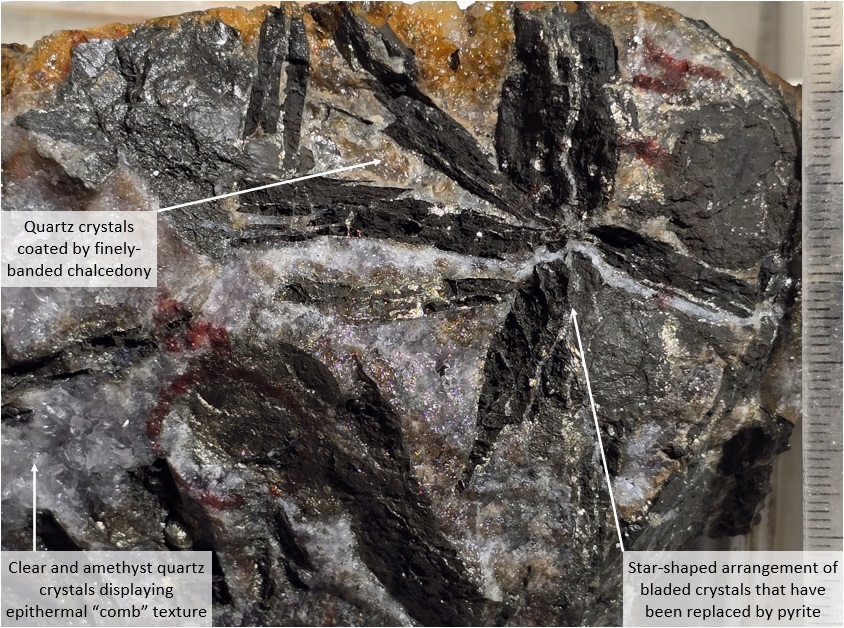
While the results at Celestina are still in the early stages, they have provided positive indications that the area could host a significant mineral system. The discovery of multiple veins with high gold and silver content underscores the potential of the Celestina target, although much more work remains to be done to fully assess the area’s mineral potential. As exploration continues, Solaris will look to refine its understanding of the geological controls on mineralization and pinpoint the best locations for future drilling. If successful, these efforts could add value to the company’s broader Warintza Project, which remains its flagship asset.
The above references an opinion and is for information purposes only. It is not intended to be investment advice. Seek a licensed professional for investment advice. The author is not an insider or shareholder of any of the companies mentioned above.
Solaris Resources (TSX:SLS) (NYSEAmerican:SLSR) has submitted an Environmental Impact Assessment (EIA) to Ecuador’s Ministry of Environment, Water, and Ecological Transition (MAATE) as part of its ongoing efforts to develop the Warintza Project in southeastern Ecuador. The EIA, comprising over 3,000 pages, reflects more than three and a half years of work, including community dialogue, environmental monitoring, and data collection. Solaris followed Ecuadorian regulations, and international best practices, and adhered to the Equator Principles framework and Performance Standards on Environmental and Social Sustainability from the International Finance Corporation.
This assessment is not Solaris’ first step in the permitting process for Warintza. The company had previously completed community consultations and submitted another EIA, which resulted in the granting of an environmental license in 2023. This enabled Solaris to advance exploration and develop infrastructure on the project site. Since then, the company has invested over $170 million in the project, with a substantial portion of procurement sourced locally. Currently, the project provides over 500 jobs, making it one of the most significant employers in the region.
Mr. Antonio Goncalves, Minister of Energy and Mines, commented in a press release: “The steady progress of the Warintza Project is positive for Ecuador. The Project is advancing in compliance with all legal regulations and will soon generate thousands of jobs and major economic growth in the Province of Morona Santiago. The administration of President Daniel Noboa supports this type of mining Project – one that has the support of the communities in its direct area of influence and is designed to meet high social, environmental, and technical standards.”
Mr. Sixto Cóndor, Governor of Morona Santiago, also commented: “Warintza is a project that will bring great opportunities and impetus to the development of the province. Like the Mirador project, which I recently visited, and its positive impacts in Zamora-Chinchipe, Warintza will be an engine for growth in Morona Santiago, with more generation of local employment sources, revitalization of the economy, social benefits, support for entrepreneurship, businesses and local suppliers. With Warintza, we will have a better province, with greater wealth to be distributed and better opportunities. We are ready to move forward.”
Mr. Antonio Castillo, Mayor of Limón Indanza, commented: “The people of Limón Indanza have benefited and will continue to benefit significantly through the creation of local employment and opportunities for the canton’s suppliers with the Warintza Project. The communities of Warints and Yawi decided to sign an agreement with the Company, through the Strategic Alliance, for the advancement of the Project and, as a Municipality, we respect and support this decision to work together.”
Mr. Javier Toro, Chief Operating Officer of Solaris, also commented: “The submission of the EIA and commencement of permitting for construction is a major milestone for the Warintza Project. We are very grateful to all our supporters, and in particular to our host communities and the Advisory Board of the Strategic Alliance of the Warintza Project who have been integral to the socialization of this EIA, the Mayor of Limón Indanza, the Governor of the Province of Morona Santiago, and the diligent professionals at MAATE.”
ESSAM Cía. Ltda., a well-regarded environmental consulting firm in Ecuador, prepared the EIA for Warintza. The firm has previously worked on other major mining projects in the country, such as the Mirador copper mine and the Fruta del Norte gold mine. ESSAM collaborated with international experts, including Knight Piésold Consulting, which provided expertise in areas such as waste management and water design, and Ausenco, which contributed to metallurgical studies and plant design.
With the submission of the EIA, Solaris is preparing to draw on the second tranche of a $15 million credit facility. This funding comes as part of an Offtake Credit Facility that the company had previously announced. Solaris currently has $84 million in available liquidity. The company expects to receive the next update on the project’s permitting process when the technical approval of the EIA is anticipated in the first half of 2025.
In addition to progressing the Warintza Project, Solaris has begun taking steps to move some of its operations to Ecuador. The company plans to transition its head office to Quito, Ecuador’s capital, where some of its senior management will be based. Solaris is evaluating further steps toward aligning its operations with local stakeholders and regulators as the project moves into its permitting phase. The company has indicated that this move is not expected to cause any adverse tax impacts or require changes to its stock exchange listings.
The Warintza Project, which has seen significant investment and progress, represents one of the few large-scale mining operations in Ecuador. It is important to the local economy, providing formal employment opportunities in a region with few alternatives. The submission of the EIA marks a major milestone for Solaris, with the company now awaiting government approvals to advance the project further.
The above references an opinion and is for information purposes only. It is not intended to be investment advice. Seek a licensed professional for investment advice. The author is not an insider or shareholder of any of the companies mentioned above.

The above references an opinion and is for information purposes only. It is not intended to be investment advice. Seek a licensed professional for investment advice. The author is not an insider or shareholder of any of the companies mentioned above.

Western Alaska Minerals (TSXV:WAM) has announced a significant development at its Warm Springs target, a key part of the company’s ongoing exploration efforts in Alaska. The company intersected its first gold mineralization at the site, which is part of a broader effort to explore and expand the mineral resource potential in the region. This discovery, along with other encouraging drill results, indicates a new, mineral-rich pathway that could significantly extend the known mineral system in the area.
Kit Marrs, founder and CEO of Western Alaska Minerals, commented in a press release: “Finding gold at Warm Springs opens up a whole new gold target zone within the eight-kilometer-long trend between the Illinois Creek and Waterpump Creek resources. This is an exciting complement to our high-grade silver-zinc-lead resource at Waterpump Creek.
To date, WAM has completed nine drill holes at the Warm Springs target, with notable mineralization intercepted in seven of the nine holes. These drill holes revealed extensive alteration and oxide mineralization, as well as localized base-metal sulfide mineralization. The technical team reports a core recovery rate of 90.1% for the intercepted mineralization, with a combination of gold, copper, and other metals.
Dr. Peter Megaw, a renowned geologist and technical advisor for WAM, highlighted the significance of the results, stating that the discovery of gold and copper in multiply brecciated zones suggests the presence of a major pathway for mineralizing fluids. These fluids could connect the Warm Springs target to other known mineral resources in the region, including the Illinois Creek gold-copper resource and the Waterpump Creek silver-lead-zinc deposit. Megaw also indicated that the possibility of a parallel structure to the Illinois Creek Fault opens up further exploration potential.
The Warm Springs target is believed to be a key extension of the Illinois Creek carbonate replacement deposit (CRD) system. This complex mineralization has evolved over multiple stages, with WAM’s drilling providing valuable insights into the structure and content of the resource.
The company’s first drill hole at the site, IC24-0004, intercepted four distinct zones of mineralization, including:
1. Pyrite and hydrothermal quartz breccia with elevated gold, arsenic, and copper levels.
2. Recrystallized ankerite, containing trace amounts of galena.
3. Silica and oxide breccia, subdivided into limonite-dominant and hematite-dominant areas.
4. Oxidized manto gossans, with elevated levels of lead and manganese.
These mineralized zones, ranging from 18.7 to 53.65 meters in thickness, combine for a total of 100 meters of mineralization in the drill hole. This discovery represents a major step forward in understanding the Warm Springs target’s potential and its role within the broader Illinois Creek system.
In addition to Warm Springs, WAM also drilled four holes at the LH target zone, located west of the project’s airstrip. The LH target has long been considered a potential high-grade extension of the Waterpump Creek silver-lead-zinc zone, which has shown considerable promise in previous explorations.
WAM’s 2024 drilling efforts at the LH target have not yet yielded significant sulfide manto mineralization. However, the drill holes did intercept a few gossans, which warrant further investigation. Four surface trenches were also cut to refine the exploration model for the zone. Based on the initial drilling and trenching, WAM now interprets the LH target as a vertically oriented feature, likely positioned higher in the CRD system than previously thought. Mineralization is expected to be deeper than earlier estimates. Further assays are pending for both the drilling and trenching at the LH zone.
The Warm Springs discovery is part of a broader exploration effort by WAM to map and develop a large-scale carbonate replacement deposit (CRD) system in Alaska. The company’s Illinois Creek property, which includes past-producing gold and silver mines, hosts a range of mineral prospects across a 73,120-acre land package. This region, originally discovered by Anaconda Minerals in the early 1980s, encompasses multiple CRD targets, including Waterpump Creek and the Round Top copper prospects.
WAM’s strategy is to link the Warm Springs mineralization with other deposits in the district, potentially creating a large and mineable CRD system. The proximity of the Warm Springs target to other known mineral resources, including gold, silver, lead, and zinc, adds significant potential to this exploration. The company believes that the Warm Springs structure could be a critical new “spoke” in the mineral system, offering an opportunity to expand resources both laterally and vertically.
As WAM awaits further assay results from both the Warm Springs and LH targets, the company remains committed to advancing exploration across its claims. Future drilling will aim to confirm and expand the findings from this year’s program, with the ultimate goal of developing a scalable, mineable resource in western Alaska.
According to Andrew West, Vice President of WAM and a certified professional geologist, the data gathered so far has been rigorously verified to ensure accuracy. West’s 30 years of experience in mineral resource exploration provide confidence in the potential of the Warm Springs target and its significance within WAM’s broader exploration strategy.
Highlights from the results are as follows:
- Two gold zones intercepted in drill hole IC24-0004:
- 1.29 g/t Au over 4.68 meters within massive pyrite, including:
- 12.5 g/t Au and 0.9% Cu over 0.18 meters
- 2.13 g/t Au over 2.96 meters, including:
- 5.57 g/t Au over 1.01 meters
- 1.29 g/t Au over 4.68 meters within massive pyrite, including:
- Discovery of a new and separate mineralized structure parallel to the Illinois Creek Fault, opening the potential of a new “spoke” to the system.
- First significant copper and gold mineralization intercepted since WAM initiated exploration in 2021.
- The gold-bearing zone is located approximately 1.4 km southeast of the Illinois Creek gold-silver resource
The above references an opinion and is for information purposes only. It is not intended to be investment advice. Seek a licensed professional for investment advice. The author is not an insider or shareholder of any of the companies mentioned above.

Novo Resources (TSX:NVO) has issued an exploration update on its key projects in the Pilbara region of Western Australia. The update highlights significant developments at the Egina Gold Camp, Balla Balla Gold Project, and Nunyerry North, alongside recent advancements in joint venture activities.
Exploration Efforts at Egina Gold Camp and Balla Balla Gold Project
Novo Resources has been actively exploring the Mallina Basin and adjacent areas in the Pilbara since 2017, focusing primarily on gold but also investigating potential for lithium, base metals, and other commodities. This strategic exploration has led to notable successes, particularly with the discovery at Nunyerry North in 2023 and the formation of joint ventures with De Grey Mining (Egina JV) and Sociedad Quimica y Minera de Chile S.A. (SQM) under the Harding Battery Metals Joint Venture (HBMJV).
The Egina Gold Camp comprises a contiguous package of tenements situated within structurally complex, gold-fertile corridors of the Mallina Basin. This area, which includes the Nunyerry North prospect, has been a focal point of Novo’s exploration programs over the past 18 months, resulting in significant mineral discoveries.
Nunyerry North Drilling Results
In late 2023, Novo conducted a first-pass reverse circulation (RC) drilling program at Nunyerry North, focusing on a central zone of structurally controlled outcropping quartz veins. The program yielded high-grade gold intercepts, particularly in the Main Lode #1, situated within a brittle basalt unit between two shear zones. Noteworthy results include:
– 6 meters (m) at 6.12 grams per tonne (g/t) of gold (Au) from 37 m, including 5 m at 7.28 g/t Au from 37 m (NC017).
– 11 m at 2.52 g/t Au from 22 m, including 6 m at 4.19 g/t Au from 22 m (NC014).
– 13 m at 1.89 g/t Au from surface, including 4 m at 2.56 g/t Au from 3 m (NC004).
– 4 m at 5.71 g/t Au from 40 m, including 3 m at 7.47 g/t Au from 41 m (NC015).
– 17 m at 1.34 g/t Au from 37 m, including 4 m at 3.77 g/t Au from 50 m (NC022).
Following this, Novo completed a subsequent RC drilling program consisting of 34 holes for a total of 3,942 meters. The goal was to extend known mineralization in the Main Area and to test regional targets, including the Estrid Fault, Aurora West, and a porphyry unit south of the Skadi Shear. This latest program has successfully extended known mineralization by 250 meters to a total of approximately 500 meters in strike length, with notable results including:
– 9 m at 2.52 g/t Au from 87 m, including 2 m at 8.89 g/t Au from 92 m (NC061).
– 2 m at 7.38 g/t Au from 42 m (NC051).
– 11 m at 1.26 g/t Au from 85 m, including 4 m at 2.31 g/t Au from 85 m (NC053).
Results from the current program are being re-analyzed using the PhotonAssay™ method to better resolve any coarse gold component, with assays pending.
Targeted Drilling at Estrid Fault and Porphyry Targets
Three holes drilled into the Estrid Fault target, defined by high-order soil anomalies and surface alteration, produced significant gold intercepts, including:
– 13 m at 2.68 g/t Au from 66 m, including 3 m at 10.41 g/t Au from 66 m (NC046).
– 11 m at 2.20 g/t Au from 84 m, including 1 m at 18.06 g/t Au from 86 m (NC046).
– 2 m at 6.30 g/t Au from 15 m (NC062).
– 17 m at 1.85 g/t Au from 25 m, including 7 m at 3.55 g/t Au from 25 m (NC063).
Additionally, three holes drilled into the porphyry target intersected a porphyritic rhyolite to rhyodacite with pyrite mineralization. The best result was 7 m at 0.1 g/t Au, with elevated copper levels. Despite these findings, the results do not warrant immediate follow-up in the target area, though they indicate the potential for further exploration in the district.
Egina JV and Balla Balla Gold Project Developments
De Grey Mining is advancing the first stage of its earn-in at the Egina JV, where it must spend a minimum of A$7 million by December 2024 to secure its interest. As part of this, De Grey has initiated follow-up aircore (AC) and RC drilling programs at the Becher Project, with approximately 28,000 meters of drilling planned. To date, 38 RC holes and 201 AC holes have been completed, with results anticipated in late Q3 2024.
Meanwhile, Novo has made progress at the Balla Balla Gold Project, where a Determination Wide Aboriginal Heritage Protection Agreement has been signed with the Kariyarra Aboriginal Corporation. This agreement, which includes customary compensation for the Kariyarra People, enables the grant of tenement application E47/4703, prospective for gold, base metals, and lithium. A cultural site avoidance heritage survey has already been completed, paving the way for AC drilling to commence once the tenement is granted.
Mapping and Sampling at Tabba Tabba Shear Corridor
Novo is also advancing exploration at the Tabba Tabba Shear Corridor, a mantle-tapping structure in the Southern Egina Gold Camp. The company has recently completed a re-interpretation of the corridor, identifying several conceptual targets for future exploration. Novo has begun mapping and surface sampling over these targets, with plans to collect approximately 1,200 surface soil samples.
Novo Resources continues to advance its exploration efforts across the Pilbara region, with a focus on expanding known mineralization and uncovering new prospects. The company’s strategic partnerships and joint ventures with De Grey Mining and SQM provide financial backing and expertise, enabling Novo to pursue its exploration objectives with greater flexibility. As assays and survey results from ongoing programs become available, further updates are expected in the coming months.
The above references an opinion and is for information purposes only. It is not intended to be investment advice. Seek a licensed professional for investment advice. The author is not an insider or shareholder of any of the companies mentioned above.
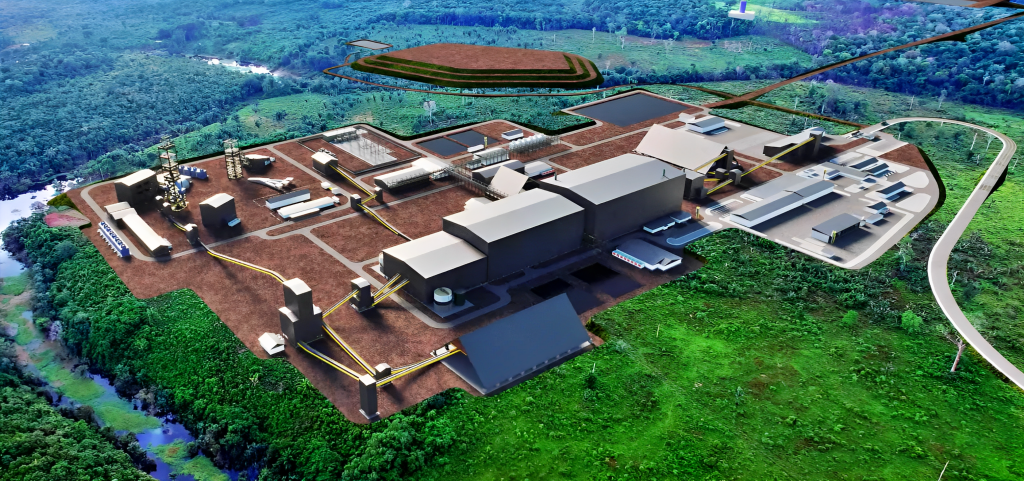
Brazil Potash has successfully obtained all the necessary permits and licenses for the construction of its Autazes Potash Project. This development marks a significant milestone in Brazil’s efforts to enhance food security both domestically and globally. The Project is strategically located in the municipality of Autazes, Amazonas, and is set to become a critical component of the nation’s agricultural sector.
Adriano Espeschit, President of Potássio do Brasil, commented in a press release: “This crucial achievement allows us to move forward in the construction of the large-scale project, which has already started with initial activities on site, but will last an average of four years to be fully ready for operation. We are finalizing the planning of necessary tasks, such as the relocation of wildlife, archaeological surveys, and the suppression of vegetation in an appropriate and environmentally responsible way. These preparatory efforts are essential to lay the groundwork for the start of civil works by the end of this year. Until then, we are preparing for large-scale construction activities on several fronts, representing a significant advancement in the development schedule of our Project. We believe that the Project will create increased benefits for the communities in the region.”
Project Location and Environmental Considerations
The Autazes Potash Project is situated on low-density former cattle farmland in the municipality of Autazes, Amazonas. Notably, the construction and operation of the Project will have no impact on any primary growth rainforest. This consideration is crucial given the global concern over deforestation and environmental degradation in the Amazon region. Brazil Potash has emphasized its commitment to environmental sustainability throughout the planning and development stages of the Project.
Licensing and Permits
Brazil Potash, through its wholly-owned subsidiary Potássio do Brasil Ltda., has obtained a total of 21 Installation Licenses, Specific Environmental Licenses, and Authorizations for the Capture, Collection, and Transport of Wild Fauna. These were issued by the Institute of Environmental Protection of Amazonas (IPAAM). The licenses cover all aspects of the Project, including the sinking of two mine shafts, the construction of the processing plant, a river barge port, and a 13-kilometer road connecting the processing plant to the port.
Initial Construction Activities
Preliminary construction activities for the Project have already commenced, facilitated by the issuance of some earlier Installation Licenses. Among these activities, the drilling of two wells for drinking water collection was completed. Each well reached a depth of approximately 130 meters. These initial works were carried out near the village of Urucurituba in Autazes. The Project has already started to benefit the local community, particularly through the contraction of local accommodation services and food service providers.
Community Impact and Job Creation
Brazil Potash is committed to ensuring strict compliance with all environmental criteria established in the licensing documents for the Autazes Potash Project. As construction progresses, the Company expects to create significant opportunities for the communities of Autazes and the surrounding region. The procedures for hiring personnel for civil construction have already been initiated, and a network of service providers and suppliers is being developed. These stakeholders can register for free on the Potássio do Brasil website, allowing them to participate in the Project’s growth.
The construction of the Autazes Potash Project is expected to have a far-reaching impact on both regional and national development. Most importantly, it will play a crucial role in enhancing food security in Brazil and the world by ensuring a steady supply of potash, a key fertilizer in agricultural production.
Future Development and Operational Phase
Upon the completion of the construction phase, and following government inspection to ensure compliance with safety standards and Brazilian legislation, Potássio do Brasil anticipates receiving the required Operating License and Mining Concession. The Project is projected to have an extraction and operational period of at least 23 years, during which potash ore will be mined and processed to support agricultural needs.
Commitment to Sustainability
Brazil Potash has also made a strong commitment to sustainability by pledging to use primarily renewable energy sources for its operations. This commitment aligns with Brazil’s national strategy to maintain its position as a global leader in renewable energy adoption. By leveraging renewable energy, the Company aims to offset approximately 1.2 million tons of carbon emissions annually, contributing positively to the global fight against climate change.
The power grid operations of the Autazes Potash Project will be connected to the national grid via a transmission line, ensuring a reliable and sustainable power supply. This connection will also bring benefits to local communities that currently depend on diesel generators, providing them with a cleaner and more sustainable energy source.
The fully permitted status of the Autazes Potash Project is a major achievement for Brazil Potash and the broader Brazilian agricultural sector. With all necessary licenses and permits in place, the Company is poised to move forward with the construction and eventual operation of a project that promises to enhance food security, support regional development, and contribute to environmental sustainability.
The above references an opinion and is for information purposes only. It is not intended to be investment advice. Seek a licensed professional for investment advice. The author is not an insider or shareholder of any of the companies mentioned above.
If you would like to receive our free newsletter via email, simply enter your email address below & click subscribe.
 Follow us on Twitter
 Become our facebook fan
CONNECT WITH US
Tweets
Tweet with hash tag #miningfeeds or @miningfeeds and your tweets will be displayed across this site.
MOST ACTIVE MINING STOCKS
Daily Gainers
 CMC Metals Ltd. CMC Metals Ltd. |
CMB.V | +900.00% |
 Eden Energy Ltd Eden Energy Ltd |
EDE.AX | +200.00% |
| GoviEx Uranium Inc. |
GXU.V | +42.86% |
| Eagle Nickel Ltd. |
ENL.AX | +41.67% |
| Citigold Corp. Limited |
CTO.AX | +33.33% |
| Mount Burgess Mining NL |
MTB.AX | +33.33% |
| Exalt Resources Limited |
ERD.AX | +31.94% |
| Casa Minerals Inc. |
CASA.V | +30.00% |
| Cariboo Rose Resources Ltd |
CRB.V | +28.57% |
| Belmont Resources Inc. |
BEA.V | +28.57% |