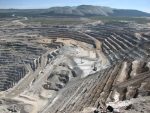
Peninsula Energy Limited (ASX:PEN) shareholders will doubtless be very grateful to see the share price up 111% in the last quarter. But will that heal all the wounds inflicted over 5 years of declines? Unlikely. Indeed, the share price is down a whopping 82% in that time. The recent bounce might mean the long decline is over, but we are not confident. The million dollar question is whether the company can justify a long term recovery.
We really hope anyone holding through that price crash has a diversified portfolio. Even when you lose money, you don't have to lose the lesson.
See our latest analysis for Peninsula Energy
Peninsula Energy wasn't profitable in the last twelve months, it is unlikely we'll see a strong correlation between its share price and its earnings per share (EPS). Arguably revenue is our next best option. Generally speaking, companies without profits are expected to grow revenue every year, and at a good clip. That's because it's hard to be confident a company will be sustainable if revenue growth is negligible, and it never makes a profit.
Over five years, Peninsula Energy grew its revenue at 2.8% per year. That's not a very high growth rate considering it doesn't make profits. It's not so sure that share price crash of 13% per year is completely deserved, but the market is doubtless disappointed. We'd be pretty cautious about this one, although the sell-off may be too severe. A company like this generally needs to produce profits before it can find favour with new investors.
The graphic below depicts how earnings and revenue have changed over time (unveil the exact values by clicking on the image).

If you are thinking of buying or selling Peninsula Energy stock, you should check out this FREE detailed report on its balance sheet.
What about the Total Shareholder Return (TSR)?
Investors should note that there's a difference between Peninsula Energy's total shareholder return (TSR) and its share price change, which we've covered above. The TSR is a return calculation that accounts for the value of cash dividends (assuming that any dividend received was reinvested) and the calculated value of any discounted capital raisings and spin-offs. Peninsula Energy hasn't been paying dividends, but its TSR of -78% exceeds its share price return of -82%, implying it has either spun-off a business, or raised capital at a discount; thereby providing additional value to shareholders.
A Different Perspective
Peninsula Energy provided a TSR of 2.8% over the year. That's fairly close to the broader market return. To take a positive view, the gain is pleasing, and it sure beats annualized TSR loss of 12%, which was endured over half a decade. We're pretty skeptical of turnaround stories, but it's good to see the recent share price recovery. I find it very interesting to look at share price over the long term as a proxy for business performance. But to truly gain insight, we need to consider other information, too. Take risks, for example – Peninsula Energy has 3 warning signs (and 1 which is significant) we think you should know about.
For those who like to find winning investments this free list of growing companies with recent insider purchasing, could be just the ticket.
Please note, the market returns quoted in this article reflect the market weighted average returns of stocks that currently trade on AU exchanges.
This article by Simply Wall St is general in nature. It does not constitute a recommendation to buy or sell any stock, and does not take account of your objectives, or your financial situation. We aim to bring you long-term focused analysis driven by fundamental data. Note that our analysis may not factor in the latest price-sensitive company announcements or qualitative material. Simply Wall St has no position in any stocks mentioned.
Have feedback on this article? Concerned about the content? Get in touch with us directly. Alternatively, email editorial-team (at) simplywallst.com.
The big shareholder groups in Metals X Limited (ASX:MLX) have power over the company. Insiders often own a large chunk of younger, smaller, companies while huge companies tend to have institutions as shareholders. We also tend to see lower insider ownership in companies that were previously publicly owned.
Metals X is not a large company by global standards. It has a market capitalization of AU$159m, which means it wouldn't have the attention of many institutional investors. Taking a look at our data on the ownership groups (below), it seems that institutional investors have bought into the company. Let's delve deeper into each type of owner, to discover more about Metals X.
View our latest analysis for Metals X

What Does The Institutional Ownership Tell Us About Metals X?
Institutions typically measure themselves against a benchmark when reporting to their own investors, so they often become more enthusiastic about a stock once it's included in a major index. We would expect most companies to have some institutions on the register, especially if they are growing.
Metals X already has institutions on the share registry. Indeed, they own a respectable stake in the company. This suggests some credibility amongst professional investors. But we can't rely on that fact alone since institutions make bad investments sometimes, just like everyone does. It is not uncommon to see a big share price drop if two large institutional investors try to sell out of a stock at the same time. So it is worth checking the past earnings trajectory of Metals X, (below). Of course, keep in mind that there are other factors to consider, too.

Our data indicates that hedge funds own 21% of Metals X. That's interesting, because hedge funds can be quite active and activist. Many look for medium term catalysts that will drive the share price higher. APAC Resources Limited is currently the company's largest shareholder with 14% of shares outstanding. For context, the second largest shareholder holds about 11% of the shares outstanding, followed by an ownership of 10% by the third-largest shareholder.
On further inspection, we found that more than half the company's shares are owned by the top 6 shareholders, suggesting that the interests of the larger shareholders are balanced out to an extent by the smaller ones.
Researching institutional ownership is a good way to gauge and filter a stock's expected performance. The same can be achieved by studying analyst sentiments. There is a little analyst coverage of the stock, but not much. So there is room for it to gain more coverage.
Insider Ownership Of Metals X
While the precise definition of an insider can be subjective, almost everyone considers board members to be insiders. The company management answer to the board and the latter should represent the interests of shareholders. Notably, sometimes top-level managers are on the board themselves.
Insider ownership is positive when it signals leadership are thinking like the true owners of the company. However, high insider ownership can also give immense power to a small group within the company. This can be negative in some circumstances.
Our most recent data indicates that insiders own some shares in Metals X Limited. In their own names, insiders own AU$5.2m worth of stock in the AU$159m company. It is good to see some investment by insiders, but I usually like to see higher insider holdings. It might be worth checking if those insiders have been buying.
General Public Ownership
The general public, with a 32% stake in the company, will not easily be ignored. While this size of ownership may not be enough to sway a policy decision in their favour, they can still make a collective impact on company policies.
Private Company Ownership
We can see that Private Companies own 11%, of the shares on issue. Private companies may be related parties. Sometimes insiders have an interest in a public company through a holding in a private company, rather than in their own capacity as an individual. While it's hard to draw any broad stroke conclusions, it is worth noting as an area for further research.
Public Company Ownership
Public companies currently own 14% of Metals X stock. We can't be certain but it is quite possible this is a strategic stake. The businesses may be similar, or work together.
Next Steps:
While it is well worth considering the different groups that own a company, there are other factors that are even more important. For instance, we've identified 2 warning signs for Metals X that you should be aware of.
Ultimately the future is most important. You can access this free report on analyst forecasts for the company.
NB: Figures in this article are calculated using data from the last twelve months, which refer to the 12-month period ending on the last date of the month the financial statement is dated. This may not be consistent with full year annual report figures.
This article by Simply Wall St is general in nature. It does not constitute a recommendation to buy or sell any stock, and does not take account of your objectives, or your financial situation. We aim to bring you long-term focused analysis driven by fundamental data. Note that our analysis may not factor in the latest price-sensitive company announcements or qualitative material. Simply Wall St has no position in any stocks mentioned.
Have feedback on this article? Concerned about the content? Get in touch with us directly. Alternatively, email editorial-team (at) simplywallst.com.
What trends should we look for it we want to identify stocks that can multiply in value over the long term? In a perfect world, we'd like to see a company investing more capital into its business and ideally the returns earned from that capital are also increasing. This shows us that it's a compounding machine, able to continually reinvest its earnings back into the business and generate higher returns. Speaking of which, we noticed some great changes in Mount Gibson Iron's (ASX:MGX) returns on capital, so let's have a look.
Understanding Return On Capital Employed (ROCE)
Just to clarify if you're unsure, ROCE is a metric for evaluating how much pre-tax income (in percentage terms) a company earns on the capital invested in its business. Analysts use this formula to calculate it for Mount Gibson Iron:
Return on Capital Employed = Earnings Before Interest and Tax (EBIT) ÷ (Total Assets – Current Liabilities)
0.14 = AU$104m ÷ (AU$805m – AU$81m) (Based on the trailing twelve months to June 2020).
Thus, Mount Gibson Iron has an ROCE of 14%. In absolute terms, that's a satisfactory return, but compared to the Metals and Mining industry average of 9.4% it's much better.
See our latest analysis for Mount Gibson Iron

Above you can see how the current ROCE for Mount Gibson Iron compares to its prior returns on capital, but there's only so much you can tell from the past. If you'd like, you can check out the forecasts from the analysts covering Mount Gibson Iron here for free.
The Trend Of ROCE
We're delighted to see that Mount Gibson Iron is reaping rewards from its investments and is now generating some pre-tax profits. Shareholders would no doubt be pleased with this because the business was loss-making five years ago but is is now generating 14% on its capital. And unsurprisingly, like most companies trying to break into the black, Mount Gibson Iron is utilizing 110% more capital than it was five years ago. This can tell us that the company has plenty of reinvestment opportunities that are able to generate higher returns.
What We Can Learn From Mount Gibson Iron's ROCE
Long story short, we're delighted to see that Mount Gibson Iron's reinvestment activities have paid off and the company is now profitable. Since the stock has returned a staggering 487% to shareholders over the last five years, it looks like investors are recognizing these changes. Therefore, we think it would be worth your time to check if these trends are going to continue.
If you'd like to know about the risks facing Mount Gibson Iron, we've discovered 3 warning signs that you should be aware of.
While Mount Gibson Iron may not currently earn the highest returns, we've compiled a list of companies that currently earn more than 25% return on equity. Check out this free list here.
This article by Simply Wall St is general in nature. It does not constitute a recommendation to buy or sell any stock, and does not take account of your objectives, or your financial situation. We aim to bring you long-term focused analysis driven by fundamental data. Note that our analysis may not factor in the latest price-sensitive company announcements or qualitative material. Simply Wall St has no position in any stocks mentioned.
Have feedback on this article? Concerned about the content? Get in touch with us directly. Alternatively, email editorial-team (at) simplywallst.com.
VANCOUVER, BC, Feb. 12, 2021 /CNW/ –
TSX VENTURE COMPANIES
AUMENTO CAPITAL VIII CORP. ("AMU.P")
BULLETIN TYPE: New Listing-CPC-Shares
BULLETIN DATE: February 12, 2021
TSX Venture Tier 2 Company
The Capital Pool Company's (the 'Company') Prospectus dated February 4, 2021, has been filed with and accepted by TSX Venture Exchange and the Ontario, British Columbia and Alberta Securities Commissions effective February 8, 2021, under the provisions of the respective Securities Acts. The common shares of the Company will be listed and admitted to trading on TSX Venture Exchange, on the effective dates stated below.
The gross proceeds to be received by the Company for the Offering are $500,000 (1,000,000 common shares at $0.50 per share).
|
Listing Date: |
At the close of business (5:01 p.m. EDT) on February 16, 2021. |
|
Commence Date: |
The common shares will commence trading on TSX Venture |
The closing of the public offering is scheduled to occur before the market opening on February 17, 2021. A further notice will be issued upon receipt of closing confirmation.
|
Corporate Jurisdiction: |
Ontario |
|
Capitalization: |
Unlimited common shares with no par value of which 2,000,000 |
|
Escrowed Shares: |
1,000,000 common shares |
|
Transfer Agent: |
TSX Trust Company |
|
Trading Symbol: |
AMU.P |
|
CUSIP Number: |
05151X103 |
|
Agent: |
Canaccord Genuity Corp. |
|
Agent's Options: |
100,000 options to purchase one share at $0.50 for a period of five |
For further information, please refer to the Company's prospectus dated February 4, 2021.
|
Company Contact: |
Paul Pathak |
|
Company Address: |
TD North, 77 King St W Tower Suite 700 Toronto, ON M5K1G8 |
|
Company Phone Number: |
(416) 644-9964 |
|
Company email: |
______________________________________
GREENLANE RENEWABLES INC. ("GRN") ("GRN.WT")
BULLETIN TYPE: Graduation
BULLETIN DATE: February 12, 2021
TSX Venture Tier 1 Company
TSX Venture Exchange has been advised that the Company's shares and warrants will be listed and commence trading on Toronto Stock Exchange at the opening on Wednesday February 17, 2021, under the symbol "GRN" and "GRN.WT".
As a result of this Graduation, there will be no further trading under the symbol "GRN" nor "GRN.WT" on TSX Venture Exchange after Tuesday February 16, 2021, and its shares and warrants will be delisted from TSX Venture Exchange at the commencement of trading on Toronto Stock Exchange.
________________________________________
HAMPTON FINANCIAL CORPORATION ("HFC.PR.A")
BULLETIN TYPE: Declaration of Dividend
BULLETIN DATE: February 12, 2021
TSX Venture Tier 2 Company
The Issuer has declared the following dividend:
Dividend per Class A Preferred Share: $0.20
Payable Date: March 1, 2021
Record Date: February 22, 2021
Ex-dividend Date: February 19, 2021:
________________________________________
21/02/12 – TSX Venture Exchange Bulletins
TSX VENTURE COMPANIES
AIM5 VENTURES INC. ("AIME.P")
BULLETIN TYPE: Remain Halted
BULLETIN DATE: February 12, 2021
TSX Venture Tier 2 Company
Further to the TSX Venture Exchange ('TSXV') Bulletin dated Feb. 11, 2021, trading in the shares of the Company will remain halted Pending receipt and review of acceptable documentation regarding the Qualifying Transaction pursuant to Listings Policy 2.4
This regulatory halt is imposed by Investment Industry Regulatory Organization of Canada, the Market Regulator of the Exchange, pursuant to the provisions of Section 10.9(1) of the Universal Market Integrity Rules.
________________________________________
AUX RESOURCES CORPORATION ("AUX")
BULLETIN TYPE: Resume Trading
BULLETIN DATE: February 12, 2021
TSX Venture Tier 2 Company
Effective at 12:15 p.m. PST, Feb. 11, 2021, shares of the Company resumed trading, an announcement having been made.
________________________________________
CLEAN SEED CAPITAL GROUP LTD. ("CSX")
BULLETIN TYPE: Warrant Term Extension
BULLETIN DATE: February 12, 2021
TSX Venture Tier 2 Company
TSX Venture Exchange has consented to the extension in the expiry date of the following warrants:
|
Private Placement: |
|
|
# of Warrants: |
3,360,000 |
|
Original Expiry Date of Warrants: |
January 31, 2021 |
|
New Expiry Date of Warrants: |
July 31, 2021 |
|
Exercise Price of Warrants: |
$0.50 |
These warrants were previously extended from September 5, 2020 to January 31, 2021, which was accepted for filing by the Exchange effective September 4, 2020. These warrants were issued pursuant to a private placement of 6,720,000 shares with 3,360,000 share purchase warrants attached, which was accepted for filing by the Exchange effective September 5, 2019.
|
Private Placement: |
|
|
# of Warrants: |
2,555,000 |
|
Original Expiry Date of Warrants: |
March 2, 2021 (1,765,000 warrants) |
|
New Expiry Date of Warrants: |
July 31, 2021 (1,765,000 warrants) |
|
Exercise Price of Warrants: |
$0.50 |
These warrants were issued pursuant to a private placement of 5,110,000 shares with 2,555,000 share purchase warrants attached, which was accepted for filing by the Exchange effective April 1, 2020.
________________________________________
CONTAGIOUS GAMING INC. ("CNS")
BULLETIN TYPE: Shares for Debt
BULLETIN DATE: February 12, 2021
TSX Venture Tier 2 Company
TSX Venture Exchange has accepted for filing the Company's proposal to issue 8,500,000 shares to settle outstanding debt for $425,000.
|
Number of Creditors: |
4 Creditors |
|||
|
Insider / Pro Group Participation: |
||||
|
Creditor |
Insider=Y / |
Amount |
Deemed Price |
# of Shares |
|
2444384 Ontario Inc. |
Y |
200,000 |
0.05 |
4,000,000 |
|
Gulfstream Capital Corp. |
Y |
90,000 |
0.05 |
1,800,000 |
|
Loverock Consulting Corp. |
Y |
90,000 |
0.05 |
1,800,000 |
For more information, refer to the Company's news release dated January 12, 2021.
The Company shall issue a news release when the shares are issued and the debt extinguished.
________________________________________
CRYPTOSTAR CORP. ("CSTR")
BULLETIN TYPE: Private Placement- Non-Brokered
BULLETIN DATE: February 12, 2021
TSX Venture Tier 1 Company
TSX Venture Exchange has accepted for filing documentation with respect to a Non-Brokered Private Placement announced on December 23, 2020:
|
Number of Shares: |
10,000,000 common shares |
|
|
Purchase Price: |
CDN$0.05 per share |
|
|
Warrants: |
10,000,000 share purchase warrants to purchase 10,000,000 common shares |
|
|
Warrant Exercise Price: |
CDN$0.075 per share for an 18-month period |
|
|
Number of Placees: |
28 Placees |
|
|
Insider / Pro Group Participation: |
||
|
Name |
Insider=Y / |
# of Units |
|
Aggregate Pro Group Involvement |
P |
200,000 |
|
[1 placee] |
||
|
Finder's Fee: |
CDN$33,250 in cash, 285,000 common shares and 285,000 finder warrants |
|
Note that in certain circumstances the Exchange may later extend the expiry date of the warrants, if they are less than the maximum permitted term.
Pursuant to Corporate Finance Policy 4.1, Section 1.9(e), the Company has issued a new release announcing the closing of the private placement and setting out the expiry dates of the hold period(s).
________________________________________
E2GOLD INC. ("ETU")
BULLETIN TYPE: Shares for Debt
BULLETIN DATE: February 12, 2021
TSX Venture Tier 2 Company
TSX Venture Exchange has accepted for filing the Company's proposal to issue 543,478 common shares at a deemed value of $0.184 per share to settle outstanding debt for $100,000.
|
Number of Creditors: |
2 Creditors |
For more information, please refer to the Company's news release dated February 3, 2021.
________________________________________
E3 METALS CORP. ("ETMC")
BULLETIN TYPE: Private Placement-Brokered
BULLETIN DATE: February 12, 2021
TSX Venture Tier 2 Company
TSX Venture Exchange has accepted for filing documentation with respect to a Brokered Private Placement announced January 21, 2021:
|
Number of Shares: |
6,793,300 shares |
|
Purchase Price: |
$1.185 per share |
|
Warrants: |
6,793,300 share purchase warrants to purchase 6,793,300 shares |
|
Warrant Exercise Price: |
$1.65 for a two-year period |
|
Number of Placees: |
29 Placees |
|
Agent's Fee: |
Canaccord Genuity Corp.- $169,051.27 cash; 142,659 Broker Warrants |
Pursuant to Corporate Finance Policy 4.1, Section 1.11(d), the Company issued a news release dated February 8, 2021 announcing the closing of the private placement and setting out the expiry dates of the hold periods. Note that in certain circumstances the Exchange may later extend the expiry date of the warrants, if they are less than the maximum permitted term.
________________________________________
ECLIPSE GOLD MINING CORPORATION ("EGLD")
BULLETIN TYPE: Halt
BULLETIN DATE: February 12, 2021
TSX Venture Tier 2 Company
Effective at 1:47 p.m. PST, Feb. 11, 2021, trading in the shares of the Company was halted at the request of the Company, pending news; this regulatory halt is imposed by Investment Industry Regulatory Organization of Canada, the Market Regulator of the Exchange pursuant to the provisions of Section 10.9(1) of the Universal Market Integrity Rules.
________________________________________
FJORDLAND EXPLORATION INC. ("FEX")
BULLETIN TYPE: Private Placement-Non-Brokered
BULLETIN DATE: February 12, 2021
TSX Venture Tier 2 Company
TSX Venture Exchange has accepted for filing documentation with respect to a Non-Brokered Private Placement announced January 25, 2021:
|
Number of Shares: |
25,000,000 shares |
||||||||||||||||||||||||||||||||||||||||||||||||||||||||||||||||||||||||||||||||||||||||||||||||||||||||||||||||||||||||||||||||||||||||||||||||||||||||||||||||||||||||||||||||||||||||||||||||||||||||||||||||||||||||||||||||||||||||||||||||||||||||||||
|
Purchase Price: |
$0.10 per share |
||||||||||||||||||||||||||||||||||||||||||||||||||||||||||||||||||||||||||||||||||||||||||||||||||||||||||||||||||||||||||||||||||||||||||||||||||||||||||||||||||||||||||||||||||||||||||||||||||||||||||||||||||||||||||||||||||||||||||||||||||||||||||||
|
Warrants: |
12,500,000 share purchase warrants to purchase 12,500,000 shares |
||||||||||||||||||||||||||||||||||||||||||||||||||||||||||||||||||||||||||||||||||||||||||||||||||||||||||||||||||||||||||||||||||||||||||||||||||||||||||||||||||||||||||||||||||||||||||||||||||||||||||||||||||||||||||||||||||||||||||||||||||||||||||||
|
Warrant Exercise Price: VANCOUVER, BC, Feb. 11, 2021 /CNW/ – Trading resumes in: Company: Goldcore Resources Ltd. TSX-Venture Symbol: GEM All Issues: Yes Resumption (ET): 10:15 AM IIROC can make a decision to impose a temporary suspension (halt) of trading in a security of a publicly-listed company. Trading halts are implemented to ensure a fair and orderly market. IIROC is the national self-regulatory organization which oversees all investment dealers and trading activity on debt and equity marketplaces in Canada. SOURCE Investment Industry Regulatory Organization of Canada (IIROC) – Halts/Resumptions   View original content: http://www.newswire.ca/en/releases/archive/February2021/11/c0829.html VANCOUVER, BC, Feb. 11, 2021 /CNW/ – The following issues have been halted by IIROC: Company: Goldcore Resources Ltd. TSX-Venture Symbol: GEM All Issues: Yes Reason: At the Request of the Company Pending News Halt Time (ET): 9:06 AM IIROC can make a decision to impose a temporary suspension (halt) of trading in a security of a publicly-listed company. Trading halts are implemented to ensure a fair and orderly market. IIROC is the national self-regulatory organization which oversees all investment dealers and trading activity on debt and equity marketplaces in Canada. SOURCE Investment Industry Regulatory Organization of Canada (IIROC) – Halts/Resumptions   View original content: http://www.newswire.ca/en/releases/archive/February2021/11/c5934.html Toronto, Ontario–(Newsfile Corp. – February 11, 2021) – Patrick Sheridan (the "Offeror"), announces that he has acquired ownership and control of 2,000,000 common shares (the "Subject Shares") and 2,000,000 share purchase warrants (the "Subject Warrants") of GPM Metals Inc. (the "Company"), representing approximately 3.03% of the issued and outstanding common shares of the Company or 5.87% of the issued and outstanding common shares of the Company on a partially diluted basis, assuming the exercise of the Subject Warrants only. Upon completion of the transaction described above, the Offeror, together with his joint actor, own and control an aggregate of 8,312,728 common shares of the Company (the "Owned Shares") (of which 7,572,562 are owned by the Offeror directly) and convertible securities entitling the Offeror to acquire an additional 2,800,000 common shares of the Company, representing approximately 12.57% of the issued and outstanding common shares of the Company as of February 11, 2021 (or approximately 16.12% calculated on a partially diluted basis, assuming the exercise of such convertible securities only). The acquisition of the Subject Shares and Subject Warrants took place pursuant to a private placement and not through any stock market. This transaction was effected for investment purposes and the Offeror and his joint actors (Exploreco International Limited) could increase or decrease their investments in the Company at any time, or continue to maintain their current investment position, depending on market conditions or any other relevant factor. The Subject Shares and Subject Warrants were acquired for an aggregate acquisition cost of $100,000, pursuant to the exemption contained in Section 2.3 of National Instrument 45-106. Additional Information A copy of the applicable securities report filed in connection with the matters set forth above may be obtained by contacting: Patrick Sheridan NEITHER THE TSX VENTURE EXCHANGE NOR ITS REGULATION SERVICES PROVIDER (AS THAT TERM IS DEFINED IN THE POLICIES OF THE TSX VENTURE EXCHANGE) ACCEPTS RESPONSIBILITY FOR THE ADEQUACY OR ACCURACY OF THIS RELEASE. To view the source version of this press release, please visit https://www.newsfilecorp.com/release/74290 Aerometrex Limited (ASX:AMX) shareholders should be happy to see the share price up 17% in the last month. But that doesn't change the reality of under-performance over the last twelve months. The cold reality is that the stock has dropped 44% in one year, under-performing the market. View our latest analysis for Aerometrex Because Aerometrex made a loss in the last twelve months, we think the market is probably more focussed on revenue and revenue growth, at least for now. Shareholders of unprofitable companies usually expect strong revenue growth. As you can imagine, fast revenue growth, when maintained, often leads to fast profit growth. In the last twelve months, Aerometrex increased its revenue by 24%. We think that is pretty nice growth. Meanwhile, the share price is down 44% over twelve months, which is disappointing given the progress made. You might even wonder if the share price was previously over-hyped. However, that's in the past now, and it's the future that matters most. The image below shows how earnings and revenue have tracked over time (if you click on the image you can see greater detail).  Balance sheet strength is crucial. It might be well worthwhile taking a look at our free report on how its financial position has changed over time. A Different PerspectiveGiven that the market gained 4.0% in the last year, Aerometrex shareholders might be miffed that they lost 44%. However, keep in mind that even the best stocks will sometimes underperform the market over a twelve month period. Putting aside the last twelve months, it's good to see the share price has rebounded by 6.3%, in the last ninety days. This could just be a bounce because the selling was too aggressive, but fingers crossed it's the start of a new trend. Before spending more time on Aerometrex it might be wise to click here to see if insiders have been buying or selling shares. Of course, you might find a fantastic investment by looking elsewhere. So take a peek at this free list of companies we expect will grow earnings. Please note, the market returns quoted in this article reflect the market weighted average returns of stocks that currently trade on AU exchanges. This article by Simply Wall St is general in nature. It does not constitute a recommendation to buy or sell any stock, and does not take account of your objectives, or your financial situation. We aim to bring you long-term focused analysis driven by fundamental data. Note that our analysis may not factor in the latest price-sensitive company announcements or qualitative material. Simply Wall St has no position in any stocks mentioned. Have feedback on this article? Concerned about the content? Get in touch with us directly. Alternatively, email editorial-team (at) simplywallst.com. Vancouver, British Columbia–(Newsfile Corp. – February 11, 2021) – Gitennes Exploration (TSXV: GIT) (OTC PINK: GILXF) has optioned its Snowbird high grade orogenic gold project to Plutus Gold. The Snowbird Project, located approximately 20 kilometers west of Fort St. James, British Columbia, covers an area of 2,021 hectares and displays characteristics similar to the Motherlode District in California and the Bralorne Mine in British Columbia. For more information, please view the InvestmentPitch Media "video" which provides additional information on the company. If this link is not enabled, please visit www.InvestmentPitch.com and enter "Gitennes" in the search box. Cannot view this video? Visit: In February 2017, Gitennes signed an option to earn a 100% interest in the Snowbird property and to earn its interest Gitennes was required to issue 12 million shares and incur $1.5 million in exploration expenditures in stages. To date, the company has completed approximately $1,030,000 in exploration expenditures and has made all required payments. Under the option with Plutus Gold, a private company seeking to list on the Canadian Securities Exchange, Plutus must expend $500,000 on Snowbird by June 30, 2021 or the agreement will terminate. This amount will complete Gitennes' 100% earn-in of the Snowbird Project. With the signing if the agreement, Gitennes has received $25,000 and will receive 20 million shares at deemed price of $0.10 per share. If Plutus fails to get listed on a recognized stock exchange by April 16th, Gitennes will receive an additional 2 million shares and if Plutus is not listed on a recognized stock exchange by February 2022, Gitennes will receive additional Plutus shares at $0.10 per share to equal 22 million shares. The main target zone at Snowbird is within the 4.8-kilometre-long Sowchea Fault, where Gittennes has reported high-grade gold intercepts occurring within and adjacent to the 25 to 150-metre-wide area of high deformation. Gitennes drilled 30 holes for approximately 4,820 meters, which consistently confirmed the presence of high grade gold, with 85% of all anomalous gold values occurring along a mudstone-ultramafic contact. Highlights include 19.3 grams per tonne gold and 33.5 grams per tonne silver over 0.6 meters, 9.7 grams per tonne gold over 1.2 meters, 11.32 grams per tonne gold over 1.32 meters, and 16.25 grams per tonne gold over 1.0 meter. The company currently has four gold properties with three recently acquired properties in active gold camps in Quebec. It also retains a 1.5% NSR royalty on the 18 million ounce Urumalqui Silver Project in Peru. For more information, please visit the company's website www.gitennes.com contact Ken Booth, President and CEO at 604-682-7970 or email info@gitennes.com. About InvestmentPitch Media InvestmentPitch Media leverages the power of video, which together with its extensive distribution, positions a company's story ahead of the 1,000's of companies seeking awareness and funding from the financial community. The company specializes in producing short videos based on significant news releases, research reports and other content of interest to investors. CONTACT:  To view the source version of this press release, please visit https://www.newsfilecorp.com/release/74231 CHANGSHA, China, Feb. 10, 2021 /PRNewswire/ — Zoomlion Heavy Industry Science & Technology Co., Ltd. (Zoomlion) has published an attributable net profit of 7 to 7.5 billion yuan ($US1.08-1.16 billion) in its 2020 performance forecast released on January 20, achieving 60-72 percent year-on-year growth. Profit after deduction of non-recurring gains and losses increased by 74-93.5 percent year-on-year. Despite the downtrend in the global economy, Zoomlion's sales revenue in international markets saw a strong upward trend in 2020. Li Bin, deputy general manager of Zoomlion Overseas Company, attributed the achievement to the company's core competitiveness, especially big investments in research and development as well as carrying out an integrated localization strategy. Zoomlion's R&D program for 4.0 intelligent machinery has brought a lineup of industry-leading technologies and products to customers worldwide, and as Chinese employees have been unable to travel abroad due to the COVID-19 pandemic, Zoomlion is hiring more local employees to expand the businesses in international markets. "We'll continue investing in R&D for international markets, we have more engineers to study the overseas market and develop usable models," said Li. "It's a good time to hire more local employees to assist our business worldwide." During the pandemic, Zoomlion hired over 200 local employees across different international markets including Indonesia, Thailand, Russia, UAE, Saudi Arabia and more. The company's localization rate in terms of talent has exceeded 85 percent. For Zoomlion, it is a big challenge to manage international talents from different cultures and religious backgrounds, and the company shows full respect to every employee. Zoomlion uses internet platforms such as Zoom and WeChat for meetings and shares the company's core values and vision through social media platforms including Facebook, Twitter, and YouTube. "In 2021, from our estimation, there'll be a recovery in the global economy. It is our plan to extend our global business with more resources. We will continue to collaborate with our partners, colleagues and customers around the world to create a beautiful and sustainable future together," remarked Li. About Zoomlion Founded in 1992, Zoomlion Heavy Industry Science & Technology Co., Ltd. (01157.HK) is a high-end equipment manufacturing enterprise that integrates engineering machinery, agricultural machinery, and financial services. The company now sells more than 600 cutting-edge products from 56 product lines covering ten significant categories. SOURCE Zoomlion NATCHEZ, Miss., Feb. 9, 2021 /PRNewswire/ — In connection with their previously announced letter of intent, Cadillac Ventures Inc. ("Cadillac") (TSXV: CDC) and KFG Resources Ltd. ("KFG") (TSXV: KFG) are pleased to announce that they have entered into a definitive arrangement agreement (the "Arrangement Agreement") dated February 9, 2021 pursuant to which, among other things, Cadillac will acquire all of the issued and outstanding common shares of KFG (the "Transaction"). Under the Arrangement Agreement, KFG shareholders will be entitled to receive one common share of Cadillac in exchange for each KFG common share held. The Arrangement Agreement will be filed on KFG's SEDAR profile on the SEDAR website www.sedar.com. The Transaction will be effected by way of a court approved plan of arrangement under the Business Corporations Act (British Columbia) and will require approval by at least 66 2/3% of votes cast by KFG shareholders present in person or represented by proxy at a special meeting of KFG shareholders to be called in connection with the Transaction (the "Meeting") in addition to any minority approval required under Multilateral Instrument 61-101 – Protection of Minority Security Holders in Special Transactions. In addition to KFG shareholder approval, closing of the Transaction is subject to the receipt of certain regulatory, court and stock exchange approvals and the satisfaction of other closing conditions customary in transactions of this nature. Further information regarding the Transaction will be contained in a management information circular that KFG will prepare, file and mail to KFG shareholders in connection with the Meeting. All KFG shareholders are urged to read the information circular once available as it will contain additional important information concerning the Transaction. The Transaction has been unanimously approved by the board of directors of both KFG and Cadillac. The board of directors of KFG unanimously recommends that KFG shareholders vote in favour of the Transaction at the Meeting. Following completion of the Transaction, it is anticipated one KFG director will be appointed to the Cadillac board of directors and a second KFG nominee will be appointed at Cadillac's next annual shareholders meeting. KFG common shares will be delisted from the TSXV. For more information about Cadillac and KFG, please refer to each company's profile on SEDAR at www.sedar.com. Cautionary statement regarding forward–looking information This news release contains 'forward-looking statements' within the meaning of applicable securities laws. Forward-looking statements are statements that are not historical facts and are generally, but not always, identified by words such as the following: expects, plans, anticipates, believes, intends, estimates, projects, assumes, potential and similar expressions. Forward-looking statements also include reference to events or conditions that will, would, may, could or should occur, including, without limitation, statements relating to the Transaction, including the terms, conditions and process associated therewith; the timing of the Meeting and mailing of the meeting materials in connection therewith; the anticipated receipt of required shareholder, regulatory, court, stock exchange and other third party approvals for the Transaction; the ability of Cadillac and KFG to satisfy the conditions to, and to complete, the Transaction; the anticipated appointment of KFG nominees to the Cadillac board of directors following completion of the Transaction; and the de-listing of the KFG common shares from the TSX Venture Exchange. These forward-looking statements are necessarily based upon a number of estimates and assumptions that, while based on management's expectations and considered reasonable at the time they are made, are inherently subject to a variety of risks and uncertainties which could cause actual events or results to differ materially from those reflected in the forward-looking statements, including those described in the KFG's public disclosure documents on SEDAR at www.sedar.com. As a result, readers are cautioned not to place undue reliance on these forward-looking statements. The forward-looking statements contained in this news release are made as of the date of this release. Unless required by law, KFG has no intention to and assumes no obligation to update or revise any forward-looking statements, whether as a result of new information, future events or otherwise. Neither the TSX Venture Exchange nor its Regulation Service Provider (as that term is defined in the policies of the TSX Venture Exchange) accepts responsibility for the adequacy or accuracy of this new release. SOURCE KFG Resources Ltd.  We can readily understand why investors are attracted to unprofitable companies. For example, although software-as-a-service business Salesforce.com lost money for years while it grew recurring revenue, if you held shares since 2005, you'd have done very well indeed. But while history lauds those rare successes, those that fail are often forgotten; who remembers Pets.com? So, the natural question for Sama Resources (CVE:SME) shareholders is whether they should be concerned by its rate of cash burn. In this article, we define cash burn as its annual (negative) free cash flow, which is the amount of money a company spends each year to fund its growth. The first step is to compare its cash burn with its cash reserves, to give us its 'cash runway'. See our latest analysis for Sama Resources When Might Sama Resources Run Out Of Money?A company's cash runway is calculated by dividing its cash hoard by its cash burn. As at September 2020, Sama Resources had cash of CA$2.5m and such minimal debt that we can ignore it for the purposes of this analysis. Looking at the last year, the company burnt through CA$4.4m. So it had a cash runway of approximately 7 months from September 2020. To be frank, this kind of short runway puts us on edge, as it indicates the company must reduce its cash burn significantly, or else raise cash imminently. The image below shows how its cash balance has been changing over the last few years.  How Is Sama Resources' Cash Burn Changing Over Time?Sama Resources didn't record any revenue over the last year, indicating that it's an early stage company still developing its business. Nonetheless, we can still examine its cash burn trajectory as part of our assessment of its cash burn situation. As it happens, the company's cash burn reduced by 36% over the last year, which suggests that management are mindful of the possibility of running out of cash. Admittedly, we're a bit cautious of Sama Resources due to its lack of significant operating revenues. So we'd generally prefer stocks from this list of stocks that have analysts forecasting growth. How Easily Can Sama Resources Raise Cash?Even though it has reduced its cash burn recently, shareholders should still consider how easy it would be for Sama Resources to raise more cash in the future. Generally speaking, a listed business can raise new cash through issuing shares or taking on debt. Commonly, a business will sell new shares in itself to raise cash and drive growth. By comparing a company's annual cash burn to its total market capitalisation, we can estimate roughly how many shares it would have to issue in order to run the company for another year (at the same burn rate). Since it has a market capitalisation of CA$34m, Sama Resources' CA$4.4m in cash burn equates to about 13% of its market value. Given that situation, it's fair to say the company wouldn't have much trouble raising more cash for growth, but shareholders would be somewhat diluted. So, Should We Worry About Sama Resources' Cash Burn?Even though its cash runway makes us a little nervous, we are compelled to mention that we thought Sama Resources' cash burn reduction was relatively promising. Looking at the factors mentioned in this short report, we do think that its cash burn is a bit risky, and it does make us slightly nervous about the stock. Separately, we looked at different risks affecting the company and spotted 4 warning signs for Sama Resources (of which 3 shouldn't be ignored!) you should know about. Of course, you might find a fantastic investment by looking elsewhere. So take a peek at this free list of interesting companies, and this list of stocks growth stocks (according to analyst forecasts) This article by Simply Wall St is general in nature. It does not constitute a recommendation to buy or sell any stock, and does not take account of your objectives, or your financial situation. We aim to bring you long-term focused analysis driven by fundamental data. Note that our analysis may not factor in the latest price-sensitive company announcements or qualitative material. Simply Wall St has no position in any stocks mentioned. Have feedback on this article? Concerned about the content? Get in touch with us directly. Alternatively, email editorial-team (at) simplywallst.com. Site selection optionality, while reducing capital costs, and permitting and technical risks Fortune Minerals Limited (TSX: FT) (OTCQB: FTMDF) ("Fortune" or the "Company") (www.fortuneminerals.com) is pleased to announce that it has received indicative terms from a large waste disposal and environmental services company to dispose of the process residue from the planned refinery for the NICO Cobalt-Gold-Bismuth-Copper Project ("NICO Project"). This waste disposal company operates a number of facilities in western Canada and provided its quote after reviewing the chemistry and environmental characteristics of the process residue produced in Fortune’s earlier pilot plant. The ability to dispose of the residue in an existing permitted facility provides Fortune with flexible options to finalize the preferred site for its planed refinery and reduces the amount of land that would need to be acquired as well as the capital costs for the refinery. This contracted disposal solution would also reduce permitting times, technical risks during operations, and eliminates long-term legacy issues associated with a Company-owned facility. Like our news? Click-to-Tweet. The NICO Project is a Canadian, advanced vertically integrated development that is planned to produce cobalt sulphate, gold doré, bismuth ingot and oxide, and copper as a minor by-product. Both cobalt and bismuth are identified on the United States ("U.S.") and European ("E.U.") Critical Minerals Lists, being minerals needed for defense and new technologies, cannot be easily substituted, and have supply chain risks from geographic concentration of production and/or geopolitical issues. Cobalt sulphate is needed to manufacture the cathodes of most lithium-ion rechargeable batteries used in electric vehicles, portable electronics and stationary storage cells. Fastmarkets (formerly, Metal Bulletin) reports that cobalt prices are up about 30% over the past two months with cathodes trading above US$20 per pound. There is also a significant premium being paid for cobalt contained in sulphate, which represents a price of approximately US$25 per pound of cobalt. The NICO Project stands out among other cobalt developments with 12% of global bismuth reserves, and 1.1 million ounces of gold contained in the Mineral Reserves, the latter providing a countercyclical and highly liquid co-product. The NICO Project is comprised of a planned open pit and underground mine and mill in Canada’s Northwest Territories ("NWT") and a related hydrometallurgical refinery in southern Canada. The Company has received environmental assessment ("EA") approval, the Land Use Permit, and the Type "A" Water License to construct and operate the NICO mine and concentrator in the NWT. The Tlicho Highway under construction for the NWT government, is a key enabler for the NICO development and is nearing completion and expected to open to the public later this year. This C$213 million, 97-kilometre all-season road to the community of Whati, together with the spur road Fortune plans to construct, will allow metal concentrates to be trucked from the mine to the rail head at Hay River or Enterprise, NWT for railway delivery to the Company’s planned refinery. Fortune received EA approval for a refinery site in Saskatchewan, but is looking at alternative locations in western Canada with the municipal industrial planning approvals already in place. They include brownfield sites with existing permits and facilities to reduce capital costs for the planned development. The Company is also working with Canadian government departments, several Provinces as well as the U.S. and E.U. for their support of a new reliable Canadian producer of Critical Minerals with supply chain transparency of metals from ore through to the production of value-added products. Fortune has already completed a positive Feasibility Study for the NICO development in 2014, prepared by Micon International Limited. The economics for the NICO development will be re-assessed when the refinery site has been finalized and after the Company completes the optimizations underway to produce a more financially robust project to mitigate metal price volatility. For more detailed information about the NICO Mineral Reserves and certain technical information in this news release, please refer to the Technical Report on the NICO Project, entitled "Technical Report on the Feasibility Study for the NICO-Gold-Cobalt-Bismuth-Copper Project, Northwest Territories, Canada", dated April 2, 2014 and prepared by Micon International Limited which has been filed on SEDAR and is available under the Company's profile at www.sedar.com. The disclosure of scientific and technical information contained in this news release has been approved by Robin Goad, M.Sc., P.Geo., President and Chief Executive Officer of Fortune, who is a "Qualified Person" under National Instrument 43-101. About Fortune Minerals: Fortune is a Canadian mining company focused on developing the NICO Gold-Cobalt-Bismuth-Copper Project in the NWT. The Company has an option to purchase lands in Saskatchewan where it may build the hydrometallurgical plant to process NICO metal concentrates. Fortune also owns the satellite Sue-Dianne Copper-Silver-Gold Deposit located 25 km north of the NICO Project, which is a potential future source of incremental mill feed to extend the life of the NICO Project mill. Follow Fortune Minerals: Click here to subscribe to Fortune’s email list. Click here to follow Fortune on LinkedIn. @FortuneMineral on Twitter. This press release contains forward-looking information and forward-looking statements within the meaning of applicable securities legislation. This forward-looking information includes statements with respect to, among other things, a potential contract for the disposal of the process residue from the planned refinery for the NICO Project, the Company’s plans to develop the NICO Project, the construction ot he Tlicho Highway and the potential for the Sue-Dianne property to provide incremental mill feed to the NICO Project. Forward-looking information is based on the opinions and estimates of management as well as certain assumptions at the date the information is given (including, in respect of the forward-looking information contained in this press release, assumptions regarding: the Company’s ability to conclude a contract for the disposal of the process residue from the planned refinery for the NICO Project on the indicative terms provided to it, the anticipated completion of the Tlicho Highway, the Company’s ability to secure a site in southern Canada for the construction of a NICO Project refinery; the Company’s ability to arrange the necessary financing to continue operations and develop the NICO Project; the receipt of all necessary regulatory approvals for the construction and operation of the NICO Project and the related hydrometallurgical refinery and the timing thereof; growth in the demand for cobalt; the time required to construct the NICO Project; and the economic environment in which the Company will operate in the future, including the price of gold, cobalt and other by-product metals, anticipated costs and the volumes of metals to be produced at the NICO Project). However, such forward-looking information is subject to a variety of risks and uncertainties and other factors that could cause actual events or results to differ materially from those projected in the forward-looking information. These factors include the risks that : the Company may not be able to conclude a contract for the disposal of the process residue from the planned refinery for the NICO Project on the indicative terms provided to it,, the NICO Project may not receive the benefit of any financing under the published initiatives of the United States and European Union with respect to critical minerals or any other benefits therefrom, the Company may not be able to secure a site for the construction of a refinery, the Company may not be able to finance and develop NICO on favourable terms or at all, uncertainties with respect to the receipt or timing of required permits, approvals and agreements for the development of the NICO Project, including the related hydrometallurgical refinery, the construction of the Tlicho Highway and the NICO Project may take longer than anticipated, the Company may not be able to secure offtake agreements for the metals to be produced at the NICO Project, the Sue-Dianne Property may not be developed to the point where it can provide mill feed to the NICO Project, the inherent risks involved in the exploration and development of mineral properties and in the mining industry in general, the market for products that use cobalt or bismuth may not grow to the extent anticipated, the future supply of cobalt and bismuth may not be as limited as anticipated, the risk of decreases in the market prices of cobalt, bismuth and other metals to be produced by the NICO Project, discrepancies between actual and estimated Mineral Resources or between actual and estimated metallurgical recoveries, uncertainties associated with estimating Mineral Resources and Reserves and the risk that even if such Mineral Resources prove accurate the risk that such Mineral Resources may not be converted into Mineral Reserves once economic conditions are applied, the Company’s production of cobalt, bismuth and other metals may be less than anticipated and other operational and development risks, market risks and regulatory risks. Readers are cautioned to not place undue reliance on forward-looking information because it is possible that predictions, forecasts, projections and other forms of forward-looking information will not be achieved by the Company. The forward-looking information contained herein is made as of the date hereof and the Company assumes no responsibility to update or revise it to reflect new events or circumstances, except as required by law. View source version on businesswire.com: https://www.businesswire.com/news/home/20210209005610/en/ Contacts Fortune Minerals Limited Dan Lougher became the CEO of Western Areas Limited (ASX:WSA) in 2012, and we think it's a good time to look at the executive's compensation against the backdrop of overall company performance. This analysis will also evaluate the appropriateness of CEO compensation when taking into account the earnings and shareholder returns of the company. See our latest analysis for Western Areas How Does Total Compensation For Dan Lougher Compare With Other Companies In The Industry?According to our data, Western Areas Limited has a market capitalization of AU$685m, and paid its CEO total annual compensation worth AU$2.0m over the year to June 2020. This means that the compensation hasn't changed much from last year. While this analysis focuses on total compensation, it's worth acknowledging that the salary portion is lower, valued at AU$779k. On examining similar-sized companies in the industry with market capitalizations between AU$261m and AU$1.0b, we discovered that the median CEO total compensation of that group was AU$951k. This suggests that Dan Lougher is paid more than the median for the industry. Moreover, Dan Lougher also holds AU$1.3m worth of Western Areas stock directly under their own name.
On an industry level, roughly 69% of total compensation represents salary and 31% is other remuneration. It's interesting to note that Western Areas allocates a smaller portion of compensation to salary in comparison to the broader industry. It's important to note that a slant towards non-salary compensation suggests that total pay is tied to the company's performance.  Western Areas Limited's GrowthWestern Areas Limited's earnings per share (EPS) grew 18% per year over the last three years. In the last year, its revenue is up 15%. This demonstrates that the company has been improving recently and is good news for the shareholders. It's a real positive to see this sort of revenue growth in a single year. That suggests a healthy and growing business. Historical performance can sometimes be a good indicator on what's coming up next but if you want to peer into the company's future you might be interested in this free visualization of analyst forecasts. Has Western Areas Limited Been A Good Investment?Given the total shareholder loss of 16% over three years, many shareholders in Western Areas Limited are probably rather dissatisfied, to say the least. Therefore, it might be upsetting for shareholders if the CEO were paid generously. To Conclude…As previously discussed, Dan is compensated more than what is normal for CEOs of companies of similar size, and which belong to the same industry. But the company has impressed with its EPS growth, but we cannot say the same about the uninspiring shareholder returns (over the last three years). Although we'd stop short of calling it inappropriate, we think Dan is earning a very handsome sum. Whatever your view on compensation, you might want to check if insiders are buying or selling Western Areas shares (free trial). Arguably, business quality is much more important than CEO compensation levels. So check out this free list of interesting companies that have HIGH return on equity and low debt. This article by Simply Wall St is general in nature. It does not constitute a recommendation to buy or sell any stock, and does not take account of your objectives, or your financial situation. We aim to bring you long-term focused analysis driven by fundamental data. Note that our analysis may not factor in the latest price-sensitive company announcements or qualitative material. Simply Wall St has no position in any stocks mentioned. Have feedback on this article? Concerned about the content? Get in touch with us directly. Alternatively, email editorial-team (at) simplywallst.com. Vancouver, British Columbia–(Newsfile Corp. – February 5, 2021) – David H. Brett, President and CEO, Pacific Bay Minerals Ltd. (TSX Venture: PBM) ("Pacific Bay" or the "Company") reports that the Company has closed a $35,750 final tranche of a previously announce financing through issuance of 286,000 units at a price of at a price of $0.125 per unit (the "Units"). The Units consist of one common share and one warrant to purchase one additional common share at a price of $0.175 for one year. The Units issued under this final tranche will be subject to a four month hold period expiring June 6th, 2021. The Company plans to use the proceeds of the financing to explore its 100% owned British Columbia gold and polymetallic properties and for working capital purposes. No finder's fees were paid with respect to the closing. Pacific Bay Minerals Ltd. David H. Brett, MBA This news release contains "forward‐looking statements" within the meaning of Canadian securities legislation. Forward‐looking statements include, but are not limited to, statements with respect to the expected use of proceeds of the Financing. Such statements and information are based on numerous assumptions regarding present and future business strategies and the environment in which Pacific Bay will operate in the future. Certain important factors that could cause actual results, performances or achievements to differ materially from those in the forward‐looking statements include, amongst others, the global economic climate, dilution, share price volatility and competition. Although Pacific Bay has attempted to identify important factors that could cause actual results to differ materially from those contained in forward‐looking statements, there may be other factors that cause results not to be as anticipated, estimated or intended. There can be no assurance that such statements will prove to be accurate, as actual results and future events could differ materially from those anticipated in such statements. Accordingly, readers should not place undue reliance on forward‐looking statements. Pacific Bay does not undertake to update any forward‐looking statements, except in accordance with applicable securities laws. Neither the TSX Venture Exchange nor its Regulation Services Provider (as that term is defined in the policies of the TSX Venture Exchange) accepts responsibility for the adequacy or accuracy of this release. NOT FOR DISTRIBUTION TO U.S. NEWSWIRE SERVICES OR FOR RELEASE, PUBLICATION, DISTRIBUTION OR DISSEMINATION DIRECTLY, OR INDIRECTLY, IN WHOLE OR IN PART, IN OR INTO THE UNITED STATES.  To view the source version of this press release, please visit https://www.newsfilecorp.com/release/73812 Just because a business does not make any money, does not mean that the stock will go down. For example, biotech and mining exploration companies often lose money for years before finding success with a new treatment or mineral discovery. But while history lauds those rare successes, those that fail are often forgotten; who remembers Pets.com? So should Rox Resources (ASX:RXL) shareholders be worried about its cash burn? In this report, we will consider the company's annual negative free cash flow, henceforth referring to it as the 'cash burn'. Let's start with an examination of the business' cash, relative to its cash burn. Check out our latest analysis for Rox Resources Does Rox Resources Have A Long Cash Runway?A company's cash runway is the amount of time it would take to burn through its cash reserves at its current cash burn rate. In June 2020, Rox Resources had AU$11m in cash, and was debt-free. Importantly, its cash burn was AU$8.9m over the trailing twelve months. Therefore, from June 2020 it had roughly 14 months of cash runway. While that cash runway isn't too concerning, sensible holders would be peering into the distance, and considering what happens if the company runs out of cash. You can see how its cash balance has changed over time in the image below.  How Is Rox Resources' Cash Burn Changing Over Time?Rox Resources didn't record any revenue over the last year, indicating that it's an early stage company still developing its business. Nonetheless, we can still examine its cash burn trajectory as part of our assessment of its cash burn situation. With the cash burn rate up 36% in the last year, it seems that the company is ratcheting up investment in the business over time. However, the company's true cash runway will therefore be shorter than suggested above, if spending continues to increase. Rox Resources makes us a little nervous due to its lack of substantial operating revenue. We prefer most of the stocks on this list of stocks that analysts expect to grow. How Easily Can Rox Resources Raise Cash?While Rox Resources does have a solid cash runway, its cash burn trajectory may have some shareholders thinking ahead to when the company may need to raise more cash. Issuing new shares, or taking on debt, are the most common ways for a listed company to raise more money for its business. Commonly, a business will sell new shares in itself to raise cash and drive growth. We can compare a company's cash burn to its market capitalisation to get a sense for how many new shares a company would have to issue to fund one year's operations. Rox Resources has a market capitalisation of AU$74m and burnt through AU$8.9m last year, which is 12% of the company's market value. As a result, we'd venture that the company could raise more cash for growth without much trouble, albeit at the cost of some dilution. How Risky Is Rox Resources' Cash Burn Situation?Even though its increasing cash burn makes us a little nervous, we are compelled to mention that we thought Rox Resources' cash burn relative to its market cap was relatively promising. Even though we don't think it has a problem with its cash burn, the analysis we've done in this article does suggest that shareholders should give some careful thought to the potential cost of raising more money in the future. Separately, we looked at different risks affecting the company and spotted 4 warning signs for Rox Resources (of which 1 is a bit unpleasant!) you should know about. If you would prefer to check out another company with better fundamentals, then do not miss this free list of interesting companies, that have HIGH return on equity and low debt or this list of stocks which are all forecast to grow. This article by Simply Wall St is general in nature. It does not constitute a recommendation to buy or sell any stock, and does not take account of your objectives, or your financial situation. We aim to bring you long-term focused analysis driven by fundamental data. Note that our analysis may not factor in the latest price-sensitive company announcements or qualitative material. Simply Wall St has no position in any stocks mentioned. Have feedback on this article? Concerned about the content? Get in touch with us directly. Alternatively, email editorial-team (at) simplywallst.com. The big shareholder groups in BCI Minerals Limited (ASX:BCI) have power over the company. Insiders often own a large chunk of younger, smaller, companies while huge companies tend to have institutions as shareholders. I quite like to see at least a little bit of insider ownership. As Charlie Munger said 'Show me the incentive and I will show you the outcome. BCI Minerals is not a large company by global standards. It has a market capitalization of AU$180m, which means it wouldn't have the attention of many institutional investors. In the chart below, we can see that institutional investors have bought into the company. We can zoom in on the different ownership groups, to learn more about BCI Minerals. Check out our latest analysis for BCI Minerals  What Does The Institutional Ownership Tell Us About BCI Minerals?Many institutions measure their performance against an index that approximates the local market. So they usually pay more attention to companies that are included in major indices. We can see that BCI Minerals does have institutional investors; and they hold a good portion of the company's stock. This suggests some credibility amongst professional investors. But we can't rely on that fact alone since institutions make bad investments sometimes, just like everyone does. When multiple institutions own a stock, there's always a risk that they are in a 'crowded trade'. When such a trade goes wrong, multiple parties may compete to sell stock fast. This risk is higher in a company without a history of growth. You can see BCI Minerals' historic earnings and revenue below, but keep in mind there's always more to the story.  BCI Minerals is not owned by hedge funds. Australian Capital Equity Pty Ltd. is currently the company's largest shareholder with 40% of shares outstanding. For context, the second largest shareholder holds about 4.2% of the shares outstanding, followed by an ownership of 3.5% by the third-largest shareholder. Additionally, the company's CEO Alwyn Vorster directly holds 0.9% of the total shares outstanding. To make our study more interesting, we found that the top 4 shareholders control more than half of the company which implies that this group has considerable sway over the company's decision-making. While studying institutional ownership for a company can add value to your research, it is also a good practice to research analyst recommendations to get a deeper understand of a stock's expected performance. There are a reasonable number of analysts covering the stock, so it might be useful to find out their aggregate view on the future. Insider Ownership Of BCI MineralsWhile the precise definition of an insider can be subjective, almost everyone considers board members to be insiders. The company management answer to the board and the latter should represent the interests of shareholders. Notably, sometimes top-level managers are on the board themselves. Most consider insider ownership a positive because it can indicate the board is well aligned with other shareholders. However, on some occasions too much power is concentrated within this group. We can see that insiders own shares in BCI Minerals Limited. It has a market capitalization of just AU$180m, and insiders have AU$12m worth of shares, in their own names. It is good to see some investment by insiders, but I usually like to see higher insider holdings. It might be worth checking if those insiders have been buying. General Public OwnershipThe general public, with a 41% stake in the company, will not easily be ignored. While this size of ownership may not be enough to sway a policy decision in their favour, they can still make a collective impact on company policies. Private Company OwnershipOur data indicates that Private Companies hold 41%, of the company's shares. Private companies may be related parties. Sometimes insiders have an interest in a public company through a holding in a private company, rather than in their own capacity as an individual. While it's hard to draw any broad stroke conclusions, it is worth noting as an area for further research. Next Steps:While it is well worth considering the different groups that own a company, there are other factors that are even more important. To that end, you should learn about the 4 warning signs we've spotted with BCI Minerals (including 1 which doesn't sit too well with us) . Ultimately the future is most important. You can access this free report on analyst forecasts for the company. NB: Figures in this article are calculated using data from the last twelve months, which refer to the 12-month period ending on the last date of the month the financial statement is dated. This may not be consistent with full year annual report figures. This article by Simply Wall St is general in nature. It does not constitute a recommendation to buy or sell any stock, and does not take account of your objectives, or your financial situation. We aim to bring you long-term focused analysis driven by fundamental data. Note that our analysis may not factor in the latest price-sensitive company announcements or qualitative material. Simply Wall St has no position in any stocks mentioned. Have feedback on this article? Concerned about the content? Get in touch with us directly. Alternatively, email editorial-team (at) simplywallst.com. Toronto, Ontario–(Newsfile Corp. – February 4, 2021) – Xtierra Inc. (TSXV: XAG) ("Xtierra" or the "Company") is pleased to announce positive drill results on the first two drill holes of a five hole program totaling 1800 meters into a previously identified structure (Victor vein) with high-grade silver mineralization located adjacent to and west of the main Bilbao Silver-Lead-Zinc deposit. The objective of the first hole, X4B, located at the southern end of the Victor vein, was to establish continuity of the mineralization with high silver values at different elevations and along strike from two prior drill holes spaced 100 meters apart: between drill hole X96 which intersected 2 meters of 373 g/t Ag and drill hole X84B which intersected 3.25 meters of 412 g/t Ag. Drill hole X4B was 395.1 meters in length with 92% recovery and intersected five different levels of mineralization as follows:
The objective of the second hole, X5B, located at the northern end of the approximately 500 meters strike length of the Victor vein was to confirm the continuity of high-grade silver mineralisation between earlier drill holes X42 which intersected 1 meter of 182 g/t Ag and X75 which intersected 0.7 meters of 2,047 g/t Ag. Drill hole X5B with a total depth of 337.55 meters and a recovery of 96% also intersected mineralization at five levels of elevation as follows:
It is important to compare these drill results to the average grades of the resource estimate used in the preliminary economic assessment (PEA) of the main Bilbao deposit by Runge Pincock Minarco (Canada) Limited ("RPM") dated April 28, 2014. This independent Technical Report in accordance with NI 43-101 reported a resource estimate on the Bilbao Project with average grades of 2.1% zinc, 1.4% lead and 63.96 g/t silver, based on 3 year trailing average metal prices of: Zinc US$0.94/lb, Lead US$1.01/lb and Silver US$30.24/ounce. The mine plan incorporated in the PEA targeted the extraction of only the lower, unoxidized, sulphide zone based on a production rate of 2,000 tonnes per day, or 720,000 tonnes per year for a total of 5.2 million tonnes with over a mine life of approximately 8 years. Commenting on the results, Tim Gallagher, Company President said, "The drill results on the first two holes are consistent with our expectations and demonstrate both the tenor and the continuity of the mineralization within the Victor vein which should add tonnage and increase the value of the Bilbao deposit, especially with the much-improved outlook for silver prices, approaching the US$30 per ounce level. Three more holes, X6B, X7B and X8B have now been completed for a total of 1,067.75 meters and we expect the final drill results in approximately two weeks." The third hole, X6B, tested the continuity between the two best drill hole results from the 2010-2013 exploration work in which X26 intersected 6 meters of 847 Ag/t and X40-1 and 2.45 meters of 1623 Ag/t at 424 meters depth. X7B tested the continuity between X5B at the northern end and X6B. The fifth and final hole, X8B was drilled just north of the southernmost previous drill hole X100 which intersected 1 meter of 810 g/t Ag to test the extension of the Victor vein where it intersects a manto stockwork area. Drill core samples were sent to an SGS laboratory in Durango. Historically, samples from half-core were prepared at the Stewart Group laboratory in Zacatecas and analyzed for multi-element content using ICP-MS by Stewart Group in Kamloops, British Columbia. Standards and blanks were used regularly for quality control. Significant mineralized intervals are reported in the table as core lengths and estimated true thickness (70 to 95 per cent of core length). Qualified Person Scientific and technical information disclosed in this press release was prepared by or under the supervision of and approved by Gerry J. Gauthier, P. Eng., a Director and former President of the Company and a 'Qualified Person' within the meaning of NI 43-101. * * * * * * About Xtierra Inc. Xtierra is a natural resource company with precious and base metal mineral properties in the Central Silver Belt of Mexico in the State of Zacatecas and is pursuing new opportunities including identifying and evaluating new potential royalty acquisitions. Xtierra holds a 100% interest, subject to a 1.5% net smelter royalty repurchased in July 2019, on the Bilbao project silver-lead-zinc-copper project located in the southeastern part of the State of Zacatecas. Xtierra owns 88% of the outstanding shares of Minera Portree de Zacatecas, S.A. de C.V ("Minera Portree") which holds various legal or royalty interests in certain mineral properties in Mexico, including the Company's Bilbao property, and an asserted claim to a 2% net smelter royalty on six mining concessions located adjacent to the Cozamin Mine operated by Capstone Mining Corp., which claim is challenged by Capstone. For further information contact Xtierra Inc. at info@xtierra.ca. John F. Kearney Tim Gallagher Neither the TSX Venture Exchange nor its Regulation Service Provider (as that term is defined in the policies of the TSX Venture Exchange) accepts responsibility for the adequacy or accuracy of this release.  To view the source version of this press release, please visit https://www.newsfilecorp.com/release/73668 VANCOUVER, British Columbia, Feb. 04, 2021 (GLOBE NEWSWIRE) — Lupaka Gold Corp. ("Lupaka" or the “Company") (TSX-V: LPK, FRA: LQP) provides an update on progress with its international arbitration claim against the Republic of Peru. After a number of minor delays due to the holiday period and the required sourcing of available candidates with the agreed profile, the International Centre for Settlement of Investment Disputes (ICSID) has provided a final list of candidates for the third and final arbitrator to chair the Tribunal. With this list complete, the parties will indicate their preferences and ICSID will then make the final decision as to the third arbitrator within the next few weeks. Please note that Lupaka and the Republic of Peru have previously appointed their respective arbitrators. Once the chair is appointed, the Tribunal’s initial steps will be to organize the procedural rules and calendar for the remainder of the proceedings. For ongoing updates with respect to the arbitration, please refer to the Company’s website (www.lupakagold.com/projects/arbitration). For background on the basis for the arbitration please refer to the Company’s previous news releases, also available on the website (www.lupakagold.com/news/#2020). With respect to the arbitration proceedings, Lupaka is represented by the international law firm, LALIVE (www.lalive.law), and has the financial backing of Bench Walk Advisors (www.benchwalk.com). Neither the TSX Venture Exchange nor its Regulation Service Provider (as the term is defined in the policies of the TSX Venture Exchange) accepts responsibility for the adequacy of this news release. About Lupaka Gold About Bench Walk Advisors About LALIVE FOR FURTHER INFORMATION PLEASE CONTACT: Gordon Ellis, C.E.O. or visit the Company’s profile at www.sedar.com or its website at www.lupakagold.com TSX: MSV; OTCQX: MISVF; VANCOUVER, BC, Feb. 3, 2021 /CNW/ – Minco Silver Corporation (the "Company" or "Minco Silver") (TSX: MSV OTCQX: MISVF; WKN: A0ESX5) announces that the Exploration Permit for its Changkeng Gold Project has been renewed by the Chinese Government Agencies. The new expiry date of the permit is November 21, 2022, which is subject to further renewal. In addition, the exploration permit for the Company's Fuwan Silver Project is at the late stage of the renewal process. The Company plans to resume its permitting and development activities on its Changkeng Gold Project and Fuwan Silver Project, both located in Guangdong, China, once the exploration permits are renewed. Currently, the Company has working capital of approximately $42 million with no debt, including $32 million cash and short term investments. The Company also actively reviews high quality mineral projects inside and outside China for acquisition. About Minco Silver Minco Silver Corporation is a TSX and OTCQX listed company focusing on the exploration and development of mineral resource projects. The Company holds 52% in the Changkeng Gold Project and 90% interest in the Fuwan Silver Project. We seek to identify and acquire precious metal dominant projects that we believe will enhance shareholder value. For more information on Minco Silver, please visit the Company's website at www.mincosilver.ca or contact Jennifer Trevitt, at 1-888-288-8288 or (604) 688-8002 pr@mincosilver.ca SOURCE Minco Silver Corporation   View original content: http://www.newswire.ca/en/releases/archive/February2021/03/c7790.html Today we'll do a simple run through of a valuation method used to estimate the attractiveness of Intra Energy Corporation Limited (ASX:IEC) as an investment opportunity by estimating the company's future cash flows and discounting them to their present value. One way to achieve this is by employing the Discounted Cash Flow (DCF) model. There's really not all that much to it, even though it might appear quite complex. Companies can be valued in a lot of ways, so we would point out that a DCF is not perfect for every situation. If you want to learn more about discounted cash flow, the rationale behind this calculation can be read in detail in the Simply Wall St analysis model. View our latest analysis for Intra Energy The calculationWe are going to use a two-stage DCF model, which, as the name states, takes into account two stages of growth. The first stage is generally a higher growth period which levels off heading towards the terminal value, captured in the second 'steady growth' period. In the first stage we need to estimate the cash flows to the business over the next ten years. Seeing as no analyst estimates of free cash flow are available to us, we have extrapolate the previous free cash flow (FCF) from the company's last reported value. We assume companies with shrinking free cash flow will slow their rate of shrinkage, and that companies with growing free cash flow will see their growth rate slow, over this period. We do this to reflect that growth tends to slow more in the early years than it does in later years. Generally we assume that a dollar today is more valuable than a dollar in the future, so we discount the value of these future cash flows to their estimated value in today's dollars: 10-year free cash flow (FCF) forecast
("Est" = FCF growth rate estimated by Simply Wall St) After calculating the present value of future cash flows in the initial 10-year period, we need to calculate the Terminal Value, which accounts for all future cash flows beyond the first stage. The Gordon Growth formula is used to calculate Terminal Value at a future annual growth rate equal to the 5-year average of the 10-year government bond yield of 2.0%. We discount the terminal cash flows to today's value at a cost of equity of 11%. Terminal Value (TV)= FCF2030 × (1 + g) ÷ (r – g) = AU$324k× (1 + 2.0%) ÷ (11%– 2.0%) = AU$3.5m Present Value of Terminal Value (PVTV)= TV / (1 + r)10= AU$3.5m÷ ( 1 + 11%)10= AU$1.2m The total value is the sum of cash flows for the next ten years plus the discounted terminal value, which results in the Total Equity Value, which in this case is AU$3.2m. In the final step we divide the equity value by the number of shares outstanding. Relative to the current share price of AU$0.009, the company appears around fair value at the time of writing. The assumptions in any calculation have a big impact on the valuation, so it is better to view this as a rough estimate, not precise down to the last cent.  Important assumptionsNow the most important inputs to a discounted cash flow are the discount rate, and of course, the actual cash flows. Part of investing is coming up with your own evaluation of a company's future performance, so try the calculation yourself and check your own assumptions. The DCF also does not consider the possible cyclicality of an industry, or a company's future capital requirements, so it does not give a full picture of a company's potential performance. Given that we are looking at Intra Energy as potential shareholders, the cost of equity is used as the discount rate, rather than the cost of capital (or weighted average cost of capital, WACC) which accounts for debt. In this calculation we've used 11%, which is based on a levered beta of 1.799. Beta is a measure of a stock's volatility, compared to the market as a whole. We get our beta from the industry average beta of globally comparable companies, with an imposed limit between 0.8 and 2.0, which is a reasonable range for a stable business. Looking Ahead:Although the valuation of a company is important, it ideally won't be the sole piece of analysis you scrutinize for a company. DCF models are not the be-all and end-all of investment valuation. Rather it should be seen as a guide to "what assumptions need to be true for this stock to be under/overvalued?" If a company grows at a different rate, or if its cost of equity or risk free rate changes sharply, the output can look very different. For Intra Energy, we've put together three further elements you should explore:
PS. The Simply Wall St app conducts a discounted cash flow valuation for every stock on the ASX every day. If you want to find the calculation for other stocks just search here. This article by Simply Wall St is general in nature. It does not constitute a recommendation to buy or sell any stock, and does not take account of your objectives, or your financial situation. We aim to bring you long-term focused analysis driven by fundamental data. Note that our analysis may not factor in the latest price-sensitive company announcements or qualitative material. Simply Wall St has no position in any stocks mentioned. Have feedback on this article? Concerned about the content? Get in touch with us directly. Alternatively, email editorial-team (at) simplywallst.com. Vancouver, British Columbia–(Newsfile Corp. – February 2, 2021) – INCA ONE GOLD CORP. (TSXV: IO) (OTC Pink: INCAF) (FSE: SU92) ("Inca One" or the "Company") a gold producer operating two, fully integrated mineral processing facilities in Peru reports consolidated gold production and deliveries for the three months ending December 2020 ("Q4 2020" or "the Quarter") from its Chala One Plant ("Chala One") and Kori One Plant ("Kori One"). All comparative year-over-year ("YoY") production numbers represent consolidated operations from both facilities. Q4 2020 Highlights
Q4 2020 Production Results Highlighting operations in Q4 2020 was the sharp increase in ore supply, as deliveries to our plants were 11,385 tonnes for the Quarter, an increase of 43% from the prior Q3 2020 (7,978 tonnes). This increase was driven by strong demand for ore processing services, from an expanded customer base that emerged from the additional 34,600 small-scale miners that entered the marketplace under the formalization amnesty announced early in 2020 by the Peruvian Mining Ministry. Specifically, deliveries in December alone reached their highest single monthly total in two years, as 5,011 tonnes of raw material was delivered to both Chala One and Kori One plants, an increase of 57% from the prior month of November 2020 (3,194 tonnes). Additionally, the Company processed 11,459 tonnes of material in the Quarter, an increase of 81% from the prior Q3 2020 (6,347 tonnes). This represented a throughput of approximately 125 tpd in Q4 2020, which also was a high for the year. Inca One also had its highest daily throughput this past December as the Company processed an average of 134 tpd for the month, an increase of 21% on a monthly basis. Of particular note, Inca One reached an all-time daily production record of 322 tonnes per day during December. Gold production during Q4 2020 reached 5,399 ounces, an increase of 56% over the previous Q3 2020, (3,472 oz). Production this quarter also included silver production of 10,713 ounces. Of note, YoY gold production was only off 9% as compared to Q4 2019 (5,924 ounces). This is significant as the promise of increased miners and mining activity from the formalization amnesty and a rebounding gold market began to reflect in increased deliveries and new miners requiring custom milling services with excess processing capacity, reversing the negative effects of the Coronavirus ("COVID-19") pandemic observed in prior quarterly performance. This increase in mining activity post COVID-19 continued into the first month of 2021 as Inca One had positive YoY increases of 11% in both deliveries and processing and a 38% YoY increase in gold production. Again, helping drive these YoY gains was a strong gold price and more miners in the small-scale mining sector. "This past year will be remembered as being influenced by a global pandemic that gravely impacted the world and economic prospects of the global economy," stated Inca One President and CEO, Edward Kelly. "Although the effects of COVID-19 lasted throughout the entire year, the Company focused on efficiency and sales, finishing 2020 on a strong note, with robust production and near record deliveries in December, including our strong start to 2021. However, our most significant achievement was the tremendous operational performance of our Peruvian team in the face of a challenging business environment that drove not only our quarterly results but our entire 2020 sales. We are encouraged by this strong finish to the year and we look forward on building on this momentum, supported by a strengthened gold price and re-established gold market." "I am grateful to our board of directors and management teams, both in Vancouver and Peru, for their dedication and unwavering support. Additionally, I want to thank our Peruvian staff who have allowed Inca One to continue on its path to become Peru's finest gold processing company. Every year will bring its challenges or obstacles, whether internal or external, and knowing the professionalism displayed by everyone instills confidence we have assembled the right team and are on the correct path to make this year our very best yet."  Chart 1 To view an enhanced version of Chart 1, please visit: Looking ahead in 2021, Inca One will continue to focus on technical execution and expanding its mineral buying, securing future supplies of mill feed in an expanded small-scale mining sector and a revitalized gold space. The Company believes that it has the ability to fill its remaining capacity at both plants and achieve new highs in both processing and production in 2021 and future years to follow. About Inca One Inca One Gold Corp is a TSXV listed, gold producer operating two, fully permitted, gold mineral processing facilities in Peru. The Company produced nearly 25,000 ounces of gold from its operations in 2019 and has generated over US$100 million in revenue over the last five years. Inca One, now in its sixth year of commercial production, is led by an experienced and capable management team that has established the Company as a trusted leader in servicing government permitted, small scale miners in Peru. Peru is the world's sixth-largest producer of gold and its small-scale mining sector is estimated by government officials to be valued in the billions of dollars annually. Inca One possesses a combined 450 tonnes per day permitted operating capacity at its two fully integrated plants, Chala One and Kori One, and is targeting a fourth consecutive year of increased production and sales growth. To learn more visit www.incaone.com.  Figure 1. Inca One's gold processing facilities in Peru (left: Chala One facility; right: Kori One facility) To view an enhanced version of Figure 1, please visit: On behalf of the Board, Edward Kelly, For More Information Contact: Konstantine Tsakumis NEITHER THE TSX VENTURE EXCHANGE NOR ITS REGULATION SERVICES PROVIDER (AS THAT TERM IS DEFINED IN THE POLICIES OF THE TSX VENTURE EXCHANGE) ACCEPTS RESPONSIBILITY FOR THE ADEQUACY OR ACCURACY OF THIS NEWS RELEASE. Statements regarding the Company which are not historical facts are "forward-looking statements" that involve risks and uncertainties. Such information can generally be identified by the use of forwarding-looking wording such as "may", "expect", "estimate", "anticipate", "intend", "believe" and "continue" or the negative thereof or similar variations. Since forward-looking statements address future events and conditions, by their very nature, they involve inherent risks and uncertainties. Actual results in each case could differ materially from those currently anticipated in such statements due to factors such as: (i) fluctuation of mineral prices; (ii) a change in market conditions; and (iii) the fact that future operational results may not be accurately predicted based on this limited information to date. Except as required by law, the Company does not intend to update any changes to such statements. Inca One believes the expectations reflected in those forward-looking statements are reasonable but no assurance can be given that these expectations will prove to be correct and such forward-looking statements included herein should not be unduly relied upon. This press release shall not constitute an offer to sell or the solicitation of an offer to buy, nor shall there be any sale of these securities in any state in which such offer, solicitation, or sale would be unlawful prior to registration or qualification under the securities laws of any such state.  To view the source version of this press release, please visit https://www.newsfilecorp.com/release/73411 Vancouver, British Columbia–(Newsfile Corp. – February 1, 2021) – Philippine Metals Inc. (TSXV: PHI) (the "Company") is pleased to announce the acquisition of an option to acquire a 100% interest in the 1,161 hectare Consortium Property ("Consortium" or the "Property") located in British Columbia, Canada. The arm's length acquisition is subject only to a 3.0% NSR royalty interest in favour of the vendor. Key Highlights
A NI 43-101 Technical Report on the Property and commissioned by the Company will be filed on SEDAR within 30 days. Exploration Plans Field work conducted in the past 3 years consists of baseline exploration including mapping and sampling. In 2018 the Property was the subject of a soil sampling program along logging roads, silt sampling in creeks, and prospecting rock cuts. Approximately 300 soil samples, 15 silts, and 33 rocks were collected, which was designed to extend and infill historical geochemical surveys. Initial follow-up work in 2020 included the bedrock samples from A1 Creek noted above, 33 soil samples along new logging roads, and lithogeochemical sampling. The Company is continuing to compile and review historic data from the newly acquired assets with the goal of planning and implementing an exploration program for this year. Immediate work recommended includes ground-based geophysics, geology and geochemistry, which would be followed with initial drill-testing (dependent on results of the first-phase exploration). Dr. Hardolph Wasteneys, Ph.D., P.Geo., a Qualified Person as defined by NI 43-101, has reviewed and approved the technical contents of this news release and has verified the data disclosed herein. Terms of the Acquisition The Company has purchased an initial 51% interest in the Property for cash consideration of $5,000. An additional 49% interest in the Property can be purchased for cash consideration of $165,000 payable over four years, the issuance of 800,000 common shares in the Company over three years and the completion of $500,000 of exploration expenditures over four years. Additionally, the acquisition is subject to a 3.0% net smelter royalty in favour of the vendor (who is arm's length to the Company). The transaction proposed herein is subject to a review and approval by the TSX Venture Exchange. ON BEHALF OF THE BOARD "Craig T. Lindsay" Chief Executive Officer For additional information, please contact: Craig Lindsay Forward Looking Information This news release contains forward-looking statements and other statements that are not historical facts. Forward-looking statements are often identified by terms such as "will", "may", "should", "anticipate", "expects" and similar expressions. All statements other than statements of historical fact included in this release, including, without limitation, statements regarding the transactions, concurrent financings or any contemplated change to the Company, are forward-looking statements that involve risks and uncertainties. There can be no assurance that such statements will prove to be accurate and actual results and future events could differ materially from those anticipated in such statements. Important factors that could cause actual results to differ materially from the Company's expectations are risks detailed from time to time in the filings made by the Company with securities regulations. The reader is cautioned that assumptions used in the preparation of any forward-looking information may prove to be incorrect. Events or circumstances may cause actual results to differ materially from those predicted, as a result of numerous known and unknown risks, uncertainties, and other factors, many of which are beyond the control of the Company. As a result, the Company cannot guarantee that any forward-looking statement will materialize and the reader is cautioned not to place undue reliance on any forward-looking information. Such information, although considered reasonable by management at the time of preparation, may prove to be incorrect and actual results may differ materially from those anticipated. Forward-looking statements contained in this news release are expressly qualified by this cautionary statement. The forward-looking statements contained in this news release are made as of the date of this news release and the Company will only update or revise publicly any of the included forward-looking statements as expressly required by Canadian securities law. Neither TSX Venture Exchange nor its Regulation Services Provider (as defined in the policies of the TSX Venture Exchange) accepts responsibility for the adequacy or accuracy of this release. This News Release does not constitute an offer to sell or a solicitation of an offer to sell any securities in the United States. The securities have not been and will not be registered under the United States Securities Act of 1933, as amended (the "US Securities Act") or any State securities laws, and may not be offered or sold within the United States or to US Persons unless registered under the US Securities Act and applicable State securities laws, or an exemption from such registration is available.  To view the source version of this press release, please visit https://www.newsfilecorp.com/release/73294 Vancouver, British Columbia–(Newsfile Corp. – February 1, 2021) – ATEX Resources Inc. (TSXV: ATX) ("ATEX") is pleased to announce that it has commenced the mobilization of drilling and related support equipment to the Valeriano Project. The goal of the planned 3,000 metre reverse circulation drilling program is to expand the existing near surface oxide gold resource and convert a portion of inferred gold resources to the measured and indicated categories. In addition, after discussions with the vendors of the Valeriano property, taking into account the difficulties of the past year, ATEX has entered into an agreement extending the timing of all future option payments for a period of one year from each payment's previous due date. The Valeriano epithermal oxide gold deposit contains 0.585 million ounces of gold and 2.65 million ounces of silver for 0.623 million gold equivalent ounces hosted in an inferred resource estimate of 34.4 million tonnes at a grade of 0.528 grams per tonne ('g/t") gold and 2.4 g/t silver, for a gold equivalent grade of 0.561 g/t at a 0.275 g/t gold cut-off grade. "We are pleased to start the process of advancing the Valeriano oxide gold resource towards a measured and indicated resource," said Raymond Jannas, CEO of ATEX. "This initial drilling program is the first step towards our goal of outlining an economically viable, heap leachable gold deposit at Valeriano which can be developed in a reasonable time frame with relatively low capital requirements. Further, the payment moratorium provides ATEX with flexibility in moving the oxide gold deposit forward as well as progressing the copper gold porphyry resource lying at depth below the near surface gold deposit." Underlying the Valeriano oxide gold deposit is a large copper gold porphyry hosting an estimated inferred resource of 297.3 million tonnes grading 0.59% copper, 0.193 g/t gold and 0.9 g/t silver (copper equivalent grade of 0.77%) for an estimated 1.77 million tonnes of copper, 1.845 million ounces of gold and 8.62 million ounces of silver or 2.30 million tonnes of contained copper equivalent at a 0.50% copper cut-off grade. The porphyry copper resource remains open horizontally in all directions and to depth. Option Grant ATEX has granted 100,000 stock options to a director of ATEX. Each option entitles the holder to acquire one ATEX common share at an exercise price of $0.35 until January 28, 2026. NI 43-101 Disclosure David Hopper, a geological consultant and resident of El Arrayán, Santiago, Chile, is the qualified person ("QP"), as defined by National Instrument 43-101 Standards for Disclosure for Mineral Projects, for the Valeriano Project. Mr. Hopper is a Chartered Geologist of the Geological Society of London, Fellow No. 1030584. The Valeriano Project resource estimates was undertaken by SRK Consulting (Chile) SpA. Joled Nur, Civil Mining Engineer, SRK Consulting (Chile) SpA, a member of the Public Register of Competent Persons in Mining Resources and Reserves of Chile, No. 181, was the independent QP who prepared the resource estimates. Valeriano Resource Estimates Disclosure The mineral resources are not confined by economic or mining parameters. The cut-off grades noted are for reporting purposes only and no economic conditions are implied. Metal recoveries were not considered. Equivalent grades are calculated based upon a gold price of $1,800 per ounce, a copper price of $3.00 per pound and a silver price of $25.00 per ounce. The formula for the equivalent grade calculations are as follows: Aueq(g/t) = Aug/t + (Agg/t x Agprice / Auprice); and, Cueq(%) = (Cuppm / 10,000) + (Aug/t x Auprice / 22.0462 x 31.0135 x Cuprice) + (Agg/t x Agprice / 22.0462 x 31.0135 x Cuprice). All prices are in US$. For further details on the Valeriano resource estimates, see ATEX's "NI 43-101 Technical Report Valeriano Project Inferred Resources Estimates" dated November 13, 2020 filed at www.sedar.com. About ATEX Resources Inc. ATEX is a mineral exploration company focused on the acquisition, development and monetization of projects throughout the Americas. ATEX's flagship Valeriano Project is located in Chile's prolific El Indio Mineral Belt. On behalf of ATEX Resources Inc. For additional information, please email info@atexresources.com or call 1-647-287-3778 CAUTIONARY NOTE REGARDING FORWARD-LOOKING STATEMENTS: This news release contains forward-looking statements, including predictions, projections and forecasts. Forward-looking statements include, but are not limited to: plans for the evaluation of the Valeriano property; the success of evaluation plans; the success of exploration activities; mine development prospects; and, potential for future metals production. Often, but not always, forward-looking statements can be identified by the use of words such as "plans", "planning", "expects" or "does not expect", "continues", "scheduled", "estimates", "forecasts", "intends", "potential", "anticipates", "does not anticipate", or describes a "goal", or variation of such words and phrases or state that certain actions, events or results "may", "could", "would", "might" or "will" be taken, occur or be achieved. Forward-looking statements involve known and unknown risks, future events, conditions, uncertainties and other factors which may cause the actual results, performance or achievements to be materially different from any future results, prediction, projection, forecast, performance or achievements expressed or implied by the forward-looking statements. Such factors include, among others, changes in economic parameters and assumptions, the interpretation and actual results of current exploration activities; changes in project parameters as plans continue to be refined; the conversion of inferred resources to the measured and indicated category; the results of regulatory and permitting processes; future metals price; possible variations in grade or recovery rates; failure of equipment or processes to operate as anticipated; labour disputes and other risks of the mining industry; the results of economic and technical studies, delays in obtaining governmental approvals or financing or in the completion of exploration, as well as those factors disclosed in ATEX's publicly filed documents. Although ATEX has attempted to identify important factors that could cause actual actions, events or results to differ materially from those described in forward-looking statements, there may be other factors that cause actions, events or results not to be as anticipated, estimated or intended. There can be no assurance that forward-looking statements will prove to be accurate, as actual results and future events could differ materially from those anticipated in such statements. Accordingly, readers should not place undue reliance on forward-looking statements. Neither TSX Venture Exchange nor its Regulation Services Provider (as that term is defined in the policies of the TSX Venture Exchange) accepts responsibility for the adequacy or accuracy of this press release.  To view the source version of this press release, please visit https://www.newsfilecorp.com/release/73349 Just because a business does not make any money, does not mean that the stock will go down. Indeed, Ironbark Zinc (ASX:IBG) stock is up 167% in the last year, providing strong gains for shareholders. But the harsh reality is that very many loss making companies burn through all their cash and go bankrupt. Given its strong share price performance, we think it's worthwhile for Ironbark Zinc shareholders to consider whether its cash burn is concerning. In this report, we will consider the company's annual negative free cash flow, henceforth referring to it as the 'cash burn'. Let's start with an examination of the business' cash, relative to its cash burn. See our latest analysis for Ironbark Zinc Does Ironbark Zinc Have A Long Cash Runway?A company's cash runway is the amount of time it would take to burn through its cash reserves at its current cash burn rate. As at June 2020, Ironbark Zinc had cash of AU$2.1m and no debt. Importantly, its cash burn was AU$1.4m over the trailing twelve months. That means it had a cash runway of around 19 months as of June 2020. That's not too bad, but it's fair to say the end of the cash runway is in sight, unless cash burn reduces drastically. The image below shows how its cash balance has been changing over the last few years.  How Is Ironbark Zinc's Cash Burn Changing Over Time?Because Ironbark Zinc isn't currently generating revenue, we consider it an early-stage business. So while we can't look to sales to understand growth, we can look at how the cash burn is changing to understand how expenditure is trending over time. The 74% reduction in its cash burn over the last twelve months may be good for protecting the balance sheet but it hardly points to imminent growth. Ironbark Zinc makes us a little nervous due to its lack of substantial operating revenue. So we'd generally prefer stocks from this list of stocks that have analysts forecasting growth. How Easily Can Ironbark Zinc Raise Cash?There's no doubt Ironbark Zinc's rapidly reducing cash burn brings comfort, but even if it's only hypothetical, it's always worth asking how easily it could raise more money to fund further growth. Companies can raise capital through either debt or equity. Many companies end up issuing new shares to fund future growth. By looking at a company's cash burn relative to its market capitalisation, we gain insight on how much shareholders would be diluted if the company needed to raise enough cash to cover another year's cash burn. Ironbark Zinc has a market capitalisation of AU$30m and burnt through AU$1.4m last year, which is 4.5% of the company's market value. That's a low proportion, so we figure the company would be able to raise more cash to fund growth, with a little dilution, or even to simply borrow some money. Is Ironbark Zinc's Cash Burn A Worry?It may already be apparent to you that we're relatively comfortable with the way Ironbark Zinc is burning through its cash. In particular, we think its cash burn reduction stands out as evidence that the company is well on top of its spending. Its cash runway wasn't quite as good, but was still rather encouraging! Considering all the factors discussed in this article, we're not overly concerned about the company's cash burn, although we do think shareholders should keep an eye on how it develops. Taking a deeper dive, we've spotted 4 warning signs for Ironbark Zinc you should be aware of, and 1 of them makes us a bit uncomfortable. Of course, you might find a fantastic investment by looking elsewhere. So take a peek at this free list of companies insiders are buying, and this list of stocks growth stocks (according to analyst forecasts) This article by Simply Wall St is general in nature. It does not constitute a recommendation to buy or sell any stock, and does not take account of your objectives, or your financial situation. We aim to bring you long-term focused analysis driven by fundamental data. Note that our analysis may not factor in the latest price-sensitive company announcements or qualitative material. Simply Wall St has no position in any stocks mentioned. Have feedback on this article? Concerned about the content? Get in touch with us directly. Alternatively, email editorial-team (at) simplywallst.com. It is not uncommon to see companies perform well in the years after insiders buy shares. On the other hand, we'd be remiss not to mention that insider sales have been known to precede tough periods for a business. So we'll take a look at whether insiders have been buying or selling shares in Canstar Resources Inc. (CVE:ROX). What Is Insider Buying?It is perfectly legal for company insiders, including board members, to buy and sell stock in a company. However, most countries require that the company discloses such transactions to the market. We don't think shareholders should simply follow insider transactions. But it is perfectly logical to keep tabs on what insiders are doing. As Peter Lynch said, 'insiders might sell their shares for any number of reasons, but they buy them for only one: they think the price will rise'. Check out our latest analysis for Canstar Resources Canstar Resources Insider Transactions Over The Last YearThe Chairman Dennis Peterson made the biggest insider purchase in the last 12 months. That single transaction was for CA$125k worth of shares at a price of CA$0.05 each. We do like to see buying, but this purchase was made at well below the current price of CA$0.25. Because it occurred at a lower valuation, it doesn't tell us much about whether insiders might find today's price attractive. Over the last year, we can see that insiders have bought 5.37m shares worth CA$398k. On the other hand they divested 125.00k shares, for CA$31k. Overall, Canstar Resources insiders were net buyers during the last year. They paid about CA$0.074 on average. We don't deny that it is nice to see insiders buying stock in the company. But we must note that the investments were made at well below today's share price. The chart below shows insider transactions (by companies and individuals) over the last year. If you click on the chart, you can see all the individual transactions, including the share price, individual, and the date!  There are plenty of other companies that have insiders buying up shares. You probably do not want to miss this free list of growing companies that insiders are buying. Have Canstar Resources Insiders Traded Recently?There was only a small bit of insider buying, worth CA$5.9k, in the last three months. Overall, we don't think these recent trades are particularly informative, one way or the other. Insider OwnershipMany investors like to check how much of a company is owned by insiders. Usually, the higher the insider ownership, the more likely it is that insiders will be incentivised to build the company for the long term. Our data indicates that Canstar Resources insiders own about CA$2.1m worth of shares (which is 12% of the company). Whilst better than nothing, we're not overly impressed by these holdings. So What Do The Canstar Resources Insider Transactions Indicate?Our data shows a little insider buying, but no selling, in the last three months. Overall the buying isn't worth writing home about. But insiders have shown more of an appetite for the stock, over the last year. The transactions are fine but it'd be more encouraging if Canstar Resources insiders bought more shares in the company. So these insider transactions can help us build a thesis about the stock, but it's also worthwhile knowing the risks facing this company. To that end, you should learn about the 4 warning signs we've spotted with Canstar Resources (including 2 which don't sit too well with us). But note: Canstar Resources may not be the best stock to buy. So take a peek at this free list of interesting companies with high ROE and low debt. For the purposes of this article, insiders are those individuals who report their transactions to the relevant regulatory body. We currently account for open market transactions and private dispositions, but not derivative transactions. This article by Simply Wall St is general in nature. It does not constitute a recommendation to buy or sell any stock, and does not take account of your objectives, or your financial situation. We aim to bring you long-term focused analysis driven by fundamental data. Note that our analysis may not factor in the latest price-sensitive company announcements or qualitative material. Simply Wall St has no position in any stocks mentioned. Have feedback on this article? Concerned about the content? Get in touch with us directly. Alternatively, email editorial-team (at) simplywallst.com. It's possible to achieve returns close to the market-weighted average return by buying an index fund. A talented investor can beat the market with a diversified portfolio, but even then, some stocks will under-perform. While the Astro Resources NL (ASX:ARO) share price is down 33% over half a decade, the total return to shareholders (which includes dividends) was 122%. And that total return actually beats the market return of 66%. Unhappily, the share price slid 20% in the last week. Check out our latest analysis for Astro Resources Astro Resources didn't have any revenue in the last year, so it's fair to say it doesn't yet have a proven product (or at least not one people are paying for). You have to wonder why venture capitalists aren't funding it. So it seems shareholders are too busy dreaming about the progress to come than dwelling on the current (lack of) revenue. It seems likely some shareholders believe that Astro Resources will find or develop a valuable new mine before too long. As a general rule, if a company doesn't have much revenue, and it loses money, then it is a high risk investment. There was already a significant chance that they would need more money for business development, and indeed they recently put themselves at the mercy of capital markets and raised equity. So the share price itself impacts the value of the shares (as it determines the cost of capital). While some such companies do very well over the long term, others become hyped up by promoters before eventually falling back down to earth, and going bankrupt (or being recapitalized). Our data indicates that Astro Resources had more in total liabilities than it had cash, when it last reported. That made it extremely high risk, in our view. But since the share price has dived 8% per year, over 5 years , it looks like some investors think it's time to abandon ship, so to speak, even though the cash reserves look a little better with the capital raising. You can click on the image below to see (in greater detail) how Astro Resources' cash levels have changed over time.  It can be extremely risky to invest in a company that doesn't even have revenue. There's no way to know its value easily. What if insiders are ditching the stock hand over fist? I'd like that just about as much as I like to drink milk and fruit juice mixed together. You can click here to see if there are insiders selling. What about the Total Shareholder Return (TSR)?We've already covered Astro Resources' share price action, but we should also mention its total shareholder return (TSR). The TSR is a return calculation that accounts for the value of cash dividends (assuming that any dividend received was reinvested) and the calculated value of any discounted capital raisings and spin-offs. Astro Resources hasn't been paying dividends, but its TSR of 122% exceeds its share price return of -33%, implying it has either spun-off a business, or raised capital at a discount; thereby providing additional value to shareholders. A Different PerspectiveInvestors in Astro Resources had a tough year, with a total loss of , against a market gain of about 2.1%. Even the share prices of good stocks drop sometimes, but we want to see improvements in the fundamental metrics of a business, before getting too interested. Longer term investors wouldn't be so upset, since they would have made 17%, each year, over five years. If the fundamental data continues to indicate long term sustainable growth, the current sell-off could be an opportunity worth considering. While it is well worth considering the different impacts that market conditions can have on the share price, there are other factors that are even more important. Even so, be aware that Astro Resources is showing 4 warning signs in our investment analysis , and 2 of those are a bit concerning… For those who like to find winning investments this free list of growing companies with recent insider purchasing, could be just the ticket. Please note, the market returns quoted in this article reflect the market weighted average returns of stocks that currently trade on AU exchanges. This article by Simply Wall St is general in nature. It does not constitute a recommendation to buy or sell any stock, and does not take account of your objectives, or your financial situation. We aim to bring you long-term focused analysis driven by fundamental data. Note that our analysis may not factor in the latest price-sensitive company announcements or qualitative material. Simply Wall St has no position in any stocks mentioned. Have feedback on this article? Concerned about the content? Get in touch with us directly. Alternatively, email editorial-team (at) simplywallst.com. The big shareholder groups in Galan Lithium Limited (ASX:GLN) have power over the company. Large companies usually have institutions as shareholders, and we usually see insiders owning shares in smaller companies. Warren Buffett said that he likes "a business with enduring competitive advantages that is run by able and owner-oriented people." So it's nice to see some insider ownership, because it may suggest that management is owner-oriented. Galan Lithium is not a large company by global standards. It has a market capitalization of AU$139m, which means it wouldn't have the attention of many institutional investors. Our analysis of the ownership of the company, below, shows that institutional investors have not yet purchased much of the company. Let's delve deeper into each type of owner, to discover more about Galan Lithium. Check out our latest analysis for Galan Lithium  What Does The Institutional Ownership Tell Us About Galan Lithium?Institutional investors commonly compare their own returns to the returns of a commonly followed index. So they generally do consider buying larger companies that are included in the relevant benchmark index. Institutions have a very small stake in Galan Lithium. That indicates that the company is on the radar of some funds, but it isn't particularly popular with professional investors at the moment. If the business gets stronger from here, we could see a situation where more institutions are keen to buy. When multiple institutional investors want to buy shares, we often see a rising share price. The past revenue trajectory (shown below) can be an indication of future growth, but there are no guarantees.  Hedge funds don't have many shares in Galan Lithium. Looking at our data, we can see that the largest shareholder is the CEO Juan Pablo de la Vega with 8.0% of shares outstanding. With 7.8% and 2.9% of the shares outstanding respectively, Havelock Mining Investments Limited and Terry Gardiner are the second and third largest shareholders. Interestingly, the third-largest shareholder, Terry Gardiner is also a Member of the Board of Directors, again, indicating strong insider ownership amongst the company's top shareholders. Our studies suggest that the top 22 shareholders collectively control less than half of the company's shares, meaning that the company's shares are widely disseminated and there is no dominant shareholder. While studying institutional ownership for a company can add value to your research, it is also a good practice to research analyst recommendations to get a deeper understand of a stock's expected performance. As far I can tell there isn't analyst coverage of the company, so it is probably flying under the radar. Insider Ownership Of Galan LithiumWhile the precise definition of an insider can be subjective, almost everyone considers board members to be insiders. The company management answer to the board and the latter should represent the interests of shareholders. Notably, sometimes top-level managers are on the board themselves. Most consider insider ownership a positive because it can indicate the board is well aligned with other shareholders. However, on some occasions too much power is concentrated within this group. Our information suggests that insiders maintain a significant holding in Galan Lithium Limited. Insiders own AU$33m worth of shares in the AU$139m company. This may suggest that the founders still own a lot of shares. You can click here to see if they have been buying or selling. General Public OwnershipThe general public — mostly retail investors — own 60% of Galan Lithium. This size of ownership gives retail investors collective power. They can and probably do influence decisions on executive compensation, dividend policies and proposed business acquisitions. Private Company OwnershipOur data indicates that Private Companies hold 14%, of the company's shares. It might be worth looking deeper into this. If related parties, such as insiders, have an interest in one of these private companies, that should be disclosed in the annual report. Private companies may also have a strategic interest in the company. Next Steps:I find it very interesting to look at who exactly owns a company. But to truly gain insight, we need to consider other information, too. Like risks, for instance. Every company has them, and we've spotted 5 warning signs for Galan Lithium (of which 2 are potentially serious!) you should know about. If you would prefer check out another company — one with potentially superior financials — then do not miss this free list of interesting companies, backed by strong financial data. NB: Figures in this article are calculated using data from the last twelve months, which refer to the 12-month period ending on the last date of the month the financial statement is dated. This may not be consistent with full year annual report figures. This article by Simply Wall St is general in nature. It does not constitute a recommendation to buy or sell any stock, and does not take account of your objectives, or your financial situation. We aim to bring you long-term focused analysis driven by fundamental data. Note that our analysis may not factor in the latest price-sensitive company announcements or qualitative material. Simply Wall St has no position in any stocks mentioned. Have feedback on this article? Concerned about the content? Get in touch with us directly. Alternatively, email editorial-team (at) simplywallst.com. Vancouver, British Columbia–(Newsfile Corp. – January 26, 2021) – New Carolin Gold Corp. (TSXV: LAD) (OTC Pink: LADFF) (the "Company" or "New Carolin") is pleased to announce the results of its annual general meeting of shareholders (the "AGM") held on Friday, January 22, 2018 in Vancouver, Canada. Shareholders voted in favour of all items put forward by the Board of Directors and management of the Company. All three of the individuals nominated for the Board of Directors, namely Kenneth R. Holmes, Robert P. Lunde and Dr. Kent Ausburn, were elected at the AGM and will serve as directors of the Company for the ensuing year. The shareholders of the Company also voted in favour of appointing Crowe MacKay LLP, Chartered Accountants, as auditors of the Company for the ensuing year, authorizing directors to fix the auditors' remuneration and re-approving the Company's incentive stock option plan. About New Carolin Gold Corp. New Carolin Gold is a Canadian-based junior company focused on the exploration, evaluation and development of our 100% owned property consisting of 144 square kilometers of contiguous mineral claims and crown grants, collectively known as the "Ladner Gold Project" (Project). The Project is located near Hope, BC in the prospective and under-explored Coquihalla Gold Belt, which is host to several historic small gold producers including the Carolin Mine, Emancipation Mine and Pipestem Mine, and numerous gold prospects. For additional information, please visit the Company's website at www.newcarolingold.com. ON BEHALF OF THE BOARD OF DIRECTORS "Kenneth R. Holmes" President Toll Free: 1(855) 891-9185 This news release does not constitute an offer to sell or a solicitation of an offer to buy any of the securities in the United States. The securities have not been and will not be registered under the United States Securities Act of 1933, as amended (the "U.S. Securities Act") or any state securities laws and may not be offered or sold within the United States or to U.S. Persons unless registered under the U.S. Securities Act and applicable state securities laws or an exemption from such registration is available. Neither the TSX Venture Exchange nor its Regulation Services Provider (as that term is defined in the policies of the TSX Venture Exchange) accepts responsibility for the adequacy or the accuracy of this press release. Caution concerning forward-looking information This news release may contain forward-looking statements that are based on the Company's expectations, estimates and projections regarding its business and the economic environment in which it operates. These statements are not guarantees of future performance and involve risks and uncertainties that are difficult to control or predict. Therefore, actual outcomes and results may differ materially from those expressed in these forward-looking statements and readers should not place undue reliance on such statements. Statements speak only as of the date on which they are made and the Company undertakes no obligation to update them publicly to reflect new information or the occurrence of future events or circumstances, unless otherwise required to do so by law.  To view the source version of this press release, please visit https://www.newsfilecorp.com/release/72915 Monreal Quebec, Jan. 26, 2021 (GLOBE NEWSWIRE) — Montreal, Quebec, January 26, 2021 – SRG Mining Inc. (TSXV: SRG) (“SRG” or the “Company”) is pleased to announce that it has closed the first tranche (“Tranche 1”) of a private placement in the form of a convertible debt financing for USD$7.5M (approximately CAD$9.53M) (the “Financing”) with Sprott Private Resource Lending II (Collector), LP (“Sprott”). The Financing is the first portion of financial resources the Company will raise should it be successful in its bid to acquire the North American Lithium Inc. (“NAL”) assets pursuant to the procedures of the Sale and Investor Solicitation Process relating to NAL (“SISP). The Company has been involved in the SISP since it was initially launched in October 2019. Since then, the Company has conducted thorough due diligence including multiple site visits and interviews with current and past management; interviews with previous lenders, owners and suppliers of NAL; a review of daily production reports; and technical studies. Furthermore, the Company conducted a review and remodelled the deposit’s geological model using NAL’s 2019 drilling results as this had not previously been completed by NAL. With this information in hand, the Company prepared a full diagnosis of the NAL project and drew up an execution plan that involves recommissioning the NAL project as an integrated operation and producing lithium chemicals within a 36-month period. SRG intends to execute its plan while minimizing its environmental footprint, maintaining worker health and safety as a core value, respecting the interests of all stakeholders and ensuring long-term profitability of the project for its shareholders. The detailed plan, along with our bid, was presented to the Raymond Chabot Inc. as monitor pursuant to the SISP and the secured lenders including Contemporary Amperex Technology (“CATL”) and Investissement Québec (“IQ”). “After several months of due diligence and consideration, we have submitted a bid and an action plan to the Monitor and the secured lenders, including the Government of Québec and IQ, which we believe will maximize stakeholder value in this project,” said Benoit La Salle, Executive Chairman of SRG. “Our offer provides secured lenders with meaningful repayment of their debts and gives IQ meaningful participation in the project via SRG shares should the project be successful. SRG is already in the battery materials space with a shovel-ready graphite project, and the addition of NAL would further strengthen our portfolio. Our team is made up of Québec-based mining specialists who have built their reputation on turning around distressed mining operations worldwide. Our bid, which is made by Quebecers for a Québec project, maximizes the lithium resource by providing for a conversion plant on site from day one of the restart.” Convertible Senior Notes Debt Financing Tranche 1 Tranche 1, which closed and was funded on January 25, 2021, comprised USD$800,000 and includes a subscription for 109,900 common shares of the Company (the “Incentive Shares”). Incentive Shares will be issued at a deemed price equal to a 10% discount to the January 22, 2021 closing share price, being $0.58 per share. Tranche 1 will be convertible into common shares of the Company, at the discretion of Sprott, at a conversion price equal to C$0.70 per share (“Tranche 1 Conversion Price”). Tranche 2 Tranche 2 represents USD$6,700,000 and shall be advanced upon certain conditions, including, amongst others, the successful closing of the equity raise contemplated for the acquisition of the NAL assets (the “Equity Financing”) should the Company be the winning bidder of the SISP for NAL (the “Closing Date”). Tranche 2 will be convertible into common shares of the Company, at the discretion of Sprott, and upon regulatory approval, at a conversion price equal to the lesser of (i) C$0.74 per share or (ii) the Equity Financing price (“Tranche 2 Conversion Price”). Concurrently, the Company will issue Sprott 5,000,000 warrants (each a “Warrant”), whereby each Warrant shall entitle the holder to purchase one common share and shall contain customary anti-dilution clauses. Warrants will be fully transferable and will have a term of 3 years from their date of issue and an exercise price equal to a 15% premium to the lesser of (a)the 20-day volume weighted average price of the common shares of the Company prior to the Closing Date and (b) the price at which common shares of the Company are issues as part of the Equity Financing price (the “Exercise Price”). The interest rate of the convertible senior note under the Financing is 8.00% per annum, payable semi-annually in arrears on the last day of June and December in each year, commencing June 30, 2021 computed on the basis of a 360-day year composed of twelve 30-day months. The Financing is subject to certain conditions including, but not limited to, the receipt of all necessary approvals, including the final approval of the TSX Venture Exchange. All securities issuable in connection with the Financing are subject to a four-month hold period from the date of issuance in accordance with applicable Canadian securities laws. Net proceeds from the Financing will be used to provide the necessary funds to complete and pursue the NAL bid. About SRG Mining SRG Mining is a Canadian-based mining company focused on developing the Lola graphite deposit located in the Republic of Guinea, West Africa. SRG is committed to operating in a socially, environmentally, and ethically responsible manner. For additional information, please visit SRG’s website at www.srgmining.com. About Sprott Sprott is a global asset manager providing investors with access to highly-differentiated precious metals strategies. Sprott’s specialized investment products include innovative physical bullion trusts, managed equities, mining ETFs, as well as private equity and debt strategies. We also partner with natural resource companies to help meet their capital needs through our brokerage and resource lending activities. Sprott is based in Toronto and has offices in New York, San Diego and Vancouver. Sprott’s common shares are listed on the New York Stock Exchange and the Toronto Stock Exchange under the symbol “SII”. Sprott today serves over 200,000 global clients and has approximately USD$16.3 billion in assets under management. Contact : Benoit La Salle, FCPA FCA Email: benoit.lasalle@srgmining.com Neither the TSXV nor its Regulation Services Provider (as that term is defined in the policies of the TSXV) accepts responsibility for the adequacy or accuracy of this release. Forward-Looking Statements This press release contains "forward-looking information" within the meaning of Canadian securities legislation. All information contained herein that is not clearly historical in nature may constitute forward-looking information. Generally, such forward-looking information can be identified by the use of forward-looking terminology such as “firm”, “anticipated”, “plan”, “intends”, “minimizing” maintaining”, “ensuring”, “potential”, “will”, “continue”, “demonstrate”, “deliver”, “believe”, or variations of such words and phrases or state that certain actions, events or results "may", "could", "would" or "might". Forward-looking information is subject to known and unknown risks, uncertainties and other factors that may cause the actual results, level of activity, performance or achievements of the Company to be materially different from those expressed or implied by such forward-looking information, including but not limited to: (i) volatile stock price; (ii) the general global markets and economic conditions; (iii) the possibility of write-downs and impairments; (iv) the risk associated with exploration, development and operations of mineral deposits and mine plans for the Company’s mining operations; (v) the risk associated with establishing title to mineral properties and assets including permitting, development, operations and production from the Company’s operations being consistent with expectations and projections; (vi) fluctuations in commodity prices, finding offtake takers and potential clients or enforcing such agreements against same and other risks and factors described or referred to in the section entitled "Risk Factors" in the MD&A of the Company and which is available at www.sedar.com, all of which should be reviewed in conjunction with the information found in this news release. Although the Company has attempted to identify important factors that could cause actual results to differ materially from those contained in the forward-looking information, there may be other factors that cause results not to be as anticipated, estimated or intended. There can be no assurance that such forward-looking information will prove to be accurate, as actual results and future events could differ materially from those anticipated in such forward-looking information. Such forward-looking information has been provided for the purpose of assisting investors in understanding the Company's business, operations and exploration plans and may not be appropriate for other purposes. Accordingly, readers should not place undue reliance on forward-looking information. Forward-looking information is given as of the date of this press release, and the Company does not undertake to update such forward-looking information except in accordance with applicable securities laws. CONTACT: Ugo Landry-Tolszczuk SRG Mining ugo.landry.tolszczuk@srgmining.com Kathleen Jones-Bartels SRG Mining 6043417474 kathleen.bartels@srgmining.com If you would like to receive our free newsletter via email, simply enter your email address below & click subscribe. CONNECT WITH USTweetsTweet with hash tag #miningfeeds or @miningfeeds and your tweets will be displayed across this site. MOST ACTIVE MINING STOCKSDaily Gainers

© 2026 MiningFeeds.com. All rights reserved.
MENU
 | |||||||||||||||||||||||||||||||||||||||||||||||||||||||||||||||||||||||||||||||||||||||||||||||||||||||||||||||||||||||||||||||||||||||||||||||||||||||||||||||||||||||||||||||||||||||||||||||||||||||||||||||||||||||||||||||||||||||||||||||||||||||||||||
 Follow us on Twitter
 Become our facebook fan