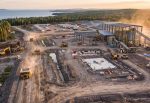
Churchill Resources (TSXV:CRI) has reported significant progress in its fall exploration campaign at the historic Frost Cove Antimony Mine, part of the company’s Black Raven Property in central Newfoundland. The discovery of massive stibnite seams and strong antimony mineralization has underscored the site’s potential as a high-grade domestic source of this critical mineral.
The exploration program, which began on September 15, 2025, represents the first comprehensive evaluation of the property for antimony, gold, and silver. It involves 5,000 meters of drilling and extensive trenching across several historic mining areas — starting with Frost Cove, followed by the Stewart Gold Mine and the Taylor’s Room Gold-Silver-Lead-Zinc prospect. The effort also includes wide-ranging soil sampling aimed at identifying both extensions of known mineralized zones and new discovery targets.
Expanding Drilling Operations
Churchill mobilized a second drill rig to the property on October 14, accelerating work at Frost Cove. By October 18, the company had completed 16 core holes totaling 1,470 meters, focusing on the northern 500-meter strike length and progressing southward from the historic mine adits. Ten surface trenches have been excavated and sampled within this section, with up to seven more drillholes planned to complete the initial phase of delineation.
According to the company, semi-massive to massive and stringer antimony mineralization has been intercepted in 14 of 16 drillholes and in 9 of 10 trenches. These mineralized zones occur along shear zones at the footwall of a quartz-feldspar porphyry dyke, which geological mapping indicates continues further south. Massive stibnite seams up to 20 centimeters thick were observed in several locations, notably in Trenches 3 and 10, located approximately 200 and 480 meters south of the lower mine adit.
Further south, Churchill’s exploration team rediscovered a second historic shaft roughly 780 meters from the lower adit entrance, where they identified additional massive stibnite mineralization. Trenches along the adjacent shear zone have traced the surface expression of this seam for about 80 meters northward from the shaft. Starting October 20, one of the drill rigs will begin delineation drilling along this southern section of the Frost Cove trend, expected to include 8 to 12 new holes covering approximately 200 to 300 meters of strike length.
Ninety-three core samples from drillholes FC25-01 to FC25-05 and 48 trench samples from Trenches 1 to 10 have been submitted to SGS Lakefield Laboratories for assay. A larger second batch of samples is scheduled for shipment shortly. In parallel, 673 soil samples were sent to Eastern Analytical in Springdale, Newfoundland, for antimony, gold, and multi-element analysis. Soil sampling is a key component of Churchill’s regional exploration approach, modeled after the successful discovery of the Beaver Brook antimony deposits located 100 kilometers to the south. Another 1,000 soil samples are expected to be submitted by the end of October.
Metallurgical testing of composite vein material from Frost Cove is also underway at SGS Lakefield. Preliminary results have shown strong antimony recoveries using conventional gravity and flotation processes, with final results expected in the coming weeks.
Structural and Resource Evaluation
The ongoing evaluation program at Frost Cove is designed to define mineralization both along strike and at depth. Surface trenches are spaced approximately 50 meters apart across vein structures, while drill pads are positioned every 100 meters, allowing multiple drillholes per site to intersect mineralized zones at depths of around 50 and 100 meters below surface.
Churchill’s longer-term objective is to generate enough data to prepare a maiden National Instrument 43-101–compliant resource estimate. The company aims to determine whether Frost Cove could support a small-footprint, high-grade underground mining operation — a model that could help re-establish North American production of antimony, which currently lacks domestic primary sources.
Antimony has been designated as a critical mineral by the Government of Canada due to its importance to national and economic security. It is widely used in flame retardants, military applications, advanced batteries, and emerging energy storage technologies. Establishing a North American supply chain for the metal has been cited as a key objective under the “Fortress North America” strategy for critical minerals, designed to reduce dependency on foreign sources and strengthen industrial resilience.
The Black Raven Property is located about 60 kilometers northwest of Gander and 100 kilometers north of the Beaver Brook Antimony Mine, currently on care and maintenance. The property hosts a high-grade polymetallic stockwork vein system rich in antimony, gold, silver, lead, and zinc. Prospecting conducted by Churchill in 2025 confirmed multiple mineralized veins, with notable grab sample results including 35.1% antimony, 35.5 grams per tonne gold, and 1,118 grams per tonne silver.
The project area benefits from nearby infrastructure, including road access, electrical power, proximity to tidewater and shipping ports, and established local mining services. These logistical advantages could facilitate development and reduce potential operational costs should a viable resource be confirmed.
If you would like to receive our free newsletter via email, simply enter your email address below & click subscribe.
 Follow us on Twitter
 Become our facebook fan
CONNECT WITH US
Tweets
Tweet with hash tag #miningfeeds or @miningfeeds and your tweets will be displayed across this site.
MOST ACTIVE MINING STOCKS
Daily Gainers
 Wallbridge Mining Co. Ltd. Wallbridge Mining Co. Ltd. |
WM.TO | +1,900.00% |
| Midlands Minerals Corp. |
MEX.V | +66.88% |
| GoviEx Uranium Inc. |
GXU.V | +42.86% |
 Mount Burgess Mining NL Mount Burgess Mining NL |
MTB.AX | +33.33% |
| International Lithium Corp. |
ILC.V | +33.33% |
| Casa Minerals Inc. |
CASA.V | +30.00% |
| Triton Gold Limited |
TON.AX | +25.00% |
| IMX Resources Ltd. |
IXR.AX | +25.00% |
| Poseidon Nickel Limited |
POS.AX | +25.00% |
| Golden Arrow Resources Corp. |
GRG.V | +21.05% |