Metallis Resources (TSXV: MTS) (OTCQB: MTLFF) has reported steady progress in its 2025 diamond drilling campaign at the Greyhound Property in central Idaho, where recent activity continues to define zones of polymetallic mineralization containing silver, gold, and antimony. The company has completed seven drill holes totaling 1,143 metres and has now mobilized to its final target area, known as Birdie.
The Greyhound Property, located in Custer County about 42 kilometres northwest of Stanley, Idaho, was the site of an active early 20th-century silver mining camp. The property includes historical workings, a former smelter, and two past-producing mines situated along the 3.5-kilometre Greyhound shear zone. This year’s program marks the first modern drill testing of several key target areas.
Multi-Metal System with Strategic Importance
The mineralized zones at Greyhound are defined by extensive shear structures containing quartz-sulfide veins that host gold, silver, and antimony, alongside accessory sphalerite and galena. Antimony, which accounts for roughly 20% of the in-situ metal value, adds strategic significance to the project, particularly following recent global supply disruptions and export restrictions from China. This combination of precious and critical metals positions Greyhound as both a gold-silver exploration project and a potential source of critical mineral supply.
Vice President of Exploration Dave Dupre said the ongoing campaign has delivered “consistently encouraging results,” noting that the team is pushing to complete as much drilling as possible before the end of the field season. To date, work has focused on the Bulldog and 1350’ zones, with additional drilling now commencing at Birdie.
1350’ Zone: Expanding a High-Grade Shear System
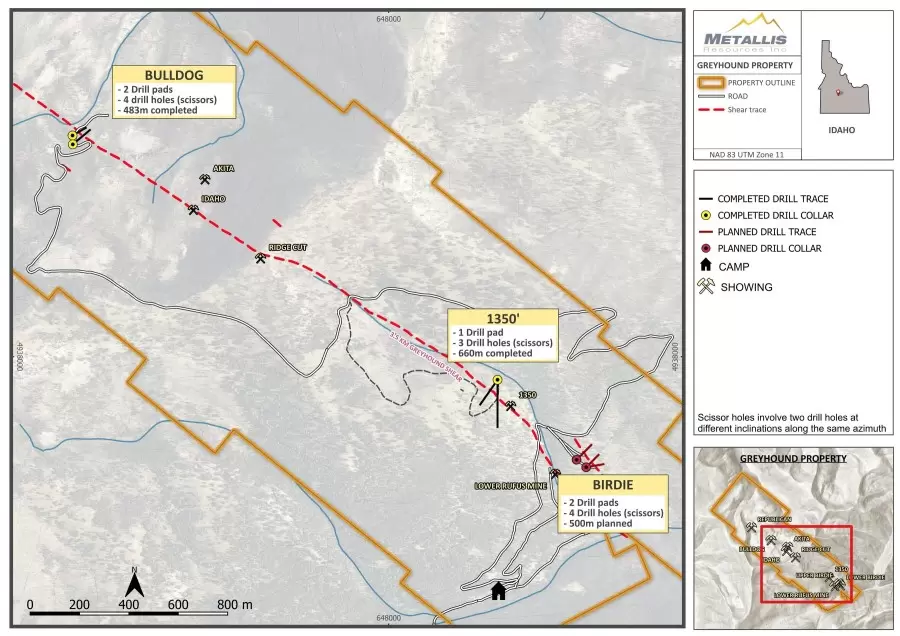
Drilling at the 1350’ zone targeted mineralization near the historic Lower Rufus adit, where historical channel sampling over 36.9 metres returned 1.85 g/t gold and 785 g/t silver, equivalent to 10.6 g/t gold equivalent. Three holes drilled from a single pad — totaling 659.8 metres — intersected strong sulphide mineralization across shear zones ranging from 7 to 25 metres in thickness, though true widths remain unknown. Sulphide assemblages included arsenopyrite, pyrite, galena, sphalerite, and stibnite, all correlating with silver mineralization.
These intercepts have now defined a mineralized zone extending approximately 100 metres vertically and 70 metres horizontally. With three clear mineralized intersections, the company reports improved understanding of the geometry and morphology of the shear-hosted system.
Bulldog Target: New Structural Insights
At the Bulldog target, four drill holes totaling 483.6 metres were completed from two pads. The area is centered on a 12-metre-wide silver-gold-antimony shear zone where surface samples returned up to 4.9% antimony and 3,360 g/t silver. Drilling has confirmed semi-massive sulphide mineralization within quartz-sulfide veins containing pyrite, arsenopyrite, and trace sphalerite, galena, and stibnite.
Structural analysis has identified east-dipping geometries not previously recognized in earlier fieldwork. Post-mineral dykes encountered in drill holes GH25-01 and GH25-04 may have offset mineralization locally. Multiple veins intersected in several holes suggest the Bulldog system is more laterally extensive than earlier interpretations indicated.
Birdie Target: Focus on Gold-Rich Zones
The final stage of the 2025 program is underway at the Birdie target, located on a parallel trend to the main Greyhound shear. Plans call for four drill holes totaling about 500 metres — two collared beneath the upper Birdie portal and two from a pad 50 metres southeast at lower Birdie. Results from this drilling are expected to clarify the relationship between the parallel shear zones across the property.
Historical and surface sampling at Birdie has indicated significant gold and silver potential. Two trench cuts located about 70 metres apart and several old adits revealed a broad shear zone with 1–3 metres of quartz-sulfide veining. An 80-centimetre float sample from the Upper Birdie cut returned 4,900 g/t silver, while other nearby samples reached up to 67.0 g/t gold equivalent. At the Lower Birdie cut, a 50-centimetre quartz-sulfide vein sample assayed 18.15 g/t gold. These results highlight Birdie as a gold-rich area within the broader Greyhound system, where high-grade values may have been overlooked historically.
Greyhound’s polymetallic quartz-sulfide veins, containing elevated gold, silver, antimony, lead, and zinc, share geological similarities with deposits in Idaho’s renowned Silver Valley mining district along Interstate 90. The Silver Valley has produced over one billion ounces of silver, three million tonnes of zinc, and eight million tonnes of lead — worth more than $6 billion — ranking it among the top ten mining districts globally.
The Greyhound Property lies approximately 35 kilometres south of Perpetua Resources’ Stibnite Mine, a project notable for its antimony-gold mineralization. Given the growing strategic importance of antimony and the presence of silver- and gold-bearing shear zones, the Greyhound Property remains a focal point of exploration for Metallis Resources as drilling continues through the final stages of the 2025 season.
If you would like to receive our free newsletter via email, simply enter your email address below & click subscribe.
 Follow us on Twitter
 Become our facebook fan
CONNECT WITH US
Tweets
Tweet with hash tag #miningfeeds or @miningfeeds and your tweets will be displayed across this site.
MOST ACTIVE MINING STOCKS
Daily Gainers
 Midlands Minerals Corp. Midlands Minerals Corp. |
MEX.V | +66.88% |
| GoviEx Uranium Inc. |
GXU.V | +42.86% |
 Mount Burgess Mining NL Mount Burgess Mining NL |
MTB.AX | +33.33% |
| Starfire Minerals Inc. |
SFR.V | +33.33% |
| Casa Minerals Inc. |
CASA.V | +30.00% |
| Lincoln Minerals Limited |
LML.AX | +27.27% |
| North Arrow Minerals Inc. |
NAR.V | +26.67% |
| Chameleon Mining NL |
CHM.AX | +25.00% |
| Poseidon Nickel Limited |
POS.AX | +25.00% |
| Goldquest Mining Corp. |
GQC.V | +23.19% |