



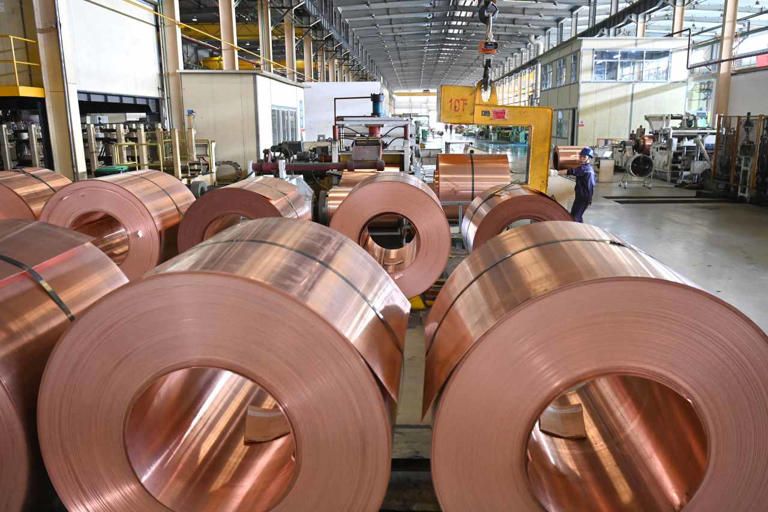
Copper has officially been added to the U.S. government’s list of critical minerals—those deemed essential to the country’s economic and national security. Yet, in a paradoxical twist, the United States already possesses one of the world’s largest copper stockpiles, second only to China’s. The accumulation has occurred without any federal intervention or taxpayer spending, fueled instead by market dynamics and a widening pricing gap between U.S. and international copper markets.
Over the past year, the U.S. copper market has seen a surge in physical metal inflows as traders capitalized on the arbitrage opportunity between the higher-priced contracts traded on the Chicago Mercantile Exchange (CME) and the lower prices quoted on the London Metal Exchange (LME). The growing premium on U.S. copper—at times reaching extraordinary levels—has incentivized the world’s major traders to divert shipments toward American shores.
This unintentional buildup has created what analysts describe as a de facto strategic stockpile of copper, though it is held by commercial entities rather than the federal government. Consultancy Benchmark Minerals Intelligence estimates that between 731,000 and 831,000 metric tons of copper are now “economically trapped” within the United States. The term refers to the fact that current market conditions make it uneconomical to re-export the metal without a significant reversal in the price differential between U.S. and global markets.
The Arbitrage Opportunity
The roots of this phenomenon can be traced to February, when President Donald Trump ordered an investigation into copper imports on national security grounds. The market swiftly priced in the potential for tariffs similar to those already imposed on steel and aluminum, prompting a wave of speculative and physical trading activity.
By July, the premium for U.S.-traded copper over its London counterpart had ballooned to nearly $3,000 per metric ton. Traders rushed to take advantage, shipping as much refined copper as possible into the U.S. market. However, that premium collapsed almost overnight when the Trump administration surprised traders by announcing tariffs on semi-manufactured copper product, while deferring a decision on refined metal until July 2026.
Although the arbitrage narrowed temporarily, it has since widened again. After dipping below $100 per ton in August, the spot CME premium has climbed back above $300, while the 10-month forward premium is nearing $800 per ton. These levels, though below the mid-year extremes, remain sufficient to cover shipping and handling costs, ensuring that physical inflows continue.
The U.S. as the Copper Market of First Resort
The most visible sign of this trade pattern is the rapid accumulation of copper in CME-registered warehouses, which serve only domestic delivery points. From a low of 83,900 tons in February, CME stocks have surged to more than 335,000 tons—now exceeding the combined inventories held by both the LME and the Shanghai Futures Exchange.
Shipments continue to arrive daily, primarily through New Orleans, with additional inflows reported in Baltimore, Salt Lake City, and Tucson. These visible stocks may represent only a portion of the total volume now held within the country’s borders. Benchmark’s analysis suggests that the overall quantity of copper now effectively immobilized in the U.S. market is far greater.
Trade statistics support this assessment. Despite disruptions to government data reporting due to the recent shutdown, figures from earlier in the year showed that refined copper imports reached more than one million tons in the first seven months of 2025—an increase of roughly 400,000 tons over the same period in 2024. Export data from key suppliers such as Chile, Peru, and Australia indicate that shipments to the U.S. have remained strong since then.
Rising Costs Reflect Tightening Supply Dynamics
The United States’ role as the preferred destination for surplus copper has had ripple effects throughout the global supply chain. Europe’s largest copper producer, Aurubis, has raised its premium for 2026 deliveries by 38% to a record $315 per ton over the LME benchmark. Analysts attribute the move in part to the strong U.S. demand that has tightened availability elsewhere.
As the market continues to anticipate potential policy changes—including the prospect of tariffs on refined copper imports—many traders expect the arbitrage gap to persist or even widen further. This would reinforce the United States’ status as a magnet for global copper supplies.
The result is an unusual market outcome: the creation of what amounts to a national copper reserve, built not through government procurement or strategic planning but through arbitrage-driven private accumulation. The combination of trade policy uncertainty, market speculation, and the new “critical mineral” designation has effectively concentrated vast quantities of the metal inside the U.S. economy.
While the formal intent behind the critical minerals list is to safeguard national supply chains, in copper’s case the market may have already achieved that objective on its own. The metal’s growing domestic inventory base—though held by private entities—now functions as a buffer against potential supply disruptions, trade barriers, or geopolitical shocks.
 Follow us on Twitter
 Become our facebook fan









Comments are closed.