



Prospect Ridge Resources (CSE:PRR) has completed a ten-hole diamond drilling program at its 100% owned Camelot copper-gold project located in British Columbia’s Cariboo Mining District, concluding field operations for the 2025 campaign. The program, which totaled 2,010 metres of drilling over a 21-day period, was carried out from eight drill pads and targeted multiple geophysical and geochemical anomalies beneath glacial till that had not previously been drill tested.
The final four drill holes of the program—CAM25-007 through CAM25-010—accounted for 903 metres of drilling and were completed from three sites along the northeastern segment of a 1.7-kilometre-long prospective trend identified through geophysical and soil geochemical surveys. The northeasternmost hole, CAM25-009, was collared approximately 1,740 metres northeast of the first hole drilled in the program, CAM25-001, highlighting the lateral extent of the target corridor.
All drill sites, access roads, and trails associated with the program have been rehabilitated, and all field activities have been completed with the exception of reseeding at some pad locations.
Exploration Rationale and Targeting Approach
The 2025 drill program was designed to test historical copper-in-soil anomalies that coincide with induced polarization (IP) chargeability highs and moderate magnetic anomalies. This approach was based on an alkalic porphyry exploration model, where such coincident geophysical responses may reflect pyrite-chalcopyrite mineralization associated with magnetite-bearing potassic alteration. Prior to this campaign, the target areas were covered by till and had not been previously drill tested.
Results from the first six drill holes were reported in a news release dated December 4, 2025. Observations from those holes established a positive correlation between elevated chargeability responses and increased occurrences of pyrite and chalcopyrite. These findings informed modifications to the collar locations of the final four holes in an effort to refine targeting.
Drilling Summary and Program Execution
Drilling was intentionally limited in depth in most holes to allow for the testing of as many targets as possible across the property. Eight of the ten holes were terminated at depths of approximately 200 metres, despite the continued presence of pyrite and chalcopyrite at the bottom of many holes. Hole CAM25-004 was stopped at 102 metres, while CAM25-010, which was designed to test a deeper geophysical anomaly, was extended to a depth of 301 metres.
Drill core samples from holes CAM25-007 and CAM25-009 were submitted for laboratory analysis on a “rush” basis, with assay results expected in late December. Accurate copper and gold grades will be determined using wet geochemical methods and fire assays, respectively. True widths of mineralization have not yet been established.
Portable XRF and Visual Core Observations
Throughout the program, a portable X-ray fluorescence (pXRF) analyzer was used to support visual logging by identifying fine-grained and disseminated chalcopyrite in altered rock units where mineralization was difficult to confirm visually. The pXRF analyses consisted of spot measurements taken at one-metre intervals along the drill core, sampling an area of approximately 0.5 square centimetres per measurement.
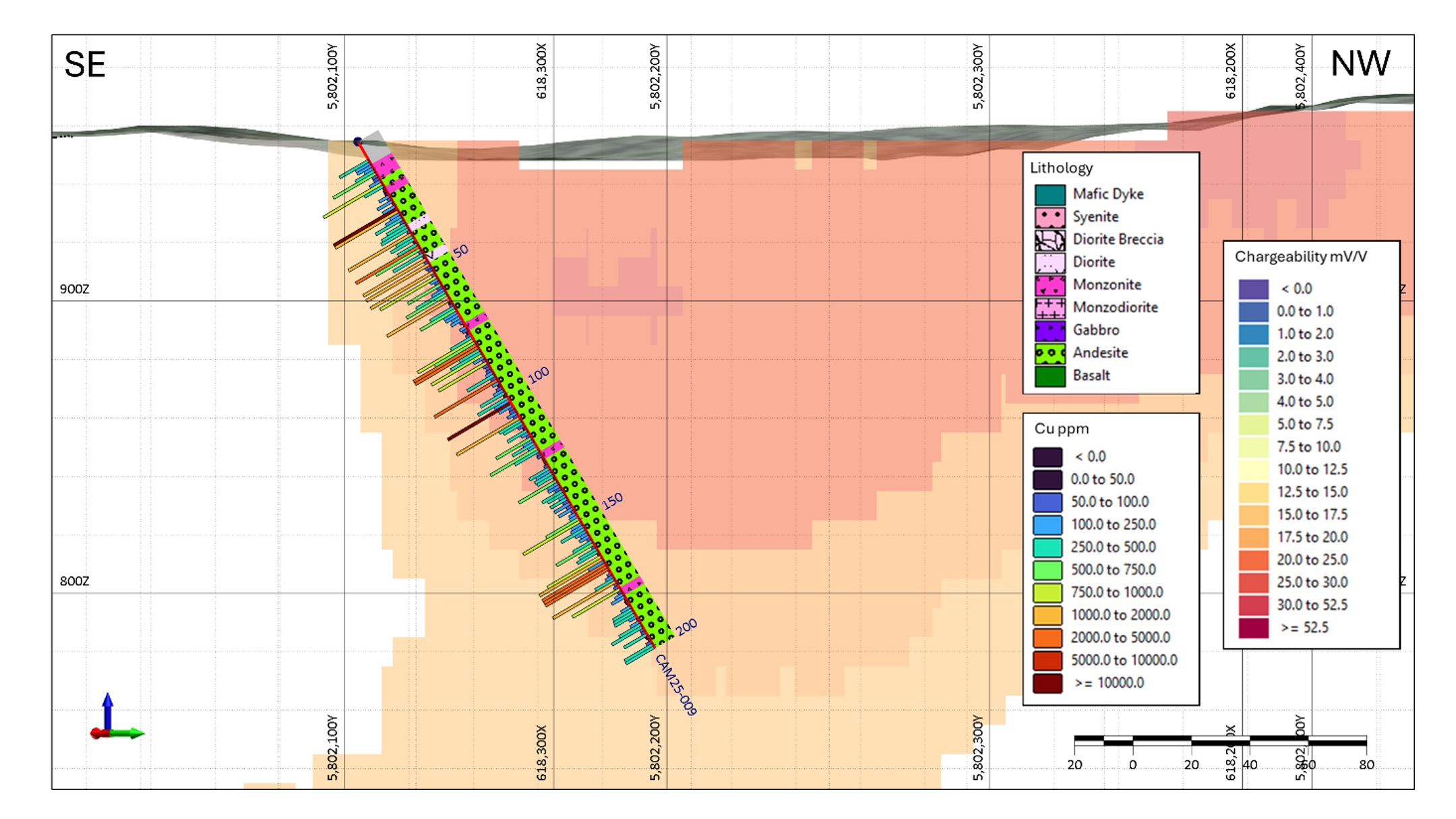
While pXRF results provide reliable qualitative confirmation of copper presence, they represent a limited volume of material and are considered a screening tool rather than a substitute for laboratory assays. Copper was detected by pXRF in all four of the final drill holes. In the case of hole CAM25-009, copper values are presented as histograms in a drill hole cross-section, illustrating continuity and variability consistent with visual core logging.
Target Area Results
Alpha Target
The Alpha target is characterized by a large chargeability anomaly with associated isolated magnetic responses interpreted as potential pipe-like intrusive features. The anomaly is underlain by a moderate to low resistivity zone. Four drill holes from three pads were completed at Alpha.
As previously reported, CAM25-005 intersected weak to moderately pyrite-mineralized diorite with trace to weak disseminated chalcopyrite and elevated quartz and quartz-carbonate veining. CAM25-006 intersected variably K-feldspar-altered andesite, diorite, and monzodiorite containing disseminated pyrite, pyrite veinlets, and weak chalcopyrite from 140 metres to the end of the hole.
Hole CAM25-008 intersected moderate to strong K-feldspar–biotite–chlorite-altered monzodiorite and diorite intruding andesite, hosting 0.5–5% disseminated fine-grained pyrite and trace chalcopyrite. CAM25-010 intersected weak to moderately altered andesite intruded by narrow intervals of diorite, monzodiorite, and monzonite, containing 1–5% disseminated pyrite and rare chalcopyrite.
Bravo Target
The Bravo target consists of a chargeability high coincident with pipe-like magnetic anomalies. Drill hole CAM25-007 intersected moderately altered monzonite intruding andesite, with 1–3% disseminated pyrite and fine-grained chalcopyrite detected through pXRF analysis. Rare quartz vein-hosted chalcopyrite was also observed.
Echo Target
The Echo target lies on the shoulder of a moderate magnetic anomaly and was tested by drill hole CAM25-009, which was drilled at a -60-degree inclination toward the northwest. The hole reached its planned depth of 201 metres and was designed to test a chargeability anomaly interpreted to be caused by disseminated pyrite.
Visual core logging confirmed that the highest chalcopyrite concentrations coincide with the chargeability anomaly, a relationship supported by real-time pXRF measurements. The hole intersected volcanic rocks cut by felsic dikes, both displaying a moderate calc-potassic alteration assemblage including epidote, magnetite, chlorite, and K-feldspar, as well as quartz veins with albite halos. Both lithologies contain pyrite and chalcopyrite.
No substantial felsic intrusive body was encountered in CAM25-009. This absence may indicate that the causative intrusion lies at greater depth or that mineralization is hosted entirely within country rock, a geological configuration observed in some porphyry-style deposits, including the nearby Mount Polley mine.
Historical Drill Core Review
During the 2025 program, partially assayed core from historical drill hole LL22-001—collared near the location of CAM25-009—was re-examined. The bottom approximately 192 metres of that hole had been assayed at a limited density, with only three metres sampled for every fifteen metres of core. Oxidation of the stored core improved the visibility of previously unrecognized chalcopyrite, prompting the decision to cut and assay the previously unsampled intervals.
The Camelot property covers 2,646 hectares and is situated approximately 65 kilometres east of Williams Lake, British Columbia, within the Quesnel Terrane. The region hosts several producing copper-gold and copper-molybdenum porphyry deposits, including the Gibraltar and Mount Polley mines. Camelot is located 34 kilometres southeast of Mount Polley and 13 kilometres northeast of Vizsla Copper’s Woodjam project.
The property is centered on the Lemon Lake stock, a Late Triassic to Early Jurassic multiphase pluton composed of early gabbro intruded by monzonite, breccias, and late-stage syenitic dikes. Potassic alteration and localized pyrite-chalcopyrite mineralization are most commonly associated with monzonite intrusions, while phyllic alteration is rare, consistent with an alkalic porphyry model.
 Follow us on Twitter
 Become our facebook fan







Comments are closed.