



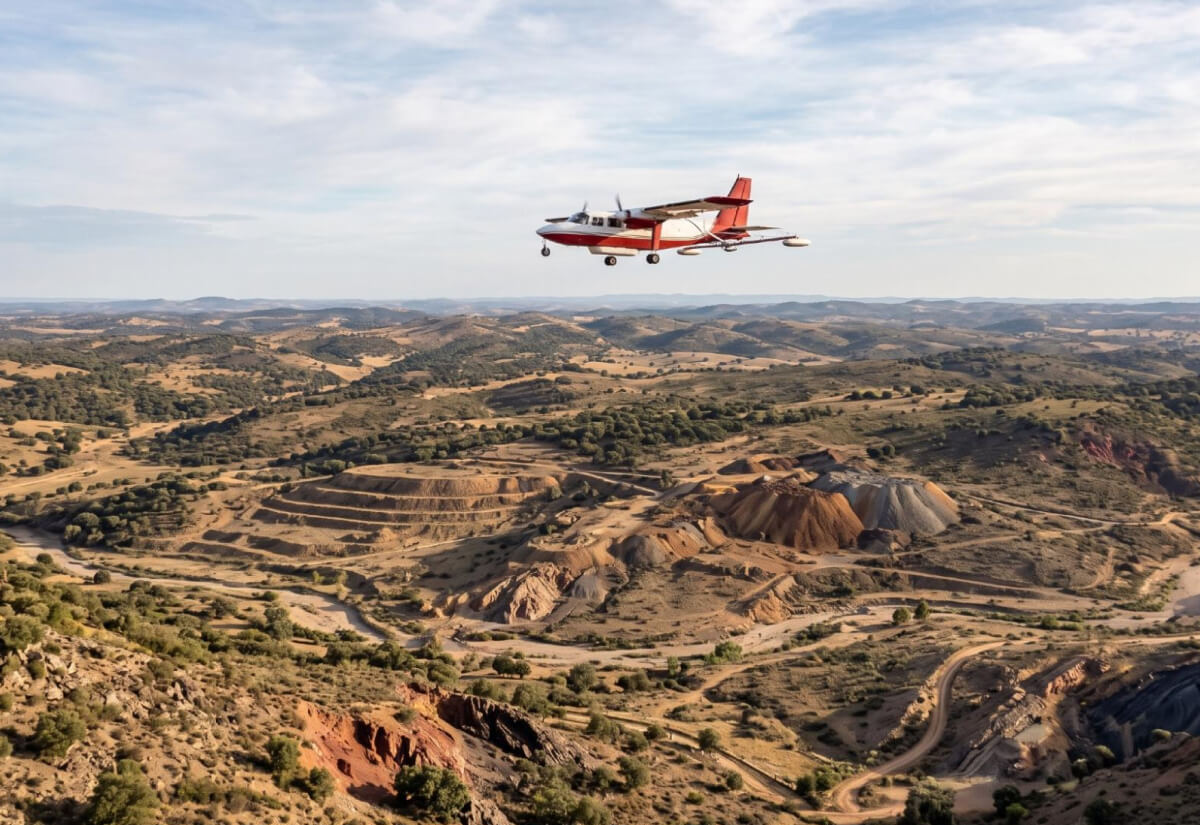
Spain is preparing to investigate 100,000 square kilometres of territory under a €197 million (US$223 million) mineral exploration program scheduled to run from 2026 through 2030. The initiative will focus on locating previously unidentified mineral deposits, assessing critical metals in historical mining waste, and improving geological data available for future exploration projects.
The Geological and Mining Institute of Spain (IGME) will undertake extensive geophysical investigations across western and southern Spain. Airborne surveys are expected to begin within weeks and conclude by June 30.
Airborne Surveys Target Potential Mineral Deposits
The airborne exploration campaign will examine three geological regions: the Central Iberian, Ossa-Morena, and South Portuguese zones.
Survey aircraft will collect magnetic, radiometric, and gravity measurements while flying approximately 100 metres above the terrain. Flight paths will be spaced 400 metres apart to provide systematic coverage of the selected areas.
The resulting geophysical datasets will help identify subsurface geological structures and anomalies that may indicate concealed mineralization.
IGME also plans to apply artificial intelligence to geological interpretation, using predictive models to identify prospective areas for subsequent field investigations.
Copper, Lithium, and Tungsten Exploration Projects
IGME has identified two initial exploration areas in Huelva and Salamanca provinces.
The San Silvestre de Guzmán project in Huelva covers 1,583.7 square kilometres within the South Portuguese geological zone. Exploration will concentrate on copper-bearing polymetallic sulphide systems, including potential occurrences of germanium, gallium, and indium.
Existing magnetic survey results have identified anomalies that will guide further geological investigations across the project area.
In Salamanca province, the Morille project covers approximately 4,353 square kilometres within the Central Iberian zone. Its exploration targets include tungsten, tin, niobium, tantalum, and lithium.
The area contains more than 100 recorded mineral occurrences and former mining workings. Historical drill cores stored at IGME’s Peñarroya repository will provide additional geological information for assessing mineral potential.
State-owned mining company Hunosa will provide technical direction for the initial state-reserve exploration areas while research permits are being prepared.
Historical Mine Waste to Be Assessed for Valuable Metals
Spain’s exploration program also includes investigations into metal recovery from existing mining waste deposits.
Four sites have been selected for assessment, including Santa Bárbara and Elena in Córdoba province, and Paquito La Manzana and El Centenillo in Jaén province.
The investigations will examine potential concentrations of antimony, cobalt, copper, nickel, silver, lead, and zinc.
These assessments will help determine whether materials left by previous mining operations contain mineral resources suitable for further evaluation.
Investment Allocated Across Exploration Activities
The exploration program’s budget includes contributions from government institutions, state-owned enterprises, and private mining companies.
Approximately €51 million is allocated to work involving IGME, other national institutions, and universities. Hunosa and private companies account for another €115 million.
The funding structure also includes €16 million in government grants and an anticipated €15 million in related private investment.
Government expenditure will remain dependent on annual budget allocations, and individual projects will require the appropriate funding approvals.
Geological Records to Support Future Mineral Discoveries
IGME is also expanding its digital collection of historical exploration information. The institute has digitized approximately 2,000 documents from 684 previous exploration projects. Its geological archive contains roughly 30,000 plans, with more than 7,000 scanned.
Further work will reassess existing geochemical data and conduct additional analyses to address gaps in earlier investigations, which focused on a narrower range of metals.
Additional laboratory analysis and geological modelling will support identifying mineral targets across Spain’s prospective mining regions.
 Follow us on Twitter
 Become our facebook fan





Comments are closed.