



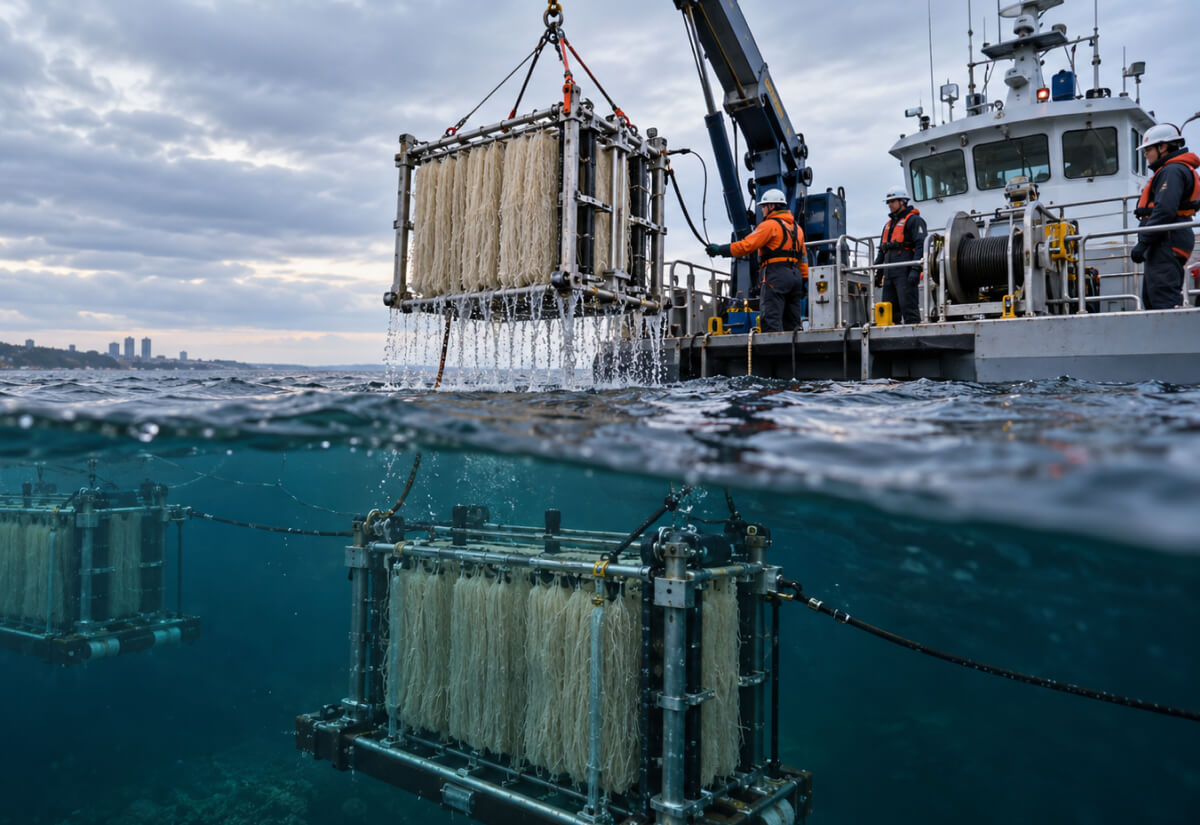
SuperCritical Materials Corp. has entered a research partnership with the University of Michigan to examine the physical systems needed to collect uranium from seawater at commercial scale.
The company’s licensed adsorbent captures dissolved uranium when seawater flows over the material. After spending a set amount of time in the water, the adsorbent is brought back for processing and uranium removal. High-volume reuse will depend on equipment that can place, hold, and recover substantial amounts of material without damaging it or creating excessive operating costs.
University researchers will study the forces imposed during packing, placement in the water, exposure to ocean movement, and retrieval. Their findings will guide prototype designs and help determine which packing arrangements can handle repeated use.
Tank Trials Will Simulate Offshore Forces
Testing is planned for the Aaron Friedman Marine Hydrodynamics Laboratory at the University of Michigan. Its tanks can reproduce waves, currents, and other marine conditions, giving researchers a controlled setting to measure how prototype systems respond to offshore loads.
Dr. Maha Haji will lead the university research. Haji is an assistant professor of mechanical engineering and directs the university’s Symbiotic Engineering and Analysis Laboratory, where her group will provide experience in hydrodynamics, offshore design, and experimental testing to SuperCritical’s development work.
Initial work will measure the adsorbent’s mechanical properties and assess potential packing formats. Researchers will then build prototypes, run hydrodynamic trials, and revise the equipment concepts. The resulting designs are intended to support a later open-water pilot.
The main engineering question concerns dependable cycling at industrial volume. A viable installation must move large quantities of adsorbent into position, keep the material exposed for the required interval, and retrieve it efficiently. Each part of that sequence must remain workable through numerous deployments in a demanding saltwater environment.
Seawater Resource Draws Nuclear Fuel Interest
SuperCritical is pursuing the project through a nearshore development program focused on industrial capacity and competitive production costs. The company is seeking a role in the American nuclear fuel chain as the United States works to increase domestic supply and reduce dependence on imported uranium.
Seawater contains uranium at very low concentrations, yet the oceans’ size creates an estimated inventory of 4.5 billion tons.
Alexander Canon Bryan, SuperCritical’s president and chief executive, has identified efficient, repeated deployment, exposure, and retrieval of the adsorbent at industrial scale as the focus of the current development program. Success in the Michigan program would supply engineering data for offshore trials and a planned feasibility assessment.
The partnership connects a uranium-selective material with the equipment research required to use it at sea. Results will help SuperCritical establish design parameters, operating limits, and preferred configurations before committing to an offshore pilot. The phased program should also identify practical constraints early, allowing engineers to adjust handling methods and prototype geometry before equipment reaches uncontrolled marine conditions.
 Follow us on Twitter
 Become our facebook fan







Comments are closed.