



Homeland Uranium (TSXV:HLU) has released a further update on exploration activities at its wholly owned Coyote Basin Uranium Project in northwestern Colorado, reporting that near-surface anomalous radioactivity continues to be identified over a broad area as part of its ongoing Phase II drilling program. According to the company, drilling completed to date has confirmed elevated radioactivity across an area measuring approximately 1,000 metres by 600 metres, with the anomalous zone remaining open for expansion. The latest results form the third update from the Phase II exploration program and reflect continued progress following a temporary pause over the holiday period.
Progress of the Phase II Drilling Program
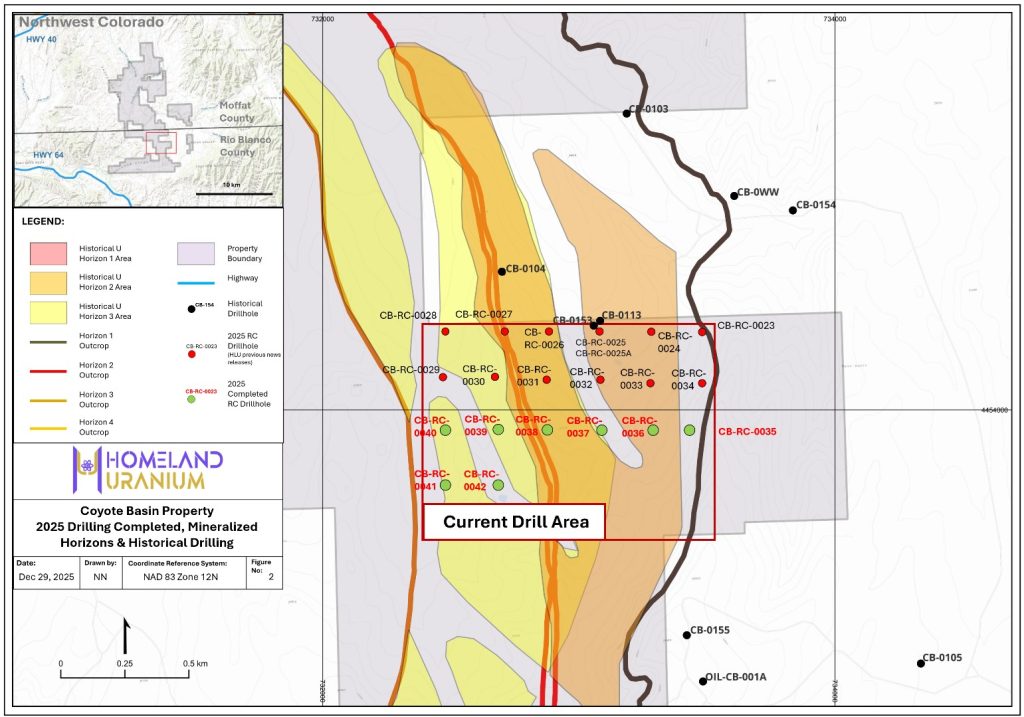
As of this update, Homeland Uranium has completed approximately 3,400 metres of drilling out of a planned total of 5,300 metres, representing roughly 64% of the Phase II program. The most recent work involved the completion of eight additional reverse circulation drillholes, designated CB-RC-0035 through CB-RC-0042.
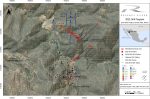
Six of these holes, CB-RC-0035 to CB-RC-0040, were drilled along a single east–west oriented fence located about 200 metres south of previously reported drilling. This configuration is part of a systematic step-out strategy intended to assess the lateral continuity of anomalous radioactivity across the project area. The approach builds on earlier drilling reported by the company in December 2025. The two remaining holes, CB-RC-0041 and CB-RC-0042, were drilled on what is described as the southernmost planned east–west drill fence. These holes targeted the southwestern portion of the currently tested area.
Geological Observations and Radiometric Results
Downhole spectral gamma ray logging from the newly completed drillholes continues to show elevated radioactivity at relatively shallow depths. The anomalous intervals are typically encountered between approximately 50 and 100 metres below surface. The radiometric signatures and rock types observed in this latest drill fence are reported to be consistent with those identified in earlier phases of drilling.
The anomalous radioactivity remains associated with shales, claystones, and fine-grained sandstones belonging to the Upper Member of the Fort Union Formation. Similar geological characteristics have been observed across multiple drill fences, supporting the interpretation of a laterally extensive anomalous horizon.
Results from drillholes CB-RC-0041 and CB-RC-0042 indicate that elevated radioactivity persists toward the southern extent of the currently tested area. The company notes that these findings suggest continuity of the anomalous horizon into the southwestern portion of the drill area.
Homeland Uranium’s President and Chief Executive Officer, Roger Lemaitre, stated that the completion of the third drill fence adds further confidence to the company’s geological interpretation. He noted that the results continue to demonstrate both the scale and continuity of near-surface anomalous radioactivity at Coyote Basin, and that the horizon remains open for additional evaluation.
The company has indicated that, as drilling activities have resumed following the holiday break, its focus remains on methodically expanding the footprint of the anomalous system. At the same time, geochemical work is advancing to improve the understanding and characterization of potential uranium mineralization.
Geochemical Sampling and Laboratory Analysis
Samples collected from the completed drillholes have been shipped to SGS Laboratories in Lakefield, Ontario, for geochemical analysis. Homeland Uranium has stated that it will release geochemical and assay results once they have been received, compiled, and reviewed.
The company emphasizes that chemical assays are required before uranium grades can be accurately determined. In sandstone-hosted uranium systems, uranium mineralization can be in disequilibrium with the radioactive decay products measured by gamma logging. While downhole gamma ray data are useful for identifying radiometric horizons and correlating drilling results, they may not reliably reflect uranium grades in cases of disequilibrium.
Uranium Disequilibrium Considerations
Homeland Uranium notes that uranium disequilibrium is a recognized phenomenon in similar geological settings. This condition has been documented at the former producing Maybelle Uranium Mine, located approximately 29 kilometres northeast of the Coyote Basin Project.
To evaluate whether disequilibrium may be present at Coyote Basin, the company’s geological team has conducted preliminary testing of drill cuttings using a portable hand-held XRF analyzer. Discrepancies observed between XRF readings and downhole spectral gamma results have led the company to conclude that further geochemical and laboratory assay work is necessary before any uranium grades can be determined with confidence.
As part of this effort, Homeland has collected samples from every five-foot interval of the drillholes for laboratory analysis. SGS Laboratories, which is certified under ISO 17043 standards for proficiency testing, will conduct the analyses. The laboratory participates in SGS’s internal Laboratory Quality Systems International proficiency testing program, which includes more than 100 participating laboratories worldwide.
The Coyote Basin Project has been the subject of historical exploration. According to Energy Metals Corporation’s Management Discussion and Analysis dated September 30, 2006, the project was reported to contain an estimated historical resource of 8.85 million tons grading 0.20% U₃O₈ and 0.10% V₂O₅, equivalent to 35.4 million pounds of U₃O₈ and 17.7 million pounds of V₂O₅. This estimate was based on work conducted by a previous operator, Western Mining Resources, during a 1978–1979 exploration program that included surface sampling, coring, drillhole chip sampling, and gamma logging of 24 widely spaced holes.
With Phase II drilling ongoing, Homeland Uranium expects continued drilling and geochemical analysis to support refinement of its geological model at Coyote Basin. Further results from both drilling and laboratory analysis are expected to provide additional data on the extent and nature of anomalous radioactivity identified to date.
 Follow us on Twitter
 Become our facebook fan





Comments are closed.