



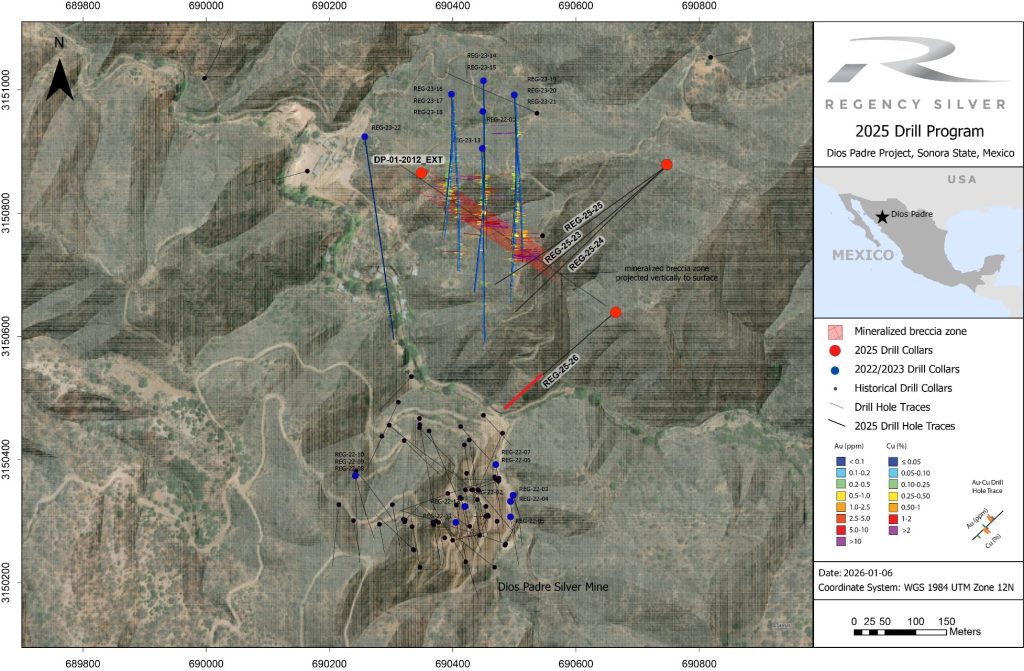
Regency Silver (TSXV:RSMX) has reported new drilling results from its Dios Padre project in Sonora, Mexico, outlining the intersection of multiple zones of sulphide–specularite supported breccia in its most recent drill hole, REG 25-26. The results extend the known breccia system southward and up-dip toward the historic Dios Padre silver mine, marking a step-out of approximately 225 metres from previous drilling.
According to the company, drill hole REG 25-26 intersected a series of non-continuous breccia zones over a broad interval of approximately 240 metres. Individual breccia bodies range in thickness from about 5 metres to 50 metres and are spatially associated with a set of quartz–feldspar porphyry intrusions. The breccias are described as sulphide–specularite bearing and are geologically comparable to breccia zones that host gold, copper, and silver mineralization encountered in earlier drill holes REG-22-01, REG 23-21, and REG 23-14. Similar breccia styles have also been documented at the company’s wholly owned Dios Padre silver mine project.
The location of hole REG 25-26 places it approximately 150 metres down-dip from the historic underground workings of the Dios Padre silver mine and roughly 225 metres up-dip from drill hole REG-25-25. The company stated that this positioning provides geological continuity between deeper breccia zones identified in earlier drilling and the near-surface historic mine area.
Previous drilling at the project has returned notable mineralized intervals. Hole REG 23-21 intersected 38 metres grading 7.36 grams per tonne gold. Hole REG-22-01 returned 35.8 metres grading 6.84 grams per tonne gold, 0.88 percent copper, and 21.82 grams per tonne silver. Hole REG 23-14 yielded 29.4 metres grading 6.32 grams per tonne gold. While these results provide a reference point, the company emphasized that analytical results for the 2025 drill program, including REG 25-26, are not yet available, and therefore direct comparisons of assay grades cannot be made at this stage.
REG 25-26 represents the final drill hole completed during the 2025 portion of Regency Silver’s ongoing drilling campaign, which resumed on October 10, 2025. The hole is the fifth completed since drilling restarted and concludes a total of five holes drilled for an aggregate length of 3,723 metres. The company indicated that this hole successfully identified the extension of the deeper breccia system at shallower levels, moving up-dip in the direction of the historic Dios Padre mine.
Mike Tucker, Director and Head Geologist for Regency Silver, commented that the intersection in REG 25-26 aligns with the company’s working geological model. He noted that the exploration team had hypothesized that the deeper, porphyry-controlled breccia system would extend upward toward the old mine workings at surface. According to Tucker, the presence of multiple porphyry dykes accompanied by adjacent sulphide–specularite breccias in REG 25-26 supports this interpretation, as these features occur between the deeper breccia zone and the historic mine site.
The company has highlighted that, consistent with observations from deeper drilling, quartz–feldspar porphyries appear to be the primary control on breccia development and associated mineralization. Drill hole REG 25-26 intersected numerous smaller porphyry bodies with adjacent breccia zones, which the company believes delineate structural pathways important for mineralization. Regency Silver stated that detailed mapping of these porphyry and breccia relationships is ongoing, with the aim of refining future drill targeting as exploration advances.
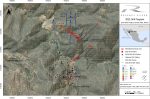
Visual documentation from the drill program includes close-up photographs of more strongly mineralized sections from REG 25-26, which are referenced in company figures. In addition, plan maps and three-dimensional long sections illustrate the locations and traces of the completed drill holes relative to the projected mineralized breccia system.
Although assay data from the 2025 drill program are pending, Regency Silver noted that the geological characteristics of the newly intersected zones—such as alteration styles, mineral species, and apparent mineral abundance—are similar to those observed in previously reported mineralized intervals. For reference, details of earlier mineralized intersections and their analytical results are contained in company press releases dated February 23, 2023, and November 2, 2023.
The technical aspects of the drilling and geological interpretation have been reviewed by Michael Tucker, P. Geo., who is recognized as a Qualified Person under National Instrument 43-101. Mr. Tucker is also a director of Regency Silver and, as such, is not considered independent. He has reviewed and approved the technical information disclosed in the company’s announcement.
Regency Silver also outlined its quality assurance and quality control procedures for the drill program. Once drill core was received from the site, samples were selected, logged for geological characteristics, sawn in half, labeled, and prepared for shipment to the laboratory. The remaining half-core was stored at a secure facility located in buildings surrounding the former milling site at the Dios Padre silver mine. Quality control measures included the regular insertion of blanks, preparation duplicates, and certified reference materials into the sample stream to monitor laboratory performance. Sample shipments were managed under a documented chain-of-custody protocol.
Analytical work was carried out by ALS Global at its Hermosillo, Mexico facility. Sample preparation involved drying and weighing, crushing the entire sample, and pulverizing a 250-gram subsample. Gold analysis was performed using a 30-gram fire assay with atomic absorption spectroscopy finish under method Au-AA23, with a detection range from 0.005 parts per million to 10 parts per million. Samples exceeding 10 parts per million gold were reanalyzed using a gravimetric fire assay method, Au-GRA21.
Silver and base metal analyses were conducted using method ME-ICP61m, which involves a four-acid digestion of a 0.75-gram sample followed by ICP-AES analysis. Detection limits for this method are 0.5 to 100 parts per million for silver, 1 to 10,000 parts per million for copper, and 2 to 10,000 parts per million for zinc and lead. Silver samples exceeding 100 parts per million were automatically reanalyzed using method Ag-OG62, and those above 1,500 parts per million were further analyzed by gravimetric fire assay under method Ag-GRA21. Copper, lead, and zinc values exceeding 10,000 parts per million were reanalyzed using corresponding over-limit methods.
 Follow us on Twitter
 Become our facebook fan





Comments are closed.