Core Silver (CSE:CC) has released new geological information and visual results from drill hole LAV25-012, part of its 2025 diamond drilling campaign at the Laverdiere Copper Project in British Columbia’s Atlin Mining District. The hole represents the third of four deep exploratory drill holes completed during the season and provides further data on the scale, continuity, and geological characteristics of copper-molybdenum-silver mineralization at the project.
The Laverdiere Copper Project is located on the eastern portion of the Blue Property, an extensive mineral tenure within northwestern British Columbia. Exploration in 2025 was designed to evaluate the depth potential and lateral continuity of a large, multi-phase Cu-Mo-Ag±Au porphyry system through a combination of diamond drilling, structural mapping, and surface sampling. Over the course of the program, seven drill holes were completed across five priority target areas along the Valley Fault Zone, totaling 3,857 metres of drilling.
Drill Hole LAV25-012 and Southern Extension of the System
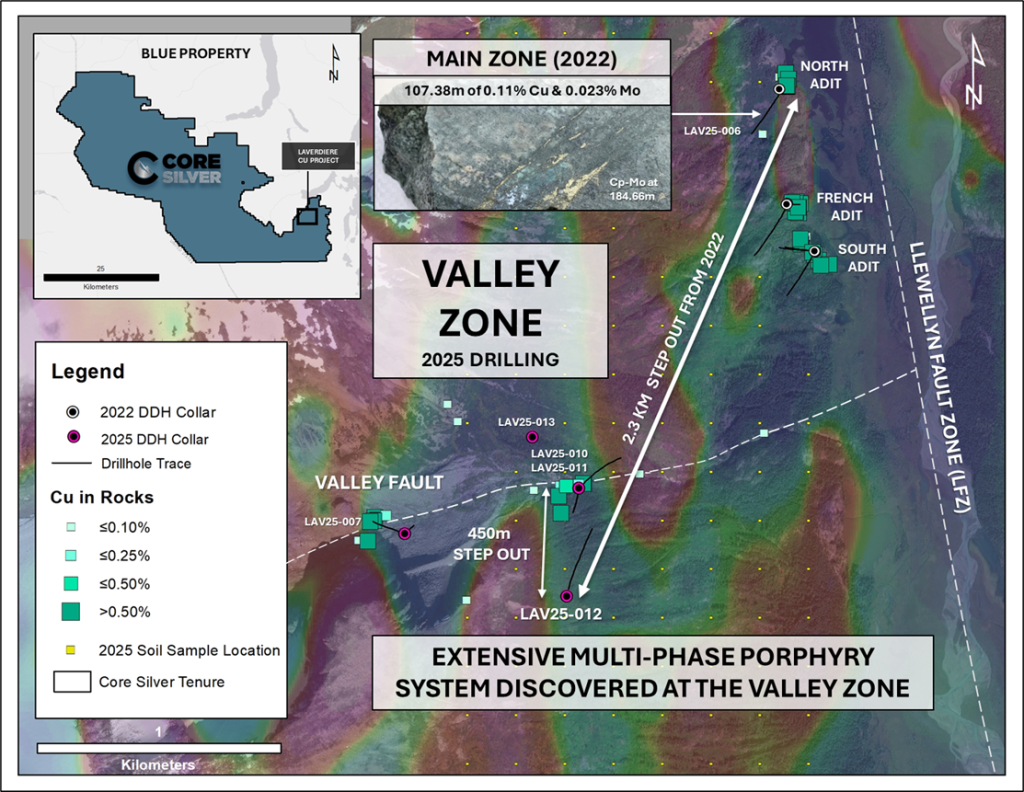
Drill hole LAV25-012 was collared approximately 450 metres south of earlier 2025 drill holes LAV25-010 and LAV25-011. The hole targeted a magnetic low anomaly interpreted as an area of enhanced hydrothermal alteration and structural complexity associated with the Valley Fault Zone. Drilled steeply to the north, the hole reached a final depth of 840 metres.
Results from LAV25-012 confirmed the presence of porphyry-style copper-molybdenum-silver mineralization from approximately 325 metres to beyond 825 metres drilled depth. This intersection extended the known southern limit of the Laverdiere Porphyry System by an additional 450 metres within the Valley Zone. Mineralization in the hole consists of multiple intervals of copper- and molybdenum-bearing quartz veining, mineralized breccias, and zones containing higher-grade copper sulphides, including chalcopyrite and locally bornite, particularly below 250 metres drilled depth.
The mineralized intervals are hosted within altered phases of the Laverdiere Porphyry and are bounded by late- to post-mineral intrusive phases. These relationships indicate multiple intrusive and mineralizing events over time. Alteration and mineralization styles observed in LAV25-012 are consistent with those typically associated with large, multi-phase porphyry systems and suggest that the system remains open both at depth and along strike.
Geological Observations and System Scale
Geological logging of LAV25-012 identified extensive zones of late- to post-mineral porphyry intrusions beginning near surface, reinforcing the interpretation that the porphyry system is long-lived and multi-phase in nature. While metal zonation patterns similar to those observed in LAV25-010 and LAV25-011 are present, they are locally overprinted by younger intrusions. In the upper portions of the hole, epithermal quartz-carbonate veins are common, representing a later hydrothermal overprint that has locally remobilized or partially disrupted earlier porphyry mineralization.
Below 325 metres drilled depth, mineralization becomes dominated by copper sulphides within narrow but well-developed zones. These deeper intersections contributed to confirming the southern extension of the porphyry system and further defined its vertical extent.
With less than 6,000 metres drilled across the project to date, Core Silver has delineated porphyry copper-molybdenum-silver mineralization and associated alteration over approximately 600 metres between drill holes LAV25-010 and LAV25-012. When combined with drilling at both the Valley Zone and the Main Zone, mineralization has now been traced over approximately 2.3 kilometres. In a broader context, copper and molybdenum mineralization has been identified across more than 4.5 kilometres along the Valley Fault corridor, highlighting the district-scale nature of the system.
The Laverdiere Copper Project is an early-stage, drill-permitted porphyry-skarn target situated at low elevation. The area has a history of sporadic exploration dating back to the early 1900s but has not previously been subject to sustained, modern exploration programs. The project is underlain by a large Cretaceous granodiorite intrusion that hosts widespread porphyry-style Cu-Mo-Ag±Au mineralization. Along its western margin, the intrusion is associated with high-grade iron-copper-gold-silver massive sulphide skarn mineralization exposed at surface in the Main Zone, near the contact with marble units along the Llewellyn Fault Zone.
Historical underground development in the early 20th century included adits that reportedly intersected up to 27 metres grading 1.20% copper. Subsequent shallow diamond drilling carried out in 1974 approximately 125 metres north of the French Adit reportedly returned 175 metres grading 0.27% copper, including shorter intervals grading 1.60% copper.
Core Silver’s inaugural drilling campaign at Laverdiere in 2022 produced several notable intersections, including 48.5 metres of 0.90% copper with silver and gold credits in drill hole LAV22-001, 223 metres of 0.11% copper and 0.006% molybdenum in LAV22-002, and 107.38 metres of 0.11% copper and 0.023% molybdenum in LAV22-006.
Valley Zone and Additional Targets
In 2024, Core Silver identified and mapped high-grade porphyry Cu-Mo-Ag±Au mineralization at the Valley Zone, located approximately 2.2 kilometres southwest of the Main Zone. Structural mapping and sampling revealed sheeted porphyry veins and mineralized fractures hosted in altered granodiorite over a one-kilometre east–west trend following the Valley Fault. Historical sampling in this area returned values of up to 3.24% copper with silver, gold, and molybdenum, as well as molybdenum values up to 0.32%.
Additional exploration in 2024 identified a 20-centimetre-thick east–west striking quartz vein on the opposite side of the Valley Fault, grading 0.83% copper with associated silver, gold, and molybdenum. Beyond the currently explored zones, mapping has identified large, unexplored embayments in the granodiorite intrusion both south and southwest of Laverdiere that are in contact with carbonate rocks considered favourable for additional skarn mineralization.
 **Core Assets Corp. Reports on 2024 Exploration Season**
Core Assets (CSE:CN) has released an update on its 2024 exploration activities at the Silver Lime CRD-Skarn-Porphyry Project and the central Blue Property, both located in the Atlin Mining District of northwest British Columbia.
Core Assets’ President & CEO Nick Rodway commented in a press release: “We have made significant strides in understanding and uncovering the mineralizing system at Silver Lime. The data collected thus far has greatly enhanced our confidence in the presence of a deeply buried and extensive mineralized system. Moreover, regional prospecting has uncovered exciting new prospects for future exploration. All assays from drill core and surface samples are pending, and we look forward to presenting the data as it becomes available.”
The company has completed 3,600 meters of diamond drilling over 10 holes in four target areas of the Silver Lime Project. The 2024 drilling aimed to evaluate the mineralized extent of the Sulphide City Mo-Cu Porphyry and associated skarn mineralization at depths exceeding 500 meters. The drill campaign also targeted high chargeability anomalies detected during a 2023 3D-DCIP survey.
Drilling focused on several key areas: the Sulphide City Mo-Cu Porphyry Target, the Sulphide City – Whaleback Zn-Cu-Ag Skarn Target, and two newly identified epithermal-style vein occurrences at Pike Valley and Pete’s North. These targets form a 2.6-kilometer trend of Porphyry-Skarn-Epithermal mineralization at Silver Lime.
At Pike Valley, previously known as Gally South, drilling intersected sheeted to stockwork-style quartz-carbonate base metal sulphide veining, approximately 1 km south of the Sulphide City Porphyry. In 2023, surface samples from this area returned high grades of silver, lead, zinc, copper, and gold.
Four additional drill holes were completed at the Sulphide City Porphyry Target and Pike Valley. At Sulphide City, the drills intersected widespread quartz-sericite-pyrite alteration with increased porphyry vein density and mineralization. Molybdenite and chalcopyrite-bearing zones were observed, marked by increases in biotite and k-feldspar. However, these holes were cut short due to significant deviation caused by intense faulting and veining.
At Pike Valley, two shallow holes were drilled to assess the grade potential of high-sulphidation base metal sulphide veining discovered on the surface in 2023. These holes intersected numerous centimetre-scale high-sulphidation epithermal base metal sulphide veins, associated with increased silicification and demagnetization of the intermediate intrusive host.
Geological and structural mapping conducted alongside drilling identified four main phases of the Sulphide City Mo-Cu Porphyry, including two mineralized diatreme breccia zones. Mapping also revealed a zone of strong skarn alteration surrounding the porphyry, zones of silicification and argillic alteration with low-grade gold mineralization, and moderate-to-high-grade base metal sulphide-bearing epithermal-style veins surrounding the porphyry. Additionally, a new zone of interest with quartz-arsenopyrite veins was identified about 6 km north of the main Sulphide City system.
A newly mapped mafic-to-intermediate intrusion extends over 2.0 km between the Jackie and Pike Valley targets. This intrusion, which is locally magnetic, hosts high-grade base metal sulphide veins in demagnetized zones and appears to be causative of carbonate replacement mineralization. It has been preliminarily dated as Cretaceous, suggesting two distinct generations of mineralization at the Silver Lime Project.
All drill core has been sent to the Bureau Veritas Labs in Whitehorse, Yukon, for processing. Samples undergo a 4-Acid digestion with an ICP-MS finish and a fire assay for gold, platinum, and palladium. The results will be released as they become available.
The above references an opinion and is for information purposes only. It is not intended to be investment advice. Seek a licensed professional for investment advice. The author is not an insider or shareholder of any of the companies mentioned above.
If you would like to receive our free newsletter via email, simply enter your email address below & click subscribe.
 Follow us on Twitter
 Become our facebook fan
CONNECT WITH US
Tweets
Tweet with hash tag #miningfeeds or @miningfeeds and your tweets will be displayed across this site.
MOST ACTIVE MINING STOCKS
Daily Gainers
 CMC Metals Ltd. CMC Metals Ltd. |
CMB.V | +900.00% |
 Eden Energy Ltd Eden Energy Ltd |
EDE.AX | +200.00% |
| GoviEx Uranium Inc. |
GXU.V | +42.86% |
| Eagle Nickel Ltd. |
ENL.AX | +41.67% |
| Citigold Corp. Limited |
CTO.AX | +33.33% |
| Mount Burgess Mining NL |
MTB.AX | +33.33% |
| Exalt Resources Limited |
ERD.AX | +31.94% |
| Casa Minerals Inc. |
CASA.V | +30.00% |
| Cariboo Rose Resources Ltd |
CRB.V | +28.57% |
| Belmont Resources Inc. |
BEA.V | +28.57% |