Solaris Resources (TSX:SLS) has reported assay results from its ongoing drill program at its Warintza Project in Ecuador. The company is currently operating discovery drill programs and aiming for mineral resource growth at the project.
Solaris announced this morning that it has extended Warintza Central to South, Southeast, and still open, while announcing that drill results from maiden drilling at Warintza South are now expected in January 2022.
Mr. Jorge Fierro, Vice President, Exploration, commented in a press release: “These latest results continue to expand the dimensions of Warintza Central to the south and southeast where it remains open. Our next series of holes will target extensions to the north and northeast. In January, we are looking forward to the results of the first-ever drilling at Warintza South, where we are targeting the fourth major discovery within the 7km x 5km cluster of copper porphyries on this property.”
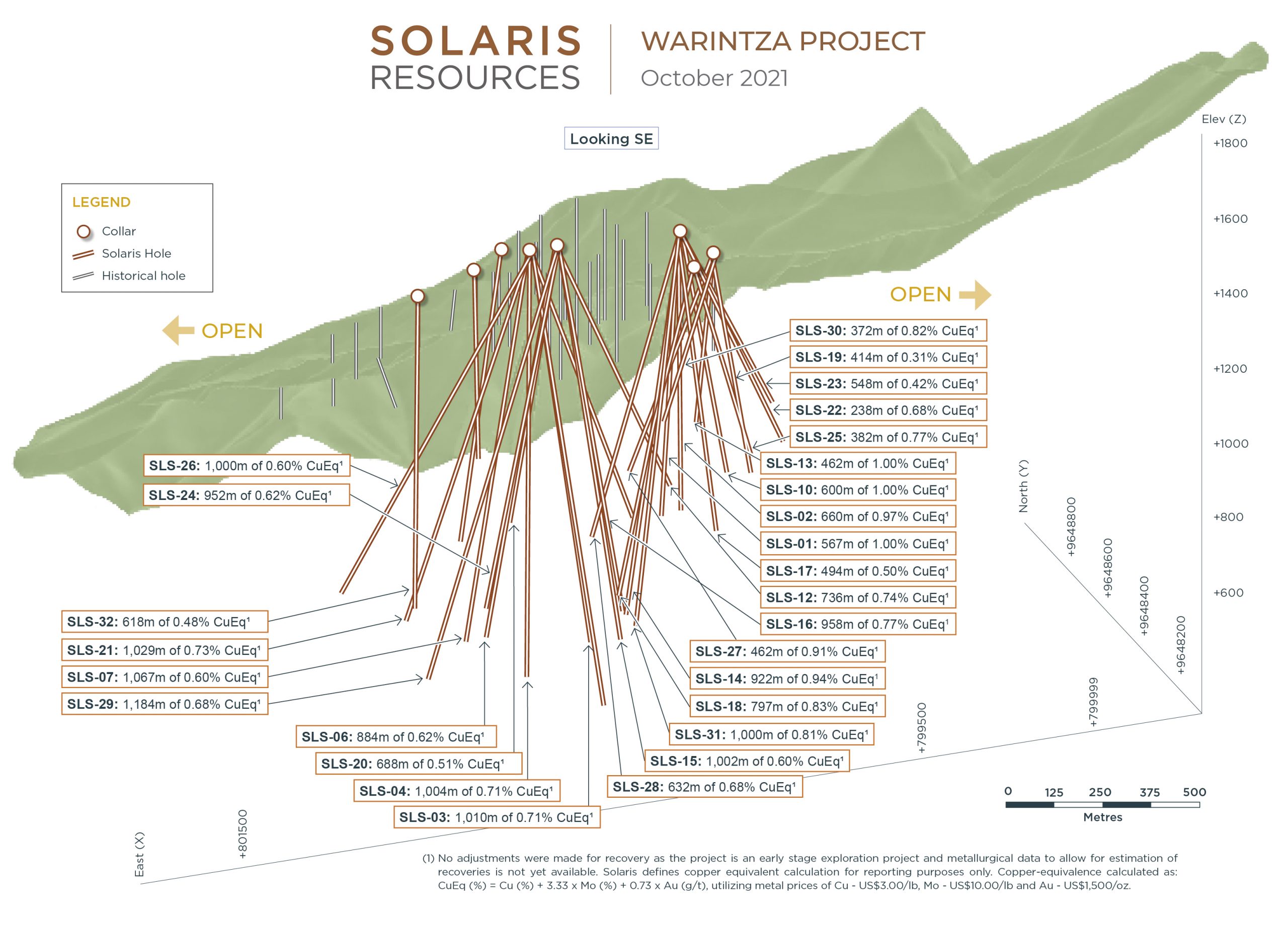
Figure 1 – Long Section of Warintza Central Drilling Looking Southeast
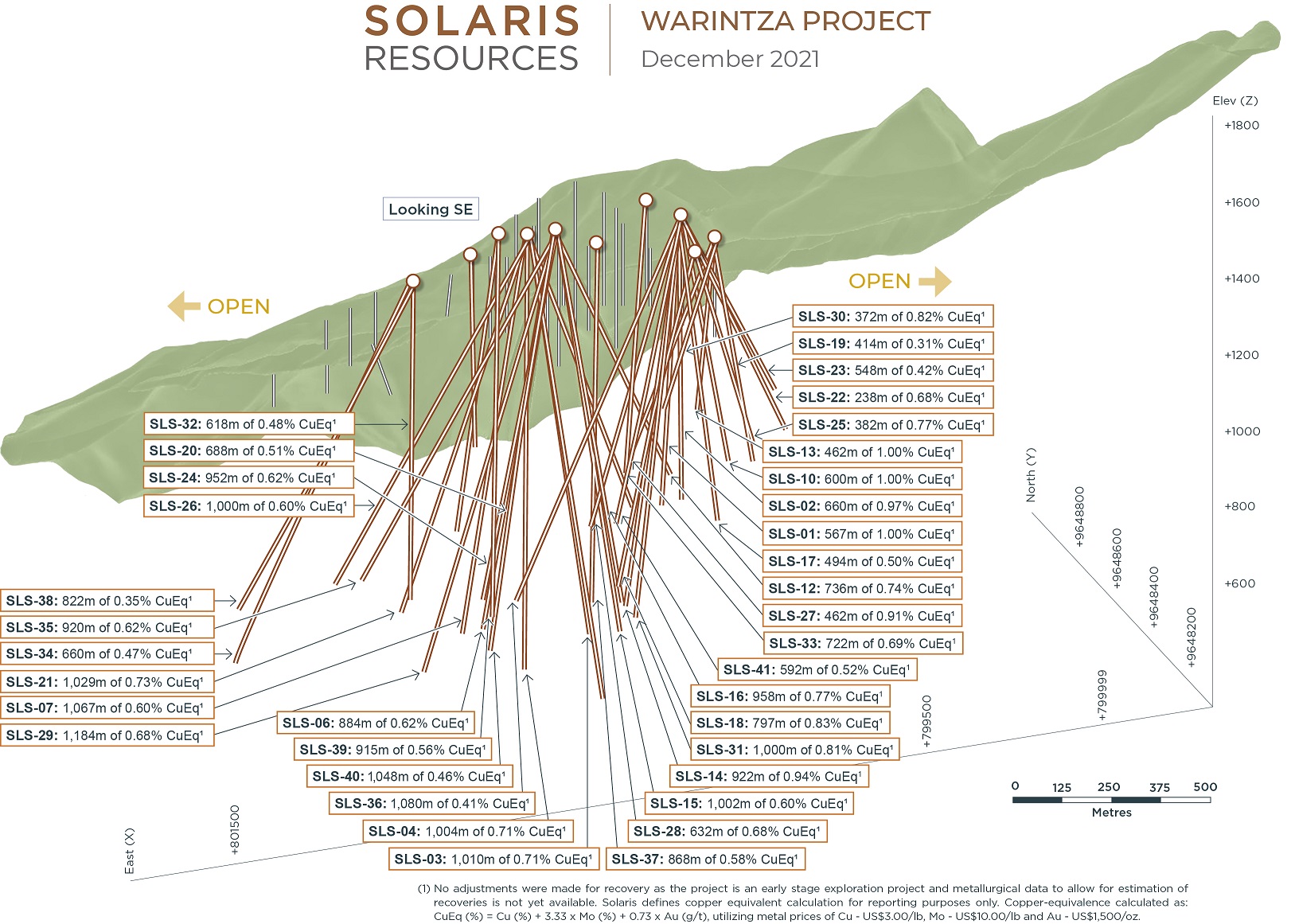
Figure 2 – Plan View of Warintza Drilling Released to Date
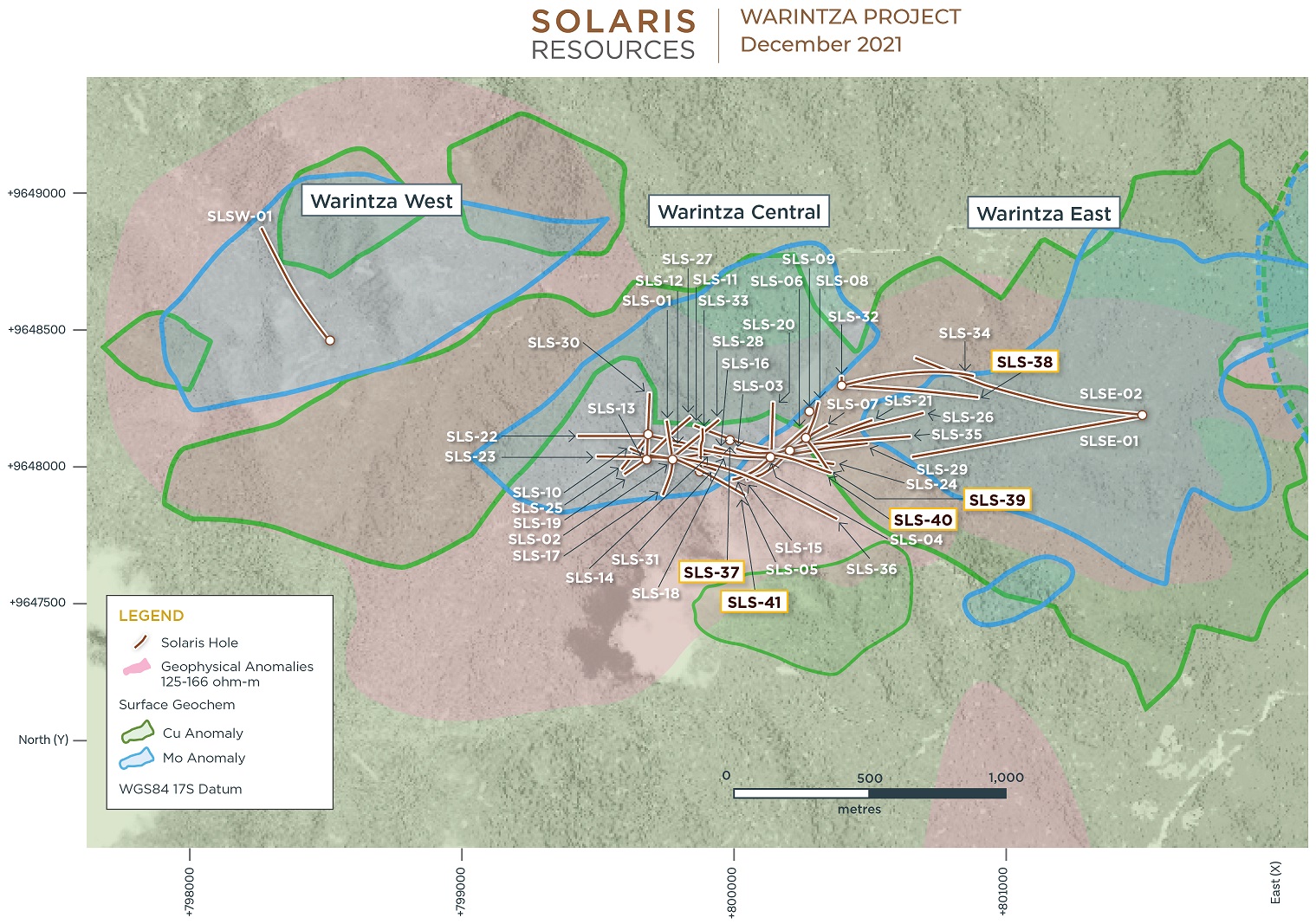
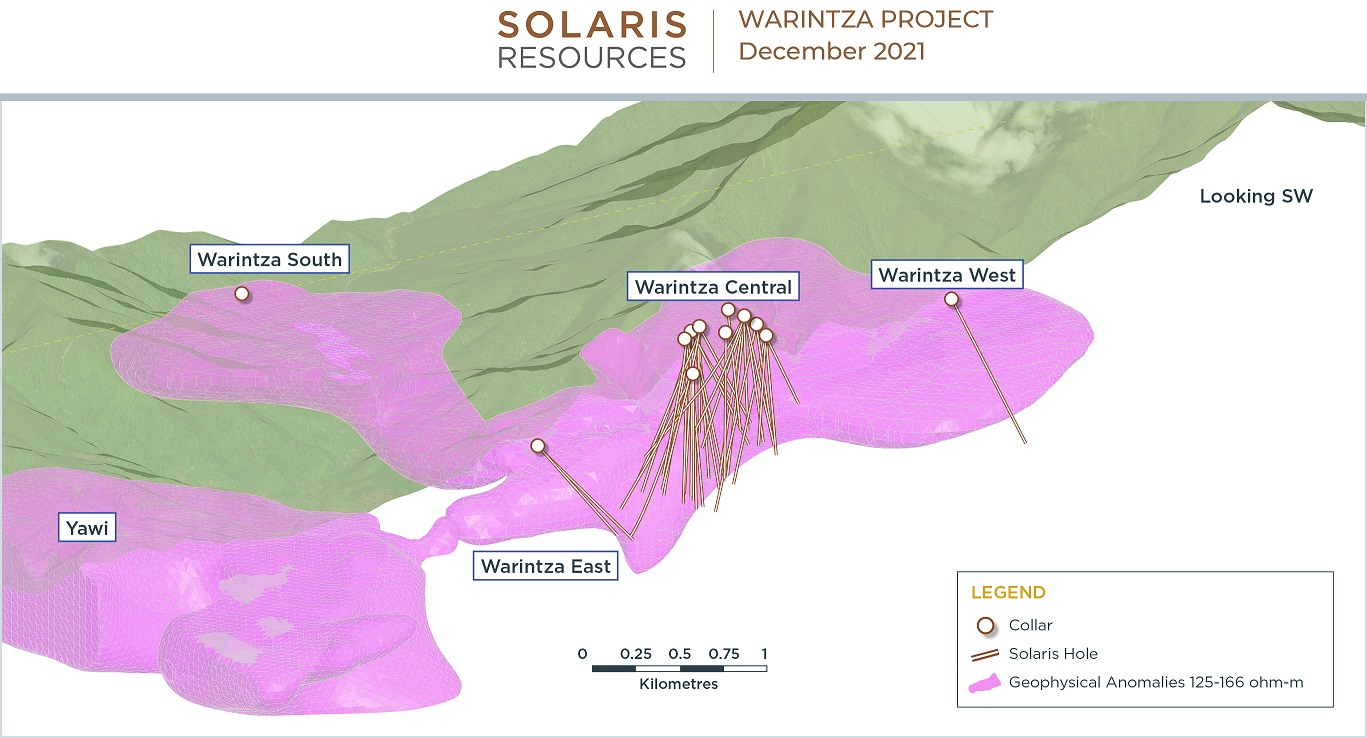
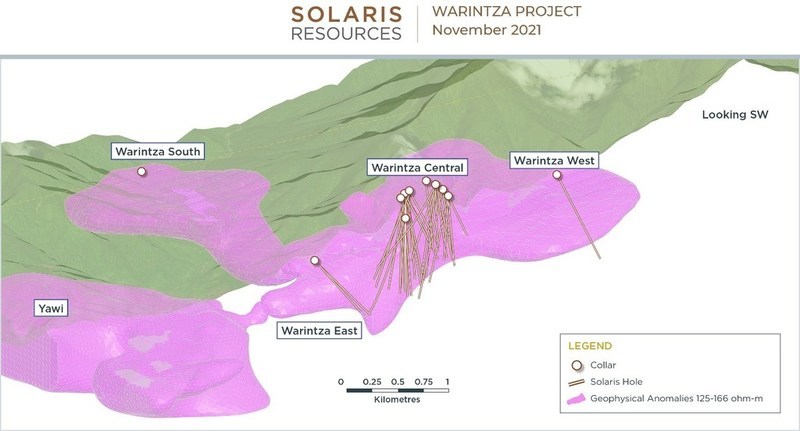
Figure 3 – Long Section of 3D Geophysics Looking Southwest
Highlights
- Five additional holes reported in this press release have expanded the dimensions of Warintza Central to the south and southeast where it remains open, with the highest-grade intervals within each hole starting at or near surface (refer to Figures 1 & 2)
- SLS-37 was collared in the middle of the Warintza Central grid and drilled vertically into a partially open volume near surface, returning 868m of 0.58% CuEq¹ from 28m depth; further drilling from this platform will target northern and southern extensions of the zone
- SLS-38 was collared at the northeastern limit of the grid and drilled east into an open volume, returning 244m of 0.70% CuEq¹ from 58m depth, within a broader interval of 822m of 0.35% CuEq¹ that included dilution from a weakly-mineralized mafic intrusive
- SLS-39 was collared on the eastern side of the grid and drilled into a partially open volume to the southeast, returning 915m of 0.56% CuEq¹, including 368m of 0.73% CuEq¹ from 90m depth, with the last 10m of the hole grading 0.61% CuEq¹ suggesting further potential to the southeast
- SLS-40 was collared at the southeastern limit of the grid and drilled into a partially open volume to the southeast, returning 1,048m of 0.46% CuEq¹ from surface, including 382m of 0.64% CuEq¹ from 50m depth, extending mineralization to the southeast where it remains open
- SLS-41 was collared in the middle of the Warintza Central grid and drilled into an open volume to the southeast, returning 592m of 0.52% CuEq¹ from surface, including 496m of 0.58% CuEq¹, extending mineralization to the south where it remains open
- To date, 55 holes have been completed at Warintza Central with assays reported for 41 of these
- Maiden drilling results are expected in January from Warintza South, a target defined by a high conductivity anomaly measuring 2.5km x 2.0km x 0.7km and overlapping copper and molybdenum anomalies where exposed at surface
Table 1 – Assay Results
| Hole ID | Date Reported | From (m) | To (m) | Interval (m) | Cu (%) | Mo (%) | Au (g/t) | CuEq¹ (%) |
| SLS-41 | Dec 14, 2021 | 0 | 592 | 592 | 0.42 | 0.02 | 0.06 | 0.52 |
| Including | 8 | 504 | 496 | 0.48 | 0.02 | 0.06 | 0.58 | |
| SLS-40 | 8 | 1056 | 1048 | 0.39 | 0.01 | 0.03 | 0.46 | |
| Including | 50 | 432 | 382 | 0.56 | 0.02 | 0.04 | 0.64 | |
| SLS-39 | 28 | 943 | 915 | 0.49 | 0.01 | 0.04 | 0.56 | |
| Including | 90 | 458 | 368 | 0.65 | 0.02 | 0.04 | 0.73 | |
| SLS-38 | 58 | 880 | 822 | 0.28 | 0.01 | 0.05 | 0.35 | |
| Including | 58 | 302 | 244 | 0.58 | 0.02 | 0.06 | 0.70 | |
| SLS-37 | 28 | 896 | 868 | 0.39 | 0.05 | 0.05 | 0.58 | |
| SLS-36 | Nov 15, 2021 | 2 | 1082 | 1080 | 0.33 | 0.01 | 0.04 | 0.41 |
| SLS-35 | 48 | 968 | 920 | 0.53 | 0.02 | 0.04 | 0.62 | |
| SLS-34 | Oct 25, 2021 | 52 | 712 | 660 | 0.36 | 0.02 | 0.06 | 0.47 |
| SLS-33 | 40 | 762 | 722 | 0.55 | 0.03 | 0.05 | 0.69 | |
| SLSE-02 | 0 | 1160 | 1160 | 0.20 | 0.01 | 0.04 | 0.25 | |
| SLS-32 | Oct 12, 2021 | 0 | 618 | 618 | 0.38 | 0.02 | 0.05 | 0.48 |
| SLS-31 | 8 | 1008 | 1000 | 0.68 | 0.02 | 0.07 | 0.81 | |
| SLS-30 | 2 | 374 | 372 | 0.57 | 0.06 | 0.06 | 0.82 | |
| SLSE-01 | Sep 27, 2021 | 0 | 1213 | 1213 | 0.21 | 0.01 | 0.03 | 0.28 |
| SLS-29 | Sep 7, 2021 | 6 | 1190 | 1184 | 0.58 | 0.02 | 0.05 | 0.68 |
| SLS-28 | 6 | 638 | 632 | 0.51 | 0.04 | 0.06 | 0.68 | |
| SLS-27 | 22 | 484 | 462 | 0.70 | 0.04 | 0.08 | 0.91 | |
| SLS-26 | July 7, 2021 | 2 | 1002 | 1000 | 0.51 | 0.02 | 0.04 | 0.60 |
| SLS-25 | 62 | 444 | 382 | 0.62 | 0.03 | 0.08 | 0.77 | |
| SLS-24 | 10 | 962 | 952 | 0.53 | 0.02 | 0.04 | 0.62 | |
| SLS-19 | 6 | 420 | 414 | 0.21 | 0.01 | 0.06 | 0.31 | |
| SLS-23 | May 26, 2021 | 10 | 558 | 548 | 0.31 | 0.02 | 0.06 | 0.42 |
| SLS-22 | 86 | 324 | 238 | 0.52 | 0.03 | 0.06 | 0.68 | |
| SLS-21 | 2 | 1031 | 1029 | 0.63 | 0.02 | 0.04 | 0.73 | |
| SLS-20 | April 19, 2021 | 18 | 706 | 688 | 0.35 | 0.04 | 0.05 | 0.51 |
| SLS-18 | 78 | 875 | 797 | 0.62 | 0.05 | 0.06 | 0.83 | |
| SLS-17 | 12 | 506 | 494 | 0.39 | 0.02 | 0.06 | 0.50 | |
| SLS-16 | Mar 22, 2021 | 20 | 978 | 958 | 0.63 | 0.03 | 0.06 | 0.77 |
| SLS-15 | 2 | 1231 | 1229 | 0.48 | 0.01 | 0.04 | 0.56 | |
| SLS-14 | 0 | 922 | 922 | 0.79 | 0.03 | 0.08 | 0.94 | |
| SLS-13 | Feb 22, 2021 | 6 | 468 | 462 | 0.80 | 0.04 | 0.09 | 1.00 |
| SLS-12 | 22 | 758 | 736 | 0.59 | 0.03 | 0.07 | 0.74 | |
| SLS-11 | 6 | 694 | 688 | 0.39 | 0.04 | 0.05 | 0.57 | |
| SLS-10 | 2 | 602 | 600 | 0.83 | 0.02 | 0.12 | 1.00 | |
| SLS-09 | 122 | 220 | 98 | 0.60 | 0.02 | 0.04 | 0.71 | |
| SLSW-01 | Feb 16, 2021 | 32 | 830 | 798 | 0.25 | 0.02 | 0.02 | 0.31 |
| SLS-08 | Jan 14, 2021 | 134 | 588 | 454 | 0.51 | 0.03 | 0.03 | 0.62 |
| SLS-07 | 0 | 1067 | 1067 | 0.49 | 0.02 | 0.04 | 0.60 | |
| SLS-06 | Nov 23, 2020 | 8 | 892 | 884 | 0.50 | 0.03 | 0.04 | 0.62 |
| SLS-05 | 18 | 936 | 918 | 0.43 | 0.01 | 0.04 | 0.50 | |
| SLS-04 | 0 | 1004 | 1004 | 0.59 | 0.03 | 0.05 | 0.71 | |
| SLS-03 | Sep 28, 2020 | 4 | 1014 | 1010 | 0.59 | 0.02 | 0.10 | 0.71 |
| SLS-02 | 0 | 660 | 660 | 0.79 | 0.03 | 0.10 | 0.97 | |
| SLS-01 | Aug 10, 2020 | 1 | 568 | 567 | 0.80 | 0.04 | 0.10 | 1.00 |
| Notes to table: True widths cannot be determined at this time. | ||||||||
Table 2 – Collar Location
| Hole ID | Easting | Northing | Elevation (m) | Depth (m) | Azimuth (degrees) | Dip (degrees) |
| SLS-41 | 799765 | 9648033 | 1571 | 792 | 115 | -70 |
| SLS-40 | 800124 | 9648044 | 1568 | 1056 | 105 | -75 |
| SLS-39 | 800253 | 9648105 | 1576 | 943 | 145 | -80 |
| SLS-38 | 800383 | 9648303 | 1412 | 923 | 90 | -56 |
| SLS-37 | 799968 | 9648102 | 1510 | 929 | 0 | -90 |
| Notes to table: The coordinates are in WGS84 17S Datum. | ||||||
Source: Solaris Resources
The above references an opinion and is for information purposes only. It is not intended to be investment advice. Seek a licensed professional for investment advice. The author is not an insider or shareholder of any of the companies mentioned above.
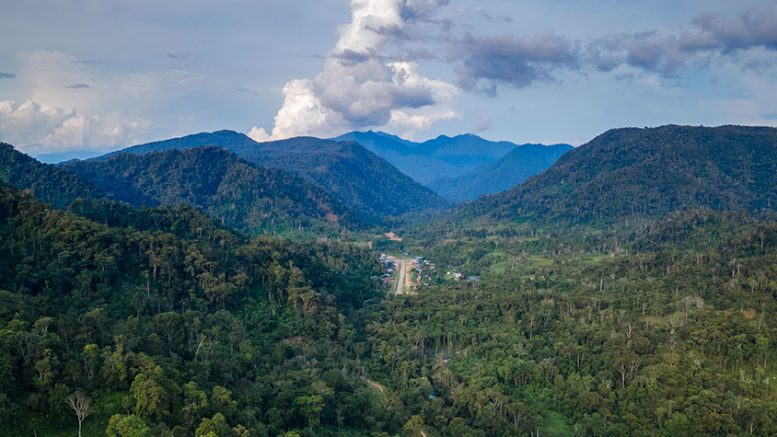
Canadian-based Solaris Resources (TSX:SLS) has announced its plans to focus on advancing its 100%-owned flagship Warintza copper and gold project in southeastern Ecuador, while transferring its non-core assets into a new private company called Solaris Exploration Inc.
The company will be transferring its noncore assets in Ecuador, Chile, Mexico, and Peru to the new company following an internal reorganization from the company. It is expected that 100% of the common shares of Solaris Resources will be spun out to shareholders relative to their shareholdings.
In order for the spin-out to be approved, at least two-thirds of Solaris Resources shareholders have to vote and agree on the future plans. The spin-out and reorganization are also subject to other approvals, including approval by the Supreme Court of British Columbia.
After the proposed spin-out has been approved, Solaris will continue trading on the Toronto Stock Exchange in Canada under the symbol “SLS”, and on the OTCQB Venture Market in the United States under the symbol “SLSSF”. Solaris Exploration will not be listed on any stock exchange post-spin-out approval, and will remain a private company for the time being.
Warintza Stands on Its Own
As the company bundles its non-core assets, Solaris plans to focus on rapidly growing and advancing its Warintza project. The 268-sq.-km property is adjacent to the San Carlos-Panantza copper and gold mine, along with the Mirador copper and gold mine about 40 km south of the property. The Mirador mine is one of the world’s lowest-cost copper operations and largest mines in Ecuador; it started production in 2019 and is expected to produce 94,000 tonnes of copper concentrate per year.
The low cost of operation at Waritnza and the surrounding mines is due to easy-to-access roads and highways, access to freshwater, and access to low-cost hydroelectric energy.
The property is also adjacent to a highway nearby that allows access to Pacific ports, transmission lines, and an airport. It is connected to grid power which supplies the company with inexpensive hydroelectric power, as well as access to fresh water, and low-cost skilled labour. This is the ideal situation for the exploration company and its flagship asset. Ultimately, the capital cost savings for the project have been lowered immensely due to the opportune placement of the project.
A 2019 mineral resource estimate for Warintza Central estimated 123.8 million inferred tonnes grading 0.56% copper, 0.03% molybdenum, and 0.06 gram gold per tonne (0.7% copper-equivalent) for 1.5 billion lb. contained copper, 77.5 million lb. molybdenum, and 238,600 oz. gold. The estimate was based on about 7,000 metres of historical drilling to an average depth of approximately 200 metres.
Warintza was first discovered by David Lowell over 20 years ago in 2000. After the discovery, the property was left alone for almost two decades as social acceptance of the property began to break down within the local communities. Through extensive communication and understanding of why operating this project would affect the community so immensely, the two parties came to a resolution in 2019.
Beyond Business, To Community Development
Now, Solaris has a strategic alliance in place with the Shuar communities of Warintza and Yawi to overlook and engage in direct and transparent dialogue regarding all Warintza project-related activities. This alliance also led to the decision to create a CSR program promoting trust, cooperation, and reciprocal support. Solaris now employs over 450 personnel, which represents full employment from the local communities.
In September 2020, the company signed an Impacts & Benefits Agreement with the Shuar communities of Warintza and Yawi for the Warintza project. This agreement provides certainty to Solaris that the communities will continue to support the company through the development and production stages of the project.
Warintza has 12 drill rigs on the property, mostly focused on Waritnza Central, currently open to the north, east, and south. Results from ongoing exploration are expected in the near-term as well, and 2022 is set to bring further big developments.
Most Exciting Year Yet?
An updated mineral resource estimate is expected to be published within the first quarter of 2022, as well as a preliminary economic assessment set to be released later in the year. Those updates could establish Warintza as a premier copper project, and reset investor expectations for how big the Warintza project – and Solaris Resources – could be.
With the new move to make it clear that Warintza is a world-class asset on its own, this could mean the start of the next chapter for the project and Solaris Resources.
The above references an opinion and is for information purposes only. It is not intended to be investment advice. Seek a licensed professional for investment advice. The author is not an insider or shareholder of any of the companies mentioned above.
Ecuador’s constitutional court ruled Wednesday that mining in the country’s protected rainforest violates nature’s constitutional rights. The landmark decision was reached after a lawsuit filed by environmental organizations, which argued that mining activities threatened Ecuador’s constitutional provisions granting rights to ecosystems and protection from degradation or pollution. In their ruling, Ecuadorian justices found that the state mining company Enami and Cornerstone Capital Resources, its Canadian partner violated constitutional protections granted to natural resources in the Los Cedros Protected Area.
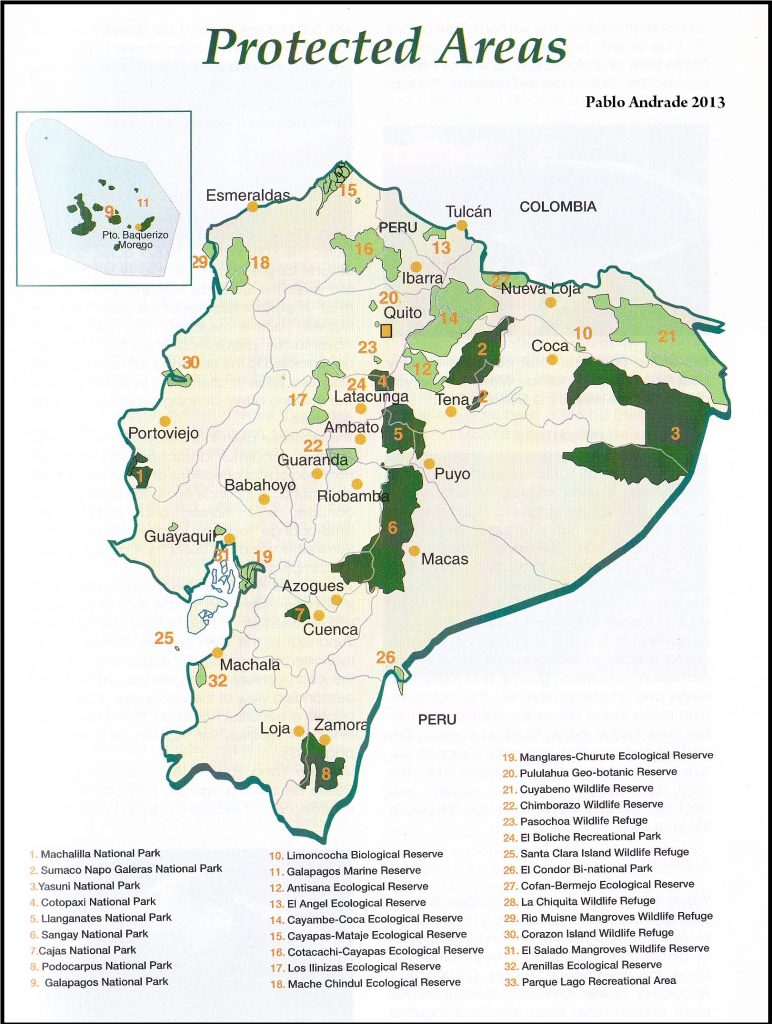
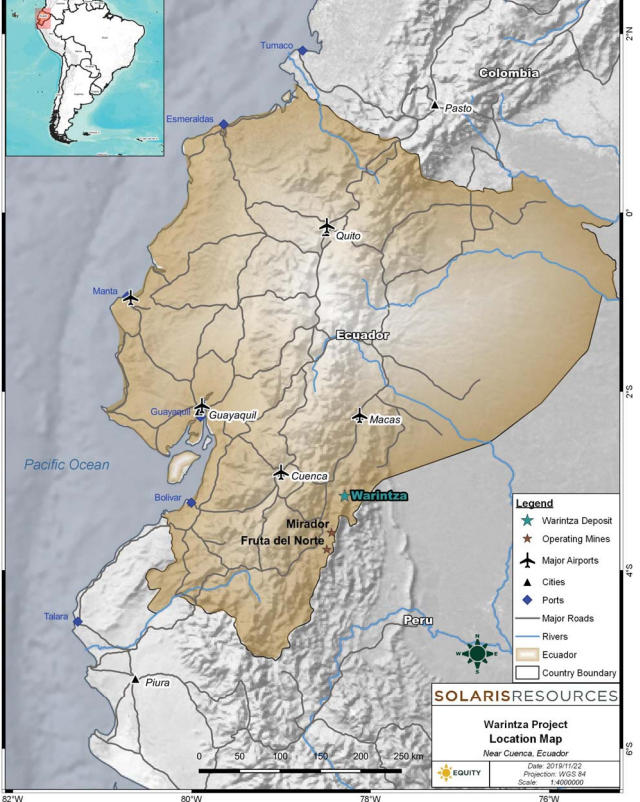
Solaris Resources (TSX:SLS) is exploring its Warintza property in southeastern Ecuador, which lies east of Cuenca. The project is not located in any of the biologically sensitive areas mapped out by the government, and does not lie within or near the rainforest.
This is good news for the junior mining company that has made significant progress in its drill program, making back-to-back discoveries at multiple targets. With several hundred kilometres between the Warintza project and the nearest protected forest, Sangay, Solaris should be able to avoid much of the risk that other mining companies will need to deal with.
The ruling creates uncertainty for other junior mining companies through this new precedent that could threaten their projects if they lie within or around the protected rainforest or other environmentally sensitive areas.
This could also be harmful to the country’s tax base and economic prosperity as the mining industry has been an important source of economic growth and contributes to Ecuador’s GDP.
With this latest constitutional court decision on protecting nature’s rights, it looks like Ecuador could be witnessing a shift towards greater environmental protections at the expense of foreign investment which could impact future economic development initiatives by President Guillermo Lasso’s administration.
The ruling is a landmark victory for the rights of nature movement, which has been growing in popularity as more countries adopt constitutional amendments and legislation recognizing the legal rights of ecosystems to exist and flourish. Ecuador is one of the first countries to recognize constitutional rights for nature, doing so in 2008 with Article 71-A of its Constitution.
Good for Nature, Harmful to Business
This week’s ruling by Ecuador’s constitutional court follows another groundbreaking verdict that granted the Vilcabamba River constitutional rights and recognized it as an entity with legal interests in the protection against pollution or degradation. The watershed of this Andean river spans across six provinces through Peru and three more provinces in southern Colombia before reaching its mouth at the Amazonian city of Iquitos, where approximately 500,000 people reside. This unprecedented ruling was also decided by seven justices voting unanimously for nature’s right to exist and flourish under Article 71A of Ecuador’s Constitution.
An Infringement of Rights?
However, the most recent ruling from the constitutional court is seen by some as an infringement of mining rights that were granted to two companies authorized to operate on those lands. According to Ecuador’s Ministry of Mines and Metal Resources, mining is the second most important source of income for the country after oil.
This places the country’s interests directly in contention with the legal ruling made by the constitutional court, which is expected to set a precedent for future constitutional protections on nature. Ultimately, this could open the country up to more litigation in the future as companies with projects in protected lands that have worked to protect those regions while maintaining operations are shut down or have their licenses revoked.
Miners may also consider the risk of doing business in Ecuador to be too high if the constitutional court continues to hand down rulings in this way, evoking images of overreach in some cases. Foreign investment from the mining industry in Ecuador is important because it boosts the country’s economy through royalties, taxes, and job creation.
If nature’s rights begin to impede economic progress, the constitutional court may have to begin to weigh that into its decision-making process. It is likely that eventually, Ecuador’s constitutional court will be forced to make definitive rulings on these issues in order for them not to continue being brought before it with each new instance of violation of pollution taking place within ecosystems protected by constitutional rights.
This ruling sets a public global precedent as well, which could lead other countries around the world where nature also has constitutional protections – such as Colombia and Bolivia – to follow suit if they are seeing similar environmental degradation from mining activities there.
For now, mining companies and investors will be watching very closely for the progress in Ecuador and any future news on this case and others.
The above references an opinion and is for information purposes only. It is not intended to be investment advice. Seek a licensed professional for investment advice. The author is not an insider or shareholder of any of the companies mentioned above.
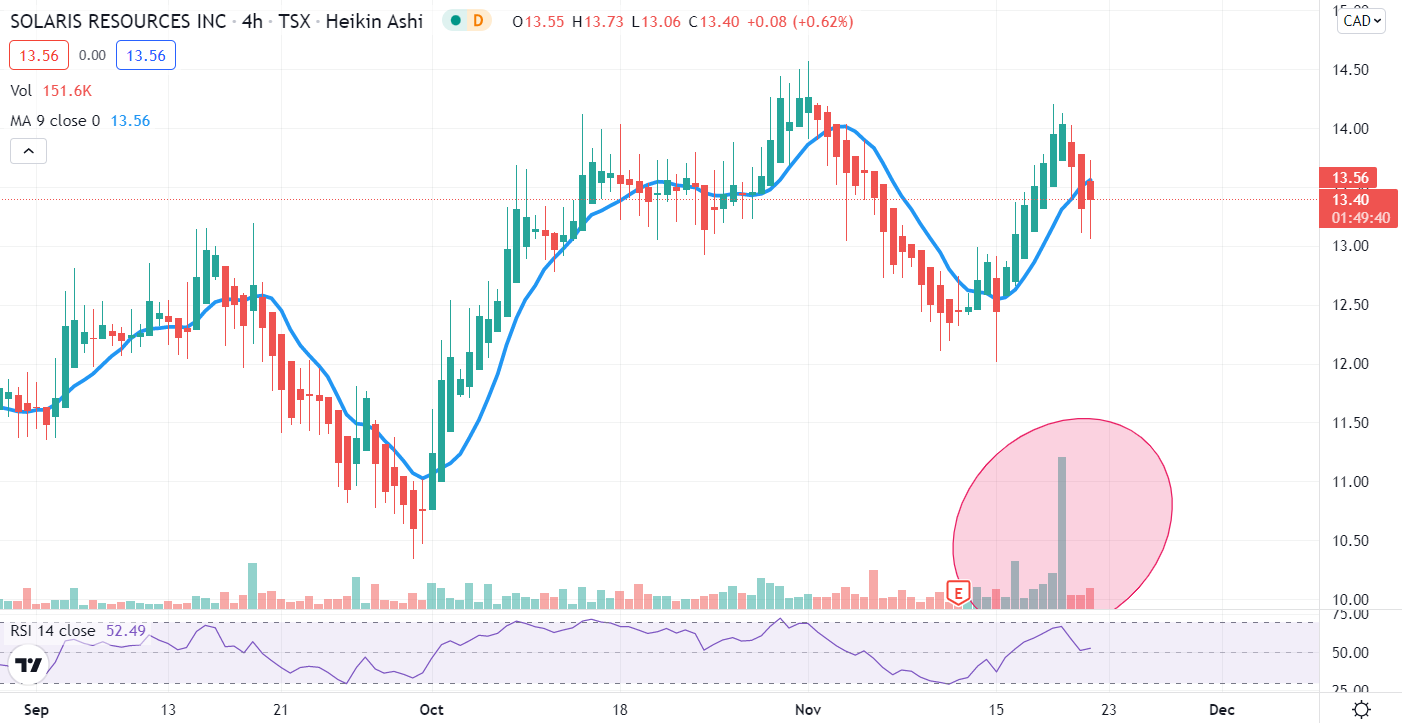
On November 18, 2021 Solaris Resources (TSX:SLS) traded above average volume by hundreds of thousands of shares at nearly 1.7 million in daily volume. Solaris’ share structure has one of the highest insider ownerships for a junior miner, begging the question of why exactly did volume spike on that day?
Could it have been that insiders are shifting positions ahead of upcoming drill results? Or is something else happening with retail investors to draw such high volume?
It would first help to understand what a breakout above regular price action and traded volume can mean for investors. Often higher volume will drive prices higher or lower depending on the bid-ask spread, but in this case, shares traded only 2% higher on the day.
The stock was not outside of its normal bounds, and closed just below C$14, at $13.90. The uptick in volume is notable for how it didn’t accompany a significantly different price action, but potentially foreshadows new price action coming down the line.
For this reason, it could be inferred that the expectation of news coming down the pipeline could be the reason for the higher than average daily volume. The company has had a run of successful assay results as part of its ongoing exploration at the Warintza Project in Ecuador.
An expansion of the Warintza Porphyry Cluster, multiple back-to-back discoveries, the commencement of maiden drilling at Warintza South, and positive preliminary results at Warintza Central have seen shares climb consistently month after month.
The stock is up over 1000% since the company’s IPO in 2020, and the bullish sentiment indicated by multiple breaks above the 50-day moving average would seem to indicate that buyers are always present.
Whether the larger than average trade volume is indicative of insiders moving shares ahead of news or higher investor interest due to the company’s performance and the drill program is yet to be seen. For now, investors will be watching closely whether Solaris (TSX:SLS) continues to climb higher.
The above references an opinion and is for information purposes only. It is not intended to be investment advice. Seek a licensed professional for investment advice. The author is not an insider or shareholder of any of the companies mentioned above.
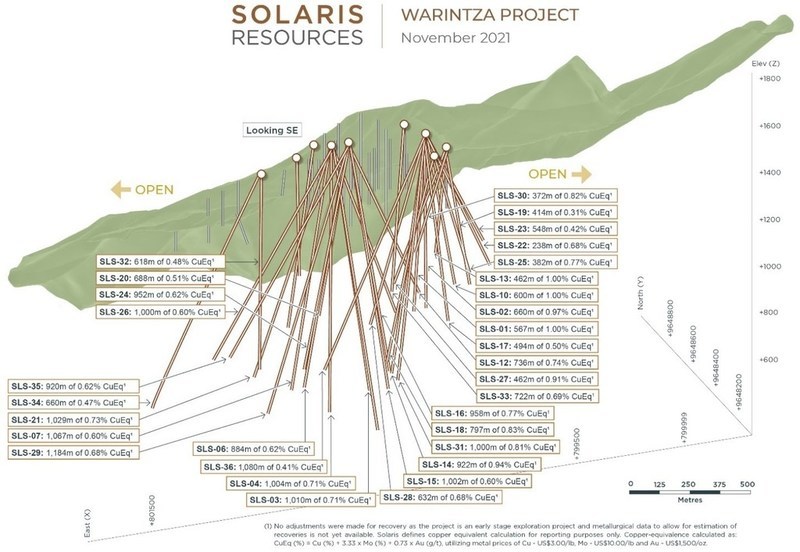
Solaris Resources (TSX:SLS) announced this morning its assay results from a set of additional holes from ongoing resource growth and discovery drilling programs at the Warintza Project in southeastern Ecuador.
Vice President, Exploration Mr. Jorge Fierro, commented: “We are pleased to see the continued growth of the Warintza Central zone, with every hole drilled having hit significant mineralization and the dimensions of the zone open and growing to the east, and broadening to the north and south where additional assays are expected soon. Our drilling fleet has now been fully reoriented to pursue aggressive growth and discovery drilling over the balance of the year and into 2022.”
The highlights from the project are as follows:
- Two additional holes reported in this press release have extended the dimensions of Warintza Central zone to the south and east, with the highest-grade intervals in each hole starting at or near surface
- Southern extension drilling in SLS-36 together with northern step-out drilling previously reported on October 12 in SLS-32, which returned 618m of 0.48% CuEq¹ from surface, including 372m of 0.64% CuEq¹ from 46m depth, have widened the Warintza Central zone
- SLS-35 was collared at the southeastern limit of the Warintza Central grid and drilled into a partially open volume to the east, returning 920m of 0.62% CuEq¹, including 326m of 0.80% CuEq¹ from 50m depth, extending mineralization to the east where it partially overlaps Warintza East
- SLS-36 was collared in the middle of the Warintza Central grid and drilled into an open volume to the southeast, returning 1,080m of 0.41% CuEq¹ from surface, including 290m of 0.81% CuEq¹ from 46m depth, extending mineralization by at least 200m to the south where it remains open
- To date, 50 holes have been completed at Warintza Central with assays reported for 36 of these
Source: Solaris Resources
Future drilling will be focused on extensional and step-out drilling. This includes establishing the potential link to the Warintza East zone, discovery drilling at the other well-defined targets within the 7km x 5km Warintza cluster of copper porphyries, and focusing on the untested gold potential.
Drilling Continues in Harmonious Alliance
A strategic alliance was made between Solaris and the Shuar communities of Warints and Yawi in 2019 to overlook and engage in direct and transparent dialogue regarding all Warintza Project-related activities. This alliance allows the people of the community to build and promote trust, reciprocal support, cooperation and strengthen the decision-making capacity of the community. It allows them to have a voice in their community when direct change is taking place.
The company states the mandate will include but not be limited to positive results including employment, business development opportunities, appropriate health care, and emergency care services, development of community infrastructure, and education and skills training.
The Warintza Project is situated in southeastern Ecuador, in the same belt as the Fruta del Norte and Mirador mines, adjacent to San Carlos – Panantza copper deposits. Solaris Resources also has four other current gold and copper projects, including La Verde in Mexico in which Solaris has earned a 60% interest via JV with Teck Resources.
There is also the Tamarugo in Chile which is an undrilled, grassroots copper porphyry exploration target in the Chilean copper belt, and the Capricho Paco Orco in Peru which is a Grassroots exploration project. The final project is Ricardo in Chile, it is a brownfield copper porphyry exploration project immediately contiguous and on the same structure as Chuquicamata, one of the largest copper mines in Chile.
Table 1 – Assay Results
|
Hole ID |
Date Reported |
From (m) |
To (m) |
Interval (m) |
Cu (%) |
Mo (%) |
Au (g/t) |
CuEq¹ (%) |
||
|
SLS-36 |
Nov 15, 2021 |
2 |
1082 |
1080 |
0.33 |
0.01 |
0.04 |
0.41 |
||
|
Including |
46 |
336 |
290 |
0.67 |
0.03 |
0.08 |
0.81 |
|||
|
SLS-35 |
48 |
968 |
920 |
0.53 |
0.02 |
0.04 |
0.62 |
|||
|
Including |
50 |
376 |
326 |
0.69 |
0.02 |
0.05 |
0.80 |
|||
|
SLS-34 |
Oct 25, 2021 |
52 |
712 |
660 |
0.36 |
0.02 |
0.06 |
0.47 |
||
|
SLS-33 |
40 |
762 |
722 |
0.55 |
0.03 |
0.05 |
0.69 |
|||
|
SLSE-02 |
0 |
1160 |
1160 |
0.20 |
0.01 |
0.04 |
0.25 |
|||
|
SLS-32 |
Oct 12, 2021 |
0 |
618 |
618 |
0.38 |
0.02 |
0.05 |
0.48 |
||
|
SLS-31 |
8 |
1008 |
1000 |
0.68 |
0.02 |
0.07 |
0.81 |
|||
|
SLS-30 |
2 |
374 |
372 |
0.57 |
0.06 |
0.06 |
0.82 |
|||
|
SLSE-01 |
Sep 27, 2021 |
0 |
1213 |
1213 |
0.21 |
0.01 |
0.03 |
0.28 |
||
|
SLS-29 |
Sep 7, 2021 |
6 |
1190 |
1184 |
0.58 |
0.02 |
0.05 |
0.68 |
||
|
SLS-28 |
6 |
638 |
632 |
0.51 |
0.04 |
0.06 |
0.68 |
|||
|
SLS-27 |
22 |
484 |
462 |
0.70 |
0.04 |
0.08 |
0.91 |
|||
|
SLS-26 |
July 7, 2021 |
2 |
1002 |
1000 |
0.51 |
0.02 |
0.04 |
0.60 |
||
|
SLS-25 |
62 |
444 |
382 |
0.62 |
0.03 |
0.08 |
0.77 |
|||
|
SLS-24 |
10 |
962 |
952 |
0.53 |
0.02 |
0.04 |
0.62 |
|||
|
SLS-19 |
6 |
420 |
414 |
0.21 |
0.01 |
0.06 |
0.31 |
|||
|
SLS-23 |
May 26, 2021 |
10 |
558 |
548 |
0.31 |
0.02 |
0.06 |
0.42 |
||
|
SLS-22 |
86 |
324 |
238 |
0.52 |
0.03 |
0.06 |
0.68 |
|||
|
SLS-21 |
2 |
1031 |
1029 |
0.63 |
0.02 |
0.04 |
0.73 |
|||
|
SLS-20 |
April 19, 2021 |
18 |
706 |
688 |
0.35 |
0.04 |
0.05 |
0.51 |
||
|
SLS-18 |
78 |
875 |
797 |
0.62 |
0.05 |
0.06 |
0.83 |
|||
|
SLS-17 |
12 |
506 |
494 |
0.39 |
0.02 |
0.06 |
0.50 |
|||
|
SLS-16 |
Mar 22, 2021 |
20 |
978 |
958 |
0.63 |
0.03 |
0.06 |
0.77 |
||
|
SLS-15 |
2 |
1231 |
1229 |
0.48 |
0.01 |
0.04 |
0.56 |
|||
|
SLS-14 |
0 |
922 |
922 |
0.79 |
0.03 |
0.08 |
0.94 |
|||
|
SLS-13 |
Feb 22, 2021 |
6 |
468 |
462 |
0.80 |
0.04 |
0.09 |
1.00 |
||
|
SLS-12 |
22 |
758 |
736 |
0.59 |
0.03 |
0.07 |
0.74 |
|||
|
SLS-11 |
6 |
694 |
688 |
0.39 |
0.04 |
0.05 |
0.57 |
|||
|
SLS-10 |
2 |
602 |
600 |
0.83 |
0.02 |
0.12 |
1.00 |
|||
|
SLS-09 |
122 |
220 |
98 |
0.60 |
0.02 |
0.04 |
0.71 |
|||
|
SLS-08 |
Jan 14, 2021 |
134 |
588 |
454 |
0.51 |
0.03 |
0.03 |
0.62 |
||
|
SLS-07 |
0 |
1067 |
1067 |
0.49 |
0.02 |
0.04 |
0.60 |
|||
|
SLS-06 |
Nov 23, 2020 |
8 |
892 |
884 |
0.50 |
0.03 |
0.04 |
0.62 |
||
|
SLS-05 |
18 |
936 |
918 |
0.43 |
0.01 |
0.04 |
0.50 |
|||
|
SLS-04 |
0 |
1004 |
1004 |
0.59 |
0.03 |
0.05 |
0.71 |
|||
|
SLS-03 |
Sep 28, 2020 |
4 |
1014 |
1010 |
0.59 |
0.02 |
0.10 |
0.71 |
||
|
SLS-02 |
0 |
660 |
660 |
0.79 |
0.03 |
0.10 |
0.97 |
|||
|
SLS-01 |
Aug 10, 2020 |
1 |
568 |
567 |
0.80 |
0.04 |
0.10 |
1.00 |
||
|
Notes to table: True widths cannot be determined at this time. |
||||||||||
Table 2 – Collar Location
|
Hole ID |
Easting |
Northing |
Elevation (m) |
Depth (m) |
Azimuth (degrees) |
Dip (degrees) |
|
SLS-36 |
799765 |
9648033 |
1571 |
1088 |
97 |
-60 |
|
SLS-35 |
800124 |
9648044 |
1568 |
995 |
78 |
-60 |
|
Notes to table: The coordinates are in WGS84 17S Datum. |
||||||
|
(1) No adjustments were made for recovery as the project is an early-stage exploration project and metallurgical data to allow for estimation of recoveries is not yet available. Solaris defines copper equivalent calculation for reporting purposes only. Copper-equivalence calculated as: CuEq (%) = Cu (%) + 3.33 × Mo (%) + 0.73 × Au (g/t), utilizing metal prices of Cu – US$3.00/lb, Mo – US$10.00/lb and Au – US$1,500/oz. |
Figure 1 – Long Section of Warintza Central Drilling Looking Southeast
Figure 2 – Plan View of Warintza Drilling Released to Date
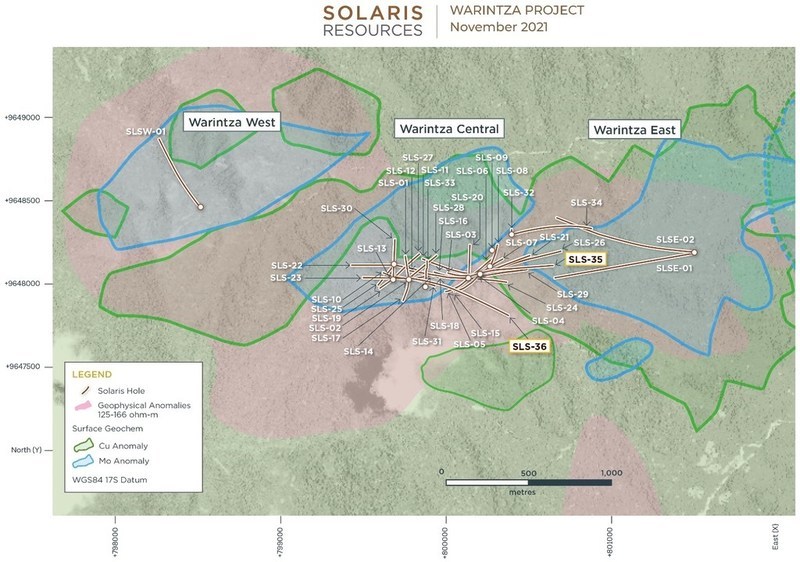
Figure 3 – Long Section of 3D Geophysics Looking Southwest
The above references an opinion and is for information purposes only. It is not intended to be investment advice. Seek a licensed professional for investment advice. The author is not an insider or shareholder of any of the companies mentioned above.
Solaris Resources (TSX:SLS) announced the commencement of maiden drilling at Warintza South this morning. In addition, updated results of detailed geophysical interpretation and geochemical sampling were delivered. The company has also refined and expanded the dimensions of the main objectives of the Warintza Project in southeastern Ecuador.
Mr. Daniel Earle, President and CEO of Solaris, said in a press release: “We are very excited to commence the first-ever drilling program at our voluminous Warintza South target, with the goal of making the fourth major discovery within our Warintza Project as we redirect our 12-rig drilling fleet toward aggressive step-out growth and discovery-oriented drilling over the balance of the year and into 2022.”
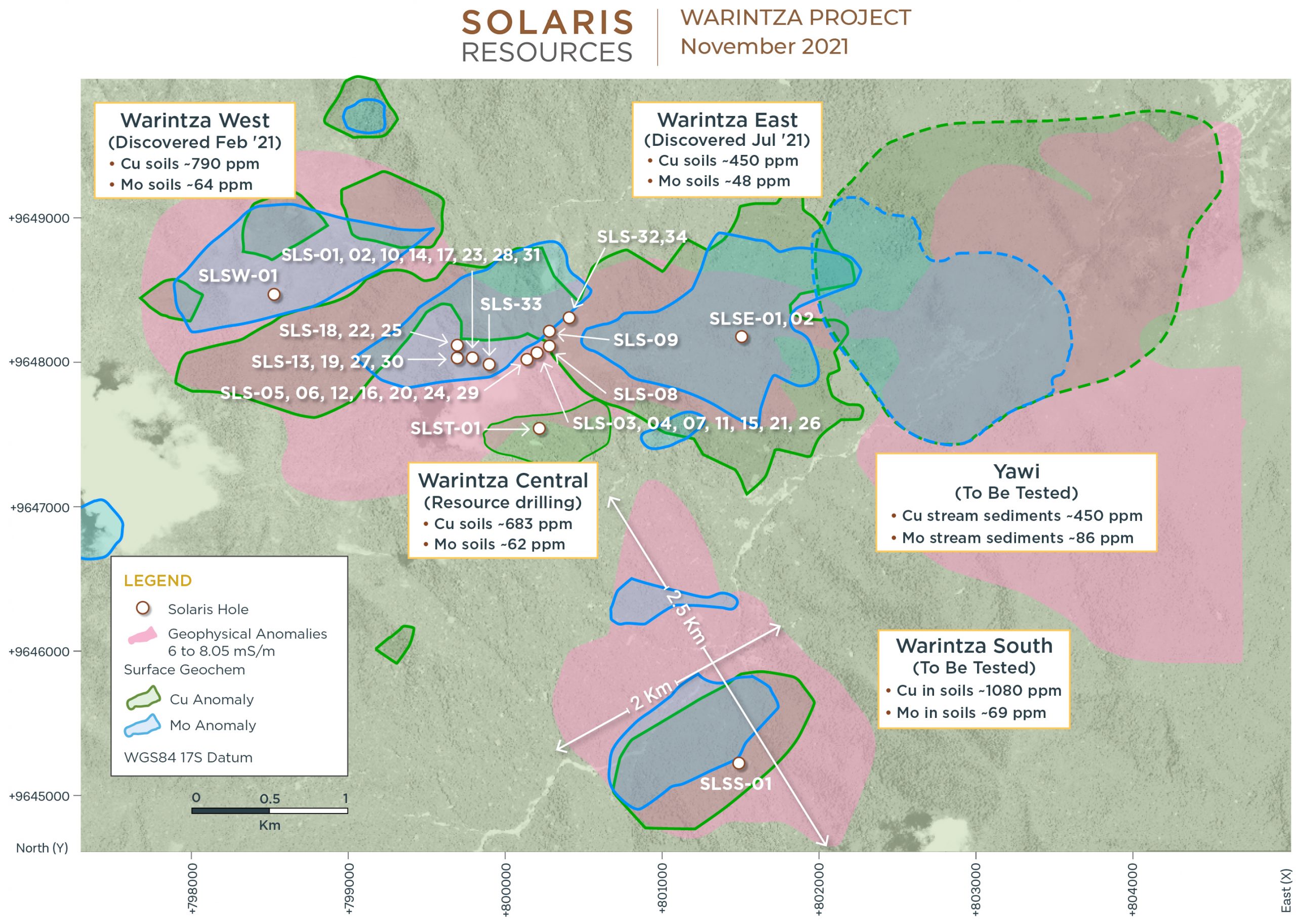
Highlights and corresponding Figures 1-3 are provided below. A dynamic 3D model featuring the updated geophysical and geochemical anomalies is available on the Company’s website.
Highlights
- Commenced maiden drilling at the Warintza South target, with the first hole collared ~3km south of Warintza Central (refer to Figures 1-3)
- The Warintza South high conductivity anomaly has dimensions more than twice the size of Warintza Central, and a similar geochemical signature where exposed at surface
- Updated interpretation has expanded the dimensions of the Warintza South high conductivity anomaly to ~2.5km x 2.0km x 0.7km and those of Warintza East and Yawi
- Additional geochemical sampling has also expanded the Warintza East anomaly further to the east and northeast where it now overlaps with Yawi
- Sampling continues to extend geochemical coverage over the sparsely sampled areas to the west and south of Warintza Central, and to targets beyond the Warintza porphyry cluster
Geophysical Reinterpretation
The Company retained Condor Consulting, Inc. (“Condor”), recognized experts in the field of airborne electromagnetics (EM), to perform detailed modelling and interpretation of the previously completed advanced airborne ZTEM survey (refer to press release dated February 16, 2021 for survey results) covering the entire 268km² Warintza and surrounding area land package.
Condor carried out a full 3D inversion of the EM and magnetic results using commercial and proprietary software producing enhanced images based on a greatly expanded dataset, including a considerable amount of additional drilling since the prior interpretation, and detailed geology, weathering and density models for the Project.
In general, the refined high conductivity volumes capture mineralization closer to surface and correlate more closely to networked sulfide mineralization in stockwork veining, with the anomalies now starting at surface and better reflecting the vertical zonation of the Warintza porphyries from higher density stockwork veining to lower density veining and disseminated mineralization.
Warintza South
Warintza South is defined by a voluminous high-conductivity anomaly located ~3km to the south of Warintza Central. The anomaly starts at surface and measures ~2.5km x 2.0km x 0.7km deep, with overlapping copper and molybdenum geochemical anomalies covering the exposed portion at surface.
Source: Solaris Resources
The above references an opinion and is for information purposes only. It is not intended to be investment advice. Seek a licensed professional for investment advice. The author is not an insider or shareholder of any of the companies mentioned above.
Solaris Resources (TSX:SLS) has reported new assay results from ongoing resource growth and discovery drilling at its flagship Warintza Project in Ecuador this morning. Warintza has now been extended, and now overlaps the Warintza East discovery.
Vice President of Exploration for Solaris Resource commented in a press release: “We are very proud to continue the great work of the late David Lowell with our first two holes confirming Warintza East as the third major copper porphyry discovery within the 7km x 5km Warintza porphyry cluster. Our drilling fleet has now been fully reoriented to pursue an aggressive growth strategy via step-out and extensional drilling as we prepare to test our next targets for further discoveries.”
Highlights are listed below, with corresponding images in Figures 1-3 and detailed results in Tables 1-2. A dynamic 3D model is available on the Company’s website and will be updated to incorporate the most recent results.
Highlights
- Eastern extension drilling has increased the strike length of Warintza Central to 1,350m where it now overlaps the western limits of Warintza East
- SLS-33 was drilled from Warintza Central into a partially open volume to the north, returning 722m of 0.69% CuEq¹, including 426m of 0.85% CuEq¹ from 46m depth, infilling and extending mineralization to the north in this area
- SLS-34 was collared at the northeastern limit of Warintza Central and drilled east into an entirely open volume, returning 660m of 0.47% CuEq¹, including 242m of 0.67% CuEq¹ from 52m depth, significantly extending mineralization to the east where it now partially overlaps Warintza East
- SLSE-02, the second hole at Warintza East, was collared approximately 1,300m east of Warintza Central and drilled northwest toward SLS-34, returning 320m of 0.48% CuEq¹ from surface within a broader interval of 1,160m assaying 0.25% CuEq¹, partially overlapping SLS-34
- SLSE-01 (previously reported September 27, 2021) was collared from the same platform as
SLSE-02 but drilled to the southwest, returning 396m of 0.42% CuEq¹ from surface within a broader interval of 1,213m assaying 0.28% CuEq¹ - Warintza East is the third major copper porphyry discovery within the Warintza cluster; each of the first two holes have returned long intervals of mineralization with the highest grades starting at or near surface reflecting the vertical zonation in the system
Figure 1 – Long Section of Warintza Central and Warintza East Drilling Looking Southeast
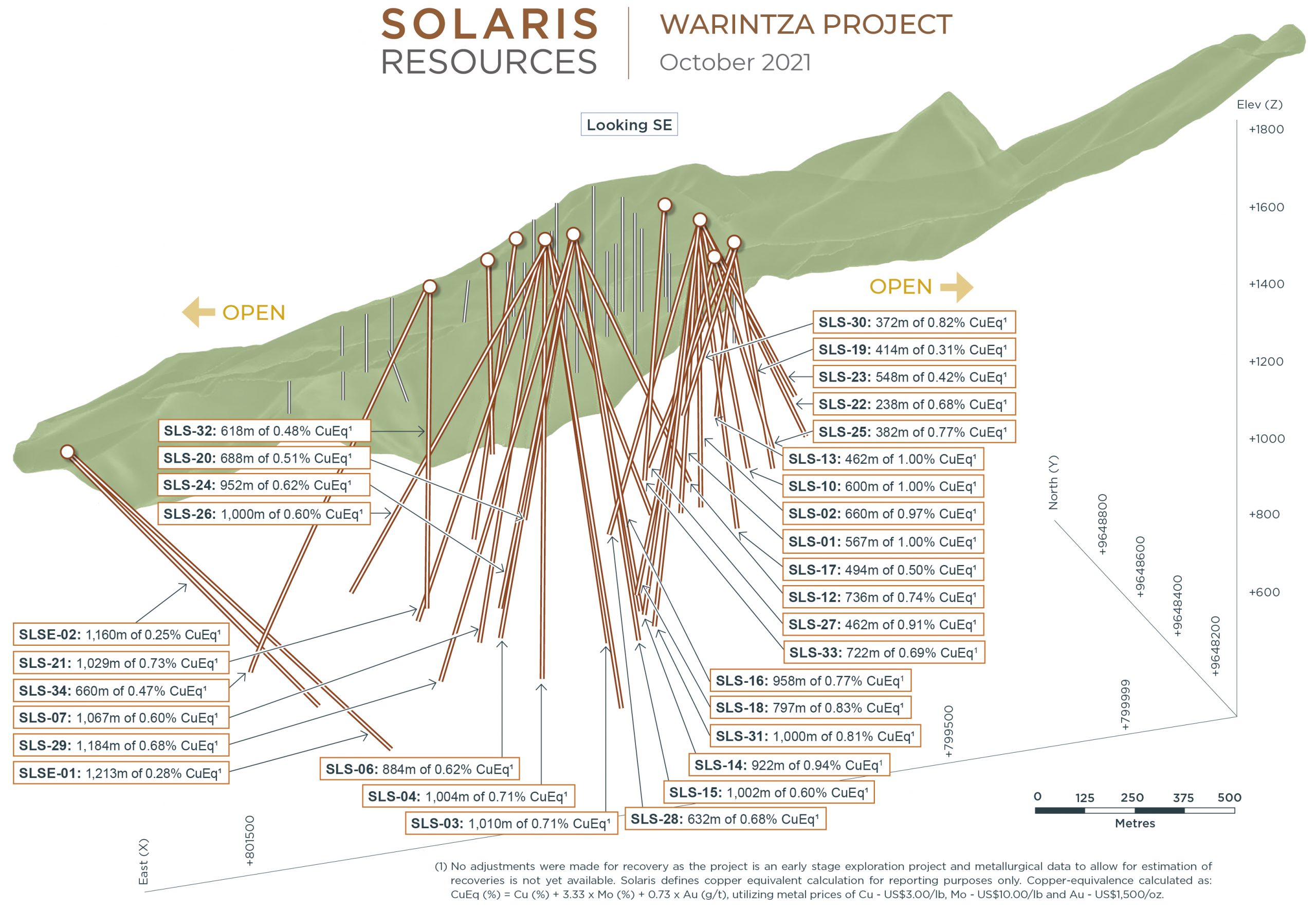
Figure 2 – Plan View of Warintza Drilling Released to Date
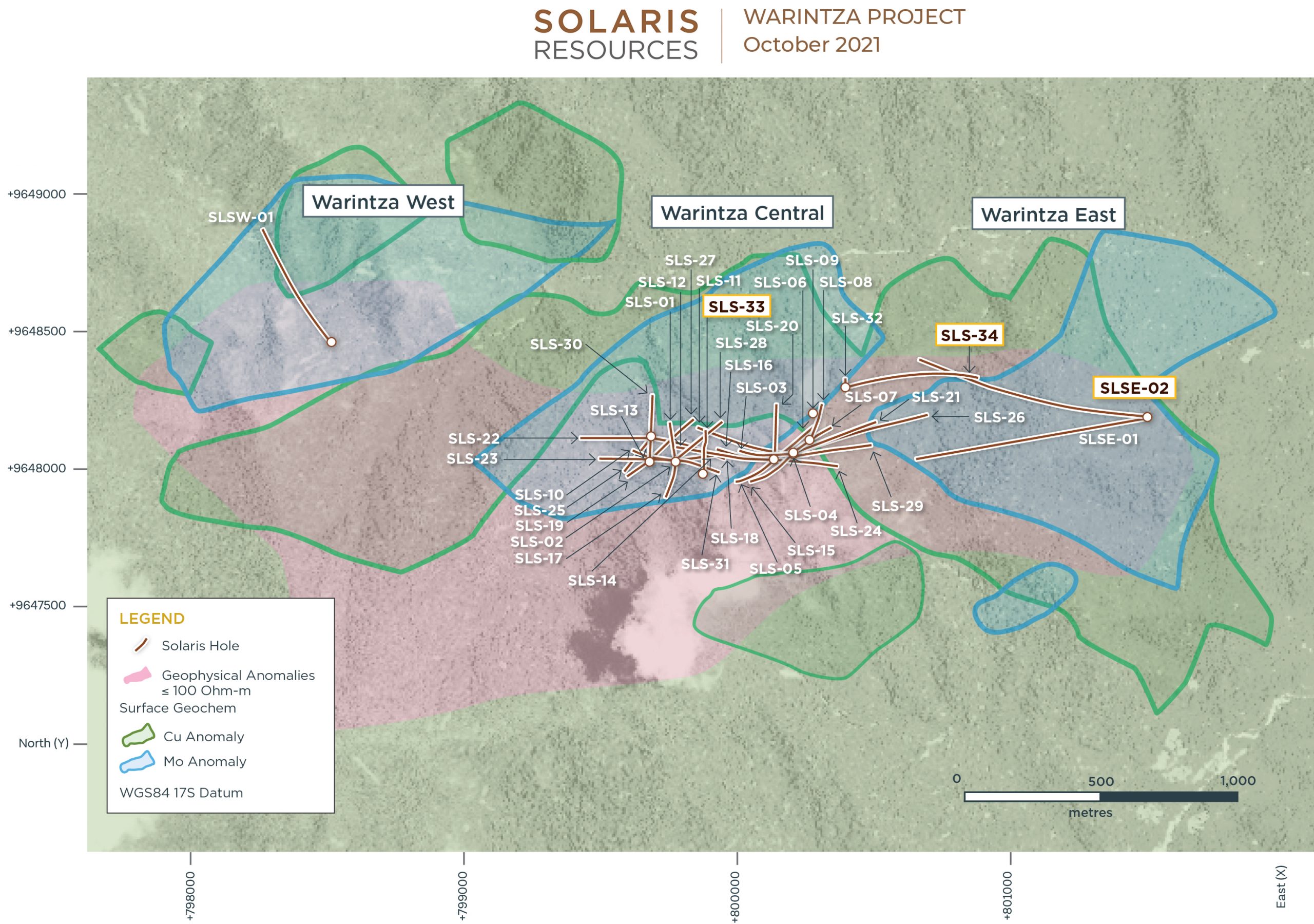
Figure 3 – Long Section of 3D Geophysics Looking Northeast
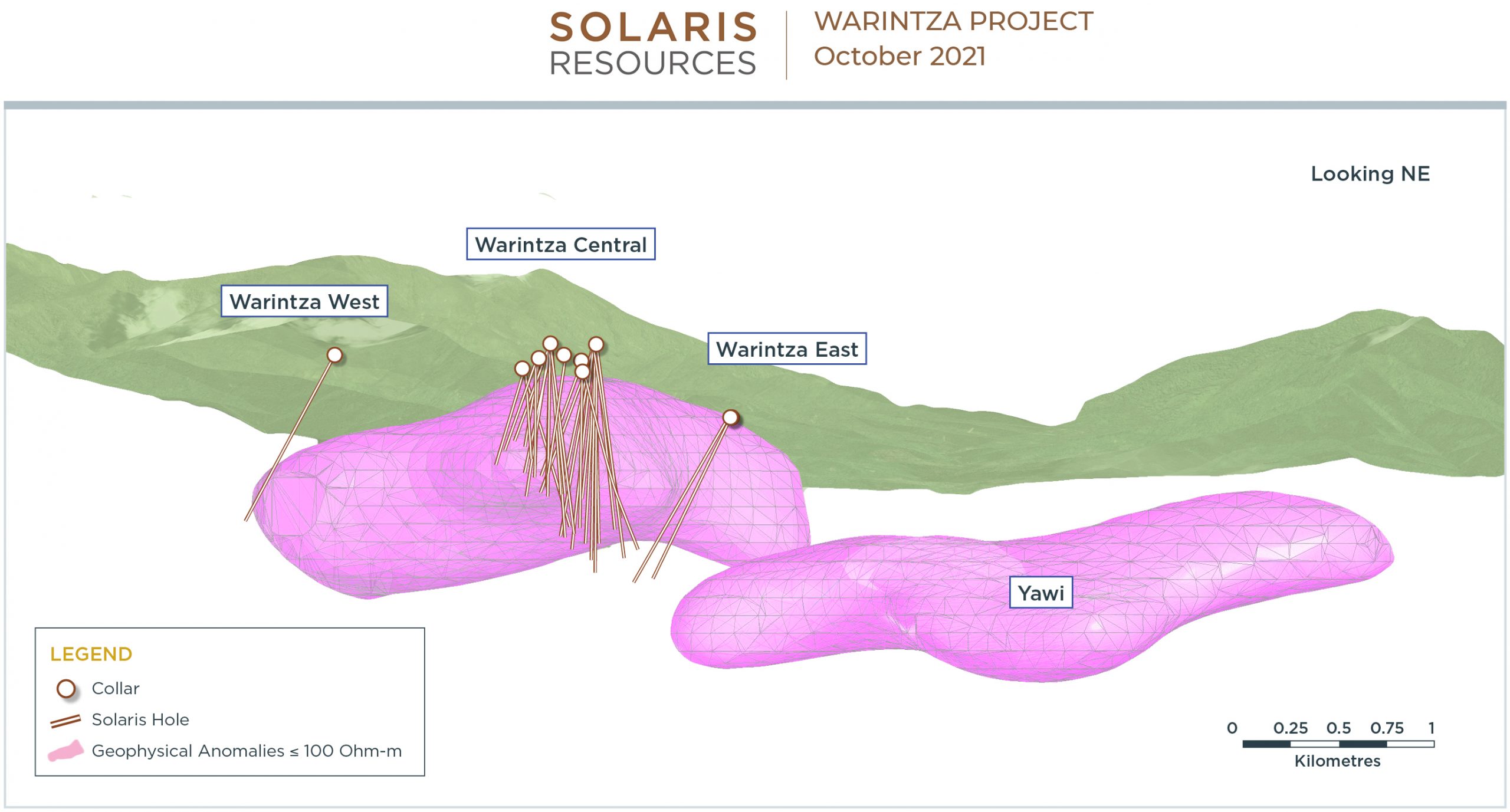
Note to Figure 3: Figure looks northeast and depicts high-conductivity geophysical anomaly (defined at 100 ohm-m) generated from 3D inversion of electromagnetic data, encompassing from left to right Warintza West, Central, East and the Yawi target (Warintza South lies off image to south).
Table 1 – Assay Results
| Hole ID | Date Reported | From (m) | To (m) | Interval (m) | Cu (%) | Mo (%) | Au (g/t) | CuEq¹ (%) | ||
| SLS-34 | Oct 25, 2021 | 52 | 712 | 660 | 0.36 | 0.02 | 0.06 | 0.47 | ||
| Including | 52 | 294 | 242 | 0.51 | 0.03 | 0.08 | 0.67 | |||
| SLS-33 | 40 | 762 | 722 | 0.55 | 0.03 | 0.05 | 0.69 | |||
| Including | 46 | 472 | 426 | 0.71 | 0.03 | 0.06 | 0.85 | |||
| SLSE-02 | 0 | 1160 | 1160 | 0.20 | 0.01 | 0.04 | 0.25 | |||
| Including | 0 | 320 | 320 | 0.39 | 0.02 | 0.04 | 0.48 | |||
| SLS-32 | Oct 12, 2021 | 0 | 618 | 618 | 0.38 | 0.02 | 0.05 | 0.48 | ||
| SLS-31 | 8 | 1008 | 1000 | 0.68 | 0.02 | 0.07 | 0.81 | |||
| SLS-30 | 2 | 374 | 372 | 0.57 | 0.06 | 0.06 | 0.82 | |||
| SLSE-01 | Sep 27, 2021 | 0 | 1213 | 1213 | 0.21 | 0.01 | 0.03 | 0.28 | ||
| SLS-29 | Sep 7, 2021 | 6 | 1190 | 1184 | 0.58 | 0.02 | 0.05 | 0.68 | ||
| SLS-28 | 6 | 638 | 632 | 0.51 | 0.04 | 0.06 | 0.68 | |||
| SLS-27 | 22 | 484 | 462 | 0.70 | 0.04 | 0.08 | 0.91 | |||
| SLS-26 | July 7, 2021 | 2 | 1002 | 1000 | 0.51 | 0.02 | 0.04 | 0.60 | ||
| SLS-25 | 62 | 444 | 382 | 0.62 | 0.03 | 0.08 | 0.77 | |||
| SLS-24 | 10 | 962 | 952 | 0.53 | 0.02 | 0.04 | 0.62 | |||
| SLS-19 | 6 | 420 | 414 | 0.21 | 0.01 | 0.06 | 0.31 | |||
| SLS-23 | May 26, 2021 | 10 | 558 | 548 | 0.31 | 0.02 | 0.06 | 0.42 | ||
| SLS-22 | 86 | 324 | 238 | 0.52 | 0.03 | 0.06 | 0.68 | |||
| SLS-21 | 2 | 1031 | 1029 | 0.63 | 0.02 | 0.04 | 0.73 | |||
| SLS-20 | April 19, 2021 | 18 | 706 | 688 | 0.35 | 0.04 | 0.05 | 0.51 | ||
| SLS-18 | 78 | 875 | 797 | 0.62 | 0.05 | 0.06 | 0.83 | |||
| SLS-17 | 12 | 506 | 494 | 0.39 | 0.02 | 0.06 | 0.50 | |||
| SLS-16 | Mar 22, 2021 | 20 | 978 | 958 | 0.63 | 0.03 | 0.06 | 0.77 | ||
| SLS-15 | 2 | 1231 | 1229 | 0.48 | 0.01 | 0.04 | 0.56 | |||
| SLS-14 | 0 | 922 | 922 | 0.79 | 0.03 | 0.08 | 0.94 | |||
| SLS-13 | Feb 22, 2021 | 6 | 468 | 462 | 0.80 | 0.04 | 0.09 | 1.00 | ||
| SLS-12 | 22 | 758 | 736 | 0.59 | 0.03 | 0.07 | 0.74 | |||
| SLS-11 | 6 | 694 | 688 | 0.39 | 0.04 | 0.05 | 0.57 | |||
| SLS-10 | 2 | 602 | 600 | 0.83 | 0.02 | 0.12 | 1.00 | |||
| SLS-09 | 122 | 220 | 98 | 0.60 | 0.02 | 0.04 | 0.71 | |||
| SLS-08 | Jan 14, 2021 | 134 | 588 | 454 | 0.51 | 0.03 | 0.03 | 0.62 | ||
| SLS-07 | 0 | 1067 | 1067 | 0.49 | 0.02 | 0.04 | 0.60 | |||
| SLS-06 | Nov 23, 2020 | 8 | 892 | 884 | 0.50 | 0.03 | 0.04 | 0.62 | ||
| SLS-05 | 18 | 936 | 918 | 0.43 | 0.01 | 0.04 | 0.50 | |||
| SLS-04 | 0 | 1004 | 1004 | 0.59 | 0.03 | 0.05 | 0.71 | |||
| SLS-03 | Sep 28, 2020 | 4 | 1014 | 1010 | 0.59 | 0.02 | 0.10 | 0.71 | ||
| SLS-02 | 0 | 660 | 660 | 0.79 | 0.03 | 0.10 | 0.97 | |||
| SLS-01 | Aug 10, 2020 | 1 | 568 | 567 | 0.80 | 0.04 | 0.10 | 1.00 | ||
| Notes to table: True widths cannot be determined at this time. | ||||||||||
Table 2 – Collar Location
| Hole ID | Easting | Northing | Elevation (m) | Depth (m) | Azimuth (degrees) | Dip (degrees) |
| SLS-34 | 800383 | 9648303 | 1412 | 1057 | 78 | -60 |
| SLS-33 | 799873 | 9648008 | 1632 | 764 | 0 | -80 |
| SLSE-02 | 801485 | 9648192 | 1170 | 1191 | 275 | -50 |
| Notes to table: The coordinates are in WGS84 17S Datum. | ||||||
The above references an opinion and is for information purposes only. It is not intended to be investment advice. Seek a licensed professional for investment advice. The author is not an insider or shareholder of any of the companies mentioned above.
In recent years, there has been much talk about the importance of helping women feel welcome, challenged in their skills, and finding opportunities in mining, an area traditionally dominated by men. Employers and an organisation called the Minerals Council of South Africa have conducted a survey on working conditions in the industry. They asked the respondents about their professional experience in the mining industry and whether it lured them into the mining industry or kept them there.
For the most part, respondents noted that the industry is constantly evolving, and never more than in the current moment. Inequality in the industry is at an all-time low and continues to drop as women take prominent positions at operational levels, middle-management, and the C-Suite.
North America Leading the Pack
A September 2019 report by international law firm Osler Hoskin Harcourt LLP & Co LLP found that in South Africa, the capital of African mining companies, a high percentage of female directors are driven by regulatory diversity standards. Whereas Latin America and the Caribbean have the lowest rates of women at the top of the mining sector. Canada and the United States are the countries making the most headway.
According to the US Bureau of Labor Statistics, women accounted for 15.8% of the labor force in the mining, quarrying, and oil and gas industries in the US in 2019. From the perspective of women with less than five years of work experience, women rank lower, while growth opportunities are higher for women with more than five years of work experience.
A report by PricewaterhouseCoopers in partnership with Women in Mining UK and Mining Talent shows that mining ranks third among global industries for women in leadership positions. Among the 500 largest mining companies in the world, 8% of directors are women.
A Prominent and Influential Executive
One of the executives breaking all barriers in their career in mining is Kylie Dickson. Kylie Dickson is a Canadian CPA with more than 14 years of experience working with listed commodity companies. She is also a Canadian auditor who has worked throughout the life cycle of the company’s growth and has played a key role in several financing and M & A transactions. Ms. Dickson is a board member of Fortuna Silver Mines Inc. and Star Royalties Ltd. and was appointed to the Board of Directors at Hillcrest Energy.
Other prominent positions have included her time as Chief Financial officer of Solaris Resources, which she resigned from in November of 2019. Before Solaris Resources was spun out of Equinox Gold, Ms. Dickson served as Vice President of Business Development at Equinox Gold.
Solaris Resources has made a deliberate effort to promote women’s empowerment in mining as the diversity of a workforce and management has been proven to lead to more innovation and profitability. Companies have adjusted expectations and seen that they do better with more women in the boardroom, and in particular, directing decisions in the C-suite.
Ms. Sunny Lowe, Chief Financial Officer of Solaris Resources Inc, states, “Solaris has embraced the Women’s Empowerment Principles established by UN Global Compact Office in an effort to advance gender equality and women’s empowerment in the workplace. We have made a deliberate effort to work towards developing a work environment that is barrier-free to developing women leaders in our organization and beyond. The Principles allow us to strengthen our commitment towards internationally proclaimed human rights and serve as a framework for us to create real impact on gender equality through commitment and action focused on seeing female representation in all our operations as well as within industry. Earlier this year, together with Women in Mining Ecuador, we launched the Soy Minera (Woman Miner) scholarship program that will finance undergraduate tuition for female engineering and/or undergraduate students in careers related to mining in Ecuador, supporting the mainstreaming of gender equality at our Warintza project, as well as the opportunity of the mining sector to incorporate actions, through investment, toward women empowerment in the industry.”
Kylie Dickson was on maternity leave for seven months after having her third child when the company she founded, Anthem United, Inc., entered into a merger with two other companies. Shortening maternity leave and hiring a nanny have been one of the toughest decisions of her career, she says.
Dickson grew up in Maple Ridge, British Columbia and earned a Bachelor of Business Administration from Simon Fraser University. During her studies, she worked at KPMG before getting a full-time job in 2003 and earning her Certificate of Accountancy. Using her skills and training, she has specialised as a manager in the mining sector.
A Track Record That Says it All
One of KPMG’s clients was Greg Smith, a mining entrepreneur who founded a company called Minefinders Corp. He hired Dickson as a financial controller and led partnerships in a series of successful mine mergers and acquisitions worth more than $2 billion. Dickson was Chief Financial officer of the subsequently acquired Esperanza Resources Corp. After leaving, Dickson co-founded Anthem United.
Her track record is an impressive one, and stands out as an example of a multi-faceted executive career in the mining industry. She was the Vice President of Business Development at Equinox Gold Corp. and, before that, VP, Business Development at Trek Mining. Kylie previously worked as Chief Financial Officer for JDL Gold Corp., Anthem United Inc. and Esperanza Resources, and served as the Corporate Controller of Minefinders Corporation.
The Latest Chapter
Most recently, Hillcrest Energy Technologies appointed Kylie Dickson to its Board of Directors.
Hillcrest is a partnership with Oropass Ltd., an Ontario-registered company that holds the U.S. license rights to a patented electrical generation technology. Through concept and commercialization, Hillcrest Energy Technologies Ltd. invests in the development of future-oriented energy solutions.
CEO Don Currie announced the appointment of Kylie Dickson to the company’s board of directors on April 9. Ms Dickson has worked throughout the life cycle of Hillcrest’s growth and has played a key role in several financing and M&A transactions. She will join the company’s Board of Directors, where she will bring experience, knowledge and involvement in areas such as audit and corporate governance committees.
Kylie Dickson also joined the Fortuna Silver Mines Inc. Board in 2017 and sits on the Audit Committee and Corporate Governance and Nominating Committee. Ms. Dickson is an executive with over 14 years of experience in the mining industry. She has worked with companies at various stages of the mining life cycle including exploration, mine development and operations, as well as playing a key role in multiple financings and M&A transactions. Kylie is currently the Vice President, Business Development of Trek Mining Inc. Kylie Dickson was the Chief Financial Officer of JDL Gold Corp. when JDL acquired Luna Gold Corp. to create Trek Mining in March 2017.
Previously, Kylie was a founding shareholder and Chief Financial Officer of Anthem United Inc. and was the Chief Financial Officer of Esperanza Resources which was acquired by Alamos Gold in 2013. She also served as the Corporate Controller of Minefinders Corporation from 2007 to 2012 prior to its acquisition by Pan American Silver. Kylie also currently serves on the Board of Directors at Hillcrest Energy Kylie began her career with KPMG LLP’s mining practice and is a Canadian CPA, CA with a BBA in Accounting from Simon Fraser University.
The above references an opinion and is for information purposes only. It is not intended to be investment advice. Seek a licensed professional for investment advice. The author is not an insider or shareholder of any of the companies mentioned above.
Solaris Resources (TSX:SLS) (OTCQB:SLSSF) has reported new assay results this morning from its ongoing resource expansion drilling at its flagship Warintza project. The project is located in southeastern Ecuador and has been progression rapidly, with a focus on Waritnza Central.
Mr. Jorge Fierro, Vice President, Exploration, commented: “Warintza Central continues to expand, with the limits of the zone to the north, south and east yet to be found. Drilling planned over the coming months is focused on further extensional and step-out drilling, including establishing the potential link to the recently-discovered Warintza East zone, and discovery drilling at the other well-defined targets within the 7km x 5km Warintza cluster of porphyries.”
Highlights
- Three additional holes at Warintza Central, as detailed below, have extended the drill defined envelope of high-grade mineralization to the north, northeast and south, with the highest-grade mineralization encountered in all holes starting at or near surface (refer to Figures 1 & 2)
- SLS-30 was collared in the western portion of the Warintza Central grid and drilled into a partially open volume to the north, returning 372m of 0.82% CuEq¹ from surface, including 264m of 0.97% CuEq¹ from 42m depth, extending mineralization in this direction
- SLS-31 was collared in the middle of Warintza Central and drilled into an entirely open volume to the southeast, returning 1,000m of 0.81% CuEq¹ from near surface, including 768m of 0.90% CuEq¹ from 44m depth, extending mineralization to the south in this area
- SLS-32, stepped out approximately 165m northeast beyond the northern limit of drilling and drilled vertically into an open volume, returning 618m of 0.48% CuEq¹ from surface, including 372m of 0.64% CuEq¹ from 46m depth, broadening the width of the zone to the north
- To date, 44 holes have been completed at Warintza Central with assays reported for 32 of these
Table 1 – Warintza Central Assay Results
| Hole ID | Date Reported | From (m) | To (m) | Interval (m) | Cu (%) | Mo (%) | Au (g/t) | CuEq¹ (%) | ||
| SLS-32 | Oct 12, 2021 | 0 | 618 | 618 | 0.38 | 0.02 | 0.05 | 0.48 | ||
| Including | 46 | 418 | 372 | 0.53 | 0.02 | 0.06 | 0.64 | |||
| SLS-31 | 8 | 1008 | 1000 | 0.68 | 0.02 | 0.07 | 0.81 | |||
| Including | 44 | 812 | 768 | 0.75 | 0.03 | 0.08 | 0.90 | |||
| SLS-30 | 2 | 374 | 372 | 0.57 | 0.06 | 0.06 | 0.82 | |||
| Including | 42 | 306 | 264 | 0.72 | 0.06 | 0.07 | 0.97 | |||
| SLS-29 | Sep 7, 2021 | 6 | 1190 | 1184 | 0.58 | 0.02 | 0.05 | 0.68 | ||
| SLS-28 | 6 | 638 | 632 | 0.51 | 0.04 | 0.06 | 0.68 | |||
| SLS-27 | 22 | 484 | 462 | 0.70 | 0.04 | 0.08 | 0.91 | |||
| SLS-26 | July 7, 2021 | 2 | 1002 | 1000 | 0.51 | 0.02 | 0.04 | 0.60 | ||
| SLS-25 | 62 | 444 | 382 | 0.62 | 0.03 | 0.08 | 0.77 | |||
| SLS-24 | 10 | 962 | 952 | 0.53 | 0.02 | 0.04 | 0.62 | |||
| SLS-19 | 6 | 420 | 414 | 0.21 | 0.01 | 0.06 | 0.31 | |||
| SLS-23 | May 26, 2021 | 10 | 558 | 548 | 0.31 | 0.02 | 0.06 | 0.42 | ||
| SLS-22 | 86 | 324 | 238 | 0.52 | 0.03 | 0.06 | 0.68 | |||
| SLS-21 | 2 | 1031 | 1029 | 0.63 | 0.02 | 0.04 | 0.73 | |||
| SLS-20 | April 19, 2021 | 18 | 706 | 688 | 0.35 | 0.04 | 0.05 | 0.51 | ||
| SLS-18 | 78 | 875 | 797 | 0.62 | 0.05 | 0.06 | 0.83 | |||
| SLS-17 | 12 | 506 | 494 | 0.39 | 0.02 | 0.06 | 0.50 | |||
| SLS-16 | Mar 22, 2021 | 20 | 978 | 958 | 0.63 | 0.03 | 0.06 | 0.77 | ||
| SLS-15 | 2 | 1231 | 1229 | 0.48 | 0.01 | 0.04 | 0.56 | |||
| SLS-14 | 0 | 922 | 922 | 0.79 | 0.03 | 0.08 | 0.94 | |||
| SLS-13 | Feb 22, 2021 | 6 | 468 | 462 | 0.80 | 0.04 | 0.09 | 1.00 | ||
| SLS-12 | 22 | 758 | 736 | 0.59 | 0.03 | 0.07 | 0.74 | |||
| SLS-11 | 6 | 694 | 688 | 0.39 | 0.04 | 0.05 | 0.57 | |||
| SLS-10 | 2 | 602 | 600 | 0.83 | 0.02 | 0.12 | 1.00 | |||
| SLS-09 | 122 | 220 | 98 | 0.60 | 0.02 | 0.04 | 0.71 | |||
| SLS-08 | Jan 14, 2021 | 134 | 588 | 454 | 0.51 | 0.03 | 0.03 | 0.62 | ||
| SLS-07 | 0 | 1067 | 1067 | 0.49 | 0.02 | 0.04 | 0.60 | |||
| SLS-06 | Nov 23, 2020 | 8 | 892 | 884 | 0.50 | 0.03 | 0.04 | 0.62 | ||
| SLS-05 | 18 | 936 | 918 | 0.43 | 0.01 | 0.04 | 0.50 | |||
| SLS-04 | 0 | 1004 | 1004 | 0.59 | 0.03 | 0.05 | 0.71 | |||
| SLS-03 | Sep 28, 2020 | 4 | 1014 | 1010 | 0.59 | 0.02 | 0.10 | 0.71 | ||
| SLS-02 | 0 | 660 | 660 | 0.79 | 0.03 | 0.10 | 0.97 | |||
| SLS-01 | Aug 10, 2020 | 1 | 568 | 567 | 0.80 | 0.04 | 0.10 | 1.00 | ||
| Notes to table: Grades are uncut and true widths cannot be determined at this time. | ||||||||||
Table 2 – Collar Locations for New Drill Holes
| Hole ID | Easting | Northing | Elevation (m) | Depth (m) | Azimuth (degrees) | Dip (degrees) |
| SLS-32 | 800383 | 9648303 | 1422 | 831 | 0 | -89 |
| SLS-31 | 799765 | 9648033 | 1571 | 1025 | 97 | -80 |
| SLS-30 | 799667 | 9648029 | 1499 | 552 | 0 | -65 |
| Notes to table: The coordinates are in WGS84 17S Datum. | ||||||
| (1) No adjustments were made for recovery as the project is an early-stage exploration project and metallurgical data to allow for estimation of recoveries is not yet available. Solaris defines copper equivalent calculation for reporting purposes only. Copper-equivalence calculated as: CuEq (%) = Cu (%) + 3.33 × Mo (%) + 0.73 × Au (g/t), utilizing metal prices of Cu – US$3.00/lb, Mo – US$10.00/lb and Au – US$1,500/oz. |
Source: Solaris Resources
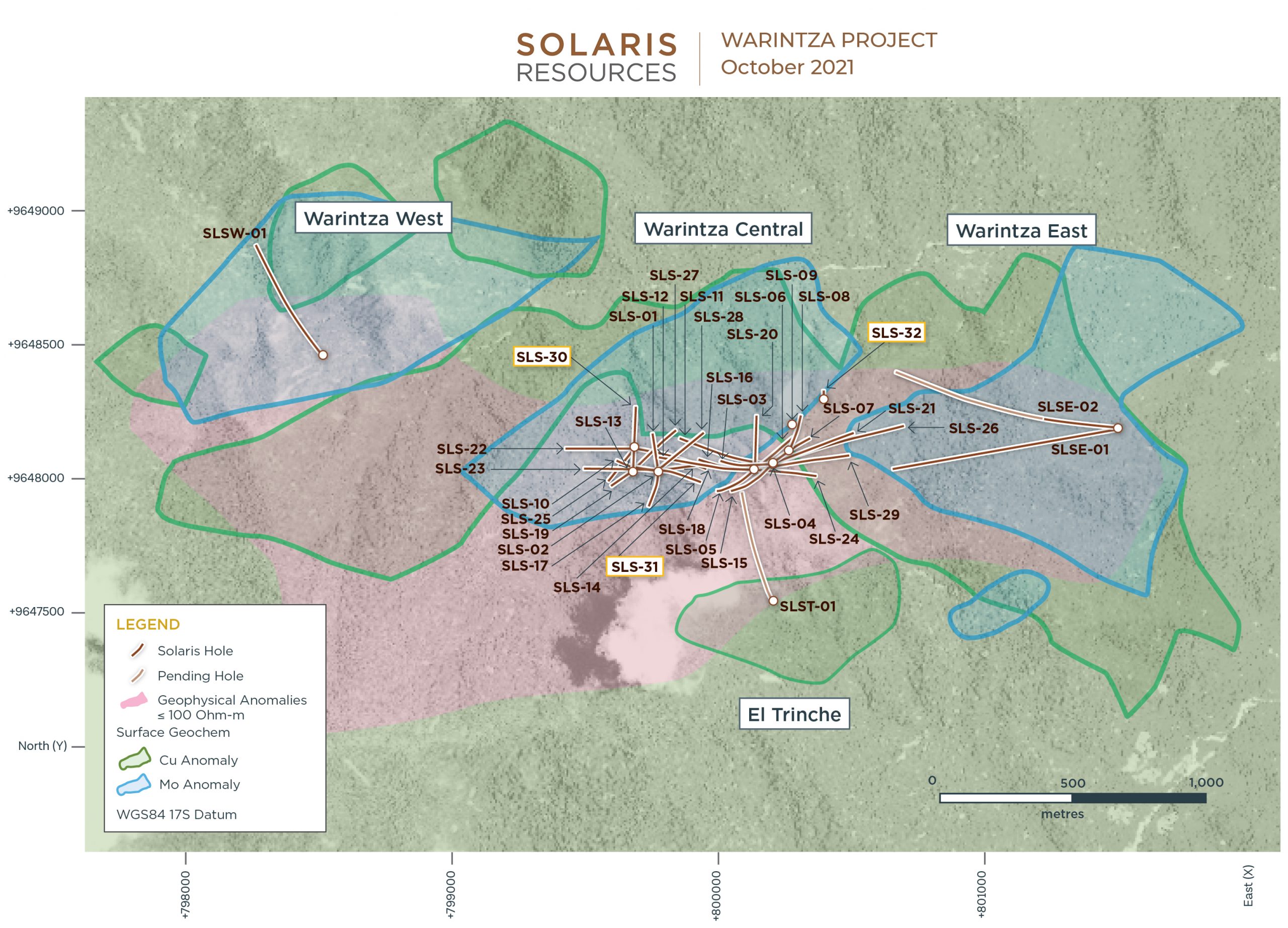
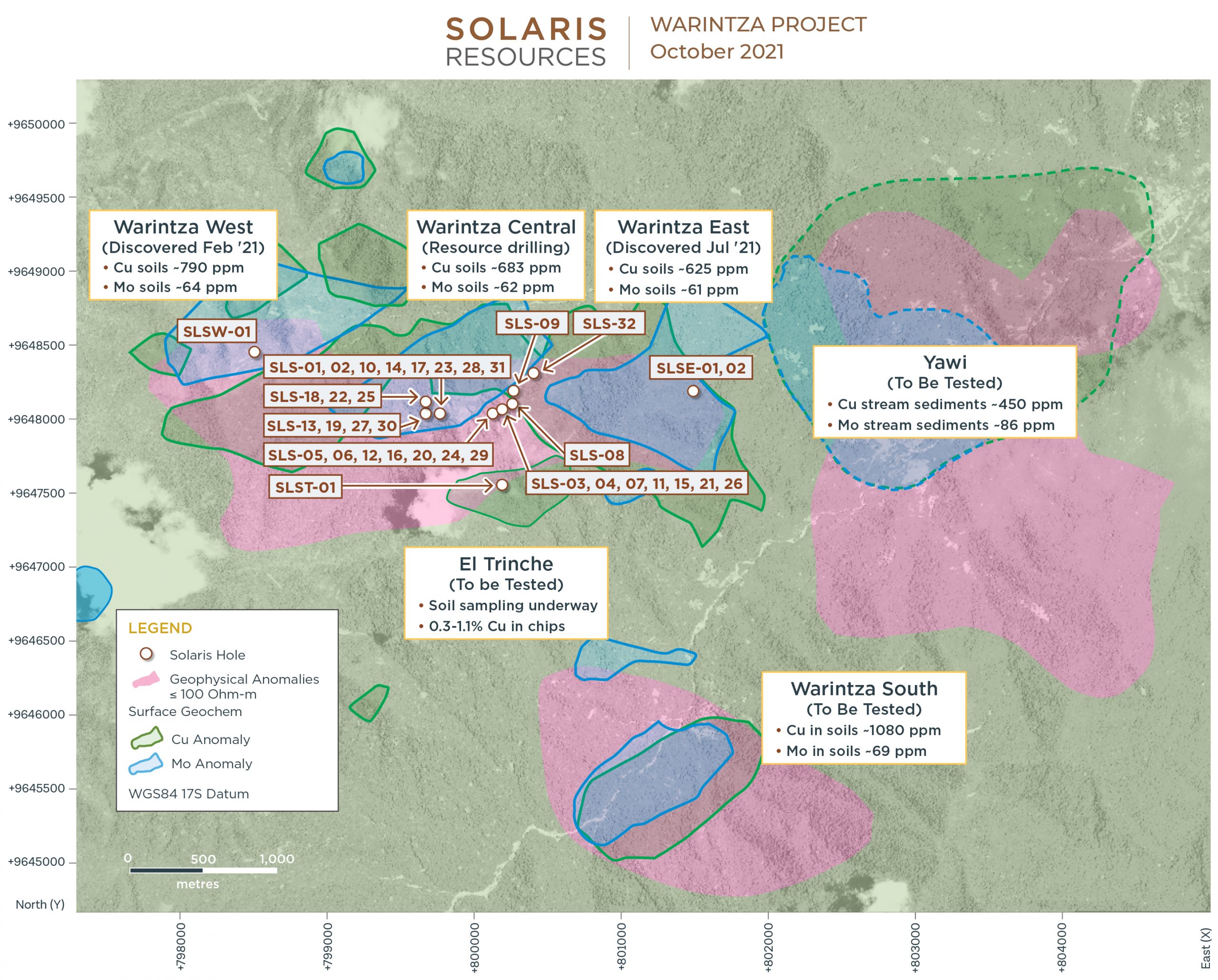
The above references an opinion and is for information purposes only. It is not intended to be investment advice. Seek a licensed professional for investment advice. The author is not an insider or shareholder of any of the companies mentioned above.
New assay results from Solaris Resources’ (TSX:SLS) Waritnza East discovery have return long intervals of copper prphyry mineralization from surface, from the first two holes. The high-grade links identified between Warintza East and Warintza Central is now being targeted, as this area to the north may yield a higher-grade mineralization.
Highlights
- The first two holes at Warintza East, as detailed below, both returned long intervals of copper porphyry mineralization from surface across a significant portion of the undrilled gap to Warintza Central, suggesting potential continuity between the two zones
- Visual observation of mineralization in the second hole and step-out drilling completed northeast of Warintza Central suggest an offset in the east-west corridor of higher-grade mineralization to the north that is being targeted in ongoing drilling
- SLSE-01, collared approximately 1,300m east of Warintza Central and drilled to the southwest, returned 396m of 0.42% CuEq¹ from surface, with the full length of the hole of 1,213m assaying 0.28% CuEq¹
- SLSE-02, collared from the same platform but drilled to the northwest, returned 320m of 0.48% CuEq¹, including 62m of 0.68% CuEq¹ from surface, from the first 320m of core for which assays have been received, with the last 10m of the interval grading 0.47% CuEq¹
- Visual observation of core from SLSE-02 suggests that a much broader interval of mineralization may exist than the portion for which assays have been received and reported herein; remaining assays are expected in October, along with the results of step-out drilling from Warintza Central
- Warintza East is the third major discovery within the 7km x 5km Warintza porphyry cluster and is defined by coincident copper and molybdenum soil anomalies, measuring approximately 1,200m in strike, and a high-conductivity geophysical anomaly that extends from the target through Warintza Central (refer to Figure 1)
Figure 1 – Long Section of 3D Geophysics Looking Northeast
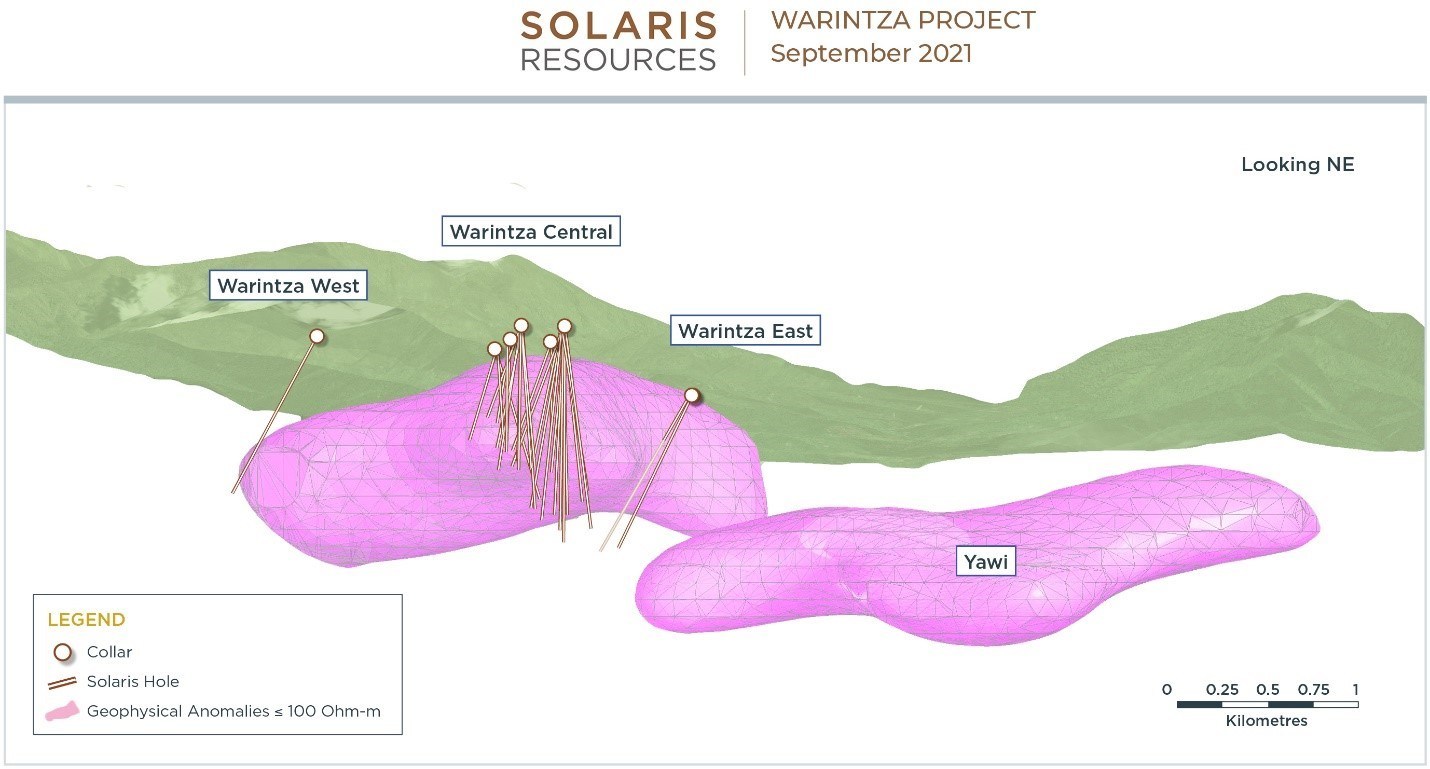
Figure 2 – Plan View Showing Wartinza East Drill Hole Traces
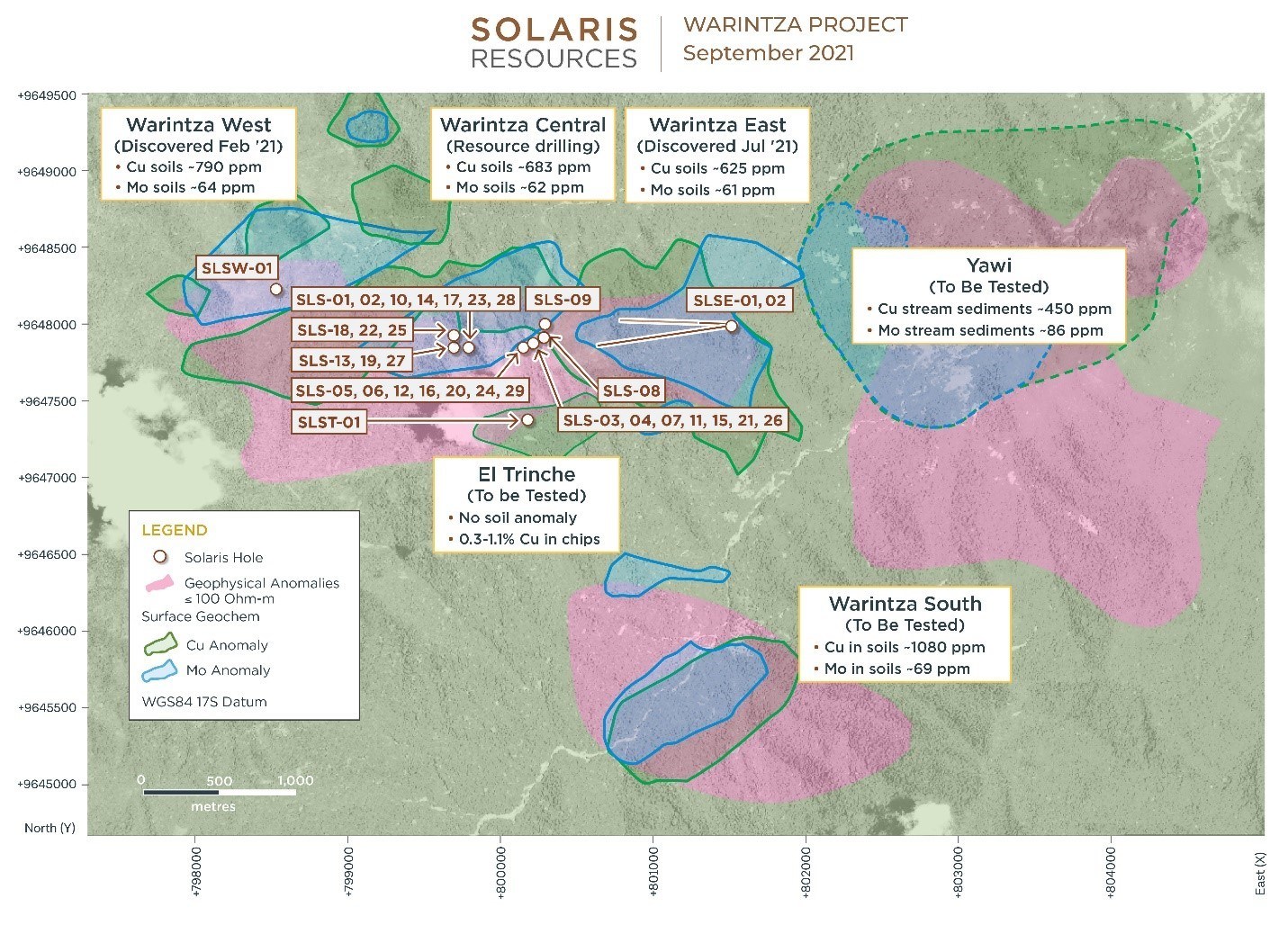
Table 1 – Warintza East Results
| Hole ID | Date Reported | From (m) | To (m) | Interval (m) | Cu (%) | Mo (%) | Au (g/t) | CuEq¹ (%) |
| SLSE-02 | September 27, 2021 | 0 | 320 | 320 | 0.39 | 0.02 | 0.04 | 0.48 |
| Including | 0 | 62 | 62 | 0.59 | 0.01 | 0.06 | 0.68 | |
| SLSE-01 | 0 | 1213 | 1213 | 0.21 | 0.01 | 0.03 | 0.28 | |
| Including | 0 | 396 | 396 | 0.33 | 0.02 | 0.04 | 0.42 | |
| Notes to table: True widths cannot be determined at this time. | ||||||||
Table 2 – Collar Location
| Hole ID | Easting | Northing | Elevation (m) | Depth (m) | Azimuth (degrees) | Dip (degrees) |
| SLSE-02 | 801485 | 9648192 | 1170 | 1191 | 275 | -50 |
| SLSE-01 | 801485 | 9648192 | 1170 | 1213 | 260 | -45 |
| Notes to table: The coordinates are in WGS84 17S Datum. | ||||||
| (1) | No adjustments were made for recovery as the project is an early-stage exploration project and metallurgical data to allow for estimation of recoveries is not yet available. Solaris defines copper equivalent calculation for reporting purposes only. Copper-equivalence calculated as: CuEq (%) = Cu (%) + 3.33 × Mo (%) + 0.73 × Au (g/t), utilizing metal prices of Cu – US$3.00/lb, Mo – US$10.00/lb and Au – US$1,500/oz. |
Mr. Jorge Fierro, Vice President, Exploration, commented: “With this latest discovery at Warintza East and the growing footprint of Warintza Central to the north and east returning some of the strongest intervals reported to date, the conceptual pit shell is expected to be extended to the north and east showing the potential to ultimately become one multi-kilometre ‘superpit’ joining the two areas. Future drilling will focus on the open, undrilled area between these two zones.”
The above references an opinion and is for information purposes only. It is not intended to be investment advice. Seek a licensed professional for investment advice. The author is not an insider or shareholder of any of the companies mentioned above.
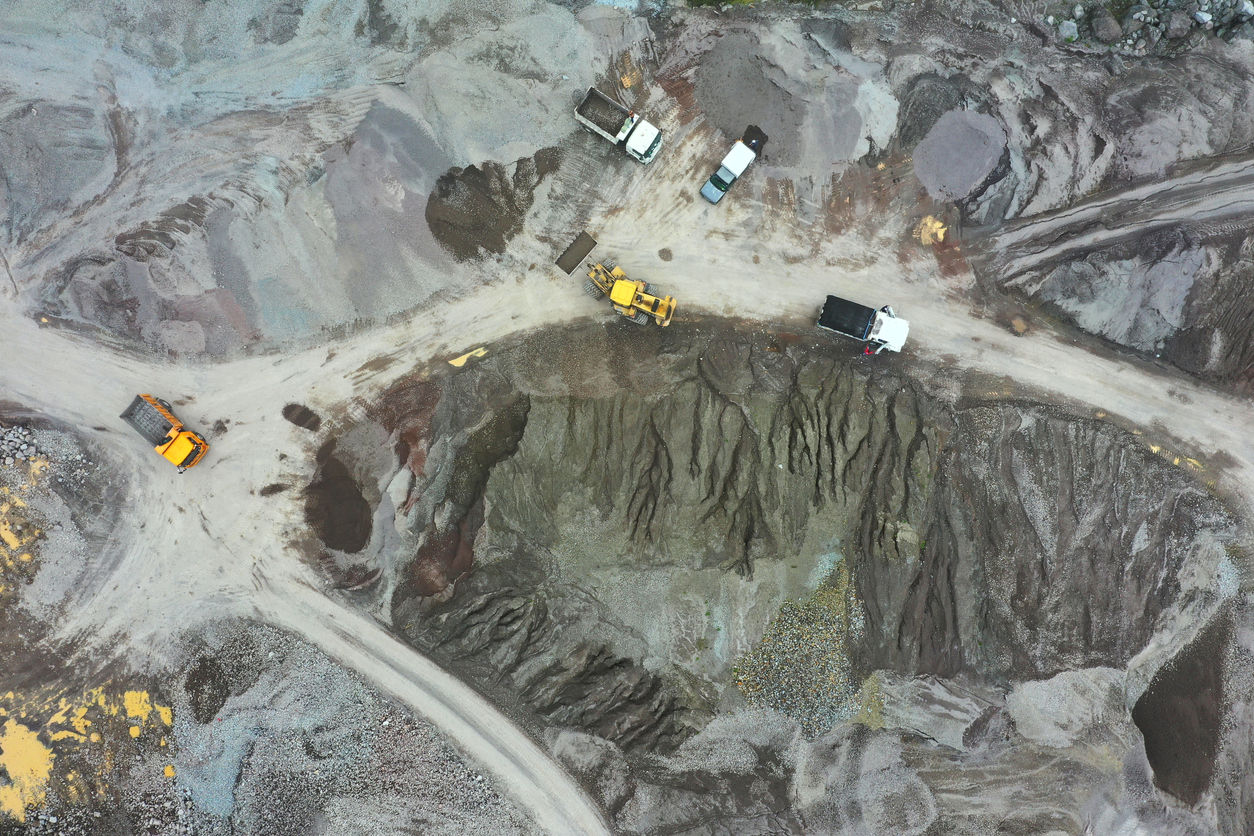
Ecuador expects to start production of four major mining projects by the end of President Guillermo Lasso’s first term in office in 2025, as he seeks to diversify the economy beyond oil exports, the Ministry of Natural Resources said on Friday. Lasso has been trying to attract private investment to boost the economy, which was in a deep recession last year, exacerbating Ecuador’s cash-strapped economy.
To do so, the President has issued a new decree, paving the way for investment in the nation and mining projects. This has the potential to open the floodgates for miners looking to expand or begin mining in the mineral-rich country.
Ecuador has rich mineral resources but lags behind its Andean neighbors Peru and Chile in the development of large mines. Many large mining projects in Ecuador face resistance from local communities and are struggling to fill informal miners who have slowed their development. However, the right approach with consultation with local communities has proven to be extremely effective. Successful projects like Solaris Resources’ (TSX:SLS) Warintza Project have been proven to be some of the most promising copper projects in the entire Andean region, and have been models of how mining companies can work hand in hand with local communities to uphold critical ESG principles.
Three gold concessions of Canadian companies Dundee Precious Metals (TSX:DPM) in Loma Largo, Atico Mining Corp (TSXV:ATY) in Plata, and Adventus Mining Corp (TSXV:ADZN) in Curipamba are in advanced exploration phase and could begin production by 2023, the Department of Energy, Non-Renewable Energy and Natural Resources said in its statement. The Cascabel concession, operated by Australia’s SolGold Plc, is expected to start copper production by 2025, the ministry added.
The largest copper mine in South America, the Mirador Project, operated by a subsidiary of the Chinese consortium CRCC Tongguan, commenced production in mid-2019. Its first major gold mine, the Canadian Lundin Gold Inc.’s (TSX:LUN) Fruta del Norte mine project, started in November this year. Its authorities expect exports of mineral resources to reach $1.6 billion a year, an increase of 7.4% from 2020.
With Ecuador positioning itself as a nation of open arms for the mining industry, it is set to catch up to, and surpass its neighbours in the coming years and decades.
The above references an opinion and is for information purposes only. It is not intended to be investment advice. Seek a licensed professional for investment advice. The author is not an insider or shareholder of any of the companies mentioned above.
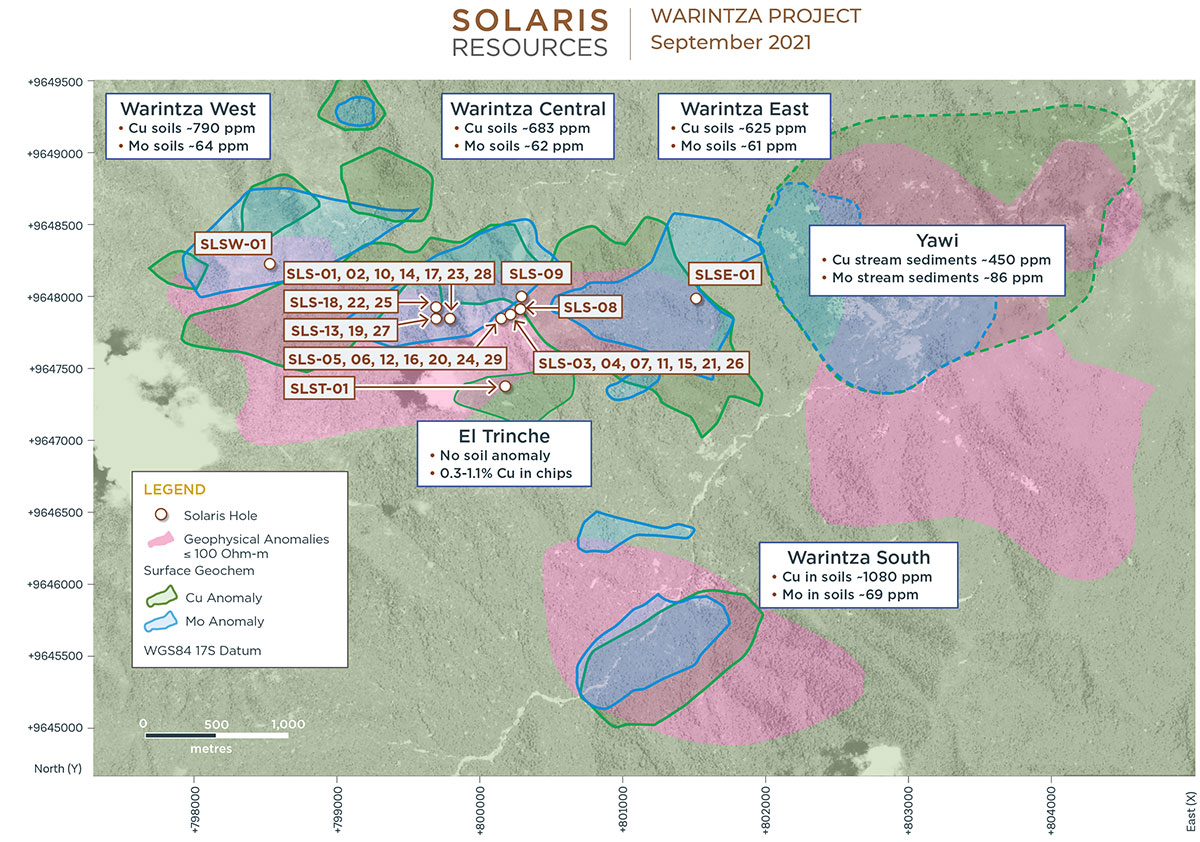
Solaris Resources has just announced its latest assay results from ongoing resource expansion drilling at its Warintza Project in southeastern Ecuador.
Mr. Jorge Fierro, Vice President, Exploration, commented “Drilling at Warintza Central continues to expand the dimensions of the zone beyond its original footprint. The strike length of Central now measures over 1,250m, with ongoing drilling aiming to extend the zone further to the east, broaden the zone to the north, and test the potential for a southern extension of at least 500m at El Trinche. At the same time, we await additional assays for our recent Warintza East discovery, where we have just added a second rig to accelerate drilling.”
The highlights from the results are as follows:
- Three additional holes at Warintza Central have unfilled gaps within the drilling pattern and extended the envelope of high-grade mineralization to the east, with high-grade mineralization encountered in all holes starting at or near the surface.
- SLS-27 was collared in the southwestern part of Warintza Central and drilled into a partially-open volume to the northeast, returning 462m of 0.91% CuEq¹ from near surface, including 372m of 1.02% CuEq¹ from 36m depth, infilling and extending mineralization in this area.
- SLS-28 was collared in the middle of Warintza Central and drilled into a partially-open volume to the northeast, returning 632m of 0.68% CuEq¹ from surface, including 316m of 1.00% CuEq¹ from 42m depth, infilling and extending mineralization in this area.
- SLS-29 was collared at the southeastern limit of the Warintza Central grid and drilled into an open volume to the east, returning 1,184m of 0.68% CuEq¹ from surface, including 480m of 0.80% CuEq¹ from 48m depth, extending mineralization to the east in this area.
- Maiden drilling has begun at El Trinche, a potential southern extension of Warintza Central, with the first hole collared approximately 500m beyond the southern limit of drilling in an area of rock sampling with values ranging from 0.3-1.1% copper at surface.
- To date, 40 holes have been completed at Warintza Central with assays reported for 29 of these. The assay backlog has grown due to downtime at the Project’s principal lab in Lima to install additional equipment and increase capacity, with operations having now resumed.
- Increased news flow is expected from September through year-end, including remaining assays from SLSE-01, which marked a new discovery at Warintza East (see press release dated July 20, 2021), with the Company adding a second rig to accelerate this important drilling.
Source: Solaris Resources
Solaris Resources Inc. is a part of the Augusta group of companies and is “responsibly and sustainably advancing a portfolio of copper and gold projects in the Americas.” The company currently operates their Warintza project in Ecuador, and expects to be drilling for discoveries at Tamarugo and Ricardo projects in Chile and Capricho and Paco Orco projects in Peru.
The above references an opinion and is for information purposes only. It is not intended to be investment advice. Seek a licensed professional for investment advice. The author is not an insider or shareholder of any of the companies mentioned above.
As President Guillermo Lasso in Ecuador casts a fresh set of eyes over the economic, social, and financial issues that the country is struggling with, the economy and mining industry is starting to look up.
President Guillermo Lasso was elected as Ecuador’s new president in April 2021, and he is committed to helping turn the country around by addressing public health concerns regarding the Covid-19 pandemic, addressing fiscal and sovereign debts, and expanding Ecuador’s mining industry.
Lasso issued a decree at the beginning of August called “Decree 151” that outlines a new mining policy and a “clearly articulated plan” to support responsible mining through key investors and investments which in turn help boost the economy.
A four-month action plan has been established in order to “develop an efficient and environmentally and socially responsible mining industry, to promote national and foreign investment, and to implement best practices for the exploitation of resources done with community engagement and care of the environment.”
Having the four-month action plan in place creates a defined timeline of specific actions and “guarantees the security of title, respects pre-existing mining rights, and will involve an inter-institutional strategy for the eradication of illegal mining.”
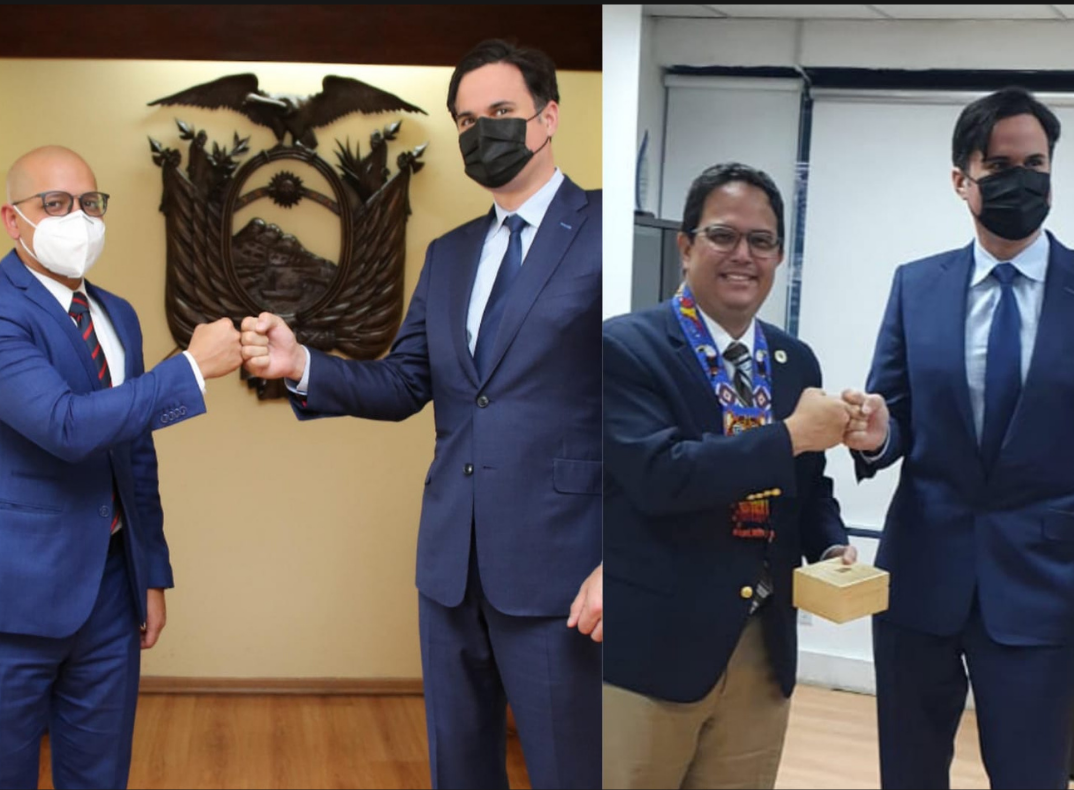
Lasso recently had a meeting with Daniel Earle, CEO of Solaris Resources in regards to the new decree and what he had in store for the future of Ecuador’s economy and mining industry.
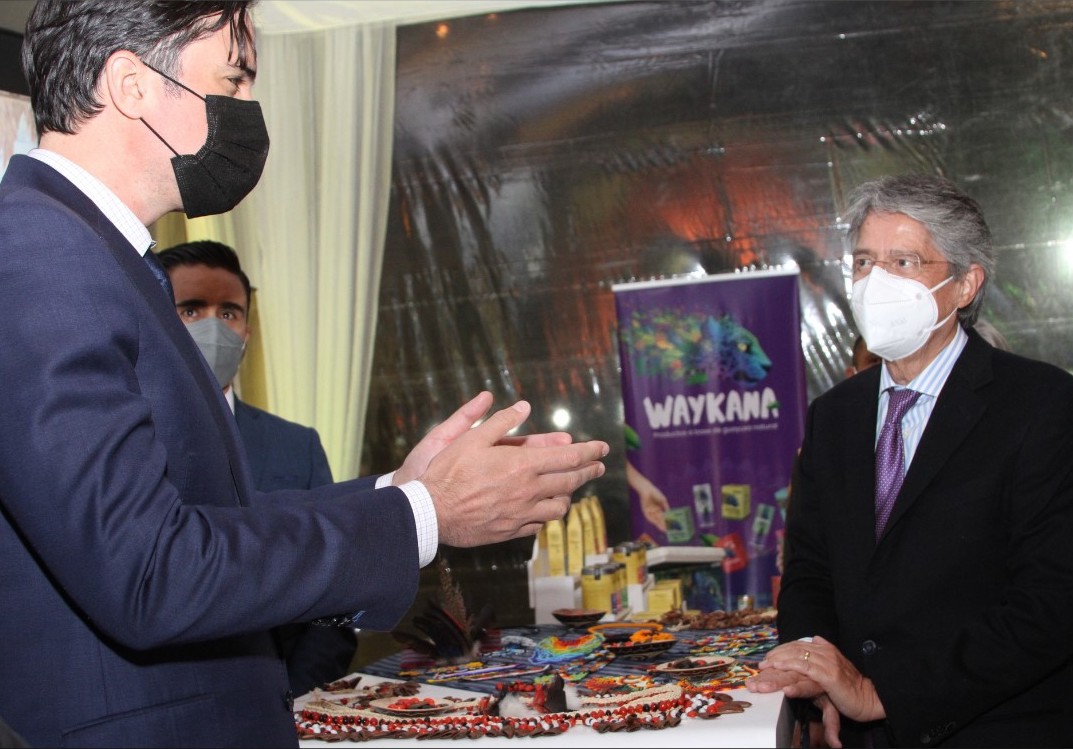
“This is a very important decree that will undoubtedly promote foreign or national private investment in the mining area of the country. The Government of the Encounter promotes clear policies to attract investment, generate new income for the State, more opportunities, employment and development for neighboring communities and for the whole country,” Lasso said in a recent Twitter video.
Ecuador’s Vice Minister of Mines, Xavier Ver Grunauer also singled out Solaris and it’s Warintza project as a model for mining in the country:
“There are very successful projects, such as Solaris’ Warintza project, which shows that with good on-site management, communication, and community participation, very interesting things can be achieved….the most important aspect is having a good relationship with the communities and empowering the project communities. I think there is no other sector like mining to promote the development of remote communities. It is very unlikely for the central government to be able to provide all the help or to foster all the projects there might be and that are generated by the private mining sector. Not all mining companies have these policies, nor do all companies have that level of commitment .” – Vice Minister of Mines of Ecuador, Xavier Vera Grunauer
Although he is optimistic about the country, Lasso was elected president at a time where the country was struggling not only financially but from the COVID-19 pandemic.
“This country, even going into the pandemic, was in a dire financial situation… they were running large fiscal deficits, they had run up their sovereign debt to unsustainable levels, and they actually had to restructure part of their debt,” Mr. Earle explained.
“His first priority as I mentioned is addressing the public health crisis created by COVID. Ecuador was very hard hit by COVID.”
The country has already made huge progress in the battle of COVID-19 under Lasso’s administration, securing vaccines for the public and plans to reopen the economy.
“When I was there a few weeks ago they had administered 9 million shots within a total population of 17 million people,” Earle said.
Although there is still a long way to go, Earle says “President Lasso is running at the highest popularity levels for president in Ecuador, a truly historic level of support.”
Lasso is a conservative and self-made entrepreneur, creating and growing his own entire banking empire before he was elected president. This has given him a major advantage in his analysis and plan for the country’s economy.
“The mining sector is seen as being absolutely critical to the economic fortunes of Ecuador. This is something that the government is absolutely focused on,” Earle explained.
“It (the decree) defines the mining policy of Ecuador to support a major expansion of the sector through foreign investment. And it lays out a clear action plan and the timeline for making progress towards this objective.”
With this new decree in place to help boost the mining industry, it will generate more employment and investment for the country, which is necessary to change the image of Ecuador. A successful mining industry will also generate more exports, more taxes, and more income for the country.
However, Lasso wants to ensure that this change is not all about investments and money.
“It’s not purely just about investment, but alongside that the government is also very clear that this isn’t just going to be about resource development or mining development, project development, this is going to go alongside social development and of course environmental projections, to the highest standards of environmental protection,” said Daniel Earle.
“As a government, we are clear that mining needs to develop because it is the future of the country. But we also realise that Ecuadorian mining has to incorporate the best environmental and social practices. We don’t want mining at any cost, and we will only allow mining that respects the environment and communities. We understand that there are some places, such as protected areas, where mining can’t take place, and that is fine. Meanwhile, we will improve the regulations to ensure that the mining that does happen is responsible,” Lasso said in a statement in July.
Social aspects, environmental protection, and of course mining and project development are all key points Lasso wants to drive home to the country. He recently made a statement citing Solaris as a model that other industries should follow.
“When the government talks about natural resource development, they are very clear to mention that there will be social development alongside it, so community development to go with the project development, and so this would be things like education and training, and infrastructure development, community buildings, health facilities and so on,” said Earle.
Earle also had the chance to speak with some of the biggest business leaders in the country.
“They are very optimistic of the potential in Ecuador for the private sector to not only grow but flourish under this Lasso administration… This is the first administration they have had in 50 years that understands the role of the private sector and the benefits it can bring.”
“You’ve seen Lasso make statements that reflect that kind of view, where he has talked about over the medium term this country turning into a major mineral exporter, such as Peru or Chile.”
Lasso touched on the importance of the mining sector, comparing it to others such as Chile and Peru.
“Ecuador has resources comparable to those of Peru and Chile; however, we are behind. We have to start moving forward and we have to promote the mining sector; thus, we will engage in debates with all those who want to demonize the oil and mining activity,” Lasso explained at an AEI Event in Quito.
According to the LatAM investor report Q3 2021, “2020 to 2030 will be the decade of mining in Ecuador. By 2030, we hope that mining will be attracting billions of dollars of investment, generating billions of dollars in annual exports, and employing hundreds of thousands of Ecuadorians. We have the same geology as Peru and Chile and even the little exploration that has happened so far has found some massive deposits. When these are turned into mines they will be among the biggest in the world, which is why we want to attract the largest, most responsible mining companies.”
Earle described Ecuador as similar to a ‘blank canvas,’ in comparison to the mining industry in Peru or Chile who have had mines for decades.
“So you’ve got basically the first two mines in the country that have just gone into production in the last couple years, so the bulk of the development is still in front of them.”
He explained that the “New Minister of Energy and Non-Renewable Natural Resources Juan Carlos Bermeo said by 2030 they hope that the mining sector will be attracting billions of dollars of investment per year and generating billions of dollars of annual exports and employing hundreds of thousands of Ecuadorians.”
The future of the economy and mining sector is something Lasso, Earle, and Solaris Resources, and the people of Ecuador hope to see flourish in the coming years.
“We all want sustainable development, we all see the long term potential in this jurisdiction… This is something that is truly extraordinary in a global context,” Mr. Earle said.
He is excited for what the future holds and what Lasso can and is already starting to do.
“It’s really going to be a happy time in front of them when this all gets going… It’s really heartening and energizing to be a part of this revival which is about to get underway in Ecuador, they haven’t had this opportunity in so long.”
The above references an opinion and is for information purposes only. It is not intended to be investment advice. Seek a licensed professional for investment advice. The author is not an insider or shareholder of any of the companies mentioned above.

Solaris Resources (TSX:SLS) experienced a slight dip in its stock last week which had investors scratching their heads. The acute pullback was notable due to the stocks incessant rise over the past year, but there is more at play for Solaris in the big picture.
Copper Prices and Industry Dynamics
Due to restrictions on mining production during the COVID-19 pandemic, many firms were forced to halt mining production across the globe. However, as restrictions begin to loosen, many believe that the mining industry is on its way to an industry-wide comeback.
Even before the pandemic, copper supply was not able to keep up with the ample demand for the precious metal resource. According to many experts in the industry, many firms worldwide are looking to find new mines as many of the current ones are depleting.
One of the main sources of hope for those looking for new copper mining opportunities is the Western end of South America, long known for its copper mining reserves. In the past year though, we have seen negative trends from Chile wherein the new elected government may enact legislation that restricts the ability of foreign companies to profit from mining extraction.
As such, Ecuador, a previously untapped center of copper resources, has come into the picture as one of the future players in the mining industry. In their recent election, conservative candidate Guillermo Lasso won a massive victory. Lasso has been a long-time supporter of encouraging foreign direct investment into Ecuador’s mining industry and reducing barriers to mining extraction.
In particular, Lasso seems to have shown an affinity for Solaris Resources’ massive Warintza Mining project in Southwest Ecuador. The Warintza mine has 5 different extraction sites spanning a 35 km area. Its results at Warintza Central and Warintza East have already been promising, with highly concentrated copper discovered. Lasso has seen the potential and has even met with Solaris’ CEO Daniel Earie to profess his support for the mining project.
So why the drop?
According to investment experts, price swings are expected during a long mining extraction process. The fruits of the Warintza extraction campaign are likely not going to be clear till the 4th quarter 2021, and until those results are available their stock price is likely to fluctuate. Warintza made their last significant discovery on July 20th, over a month ago, and some investors may be showing some impatience, leading to a drop in confidence in the firm at large.
Earlier today, the drop caused a stir on Yahoo Finance’s conversation board, as investors pondered whether to draw down positions somewhat. An investor on the forum, going by the name “Sunny”, commented his opinion on the future of Solaris, essentially stating that fluctuations were to be expected and that riding the wave of ups and downs through the extraction period would pay dividends to patient investors in the future.
The following was his comment:
Jacqueline Wagenaar, who is the VP Investor Relations of Solaris, purchased at $13.96-$14 from the open market last week. Over the past few months, insiders continued to purchase more and more as the SP rose. Again, the insider holding is already 53%. The CEO (i.e., Daniel Earie) is holding over 8 million shares (3.8 million common shares +1.9 million options + 2.5 million warrants). What does it tell you?
If you really feel the stress these days, try to close your eyes and wait until the end of the year (better wait until the exit transaction) to enjoy the gain. Otherwise, you may want to move on so that you don’t feel the pressure.
For me, my stand is unchanged regardless of the fluctuation. The retraction from the ATH $15.20 to today’s SP was undoubtedly beyond my anticipation but I have been adding in stages (well over my original targeted position) along the way with my DD.
My key opinion is still that we are talking about a copper resource in Warintza of at least 620 million tonnes but more likely to be well over 1 billion tonnes. Even at a long-term copper price of $3.25 (instead of the $4.0580 at this second with the drop), the valuation of just the Warintza project will be $4-5 billion (CAD) for the most conservative valuation. This represents a SP of $37-$46 (CAD). We are not talking about hoping for the growth of the company in revenue/earning in SLS. Even if we give a discount on this, the potential gain will still be mouth-watering. One thing to always keep in mind, we are talking about the physical copper in the discovery in the Warintza project would already make the company worths that much. There will be updates along the way in the remaining months of 2021. Major valuation updates will be in Q4. Exit transaction will likely be in the first half of 2022. All in all, I will just continue to close my eyes or continues to accumulate in stages.
Source: Yahoo Finance Conversations
Overall, the copper mining industry is still likely to grow and grow and the same applies to the promising Warintza project in Ecuador. Small dips in the stock price can be a cause for concern but should ultimately not deter investors from continuing to maintain faith in their current Solaris holdings. In fact, buying Solaris stock now as the price is low may pay off massively when the price inevitably rises again towards the end of the 4th quarter this year and perhaps even beyond that as the Warintza mine’s high-grade copper reserves may continue to bring the company and its shareholders more discoveries for some time.
The above references an opinion and is for information purposes only. It is not intended to be investment advice. Seek a licensed professional for investment advice. The author is not an insider or shareholder of any of the companies mentioned above.
On Tuesday, Solaris Resources (TSX:SLS made significant gains in their Warintza drilling campaign in southeast Ecuador and announced a new discovery at Warintza East, located ~1km east from their Warintza Central deposit where resource expansion drilling is ongoing. Warintza East is part of a more extensive copper mining campaign in the Warintza area that spans over a 35 square kilometre region and comprises five main mining targets.
Solaris Resources has been a massive player in the South American copper drilling industry for some time now, with copper and gold projects in Ecuador, Chile, Peru, and Mexico. However, their recent work in the Cordillera del Condor Mountain region of Ecuador is one of their more exciting and promising projects to date. The area is known to be ripe with tens of millions of tonnes of contained copper and millions of ounces of gold and hosts nearby mines of Lundin Gold’s Fruta del Norte mine and a Chinese consortium’s Mirador mines.
We spoke with Daniel Earle, CEO of Solaris Resources, on the results at the Warintza project and took a look at some of the biggest reasons why this company is set for the next major leap.
So far, each stage of the drill program has continued to yield positive results with discoveries. Three discoveries have been made so far, with two more targets still left to drill. Mr. Earle said, “We drilled a hole at what we call Warintza West in February, which resulted in a discovery there, and then just yesterday we drilled a hole at Warintza East, which resulted in a new discovery there. So now three discoveries within this cluster of copper deposit targets, and that leaves two more major targets to drill in the future.”
“All of our drill holes, and all of the historical drill holes, have all hit economic copper mineralization, so there is nothing drilled on this property that hasn’t resulted in economic copper.”
With Warintza South and Yawi next up on the list of discovery drilling as well as expanding Warintza Central and East, more results seem likely to continue the trend of fruitful discoveries as every single target has been a success so far.
Cash balances will allow for a very long runway for the company, with about $60 million on the balance sheet right now and approximately $20 million needed for the remaining 2021 capex: “We will be testing Warintza South and Yawi targets before the end of the year. And all of that will be covered by the $20 million budget.”
That will leave a sizable remainder for the company as it looks toward its next possible major milestone, a sale.
“By the time the calendar rolls over to 2022, we are going to be looking at a process to sell this entire company. We will still be in a very strong cash position.”
With the stock breaking above $13 recently and showing no signs of abating, the company is still not at a valuation that might match the scale of the current drilling at the Warintza Central deposit and existing and potential discoveries at the other regions.
The Company is undergoing a resource expansion drill campaign at Warintza Central which hosts a historical inferred resource of 124 million tonnes grading 0.7% copper equivalent, based on very limited, shallow historical drilling. An updated resource estimate is expected in Q4 2021 and drilling has already demonstrated that the new resource will be an order of magnitude larger. The company’s target at Warintza Central alone is to define a copper resource of 1 billion tonnes, which could ultimately see Solaris Resources triple its current valuation, not inclusive of any additional discoveries made on the property.
Mr. Earle pointed out that the Augusta Group track record bears out a pattern that may serve as a useful model for its exit strategy: “Our last company within the Augusta Group, we sold for $2.1 billion in 2018, that was at a multiple of essentially 100 percent of the net asset value of the primary assets. In Solaris today, we are trading at approximately one-third of that level.”
“So we have a lot of work to do to extract a representative evaluation here at Solaris.”
Pushing that valuation is another tailwind the market is providing: “This copper price cycle is going to be much more powerful because of greater fiscal and monetary stimulus, and number two, we have these megatrends in place of decarbonization and electrification.”
“Electrification of the residential sector, of the industrial sector, smart grids, grid storage, all these other kinds of areas of growth that are all incredibly copper intensive.”
That need is bigger than ever, possibly pointing to something bigger than just the effects of a price cycle. While copper price behaviour has matched expectations, the effect is also being multiplied by current conditions and the grand expectations of an electric future beyond anything anyone has ever seen before.
In understanding the scale and importance of Warintza, Daniel Earle notes that it is important to consider the context within which it resides and possible comparables for the project and company, “I think the key is just to understand the context around what we have here and what we are going to achieve, and to look at the global comparables for an asset like this.”
“You have to look at some of the best copper development assets in the world if you want to understand the context of what we are trying to do.”
A key copper project in Peru – Anglo American’s (LN:AAL) Quellaveco, may be a potential future comparable once the resource estimate is released. While that mine has a long proven track record, Warintza may be the project to match or surpass it. Solaris holds some other key advantages with its project that may allow the company to get a higher return out of its exploration efforts.
“We’re going to do it at much lower elevation, adjacent to a highway, adjacent to a power grid that is supplied by low cost, emission-free, renewable power, with abundant freshwater, with a low-cost and skilled labor force in Ecuador.”
“You realize that this is something totally unique.”
First Results Are In
Highlights are listed below, with corresponding images in Figures 1 and 2 and detailed results in Tables 1-2. A dynamic 3D model is available on the Company’s website.
Highlights
- SLSE-01 was the first hole ever drilled at Warintza East and collared approximately 1,300m east of Warintza Central, where recent eastern extension drilling intersected 1,000m of 0.60% CuEq¹ from surface (see press release dated July 7, 2021), with the Central zone still open in this direction
- SLSE-01 was drilled to a total depth of 1,213m with assays reported herein for the first 320m of core from surface, which were given priority in transport, cutting, preparation and assaying – results for the balance of the hole are expected in late August/early September
- SLSE-01 returned 320m of 0.46% CuEq¹ from surface, including 54m of 0.70% CuEq¹, in an open interval, marking a significant new discovery from surface at Warintza East, one of the five main targets within the 7km x 5km cluster of porphyry targets defined on the property
- Warintza East is defined by coincident overlapping copper and molybdenum soil anomalies, measuring approximately 1,200m in strike, and a high-conductivity geophysical anomaly that extends from the target through Warintza Central (refer to Figure 1)
- Further drilling will target the expansion of Warintza East, with a focus on the open area between Warintza Central and this new discovery (refer to Figure 2)
Table 1 – Warintza East Partial Results
| Hole ID | Date Reported | From (m) | To (m) | Interval (m) | Cu (%) | Mo (%) | Au (g/t) | CuEq¹ (%) |
| SLSE-01 | July 20, 2021 | 0 | 320 | 320 | 0.36 | 0.02 | 0.05 | 0.46 |
| Including | 0 | 54 | 54 | 0.49 | 0.01 | 0.05 | 0.56 | |
| Including | 162 | 216 | 54 | 0.60 | 0.02 | 0.04 | 0.70 | |
| Notes to table: True widths cannot be determined at this time. | ||||||||
Table 2 – Collar Location
| Hole ID | Easting | Northing | Elevation (m) | Depth (m) | Azimuth (degrees) | Dip (degrees) |
| SLSE-01 | 801485 | 9648192 | 1170 | 1212 | 260 |
Source: Solaris Resources
Figure 1
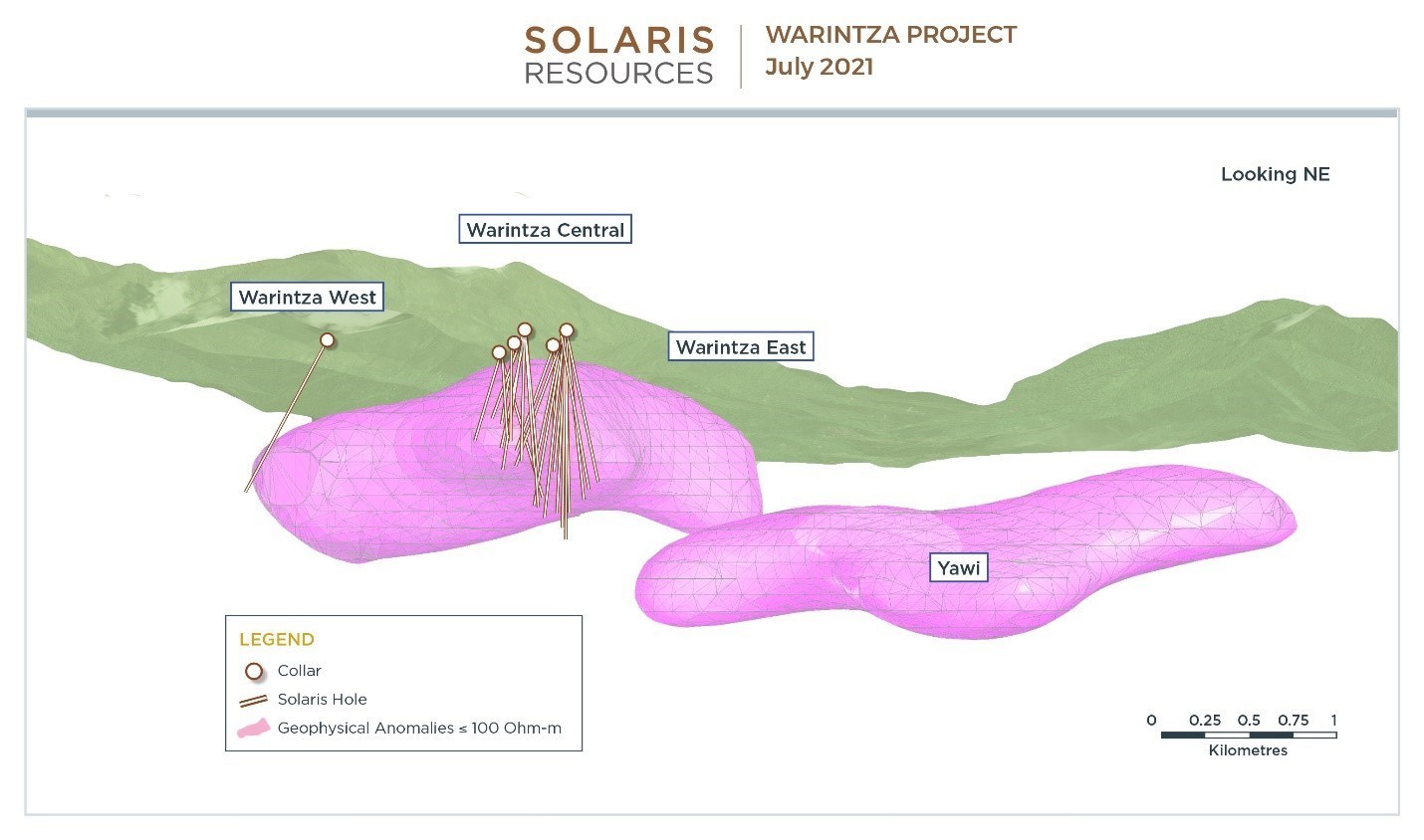
Figure 2
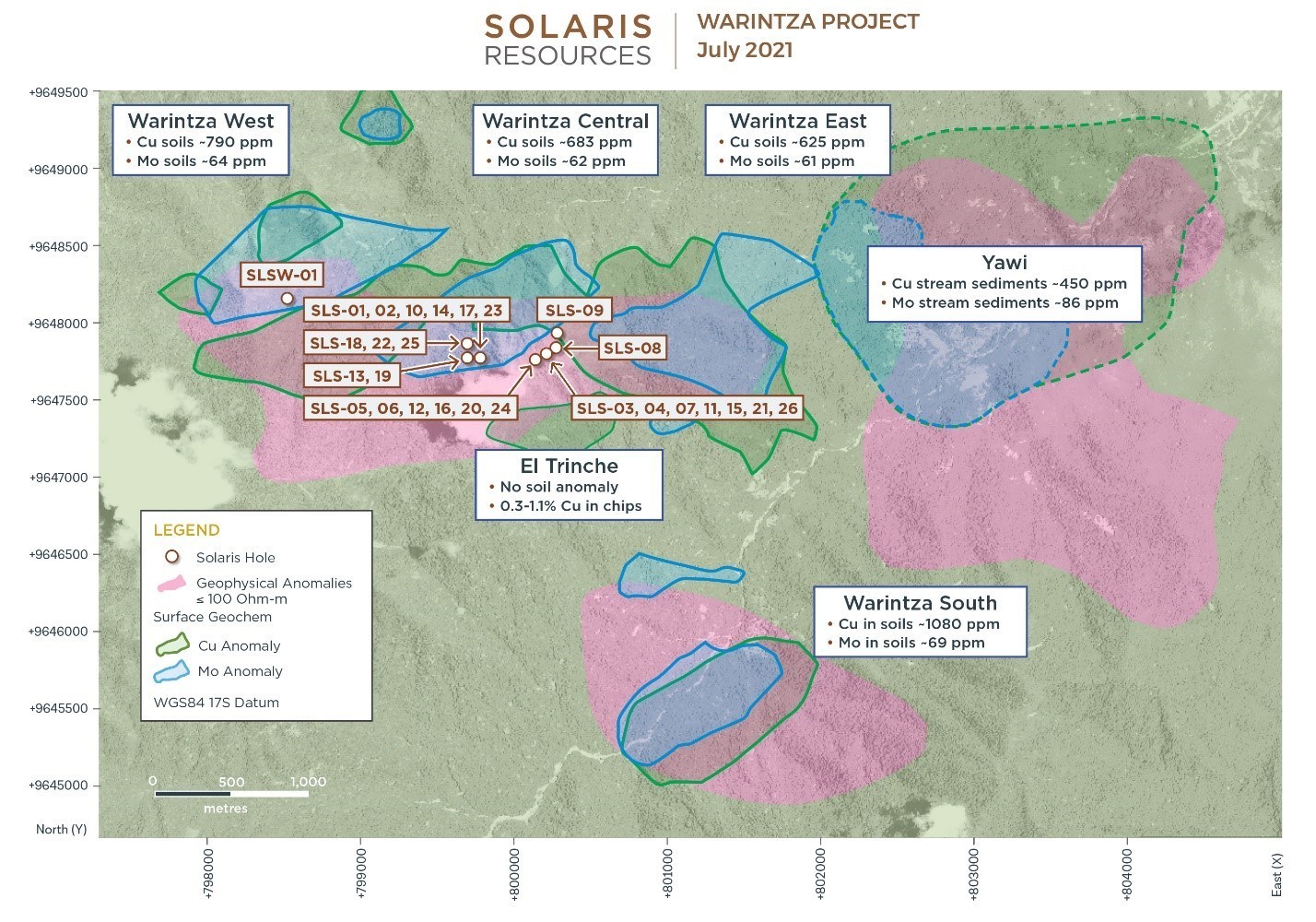
Source: Solaris Resources
Future Plans
In the upcoming weeks, the company plans to continue resource expansion drilling at Warintza Central, with the updated resource estimate expected in Q4 2021, as well as continue discovery drilling at Warintza West and East and undrilled targets at Warintza South and Yawi. Solaris’ VP Exploration commented on the drilling campaign, “The discovery at Warintza East marks the third major copper discovery within the voluminous 7km x 5km Warintza porphyry cluster. Importantly,the footprint of Warintza East overlaps conceptual pit designs for Warintza Central, which itself continues to grow eastward with recent results. Future drilling will focus on the open, undrilled area between these two zones.”
Copper prices have been on a rapid rise and have even recently hit all-time highs. With global demand for copper predicted to only rise further, the Warintza project’s expected ROI seems to have one direction – higher.
The above references an opinion and is for information purposes only. It is not intended to be investment advice. Seek a licensed professional for investment advice. The author is not an insider or shareholder of any of the companies mentioned above.
CEO of Solaris Resources (TSX:SLS) Daniel Earle recently sat down with Tom Bodrovics of Palisades Gold Radio to discuss everything from copper, work, and the mining industry. Daniel’s background is in mining engineering and has worked in banking, commodity forecasting, and financial analysis.
Daniel discusses his choice to invest his life savings in Solaris and become the CEO of a copper mining company, the reasons why copper is so critical, Ecuador as a mining jurisdiction, and the company’s ESG strategy in a changing world. The full interview can be found in the video above.
Copper is Key
With all the attention on rising copper prices and the push for decarbonization around the world with electric vehicles (EVs) and battery storage, Solaris is in the middle of a favourable copper cycle. Mr. Earle explains his decision to become the CEO of Solaris, and why the current copper price cycle is both impressive and completely normal: “We’re at a period in this copper price cycle where we’ve essentially completed the first leg of the cycle. Coming off the pandemic, or the cycle lows in March of last year, copper prices basically more than doubled and then corrected a little bit.”
“This is actually pretty normal for a copper price cycle. If you consider the perspective that’s provided by the prior two cycles, then you would have seen a similar thing with the copper price basically doubling in one year and then going on over the next couple years to double again.”
“So you get a quadrupling across on normal copper price cycles. You would have seen that in the mid-2000s cycle for example, copper went from about $1 at the start of the cycle, to a peak price of $4/pound in 2007 in less than three years.”
The Copper Supercycle
The current copper price cycle has been called a “supercycle”, with Goldman Sachs pegging its copper price target at $15,000. If the current price cycle continues in a similar fashion to those of the past two decades, the doubling and then quadrupling of the copper price could see the industry continue to heat up.
Earle noted: “I think it’s important to just keep in mind the kind of framework that this exists in. We spoke about copper and the industry dynamics of supply and demand, geopolitics, and so on, and how they would affect copper. But just bear in mind the bigger picture; people talk about a supercycle for commodities which, if you define that as just sort of above trend price growth for commodities as a whole then yes, I think you can make a case for that.”
When Do We Get to Peak Copper?
If there is a peak, we are likely not there just yet. “If you look at the existing supply profile, peak copper lands around the middle of this decade, maybe 2024 maybe 2025 if you look at existing production, planned production and then possible production.”
“Then from there, the production that’s committed starts to roll off and that’s when the gap really starts to open up to demand, growing through a steady pace through to the middle of the decade, and then accelerating from there when green demand really starts to take off exponentially,” Mr. Earle commented.
World War Copper?
Electric vehicles and battery storage are likely to be the two main drivers for copper demand over the coming years. Many countries have pledged that sales of new cars will only include electric vehicles by 2030, with others pledging a slower but committed transition away from combustion engine sales.
The evolving dynamics could eventually put copper in the middle of a geopolitical spotlight as it could be considered a critical or strategic metal. However, the market is not there yet but could translate to not just higher copper prices, but much higher multiples for equities measured against EBITDA.
“I think we wouldn’t say today that copper is considered a strategic metal. Certainly among investors, you haven’t seen a lot of rhetoric out of governments around copper supply. So that discussion is confined to some of these battery metals, and before the battery metals, the rare earth space is where you saw that kind of discussion. And then of course investors take that discussion and they apply it in the market.”
If the situation were to change and put copper at the forefront of national strategies for energy storage and infrastructure, that shift could play out in the market in a similar fashion to lithium companies: “You see it reflected in higher market multiples, so if you look at lithium companies, you have these companies that are trading at twenty to thirty times EBITDA. If you look at the copper companies without this kind of rhetoric, without this emphasis on the importance of these companies and the metal they’re supplying, you need copper companies to quadruple before they get to those kinds of multiples.”
“You’d be talking about Freeport trading at something like $160 a share, or $280 a share for Southern Copper, $120 First Quantum shares if you were to get the same kind of strategic consideration and appreciation by the market.”
“So we’re not there yet, but I think as this cycle evolves, as the supply deficit that we’re talking about actually materializes and then widens, and you get a really dramatic price response from the middle of this decade through the end of this decade, you get well into not just record price but multiples to prior record prices. Where we get to $6 and $8 copper prices. That’s when I think that you can expect that copper will begin to be considered a strategic metal, and that’ll have obviously really dramatic implications for the equities.”
“Dramatic Implications for the Equities”
What that means for Mr. Earle’s Solaris Resources is yet to be seen, but with the stock up over 1,100% since its IPO, it seems that the current copper price cycle could be supportive of a continued run higher. With the added possibility of copper being classified as a strategic metal for several governments, higher copper prices could translate to equities with multiples far higher than have been seen thus far.
“It’s obviously going to be uneven because you’ve got these different profiles of costs, different commodities. But certainly we’re going to have really rapid demand growth, where as we get to coordinated, synchronized global growth stimulated by all this incredible fiscal largess in an accommodative policy environment. And then we’ve got constrained supply so we have had tremendous under-investment in the mining sector over the last seven years or so,” Mr. Earle explained.
Under-Investment Could Accelerate Effects of Price Runs
That under investment has fueled a dearth of new copper projects that is amplifying the effects of the supply demand dynamics for copper. Pushing the timeline a few years ahead and this could play out on an exponential scale reflected in commodity prices and equities.
While the current climate has all the makings of a supercycle, not all commodities will react the same way, with some winners pulling ahead far faster than others. Most of the metals and minerals needed for the green transition like copper and lithium will be the fastest runners, with most other commodities being pulled up alongside them.
Earle went on: “So we would have gone from something like $200 billion a year of investment in the last cycle to a quarter of that coming towards the beginning of this cycle. So tremendous under-investment because of this investor push for the return of capital. Which is wonderful during the trough of the cycle to keep share prices strong, but it doesn’t make sense across the next cycle when you need to be bringing on supply.”
“Because this is a depleting business and you need to continually reinvest. I think when you look at that contrast between the demand that we’re going to have, and this inability of the supply side to respond, you see the makings of this supercycle here, uneven as it may be across different commodities.”
The above references an opinion and is for information purposes only. It is not intended to be investment advice. Seek a licensed professional for investment advice. The author is not an insider or shareholder of any of the companies mentioned above.
New assay results were reported this morning from ongoing resource expansion drilling at Solaris Resources Warintza Project. The company is reporting that the additional drill holes have extended the strike length, a consistent, high-grade mineralization, and a ramp-up of drilling activities as the weather continues to improve.
“Our latest drilling has continued to expand the footprint of Warintza Central toward our goal of defining a large, high-grade, open-pit resource. With these holes, the drilled strike length has grown to the east beyond the original limits of planned resource drilling and remains open toward Warintza East, where results of maiden drilling are expected soon.” – Mr. Jorge Fierro, Vice-President of Exploration at Solaris Resources
Highlights Include:
- Additional drill holes have extended the strike length of Warintza Central to 1,250m, exceeding the original scope of planned resource drilling across 1,000m of strike length
- Warintza Central remains open, with the most recent holes extending mineralization to the east returning some of the strongest intervals reported to date, including SLS-21 (1,029m of 0.73% CuEq¹ from surface, as previously released on May 26, 2021) and SLS-26 reported below
- Drilling has consistently shown the highest-grade mineralization at Warintza occurs at or near surface, which lends itself to establishing a robust mine plan with elevated grades benefitting the early years of mine life
- SLS-24 was collared at the southeastern limit of the Warintza Central grid and drilled into an entirely open area due east, returning 952m of 0.62% CuEq¹, including 502m of 0.67% CuEq¹ from 10m depth, expanding mineralization into this area
- SLS-25 was collared on the western limit of the grid and drilled into a partially-open volume to the southwest, returning 382m of 0.77% CuEq¹, including 230m of 1.06% CuEq¹, infilling and extending mineralization in this area
- SLS-26 was collared on the eastern side of the grid and drilled to the northeast, returning 1,000m of 0.60% CuEq¹, including 786m of 0.67% CuEq¹ from surface, extending the limits of mineralization more than 150m in this direction
- To date, 36 holes have been completed at Warintza Central with full assay results reported for 26. Weather conditions have continued to improve at site supporting the continued ramp-up of drilling activities, with increased productivity expected through the third quarter
Source: Solaris Resources
Figure 1 – Long Section of 3D Geophysics Looking Northeast
Figure 2 – Long Section of Warintza Central Drilling Looking Southeast
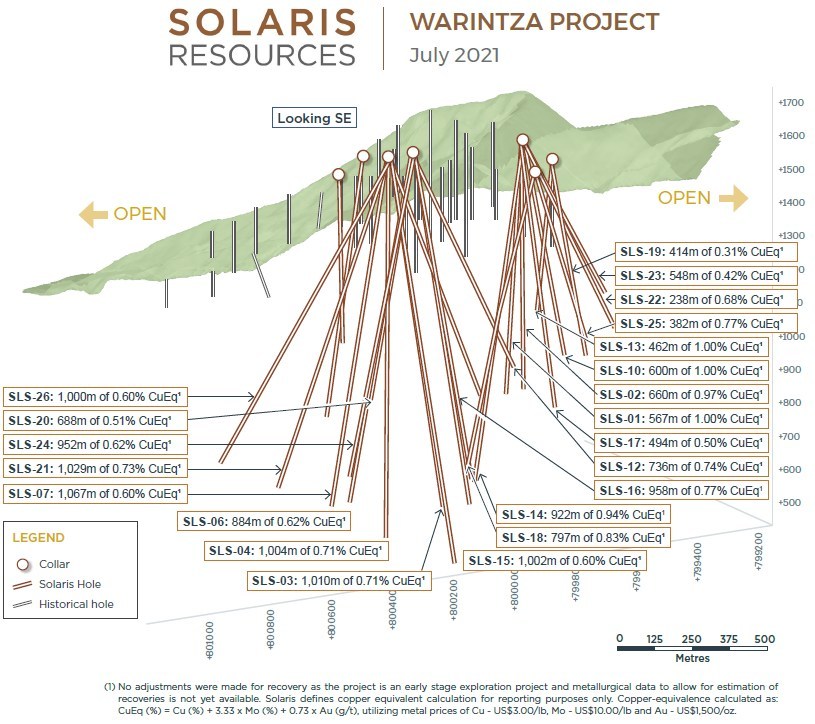
Figure 3 – Plan View
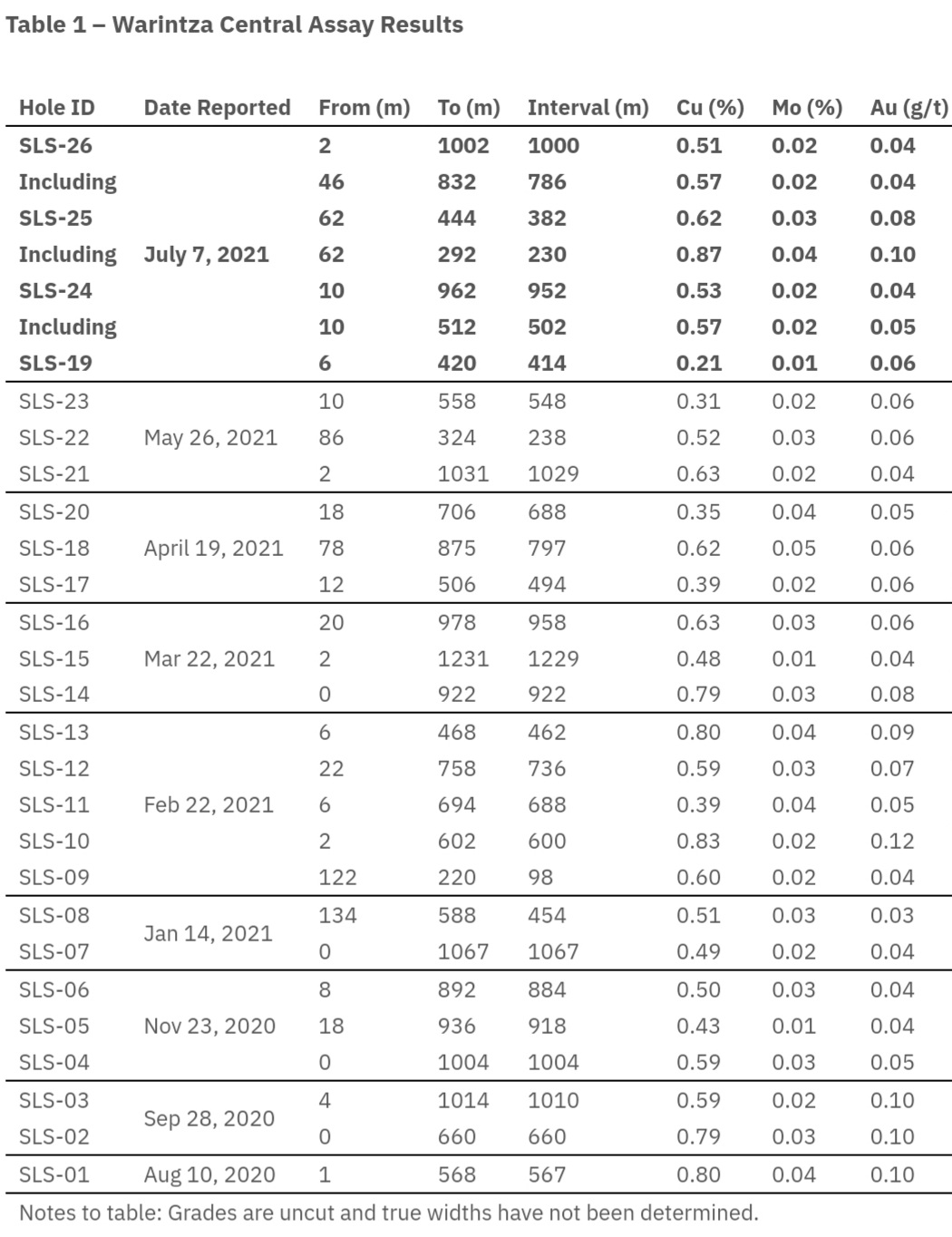
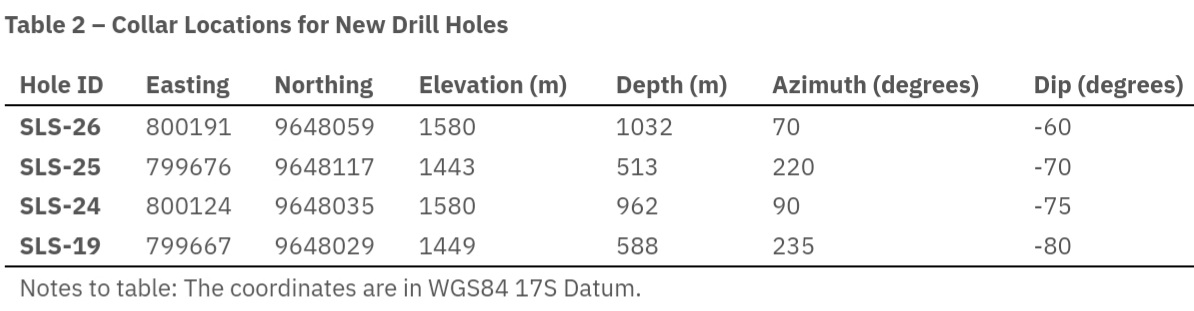
Multiple Projects, Multiple Prospects
Advancing copper projects across the Americas, Solaris is advancing quickly, particularly at its flagship Warintza Project in southeastern Ecuador. The company also boasts its Tamarugo and Ricardo projects in Chile, the Capricho and Paco Orco projects in Peru, and 60% of the La Verde joint-venture project in Mexico with Teck Resources. Warintza is located 85km east of Cuenca in a mainly rural part of the Cordillera del Condor. The area is an inland mountain range that forms the border between Ecuador and Peru. The area is a copper-rich territory, with Ecuacorriente also operating the Mirador mine 40km north of Warintza.
The property comprises five main targets with a 5km by 5km cluster of copper porphyries identified on the property so far. With key targets at Warintza Central, Warintza West, and Warintza East, there are plenty of opportunities for positive reported results. Drilling at Warintza East began this year, and the company expects to report results sometime in the coming quarters of 2021.
With other undrilled regional targets still available to the company, Warintza is by far the only project in the company’s sights. It is exploring multiple properties simultaneously to distribute resources and effort.
The Warintza project discovery was made in the early 2000s by legendary mine finder David Lowell, who discovered 17 major mineral deposits over his lengthy and storied 50-year career. One of his major discoveries, the largest copper deposits in the world La Escondida in Chile in 1981 was a launchpad for an illustrious career discovering some of the most mineral-rich deposits in the world. Warintza is set to become another accomplishment for the late Lowell, as Solaris Resources continues to advance the project.
The above references an opinion and is for information purposes only. It is not intended to be investment advice. Seek a licensed professional for investment advice. The author is not an insider or shareholder of any of the companies mentioned above.
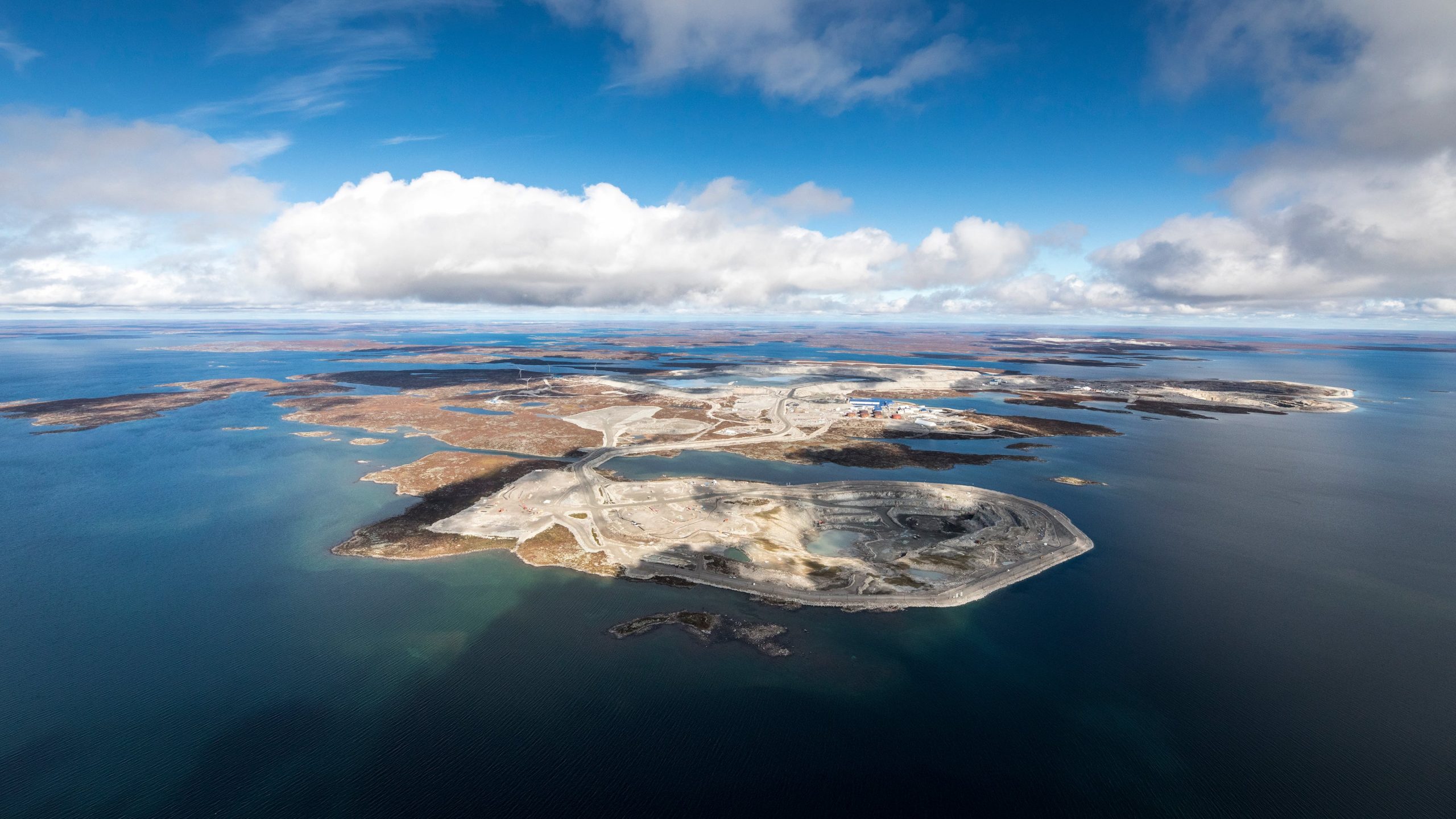
Diavik property, Canada. Source: Rio TintoCopper stocks are on a tear this year, in no small part due to the rising price of copper as supply shortages and a surging demand boom converge to create some of the best conditions in recent history for stocks. While the current climate has been more than favourable for copper stocks, they have often had an advantage historically over gold and other precious metal stocks due to the red metal’s multiple industrial uses.
Rio Tinto (NYSE:RIO)
Producing iron ore, copper, diamonds, gold, and uranium, Rio Tinto is one of the largest mining companies in the world. The stock has doubled in the past year, reflecting the company’s return to near-full production capacity as well as a lifting of lockdown restrictions in the 35 countries it operates in globally.
Southern Copper Corporation (NYSE:SCCO)
With mining operations located in Peru and Mexico along with exploration operations in both those countries plus Chile, Southern Copper is one the largest integrated copper producers. The last year has seen SCCO stock soar 110%. Investors who have held the stock must be happy to see their positions double over the past 12 months.
Solaris Resources (TSX:SLS)
As a junior mining company, Solaris Resources holds a large amount of potential. The company is focused on its flagship Warintza project in Ecuador, for which it has reported positive assay results as it continues to expand the project to adjacent sites. Investors seem to like the progress, because the stock is up over 1000% since the IPO less than a year ago.
Freeport-McMoran Inc. (NYSE:FCX)
This company operates large and long-term geographically diverse assets that hold reserves of copper, gold, and molybdenum. The company’s scale is used to maintain a dominant position in the market, using properties like the Grasberg mineral district Indonesia, which is one of the largest copper and gold deposits in the world, to fortify its balance sheet. FCX stock is up 370% in the past year, as investors continue to pile into this veteran mining company delivering year after year.
Conditions Are Ripe for Copper Miners
Mining companies exploring and producing base metals like copper usually have higher dividend yields than hedges against inflation like gold stocks. They are also generally better value as they sit cheaper in relation to earnings and cash flow. With a low P/E, copper stocks usually have less distance to fall if markets take a hit, and the upside is higher when the stock runs. With lower risk and higher potential reward, copper stocks are always in favour with the investing community for short, and long-term plays.
Short-term, copper should be able to benefit from the rising demand coming from increased battery production and clean energy storage solutions. The increase of electric car sales and the electrification of infrastructure and power grids around the world requires huge amounts of copper to transport and store the energy. Labour shortages and technical delays in some regions of the world have also contributed to a general slowdown in copper production, but as 2021 rolls on, the environment is looking strong for copper mining companies and their stocks.
The above references an opinion and is for information purposes only. It is not intended to be investment advice. Seek a licensed professional for investment advice. The author is not an insider or shareholder of any of the companies mentioned above.
Solaris Resources (TSX:SLS) (OTC:SLSSF) continues to forge ahead at its flagship Warintza project in Ecuador; maiden drilling has begun at its Warintza East site. Located approximately 1km east of Warintza Central, it is one of five main targets with a 7km x 5km cluster of porphyry targets at the property. With a similar expression at Warintza Central, Warintza East is set to become another fruitful exploration site for the company.
Major News
Solaris (TSX:SLS) (OTC:SLSSF) has also defined a major copper porphyry target at Yawi after continued processing of geophysical and geochemical data. This extends the strike length of the Warintza cluster of porphyry targets to 7km, a massive bump in the potential for the project. Listed below are some of the highlights from the recent results and accompanying press release:
- Commenced maiden drilling at Warintza East, located approximately 1km east of Warintza Central, where recent drilling has intersected 1,029m of 0.73% CuEq¹, including 420m of 0.83% CuEq¹ from surface (see press release dated May 26, 2021)
- Warintza East is one of the five main targets within the 7km x 5km cluster of porphyry targets defined on the property and has a similar expression as Warintza Central, with overlapping copper and molybdenum soil anomalies associated with an underlying high-conductivity anomaly
- Further processing of the geophysical dataset (see press release dated February 16, 2021 for initial results) has revealed a much more extensive, high-conductivity anomaly at the recently-identified Yawi target, located approximately 1.5km to the east of Warintza East
- The large-scale geophysical anomaly at Yawi coincides with overlapping copper and molybdenum stream sediment anomalies; field crews are now completing additional sampling and reconnaissance work to define locations for initial drill testing
- Weather conditions are improving at site and drilling activities are once again ramping up, with eight drill rigs turning, the ninth rig set to commence in the coming days and the tenth rig being delivered
Source: Solaris Resources
The Warintza East site is the new frontier in the expanding Wartinza Project that continues to return positive assay results from its drill program. Located one kilometre east of the main Warintza Central site, East sits at a slightly lower elevation, with the target being defined by overlapping copper and molybdenum soil anomalies associated with an underlying high-conductivity anomaly. Warintza East’s first hold was collared in weathered porphyry uncovered by earthworks. The discovery was made during drilling platform construction.
Experts Agree; This is “A New Era for Solaris” (TSX:SLS) (OTC:SLSSF)
Mining engineer Lennin Munoz, commenting on the beginning of drilling at Warintza East, said, “For me, this is driving a new era for Solaris. This reflects what you get when you are in a porphyry cluster area; your targets will come and come. The upside is clear in all directions. The byproducts trend in Yawi’s direction is confirmed with these anomalies.”
Additionally, Solaris (TSX:SLS) (OTC:SLSSF) has identified a high-potential target at Yawi through the processing of geophysical data covering the 5km strike of the Waintza porphyry cluster known at the time. The geophysical anomaly appears to be an elongated lobe on the easter boundary of the area. Once coverage was extended more to the east, stream sediment sampling has more than doubled the size of the anomaly, defined the target area, and created an exciting development for the future of the drill program. Yawi field crew are not completing additional sampling and reconnaissance work for confirmation and to select specific locations for initial drill testing.
Vice President of Exploration for Solaris Resources Jorge Fierro commented: “We are very excited to commence the first-ever drilling at Warintza East, targeting the third major copper porphyry discovery within this richly-endowed but underexplored property. In addition, further data processing has revealed a much more extensive porphyry target at Yawi than previously understood with additional sampling now underway.”
Positive Results Continue to Flood In
The commencement of maiden drilling on top of recent positive assay results from the Warintza Central site has continued to push the stock higher. Thirty-one holes have been drilled at the Warintza Central site, with promising results having been reported for 22 of those drill holes. The new first hole at Wartinza East (SLSE-01) now aims to explore the new anomaly that extends continuously from Warintza Central to the target in the east.
Figure 1 – Long Section of 3D Geophysics Looking Northeast
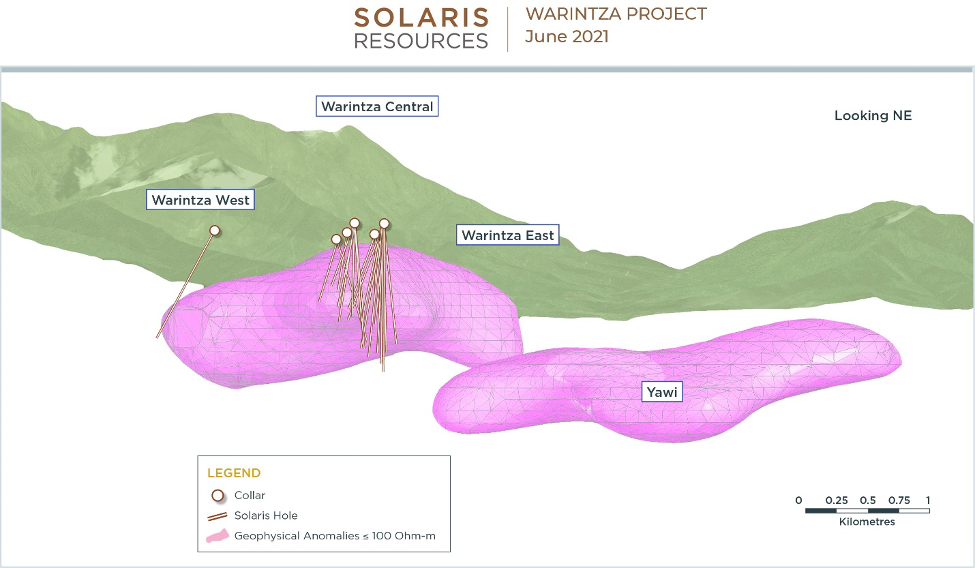
Note to Figure 1: Figure looks northeast and depicts high-conductivity geophysical anomaly (defined at 100 ohm-m) generated from 3D inversion of electromagnetic data, encompassing from left to right Warintza West, Central, East, and the Yawi target (Warintza South lies off image to south).
Source: Solaris Resources
Figure 2 – Plan View
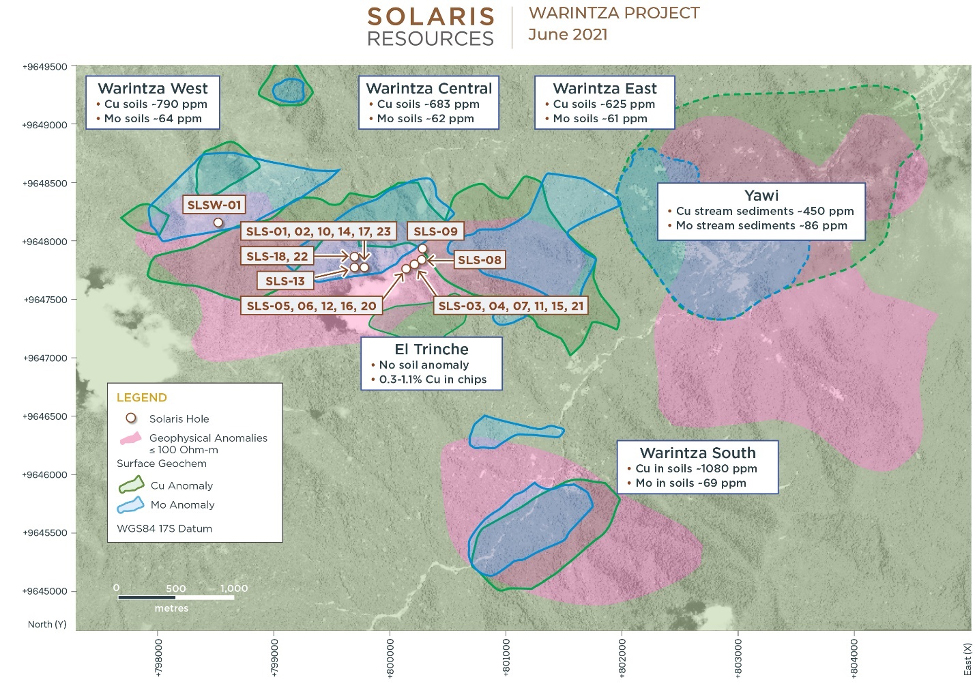
Source: Solaris Resources
The above references an opinion and is for information purposes only. It is not intended to be investment advice. Seek a licensed professional for investment advice. The author is not an insider or shareholder of any of the companies mentioned above.
Junior mining companies are the prime drivers of new IPOs for the mining industry. The rewards for investing in these companies often far outweighs the risks, as getting in on the ground floor of a junior mining company can mean triple digit percentage point gains or more. Still, there are many questions on investors’ minds before they invest in a mining company, including the company’s plan for exploration, and how to evaluate whether the junior miner has a good chance of success.
Due diligence and risk management are just as essential when investing in junior mining companies, but factors as wide ranging as the strength of the management team and technical advisors, as well as the company’s ability to finance its exploration with a strong balance sheet, to the viability and potential of its chosen drill sites. Paying attention to the financials, operations, and the drill plan and results are all required to make better decisions when investing in junior mining companies. To get a better understanding of this potentially highly lucrative investment strategy, we spoke with Lennin Munoz, a geo engineer and mining industry veteran.
Mr. Munoz was able to provide us with some of his insights into why it is important to take a broad overall look of the company, as well as a detailed assessment of its drilling results and management philosophy.
Taking a deep dive into a junior mining company means going beyond the headlines and getting in the financials, and using critical analyses like NAV, IRR, CAPEX, and more to make an informed decision.
What are the critical analysis points you use to determine the strength and viability of a project?
Desirability, Viability, Feasibility and Sustainability. Inside the desirability angle for example if I look for a tier 1 or 2 deposit, I’ll definitely start with geology, for me the ORE BODY IS ALL! So good tonnage and grade is a key factor (e.g 1 Bt 1%Cu or 200 Mt 2g/t Au), then I analyze the viability of the project, for example, potential to be developed, metal production profile, CAPEX intensity, All in Sustaining Cost position in the cash cost curve. Then, I incorporate the feasibility perspective for example, mining methods, high grading programs in first years (payback), Geotech & hydrogeology, metallurgy, processing, tailings and water management, etc. This review helps me to complete my SWOT analysis, so at the end I include the sustainability framework to have a clear map of risks and opportunities, so I can at least measure which is my main risk and what the company is doing about it.
All of this process is summarized in a model where I define the metrics to rank investment opportunities, for example, NAV, IRR, payback, CAPEX, others. I like to calculate NAV/share since this is a comparable metric with the market value and I could make decisions according to my risk/reward ratio.
How important is the environment, social, and governmental (ESG) aspect for a junior mining company? How important is it for you as an investor, and are the companies doing this right changing views on the mining industry?
ESG is here and these important three letters are a must in any project valuation, for example, I use to review assets using a mining economics framework split in desirability, viability, feasibility, and sustainability (I used the Hutton model), is in this last point that ESG plays a key role, a decisive point that can determine any GO or No GO; my experience in the industry tells me that you can have the best skarn deposit, with a tremendous mine plan, already approved by your company’s board and be in a BFS stage, but without an environmental view, a social acceptance, will not fly. Or it can, but is this sustainable in the long term?
It’s difficult, will not be easy, net zero emissions as an example will be a very expensive initiative, but is here, I’ll try to be in Minexpo this September, I’ve reading very interesting material about new technologies in different vendors, thinking in carbon emissions, green energy, or any other idea aligned with the ESG framework.
Last but not least, and by the way I think the most important part, the social aspect, is that the industry is turning mindsets and thinking about how you can work in the same environment for mutual benefit. Learning from other’s mistakes through history is a very powerful tool in this sector. I think most of the developers are changing the strategy to implement a real social, and sustainable model.
Which companies are proving out those ESG commitments and critical analysis points the best right now?
Particularly, I really like what Solaris Resources (SLS.TO) is doing in Warintza, Ecuador. This is not an easy task, a lot of effort on the ground is required, and of course you need a tier 1 team to do that, a very skillful one that can understand what is happening and what are the needs of all the stakeholders. This level of envelopment is so incredible that Lasso and Arauz mentioned the project in public interviews, so the relevance of the project is across the country.
Let’s continue with what Anglo American (AAL.L) is doing, for example they are clear about the feasibility of 100% renewable energy for the Quellaveco Project; this is a very important greenfield development for Peru, first autonomous project, 100% renewable!
Another example is Vale (VALE), after Brumadinho in 2018 and all the facts down the road, they are turning to dry stacking tailings facilities, we are at an inflection point about waste management. Going to dry stacking is not cheap but thinking in long term and safety for stakeholders as a crucial factor to put the project in the feasibility side, could be invaluable.
Which mining jurisdictions do you feel are providing the strongest advantage for junior mining companies right now?
I like stable jurisdictions like the USA or Canada, my gold positions for example are there but I think more work on the permitting front should be improved.
I like what Ecuador is doing now, when you listen to a president (Lasso) talking about mineral resources development plans for the long term? They want to be a main exporter of commodities, like Chile or Peru.
I like Chile too, but this situation about the mining tax program proposal should be solved ASAP. In the same line, Peru, I think we’ll be good, we need to work more on the ESG front and establish long term plans to develop greenfield projects, but without a social view, it will be difficult. I like these countries but for sure stability is needed.
With copper’s coming supercycle, should the industry be concerned about supply/demand dynamics?
No, we are in a middle of a stock/global consumption rate amber alerts, but this is driven as a consequence of lower production rates from previous periods, I think big players will join the party during 2021 and 2022 and the price will correct – I expect a pullback in base metals in the next quarters, I expect a support range of $3.5 – $4.0/lb in the long term as new consensus. However, if we consider the current stress scenario in LATAM I’d say that if in the short term the situation in Peru and Chile is not solved, copper prices can expect a lot of volatility without precedents.
How might this tailwind play out in the short/long-term?
In my experience this situation is split in 2 channels, short term, where operations are printing cash at these prices, and operations in the early stage can be more flexible to run high grading programs, at the end the ones sitted in the first quartile of the cost curve like Southern are having a good year.
In the long term, the increase in copper price assumption has a direct impact in the cutoff calculation, this item is used to define the mineral reserves or in practical terms, the profitable ore, the lower cutoff, the higher reserves inventory you have (if the modifying factors allows this upgrade), so, if you present an annual information format (AIF) with additional reserves, it’s very probable you submit in parallel an update technical report (e.g NI 43 101) and therefore your valuation will be different, you expect to see an extension of the life of mine, more metal production, potential upsides, etc.
So it sounds like a positive environment for junior copper mining companies exploring over the next decade?
Absolutely, let’s take the long term explanation bove, marginal projects at $3/lb can be considered now in the development pipeline at these prices, which will depend on metrics but yes, upside is at hand.
Which companies/metals are on your watchlist or your prime investment candidates?
I like asymmetrical investments, and I think junior companies can provide that. Right now, a junior copper company is my favorite one. I like the “cost opportunistic” view, so if one thing is good, why gamble on things you don’t know? I think speculation is part of the markets but in my portfolio or watchlist, at least I consider companies where I can understand what they are doing, but if I can calculate the NAV under my method, that is a place where I will wait patiently.
The Mining Stocks Lennin Muñoz is Watching
Solaris Resources: (SLS.TO)
This junior copper mining company has driven forward recently with positive assay results, the expansion of drill holes at its flagship Warintza Project in Ecuador, and stock growth generating massive investor value.
The stock’s uninterrupted climb has been pushed along since the company went public last year by strong results and the addition of drill holes. The company’s expansion to its Warintza East with the first drill hole is contributing to the optimism around the company, and Solaris (SLS.TO) is number one on Mr. Munoz’s mining stock picks.
Anglo American (AAL.L)
Anglo American’s (AAL.L) Quellavaco mine in Peru is a shining beacon of what a new copper mine can be, and the site is one of the largest undeveloped copper deposits in the world. It’s commitment to operating with ESG principles at the forefront of the project’s philosophy means that Quellavaco is, according to Mr. Munoz, a “very important greenfield development for Peru, first autonomous project, 100% renewable!
With one of the best mining jurisdictions in the world, Peru affords Anglo American the perfect opportunity to develop this massive project while keeping it cost and energy-efficient.
Vale (VALE)
Vale’s (VALE) commitment to improving the maintenance and safety of its dams gives it a unique advantage in the industry right now. The company’s plans to increase the share of dry processing in its production to 70% by 2023 will allow it to reduce the use of dams in its operations.
By investing in the implementation of dry stacking disposal technology, this initiative shows that we “are at an inflection point about waste management, “said Mr. Munoz. “Going to dry stacking is not cheap but thinking in long term and safety for stakeholders as a crucial factor to put the project in the feasibility side, could be invaluable.”
The above references an opinion and is for information purposes only. It is not intended to be investment advice. Seek a licensed professional for investment advice. The author is not an insider or shareholder of any of the companies mentioned above.
Mining companies are some of the biggest and most productive economic machines in the world. Mining produces important minerals and metals that are essential to the smooth functioning of society. Without mining, there would be no technology, no buildings, no electricity, and no global economy. For most, mining brings to mind some misconceptions about the industry and how it operates. It’s time to explore some of the positive effects of mining and get into the transformatively powerful effects of responsible mining around the world.
Kinross (NYSE:KGC) (TSX:K) Harvests Water From Snow in Chile
The Maricunga and La Coipa mines, located in the Atacama Desert approximately 4,000 metres above sea level, are some of the driest places on earth. Like everywhere else, water is critical to the ecosystems and wetlands that play host to wildlife including vicuna, flamingo, and guanaco. To ensure those habitats can thrive, Kinross Gold Corporation has implemented measures to improve the area’s water efficiency.
In 2011, the company installed 100-metre lines of wooden snow fencing. The fencing’s goal is to ensure that snowmelt infiltration into the groundwater is more efficient. This is helping to bring meaningful contribution to the local water supply. On top of that, Kinross and the Chilean National Irrigation Commission are exploring a joint research project. The project will investigate and test the snow harvesting tactic for potential use in other water-stress areas of Chile. The mining company is contributing resources and people to the job, and making a serious contribution to the country and the regions they operate in beyond the jobs and economic stimulus that their projects create.
Golden Star Resources (TSX:GSC) Builds a Health Centre
Golden Star Resources (TSX:GSC) has been a busy member of the Ghanaian community, particularly when it comes to healthcare. The company provides National Health Insurance Scheme coverage for every single employee as well as their immediate families. Golden Star was the winner of the PDAC 2018 Environmental and Social Responsibility Award, so it may come as no surprise that the company goes far beyond what is asked. The company has upgraded local clinic to provide services to all of its employees, and even built a health centre at Nsadweso, an Outpatients Department at the Prestea Government Hospital, nurses quarters at Bogoso, a mini-clinic at Brakwaline, and a community health post a Bondaye.
On top of all of the health infrastructure development Golden Star Resources (TSX:GSC) is doing, the company is also a supporter of Project C.U.R.E.. The project has delivered 29 containers of medical equipment, serving over 18 million people since 2003. Golden Star is a great example of how healthcare and wellbeing are integral to positive contributions for stakeholder communities and a company’s employees.
Solaris Resources (TSX:SLS) Flies in To Save a Child
Mining companies often need to operate in remote locations, where they are usually responsible for building and maintaining infrastructure and other services. Companies can be a powerful partner in these areas. Solaris Resources (TSX:SLS), a copper mining company with significant operations at its flagship Warintza Project in Ecuador, was exactly the kind of community partner needed in times of trouble for one 10-year-old patient.
When a child became ill and needed an emergency evacuation to a hospital in the border community of Banderas, near Peru, Solaris allowed for the air transfer of that child immediately and helped coordinate the rest of the transfer once the helicopter landed at Edmundo Carvajal airport in Macas. Since the location was so difficult to access, a helicopter was the only option, and Solaris (TSX:SLS) was able to coordinate the transport quickly, demonstrating that a powerful community partner from the mining industry could make a major difference in the lives of all stakeholders.
A statement from the Integrated Security Service and Lenin Moreno, Ecuadorian president at the time, read, “The work coordinated between security forces, citizens, and private enterprise made it possible to provide assistance at the right moment.”
Miners Continue to Be Strong Allies
While it may not always be obvious what private industry and communities can accomplish together, the results are clear. When government, citizens, and private enterprises in the mining industry come together for a common purpose, the industry is able to consistently demonstrate its ability to step up to the plate and hit home runs.
The above references an opinion and is for information purposes only. It is not intended to be investment advice. Seek a licensed professional for investment advice. The author is not an insider or shareholder of any of the companies mentioned above.
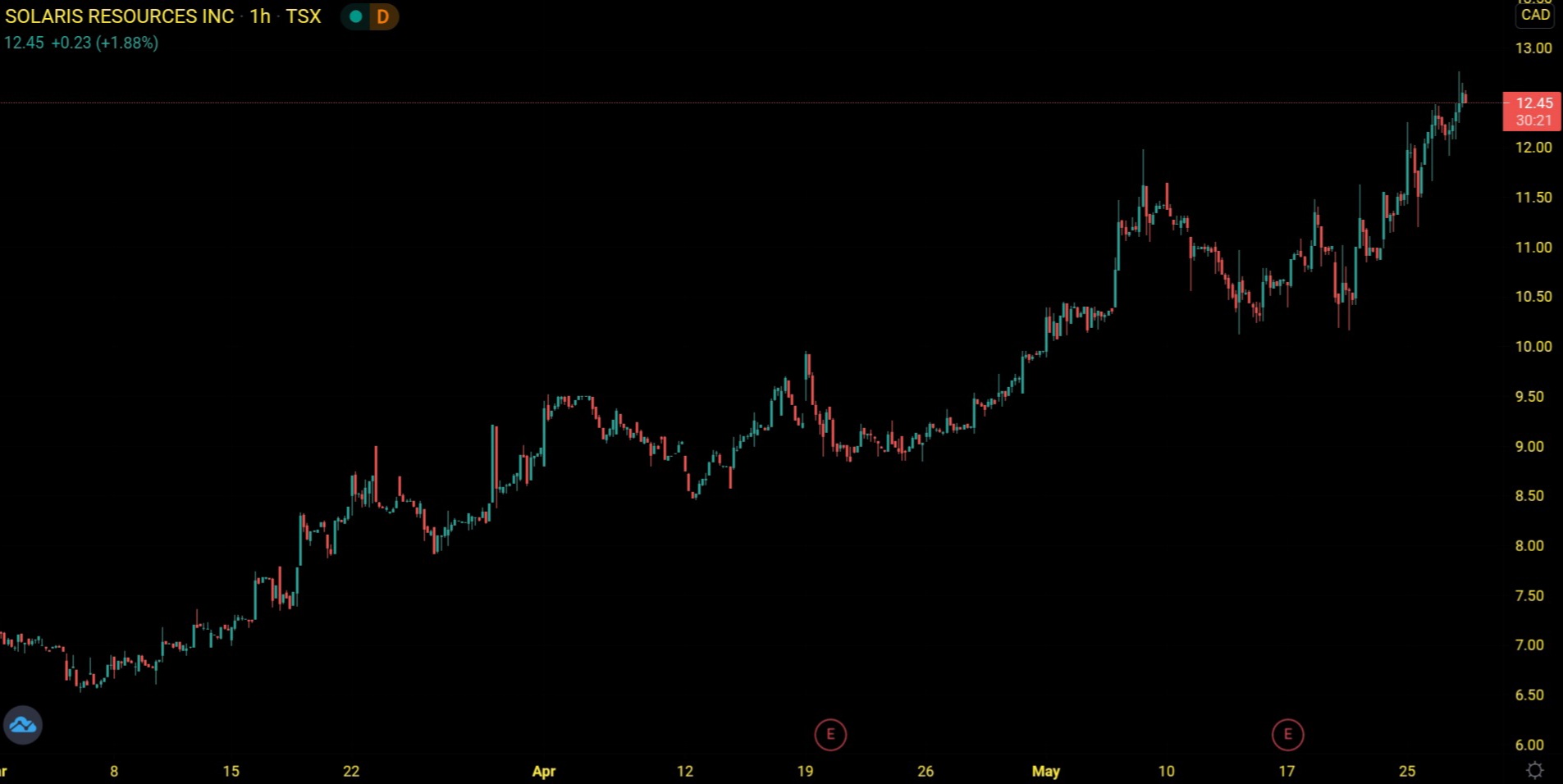
Vancouver-based Solaris Resources (TSX:SLS) is hitting a regular stride as the company continues to report positive assay results, expands its drill holes at its flagship Warintza Project, and continues to see strong stock growth.
Yesterday saw Canaccord Genuity analyst Michael Pettingell maintain a Buy rating for Solaris Resources (TSX:SLS) with a price target of C$12.50. As of May 27 12:16 EST, that target has already been broken.
How High Could It Go?
The stock has seen a steady, uninterrupted climb as it moves from strength to strength. With a strong balance sheet, the company has been able to move forward on all of its projects, with a particular emphasis on its Warintza Project in Ecuador. The project has seen strong results, and has reported for 22 of 31 holes drilled so far at the site.
The company continues to expand the project, and has begun with its first drill hole at Warintza East, sitting east of the Warintza Central site. The target has returned positive results already, and the stock is reflecting the optimism the results are setting. As more results are reported, the trend is likely to continue and possibly accelerate. The stock is also a value play considering the current trendline that could see it rise to $25 or higher.
As Solaris (TSX:SLS) continues to set new all-time highs, investors might be wondering when they should get in. However, it’s clear from the chart that any moment since the first day of trading would have been a good time to buy.
Positive Results Driving Positive Investor Returns
Solaris Resources (TSX:SLS) has released new assay results from new drill holes at the company’s Warintza Project in south-eastern Ecuador. The company announced results from three additional drill holes at Warintza Central, for a total of 31 holes drilled at the site. Results have been reported for 22 of them, with results looking very promising:
- Three additional holes at Warintza Central, as detailed below, have extended the drill defined envelope of high-grade mineralization to the east and west over a strike length of over 1,100m and open and to a depth up to 1,200m, with the highest-grade mineralization starting at surface
- SLS-21 was collared on the eastern side of Warintza Central and drilled into an open volume to the east, returning 1,029m of 0.73% CuEq¹, including 420m of 0.83% CuEq¹ from surface, extending the limits of mineralization to the east, with the hole terminating prematurely in mineralized porphyry
- SLS-22 was collared on the north-western side of Warintza Central and drilled into an open volume to the west, returning 238m of 0.68% CuEq¹, including 100m of 0.77% CuEq¹, extending the limits of mineralization in this direction
- SLS-23 was collared on the south-western side of Warintza Central and drilled to the west, returning 548m of 0.42% CuEq¹, including 352m of 0.46% CuEq¹ from surface, extending the limit of mineralization in this direction
- Maiden drilling is set to commence at Warintza East, which is one of the five main targets within the 5km x 5km cluster of copper porphyries identified on the property and has a similar geochemical and geophysical expression as Warintza Central
- To date, 31 holes have been drilled at Warintza Central with results reported for 22 of these. Unusually heavy rain in Ecuador has significantly impacted the pace of drilling productivity and platform construction over recent months, however weather conditions are now sporadically improving and the planned ramp-up of drilling activities is expected to resume
Source: Solaris Resources
Solaris has ventured into its new site, Warintza East with the first hole (SLSE-01) being collared in weathered porphyry stockwork mineralization. The mineralization was first discovered by earthworks during drilling platform construction.
The target located at the site is defined by overlapping and molybdenum anomalies that hold similar values to Wartinza Central. With approximately 1,200 m in diameter, the high-conductivity anomaly extends continuously from Warintza Central to the target in the east.
Figure 1 – Long Section of 3D Geophysics Looking Northeast
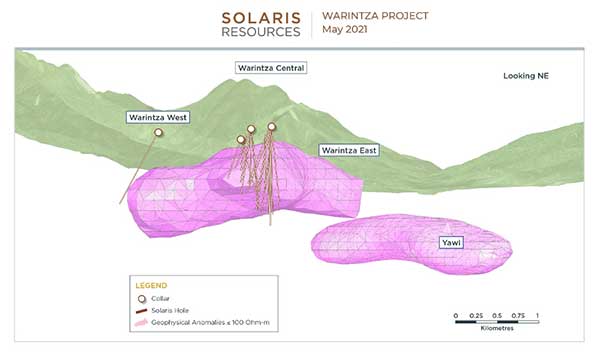
Note to Figure 1: Figure looks northeast and depicts high-conductivity geophysical anomaly (defined at 100 ohm-m) generated from 3D inversion of electromagnetic data, encompassing from left to right Warintza West, Central, East and the newly-discovered Yawi target (Warintza South lies off image to south).
Figure 2 – Long Section of Warintza Central Drilling Looking Southeast
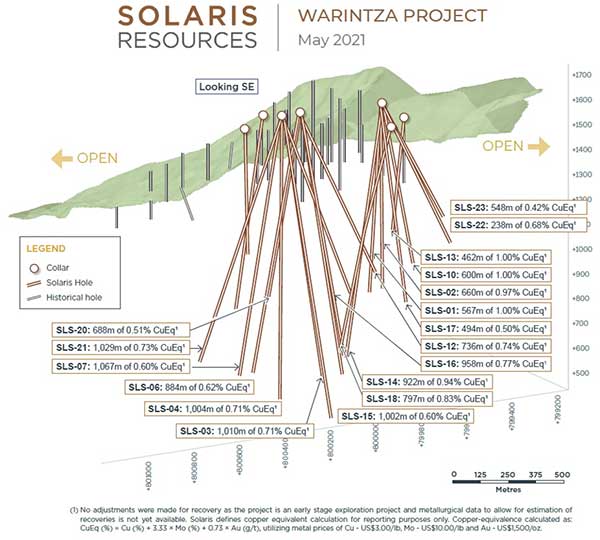
Figure 3 – Plan View
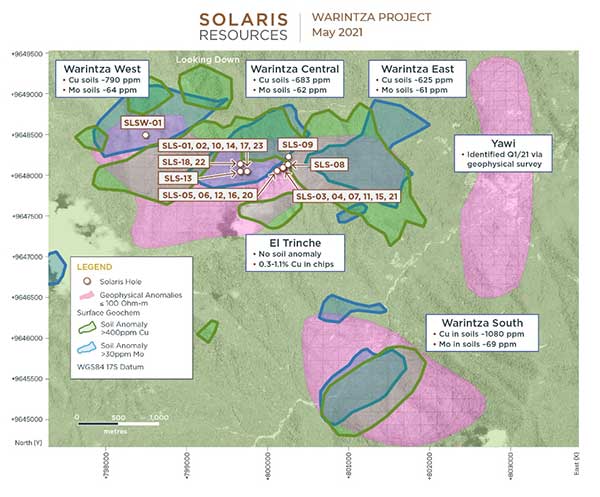
Source: Solaris Resources
The above references an opinion and is for information purposes only. It is not intended to be investment advice. Seek a licensed professional for investment advice. The author is not an insider or shareholder of any of the companies mentioned above.
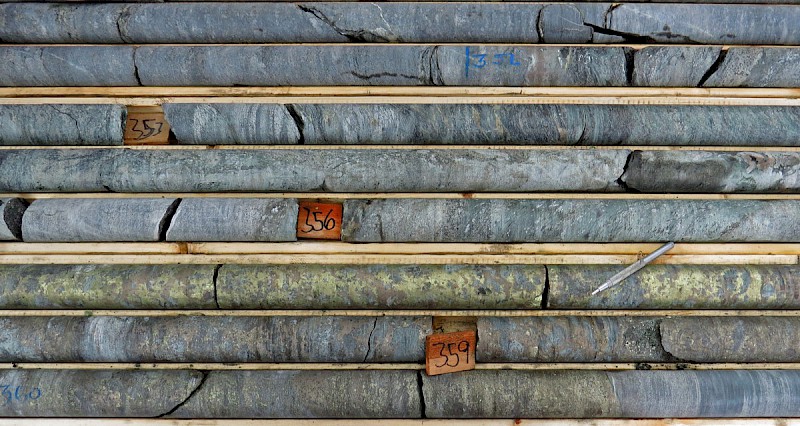
Foran Mining Corp. (TSXV:FOM) (OTCQX:FMCXF) has announced that Fairfax Financial Holdings Limited has entered into a letter agreement for a CA$100 million investment in Foran Mining Corp. (TSXV:FOM) (OTCQX:FMCXF) in exchange for common shares, non-voting common shares, and warrants. Divided into multiple tranches, the deal will allow Foran Mining Corp. (TSXV:FOM) (OTCQX:FMCXF) to rapidly advance its McIlvenna Bay project and centralized mill for the Hanson Lake district.
The company has been eyeing exploration in the district as it continues to expand operations in the region. The letter highlights that the funding will also enable investment in key technological and operational research and equipment and general corporate purposes.
A Major Vote of Confidence
The significant private placement is a decisive vote of confidence in the company and its business model and will be subscribed in two tranches:
- Tranche 1 – CAD$50 million gross proceeds, comprised of 27,777,778 voting common shares (the “Common Shares”) at a price of CAD$1.80 per Common Share, along with warrants to purchase an aggregate of 8,000,000 million Common Shares (the “Warrants”). The Warrants have an exercise price of CAD$2.09 per Common Share and an exercise period of five years.
- Tranche 2 – CAD$50 million gross proceeds, comprised of 27,777,778 non-voting common shares (the “Non-Voting Shares”) at CAD$1.80 per Non-Voting Share, along with 8,000,000 Warrants.
Source: Foran Mining Corp.
Foran shareholders know that the advantages the company holds are numerous including its 100% owned McIlvenna Bay deposits and the broader Hanson Lake district. Foran Mining Corp. (TSXV:FOM) (OTCQX:FMCXF) plans to build the world’s first carbon-neutral copper mine. The company has stiff competition, though, with companies like Solaris Resources (TSX:SLS.TO) and Rio Tinto (NYSE:RIO) setting carbon-neutral goals for their projects as well.
Creating a True Partnership Through Investment
For now, the expansion of its exploration efforts and current projects could continue to deliver substantial shareholder value, and efforts should be significantly strengthened by Fairfax’s global network of business partners. Foran Mining Corp. (TSXV:FOM) (OTCQX:FMCXF) has strong established ties with banking partners to support the exploration of potential ESG products; the goal of these initiatives is to enhance the overall investment return for all stakeholders, from shareholders to the communities in which the company operates.
The financing is still subject to TSX Venture Exchange approval and Foran Mining Corp. (TSXV:FOM) (OTCQX:FMCXF) shareholder approvals, plus some other standard closing procedures. For now, Fairfax will not be granted any Foran Mining Corp. (TSXV:FOM) (OTCQX:FMCXF) board seats as part of the deal.
The above references an opinion and is for information purposes only. It is not intended to be investment advice. Seek a licensed professional for investment advice. The author is not an insider or shareholder of any of the companies mentioned above.
The world continues to watch the mining industry for signs of a serious commitment to the decarbonisation efforts sweeping the global economy. Company after company continues to put their effort and money where their mouth is. The latest company to jump onto the net-zero train is Ivanhoe Mines (TSX:IVN), committing to net-zero greenhouse gas emissions at its Kamoa-Kakula Copper Mine.
The company’s CEO, Robert Friedland, will be speaking today at the 2021 Goldman Sachs Copper Day and made the announcement before his speech.
The mine is expected to be the world’s highest-grade major copper mine and should begin producing its first copper concentrates soon. The Phase 1 mining rate is expected to be 3.8 million tonnes per year, with an approximate feed grade of more than 6%. Phase 2 should see a ramp-up to 7.6 million tonnes per year, and with the proposed expansion to 19 million tonnes, Kamoa-Kakula could end up being the world’s second-largest copper mining complex.
The company’s ambitions don’t stop at production. The way Ivanhoe plans to mine is focused on support from a green electricity grid and a plan to reduce the use of fossil fuels until the net-zero emissions goal is reached. Electric, hybrid, and even hydrogen technologies are proposed for trucks and transportation. While the upfront investment will cut into the cash on Ivanhoe’s balance sheet, the costs down the road from reduced fuel costs, lower ventilation costs, and even lower health and safety costs as the healthier and cleaner technologies pose less of a risk to workers will more than make up for those initial investments.
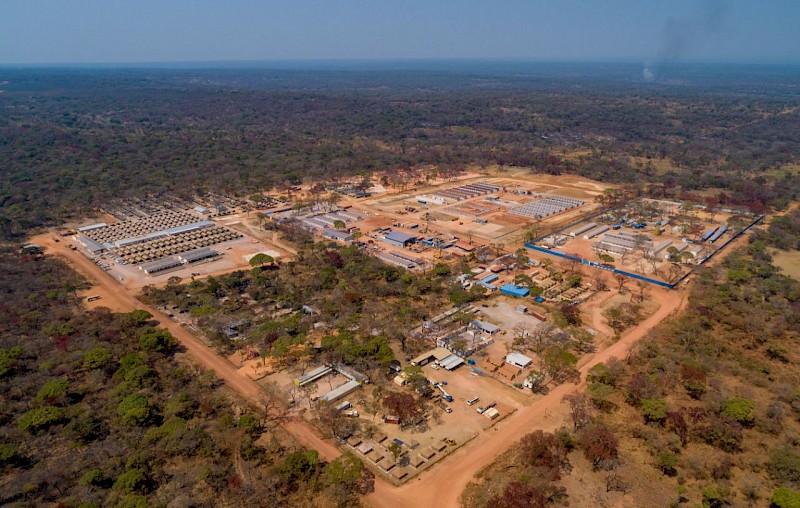
The Canadian company is not just following but leading the way when it comes to large-scale net zero emissions projects. Its Kamoa-Kakula copper discoveries in the Democratic Republic of Congo (DRC) have opened the opportunity for the project to become one of the world’s largest and make the company one of the world’s largest copper producers.
Pushed along by the Paris climate agreement and the Canadian government’s initiatives in reducing emissions to zero by 2050, copper mining companies like Ivanhoe (TSX:IVN), Solaris Resources (SLS.TO), and Glencore (LON:GLEN) are pledging their efforts to the critical cause. This is not just because of the ethical and environmental benefits, but because investors also demand these commitments now. Without a plan for the environmental, social, and governmental (ESG) principles in the planning stages of projects, investors may be hesitant to commit capital.
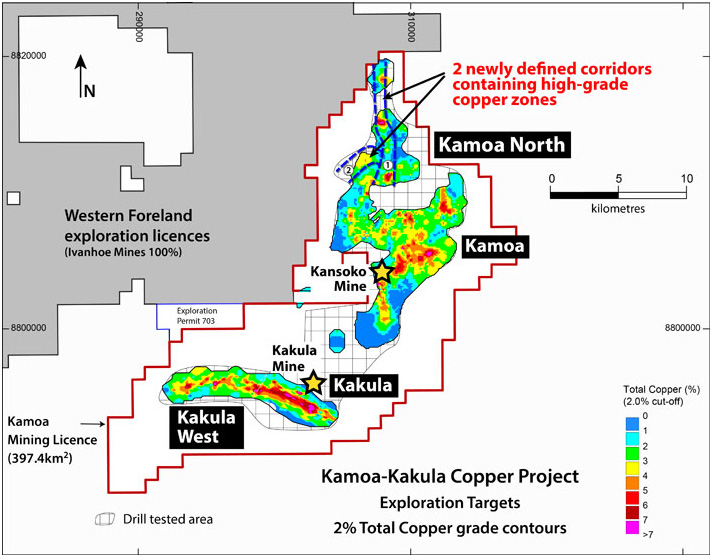
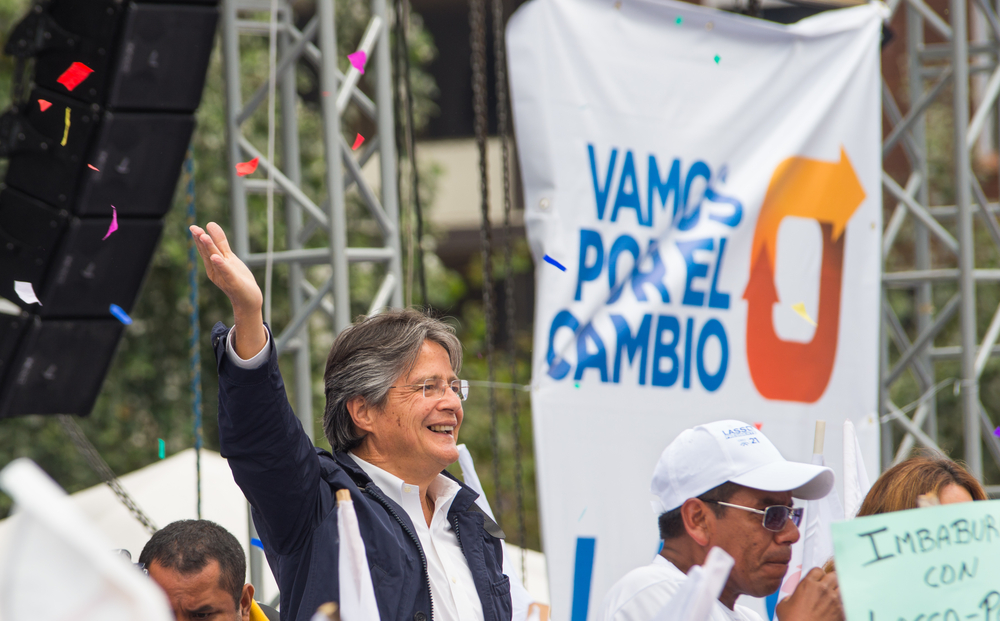
Ecuador’s election on April 11th ushered in a new era for the mining industry. The country’s new president Guillermo Lasso won the runoff with 52.5% of the vote, and opposition leader Andrew Arauz conceded defeat. Both candidates were mining-friendly options for the nation that holds some of the richest copper and gold deposits in the world.
Mining Heaven
The country has been a supporter and profitable ground for mining companies to operate in, giving mining companies wide latitude for their operations while ensuring that consultation and standards are upheld at every stage. Going forward, the mining industry will need to keep those environmental principles at the forefront of their operations, as countries like Ecuador and their new president Lasso are promoting open policies for boosting investment in the private sector while balancing environmental responsibility.
The government at both the federal and local levels is consulted regularly for mining projects because of the consultation needed for projects operating with the approval of local communities. The need to protect the land they work in and ensure the safety of the local communities is paramount to a long-term partnership in the modern mining environment. Ecuador has been a solid and reliable partner in this sense, providing mediation between opposition groups and the companies that bring jobs and economic growth to the region.
Proposals relating to mining within Lasso’s government plan framework include:
- To exploit mining resources with the application of international best practices to protect the environment
- Regulate the sector to promote legal and responsible mining
- Design a plan that maximizes mining benefits while safeguarding environmental well-being
- Appoint a Minister of Environment and Water who is concerned with environmental conservation but who will accompany and support the use of non-renewable natural resources.
- Promote new concessions, as well as compliance with all regulations for the care of the environment and water sources
- Work synergistically between the public and private sectors to develop public policies for economic and environmental development
- To present a legal framework with regulations that:
- Ensure the growth of the mining sector and care for the environment
- Dismantle illegal practices by strengthening border security
- Respect intangible zones
- Establish criminal liability and obligation to repair and compensate for infringement of environmental quality standards
Source: Guillermo Lasso’s government plan
As the pandemic slowed the country’s economic growth, Lasso will look to the mining industry to support the recovery over the coming years. 46% of Ecuador’s Foreign Direct Investment from 2017 to 2020 was generated from the mining industry. A significant portion of GDP comes from the sector, giving Lasso a clear direction for where to focus efforts.
Responsible Growth
Mining in Ecuador accounts for a large portion of the direct and indirect jobs in the country and is one of the most critical sectors for the country. It was one of the few that grew in 2020, as the pandemic shut down most economic activity. Simultaneously, the president has pledged that the sector must grow responsibly, as he considers illegal mining to be the greatest threat to economic development and environmental protection. Despite the pandemic and rising death toll, mining companies continue to operate unhindered by restrictions as the industry pushes forward on exploration, discovery, and production.
To accomplish his economic goals while preserving environmental integrity for the miners in the region, Lasso has tried to establish an open dialogue with environmental groups and indigenous Ecuadorans. The goal is for the government and miners to work in tandem with those groups to ensure respect for their culture and their customs.
The industry has little to worry about in the way of obstruction or barriers, as the president has also said he would like to appoint a Minister of Environment and Water who is open to and will support the use of non-renewable natural resources. The mission to protect Ecuador’s natural beauty and the local communities will be balanced with the mission to maintain and grow a flourishing mining industry.
A Favoured Project
It seems the new president even has a favourite partner for the sector, touting the Warintza Project in an interview on national television in early April before the election. A visit to the project should be coming imminently, as the potential of the project to be a key production source is massive.
The company taking the charge for the project is Solaris Resources, a Canadian copper mining company. Solaris has begun exploration at the site and plans to start drilling at Warintza East and South this quarter. The company has follow-up discovery drilling planned at the Warintza West site as well, with maiden drilling at Yawi and the Caya gold anomaly in the second half of the year.
Three additional holes at Warintza Central are bearing out high-mineralization results, with the highest grades starting at the surface. Solaris’ recent press release highlighted some of the progress made on the project:
- SLS-17 was collared on the western side of Warintza Central and drilled into an entirely open volume to the south, returning 494m of 0.50% CuEq¹ from the surface, extending the southern limit of mineralization in this direction
- SLS-18 was collared on the western side of Warintza Central and drilled into an open volume to the southeast, returning 797m of 0.83% CuEq¹ from near-surface, including 370m of 0.94% CuEq¹, adding mineralization between the western and eastern drilling at Warintza Central
- SLS-20 was collared on the eastern side of Warintza Central and drilled into an entirely open area to the north, returning 688m of 0.51% CuEq¹ from surface, including 366m of 0.60% CuEq¹, extending the limit of mineralization in this direction
- To date, 28 holes have been drilled at Warintza Central, with results reported for 19 of these; results for SLS-19 were delayed by geotechnical issues during drilling but are expected in the near future
Clear Skies Ahead
Having a new president in office and a willingness to push forward at full speed for the mining industry, Ecuador is sure to be a reliable and robust partner for miners like Solaris over the coming years.
With the lifting of restrictions on drilling and more discoveries at Warintza, a global economy heating up after the freeze of COVID-19, and a deposit-rich region, the future is looking very bright for miners in Ecuador.
The above references an opinion and is for information purposes only. It is not intended to be investment advice. Seek a licensed professional for investment advice. The author is not an insider or shareholder of any of the companies mentioned above.

The Paris climate goals and the transition away from fossil fuels toward electrification are set to create an unprecedented surge in copper demand, according to Goldman Sachs’s new report on copper. The global investment bank is forecasting a long-term supply gap of 8.2 million tonnes of the metal by 2030, “twice the size of the gap that triggered the bull market in copper in the early 2000s.” This would be the “highest on record” and would set the tone for the 2020s making this period the strongest phase of volume growth in global copper demand in history.
Copper’s Importance
The world isn’t just moving away from fossil fuels, but it is actively working on reducing and reversing some of the warming effects of greenhouse gases. The impact of climate change costs the global economy hundreds of billions of dollars. Investing in clean technologies is the antidote. The investment in technologies like carbon capture and storage technology, renewable energy, and electrification of everything from cars to manufacturing means that copper will have a critical role to play in this new economy.
The centrality of the red metal makes it a critical component for strategic investments both from private businesses and governments. The countries willing to invest in the infrastructure and support for mining companies now will have profits coming in steadily over the next decade. Some have even called copper a national security issue due to its strategic value.
A Shortage That Threatens National Security
The high value, current under-investment, and lack of tier one mines makes it a potentially destabilizing force as many countries classify certain metals as strategic. For context, one only needs to look at history.
The wars of the past 50 years have been fought for several reasons, but one of the prime motivators for conflicts in the Middle East was oil. Winning the war meant rebuilding the infrastructure in the region and therefore gaining a foothold in the supply. This was highly valuable to foreign countries and the mining companies extracting these extremely strategic resources.
The countries with abundant copper deposits sitting within their borders may ultimately come to realize that the global demand and urgency of the commodity will drive its importance for the largest economies in the world. As the scramble continues and even accelerates as demand multiplies, those countries may find themselves standing between powerful corporate interests and the governments fighting to secure the supply required for their needs. A shortage of copper would mean a fierce fight for the material that is certain to play a significant role in the large and developed economies accelerating toward net-zero emissions right now. With most countries targeting 2050 for this goal, copper’s demand will likely grow fastest in the first half of the century and continue into the second. By the middle of the century, it will be necessary for a plethora of manufacturing, products, and energy supply and storage.
Each of these functions could easily fit under the national security blanket, pushing countries to nationalize supply or even move aggressively, as happened during the Iraq wars. The good news is that copper mining companies are exploring and developing those projects now and are setting themselves up to be right in the middle of this boom, taking advantage of a supercycle that will drive profits for decades.
Goldman Puts Things Into Perspective
Goldman’s prediction that the copper price would reach $6.80 per pound by 2025 is a significantly bigger statement, demonstrating that the investment bank believes that copper will not need to wait until 2050 to see new peaks in demand spiking regularly. According to their recent report, prices will also spike regularly, breaking highs and setting new records within as little as four years from now. This past February, copper hit a multi-year high, foreshadowing a sliver of what is to come.
Analysis
The authors of the report, Nicholas Snowdon, Daniel Sharp, and Jeffrey Curries estimate that demand from electrification “will grow nearly 600% to 5.4Mt (million tonnes) in our base case and 900% to 8.7Mt in the case of hyper adoption of green technologies” by 2030. In the conservative base case, copper miners would see a massive demand to be filled surge faster than current production and production plans can accommodate. In the case of “hyper adoption of green technologies,” the world is likely to see a problematic copper shortage that is certain to push the price higher and faster.
The authors continued: “Crucially, the copper market as it currently stands is not prepared for this demanding environment. The market is already tight as pandemic stimulus (particularly in China) has supported a resurgence in demand, set against stagnant supply conditions. Moreover, a decade of poor returns and ESG concerns have curtailed investment in future supply growth, bringing the market the closest it’s ever been to peak supply.”
Steep Trendlines
The report forecasts a copper price of US$15,000 per tonne by 2025, up from today’s price of around $9,000 per tonne today. To get a sense of the trend, the report included estimates of the average price by year:
- 2021: US$9,675/t
- 2022: US$11,875/t
- 2023: US$12,000/t
- 2024: US$14,000/t
The culmination in 2025 at $15,000 would mean huge profits for miners as well as a need for new greenfield project approvals.
Driving Prices
The demand driving the copper price stems from three main drivers of green copper (copper mined cleanly):
- Electric vehicles (EVs)
- Solar power
- Wind power
Goldman estimates a 2021 sales volume of 5.1 million EVs in 2021, with that number rising to 31.51 million in 2030. Just to meet that demand, current copper production might need to double or triple. Including charging units (of which Goldman estimate 30 million will be installed by 2030), accessories, batteries, and other power storage needs, copper demand seems to be almost incalculable. Conservative estimates make it seem like production is far behind, and the top end of the range requires unprecedented investment in the industry for new projects.
How is it Going?
Right now, the copper market is not prepared for this demand. The massive copper deposits to be found in the Andean Copper Belt, being discovered and explored by miners like Solaris Resources, EcuaCorriente, and SolGold are set to become some of the most valuable projects in a high-value copper region.
Some analysts disagree with the borderline alarmist analysis in the report, with opinions often coming down on the side of caution where prices are concerned. According to TD Securities, “Commodity demand is being supported by a weakening dollar amid a consolidation in U.S. interest rates and fiery risk appetite. Demand continues to pick up, but as the world exits the pandemic and begins to ramp up production, “…metals supply risk is likely to subside from here, adding some pressure to industrial metals prices.”
It seems that for now, there is no perfect consensus as to where the copper market might end up. While demand is guaranteed to increase, the scale of supply risks and production worries are still speculative and do not add up to a definitive answer on where the balance lies. There will no doubt be an imbalance as demand outstrips supply for the next decade, but analysts are still split on how big that gap might be. In either of Goldman’s scenarios, the situation seems quite dire, with the price ending up in the stratosphere. TD Securities seems to temper that outlook somewhat, without disputing the key point here that copper prices are set to rise no matter what.
No matter which side of the spectrum you might fall, the next decade is sure to be a wild ride for everyone with a piece of this cake, and is guaranteed to bring a sugar high for decades to follow.
Copper miners are always looking for more. More ore, more mines, and more copper to refine and get to the market. The demand for copper is growing at such a fast clip that companies can’t keep up, so ‘more’ is the only word that matters now. For that, they need to go to the regions they are most likely to find the valuable red metal. One location is promising to deliver the copper necessary to meet the incredible demand over the coming decades.
The Andean Copper Belt
Northwestern South America, including Colombia, Ecuador, Peru, and Northern Chile is host to some of the richest copper deposits in the world. The area’s geology is among the earth’s most richly mineralized, making it an exciting area choice for the companies that are just testing the surface of hugely prospective sedimentary copper basins in those countries. This mineral-rich piece of prime mining real estate is referred to as the Andean Copper Belt.
The 2500-kilometre mineralized arc formed during the Lower Paleozoic eric around 300 million years ago. This mineral-rich multi-country zone has been sitting dormant for millions of years, and now copper miners are able to benefit from this region to help meet the current and coming copper boom.
Tip of the Iceberg
What’s impressive is that initial exploration of sedimentary basins in Colombia, Ecuador, and Peru might be the tip of giant icebergs of sediment-hosted copper-silver deposits sitting underneath. If the theory is proved, it would mean billions of pounds of copper and hundreds of millions of ounces of silver lay hidden just beneath the land in the Andean Copper Belt. Copper miners could be working on and extracting copper from the region for hundreds of years, and the work still wouldn’t be finished.
Exploration efforts are expanding quickly in countries like Ecuador at mines like Warintza, and while the pandemic may have slowed progress in 2020 a little, copper demand hasn’t. Mining companies in the area like Solaris Resources will be in a position to fill that demand as it increases over the next few years and into the coming decades.
Sedimentary Copper
Ocean basins composed of porous materials such as sandstone, limestone, and black shale area where copper deposits are formed. The copper and other minerals travel up and become trapped in the rock layers. This mineral deposition is different from a copper porphyry deposit, which is ultimately formed when a block of molten-rock magma cools. The magma might come from underground or aboveground volcanoes, or simply the earth’s crust as it is pushed upward over time.
The cooling then leads to a separation of dissolved metals into distinct zones of copper, molybdenum, gold, tin, zinc, and lead. By the time humans are ready to mine it, it has been sitting in the earth for millions of years, waiting for a capable miner prepared to put it to good use.
Copper porphyries are often visualized as a bag of flour, with millions of grains of rice (copper and other minerals). They are spread across a large area. Sedimentary copper deposits are much more concentrated, sitting underground on top of each other like a stack of books.
Ecuador First
For miners operating in the Andean Copper Belt, both types present a wealth of minerals. The exploration and production efforts of the companies in the region are exciting and lucrative. Anyone paying attention to the area and the metal that is fast becoming one of the most valuable should pay attention to any and all progress on this front.
Ecuador in particular is positioning itself as a mining-friendly partner to Western mining companies. According to government officials, the mining industry could represent up to 4% of the country’s GDP this year, up from 1.6% in 2018.
Who Are the Players?
To accomplish this, Ecuador has opened the market to more business-friendly regulations in order to attract foreign capital. This has brought strong development partners in the private sector from countries like Canada, China, and the United States.
Lundin Gold (LUG.TO)
Lundin Gold is in the basin but does not expect to encroach on copper miner’s territory as their work is focused on the Fruta Del Norte gold mine in Ecuador. The company sent off its first industrial-scale exports of gold from the mine in December 2019, and despite a slight slowdown in 2020, is still producing regularly. The project and the company also have the support of a mining-friendly government that is ensuring Ecuador is a substantial mining partner.
EcuaCorriente
EcuaCorriente owns the Mirador copper mine. The company is a subsidiary of Tongling Nonferrous Metals Group and China Railway Construction. The mine has estimated reserves of 3.2 million tons of copper, 3.4 million ounces of gold, and 27.1 million ounces of silver. The first copper exports from the company left the country in July 2019. EcuaCorriente has been a great test case for how profitable exploration and discovery efforts can be in the region.
Solaris Resources (SLS.TO)
Fulfilling the abundant promise of the Andean Copper Belt, Solaris Resources has made a significant new discovery at its Warintza copper project in southeast Ecuador. A geophysical study revealed a much more extensive porphyry system than anticipated, sparking a drill rig expansion that saw the rig count double from 6 to 12. Early results are promising, and the company will have its hands full in 2021, expanding the project and starting production soon after.
Solaris will have a grid for Warintza that includes clean, low-cost electric power and the ability to get supplies in and out of the site easily due to well-developed infrastructure. Ecuador’s abundant supply of freshwater eases the company’s work significantly as well. As a result, capital costs for the project will be much lower than average.
As drill results continue to come in and the company moves from discovery to production, their flagship Warintza project in this piece of prime copper real estate is set to be the launchpad for years and decades of significant results.
The above references an opinion and is for information purposes only. It is not intended to be investment advice. Seek a licensed professional for investment advice. The author is not an insider or shareholder of any of the companies mentioned above.

It sure looks good when public companies have a lot of volume from individual investors, institutions, and large funds on the open market. It proves that the company has something of interest to many groups and that they see their investment as a source of profit or return in the future. Confidence is key here, and that’s a good thing.
What happens if an insider at the company is a significant buyer and insiders control a majority of the shares? Any news of insiders buying up more shares of the company they manage or own is a signal that not only are current operations delivering good value, but that future plans will equate to more.
Taking Control
The recent news that Equinox Gold, the company from which Solaris Resources was born, sold Solaris shares and Warrants to Augusta Investments and another strategic shareholder for up to C$132.5 million was one of those signals. Corporate and insider ownership now accounts for almost 70% of its share structure, giving shareholders and future investors confidence that the people running the show have solid plans for the present and future of the company. Of particular note is the potential for significant porphyry discoveries at the Warintza Project in the coming year and years ahead.
A Strong Belief
TD Securities sent out a research note about the buying noting that Augusta founder and chairman Richard Warke purchased 7 million units of Solaris from Equinox at C$8.25, a stake totalling C$57.5 million. According to Bloomberg, this makes Solaris the leader by amount when it comes to insider buying in the materials sector (past 12 months). On top of that, Mr. Warke has purchased approximately C$57 million in open market transactions. Looking at the chart since the company went public 8 months ago will give you a clear picture of why.
Looking Into The Crystal Ball
Since becoming a public company, it has only risen every month, and it seems poised to keep going. TD’s 12-month target price is C$13, but based on the trend since becoming a public company, this seems conservative. Mr. Warke’s buying spree comes on the heels of a 1000% return since the IPO last year, and it’s no wonder management and other insiders love owning the stock. Clearly, they see that the future has the potential to build on the success of the past.
The above references an opinion and is for information purposes only. It is not intended to be investment advice. Seek a licensed professional for investment advice. The author is not an insider or shareholder of any of the companies mentioned above.
Mining companies often have their hands full with multiple projects spanning locations in different regions, countries, and sometimes continents. This can create complications for operations, but if the company has the right management and operational experience, having a variety of projects on the go at the same time can be a serious benefit.
Typically driven by low commodity prices, large mining companies are beginning to shift away from project diversification to focus on their best projects to increase competitiveness. By doing this, many companies believe that it will allow them to compete more effectively in specific sectors and make the most of what they have. While this can be effective for some, having a range of projects complementing each other, while maintaining focus on one or two flagship projects has proven to be a successful format for others.
Having a portfolio of projects is also necessary so that holdings are sufficiently diversified and exploration does not have to stop when one project is not moving forward. While it is good to have many projects, focus is also necessary for the proper and effective execution of any mining strategy. For a company like Solaris Resources operating in the Americas, a diversification strategy has been beneficial for their exploration and production efforts, but they have been able to balance this with a particular focus on one mine.
Flagship Status
The Warintza Mine in Ecuador discovered by David Lowell has been the flagship project for Solaris since its inception, and exploration and development has been focused on there for some time now. With the news of the added drill holes and capacity coming, the company is preparing to double down on that success while bringing out the best in the work being done there with ESG principles and particular zero-carbon project planning.
Getting Everyone Involved
The emphasis on consultation, local employment, educational practices, and ESG principles has made Warintza not just the flagship of the Solaris portfolio, but an example in the industry of how things can be done the right way while ensuring stakeholder success at every level. Prior to beginning work on the site, thorough consultation was done with the Shuar Nations of Warints and Yawi, to establish trust and transparency from the outset. In any long-term effort, starting off on the right foot is essential. This consultation process ensured that the project would get off to a good start while maintaining open communication with the local community. Transparency was also ensured by acquiring full permitting, and no Administrative Silence was allowed.
Considering the diversity and robust mining infrastructure, Ecuador is perfectly placed to complement the company’s work and extensive employment opportunities have been extended in the local and surrounding communities. The project is bringing jobs to the area while making everyone feel good about the work they are doing. The result is a community that understands the impacts and benefits of the project, was involved with the planning, and is able to directly benefit from its success. This win-win approach is not just good messaging, but part of the operational ethos of the company for the project, and has helped the company deliver transparency, education, and inclusion from the start.
History
The mine itself was discovered by David Lowell in 2000 but was largely dormant since 2001. At the time, Ecuador was a frontier jurisdiction with no commercial mining industry. Things began to change in 2014 when the government shifted its policy in the wake of the collapse of the oil sector to encourage mineral development. The change was fuelled by Lundin Gold acquiring the Fruta del Norte project, 45 km south of Warintza, and developing it in a socially and environmentally responsible manner. This improved sentiment toward mining development and created conditions for Solaris to successfully restart a dialogue with the communities surrounding its Warintza Project in 2018. After extensive dialogue with local and surrounding communities, the root causes of conflict were resolved, and by mid-2019, an innovative CSR program was instituted. By the time 2020 rolled around, the company had signed an Impact and Benefits Agreement with community stakeholders after a government-sponsored prior consultation process, and Solaris Resources was able to restart exploration on the project in earnest.
Looking Back
When tracking the company’s progress, it might be helpful to do so by following the trajectory of the stock over the past 8 months. After listing as a spin-out of Equinox Gold, Solaris’ mission began to explore and develop the Warintza Project in Ecuador. Once results started to come in, a pattern began to emerge:
- July 18, 2020: Solaris lists at $1.50.
- August 10, 2020: SLS-01 returned 567m @ 1.0% Cu-Eq effectively extending mineralization to depth below historical drilling, averaging 200m and improved upon the estimated resource grade of 0.56% Cu. Price: $2.43.
- September 28, 2020: SLS-02 returned 660m @ 0.97% Cu-Eq which confirmed further extension of higher-grade mineralization relative to historical drilling. SLS-03 returned 1,010m @ 0.71% Cu-Eq and collared 426m east of the first two holes, and further improved upon depth-extent of known mineralization. Price: $4.30.
- November 23, 2020: Three drill assays (including the first campaign at Warintza West) included SLS-04 returning 1,004m @ 0.71% Cu-Eq, SLS-05 returning 918m @ 0.5% Cu-Eq, SLS-06 returning 884m of 0.50% Cu , further extended mineralization relative to historical depth. Price: $5.72.
- January 14, 2021: SLS-07 returned 1,067m @ 0.60% Cu-Eq, bottoming in mineralization beyond the 150m depth of the corresponding historical hole, and SLS08 returned 454m @ 0.62% Cu-Eq both effectively extending mineralization to the north and northeast. Price: $6.59.
- February 16, 2021: SLSW-01, the first hole drilled at Warintza West, returned 798m @ 0.31% CuEq (0.25% Cu, 0.02% Mo, and 0.02g/t Au), extending mineralization to Warintza West. Price: $6.90.
- February 22, 2021: SLS-10 returned 600m @1.00% Cu-Eq, SLS-11 returning 668m @ 0.57% Cu-Eq), SLS-12 returning 736m @ 0.74% Cu-Eq, and SLS-13 returning 462m @ 1.00% Cu-Eq. Price: $7.27.
- March 22, 2021: SLS-14 returned 922m @ 0.94% CuEq, SLS-15 returned 1,002m of 0.60% CuEq from near surface, SLS-16 returned 958m of 0.77% CuEq from near surface, extending mineralization between east & west. Price: $8.70.
Contrary to the common narrative of many miners that list and consistently lose value as their discovery efforts return less than expected or nothing, the company’s story appears to be the exact opposite based on the eight-month period they have been a public company.
Moving Forward
The project has turned out exceptionally well for the company, and last month Solaris made it clear that it wants to expand on the success it has had so far by doubling the rig count and beginning to drill new holes, all while maintaining that commitment to the community and the ESG principles the project was planned with. The company’s press release highlighted some of the recent impressive results from the 20,200 metres that have been drilled so far at the mine:
- Three additional holes at Warintza Central, as detailed below, have returned long intervals of high-grade mineralization, with the highest grades starting from the surface, and extending mineralization between the eastern and western drilling and stepping out to the southwest.
- SLS-14 was collared on the western side of Warintza Central and drilled into an open volume to the east, returning 922m of 0.94% CuEq¹ (0.79% Cu, 0.03% Mo, and 0.08 g/t Au) from the surface, including 850m of 0.98% CuEq¹ (0.82% Cu, 0.03% Mo, and 0.08 g/t Au), significantly extending the limits of mineralization.
- SLS-15 returned 1,002m of 0.60% CuEq¹ (0.52% Cu, 0.01% Mo, and 0.04 g/t Au) from surface, including 694m of 0.67% CuEq¹ (0.57% Cu, 0.02% Mo, and 0.05 g/t Au) within a broader interval of 1,229m of 0.56% CuEq¹ (0.48% Cu, 0.01% Mo, and 0.04 g/t Au), stepping out to the southeast and extending mineralization to depth.
- SLS-16 returned 958m of 0.77% CuEq¹ (0.63% Cu, 0.03% Mo, and 0.06 g/t Au) from near surface, including 486m of 0.84% CuEq¹ (0.70% Cu, 0.03% Mo, and 0.07 g/t Au), extending mineralization between the eastern and western drilling at Warintza Central.
- To date, 20,200 metres have been drilled at Warintza Central in 25 holes of which results have been reported for 16; drilling is ongoing with six rigs currently operating and increasing to 12 by mid-year
Source: Solaris Resources
Each project has built on the success of the last, and as they expand, each step continues to pour more fuel into a tank driving the company from one milestone to the next. Not only do they stand to benefit from the expansion of the project, but from all of the future compounded gains from the Warintza mine. Drilling thus far has generated significant value for the company and stakeholders involved at every level, and with more drilling to come, one has to assume that the compounded results of that work will reflect positively on the company and stock for the foreseeable future and beyond. Lately, the stock has been balancing between $8 and $10, but with this range being tested frequently with changes of 10% or more in a single daily session, it seems investors are ready for a price above $20 or $30 now.
With the recent insider-buying activity from Solaris Chairman Richard Warke and a management team that has invested over $100M in less than a year in both private placements and on the open market, the Solaris story is proving to be a powerful one. The company has seen its share price reflect its significant progress in a very short amount of time, and it seems that the potential for moving forward is also driving much of the vigour from investors.
Potential
The company’s current market cap sits at just below $1 billion, and any breakthrough could mark a psychological shift in how the company is perceived as a result of the value generated by the Warintza project in particular. Solaris has ongoing discovery drilling that is aimed at discovery potential in 2021, meaning big news for the company may lie ahead with any discoveries this year. The Warintza Project has proved that the company’s efforts are being well-spent in the past year and that work has taken the company further than ever before.
Although progress has been made, with the expansion of the project and the focus on expanding at the same time, the company may be looking at future valuations several times greater than current levels only taking into account current rates of return. If the new drill holes and discovery plans continue at this pace or better yet accelerate, the future of the project and the company will be very bright indeed.
The above references an opinion and is for information purposes only. It is not intended to be investment advice. Seek a licensed professional for investment advice. The author is not an insider or shareholder of any of the companies mentioned above.
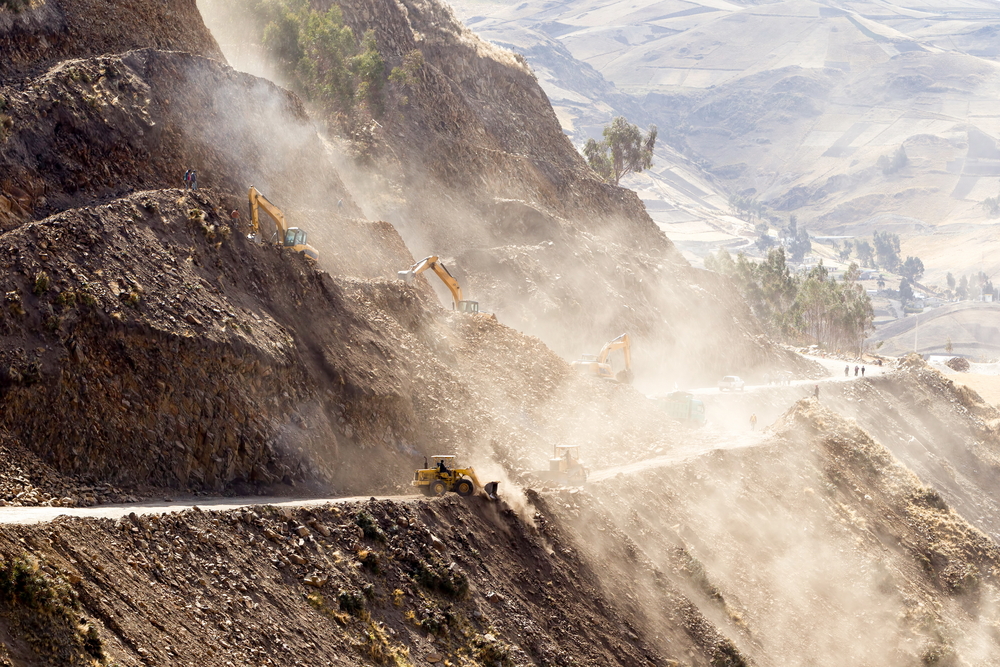 The company’s focus on the Warintza mine continues to pay off, and so expansion is in the works for six new rigs by mid-2021. 25 holes comprising 20,200 metres drilled are producing reported results for 16 of the holes so far, also included in the latest press release. Here are a few of the highlights from the release:
- Three additional holes at Warintza Central, as detailed below, have returned long intervals of high-grade mineralization, with the highest grades starting from surface, and extending mineralization between the eastern and western drilling and stepping out to the southwest.
- SLS-14 was collared on the western side of Warintza Central and drilled into an open volume to the east, returning 922m of 0.94% CuEq¹ (0.79% Cu, 0.03% Mo, and 0.08 g/t Au) from surface, including 850m of 0.98% CuEq¹ (0.82% Cu, 0.03% Mo, and 0.08 g/t Au), significantly extending the limits of mineralization.
- SLS-15 returned 1,002m of 0.60% CuEq¹ (0.52% Cu, 0.01% Mo, and 0.04 g/t Au) from surface, including 694m of 0.67% CuEq¹ (0.57% Cu, 0.02% Mo, and 0.05 g/t Au) within a broader interval of 1,229m of 0.56% CuEq¹ (0.48% Cu, 0.01% Mo, and 0.04 g/t Au), stepping out to the southeast and extending mineralization to depth.
- SLS-16 returned 958m of 0.77% CuEq¹ (0.63% Cu, 0.03% Mo, and 0.06 g/t Au) from near surface, including 486m of 0.84% CuEq¹ (0.70% Cu, 0.03% Mo, and 0.07 g/t Au), extending mineralization between the eastern and western drilling at Warintza Central.
- To date, 20,200 metres have been drilled at Warintza Central in 25 holes of which results have been reported for 16; drilling is ongoing with six rigs currently operating and increasing to 12 by mid-year.
Source: Solaris Resources
The company continues to push forward and the focus on the Warintza mine is still paying off. As new holes are drilled and new rigs are installed, capacity and production stand to increase. With the added capabilities of the additional holes, 2021 reports are sure to both impress and please investors, both current and future.
Warintza
The Warintza mine in Ecuador has been a focus for the company from the start, and the expansion shows how committed the company is to the success of the project. Backing it up is the news of the expansion of the drill holes, and the doubling of the rig count by the middle of the year.
Solaris’ commitment to increasing the value of the mine brings to mind the potential down the road for generating a profitable sale to another company. Rio Tinto’s 2018 sale of 40% of its stake in the Grasberg mine (the second-largest copper operation in the world) on the island of New Guinea was a taste of what is possible when a productive and valuable project is developed well. Selling its 40% stake to PT Indonesia Asahan Aluminum for USD 3.5 billion gave the company a massive influx of capital and an incredible return for investors in the stock.
As the mine develops and more resources are both poured into the project and extracted from it, Solaris will benefit from the dual tailwinds of their investment and the rising price of copper. 2021 is sure to be a productive year for the company’s flagship project.
If you would like to receive our free newsletter via email, simply enter your email address below & click subscribe.
 Follow us on Twitter
 Become our facebook fan
CONNECT WITH US
Tweets
Tweet with hash tag #miningfeeds or @miningfeeds and your tweets will be displayed across this site.
MOST ACTIVE MINING STOCKS
Daily Gainers
 CMC Metals Ltd. CMC Metals Ltd. |
CMB.V | +900.00% |
 Eden Energy Ltd Eden Energy Ltd |
EDE.AX | +200.00% |
| GoviEx Uranium Inc. |
GXU.V | +42.86% |
| Eagle Nickel Ltd. |
ENL.AX | +41.67% |
| Citigold Corp. Limited |
CTO.AX | +33.33% |
| Mount Burgess Mining NL |
MTB.AX | +33.33% |
| Exalt Resources Limited |
ERD.AX | +31.94% |
| Casa Minerals Inc. |
CASA.V | +30.00% |
| Cariboo Rose Resources Ltd |
CRB.V | +28.57% |
| Belmont Resources Inc. |
BEA.V | +28.57% |