Q2 Metals (TSXV:QTWO) has announced the commencement of the 2024 inaugural drill program at the Cisco Lithium Property, located within the Nemaska traditional territory of the Eeyou Istchee James Bay region of Quebec, Canada. The Spring 2024 Drill Campaign aims to test the mineralized zone where the property vendors made a discovery in the fall of 2023, known as the Discovery Zone.
The primary objective of the drill program is to test for mineralized pegmatite along strike and define the size and orientation of the Discovery Zone. Concurrently, a detailed mapping and sampling campaign is ongoing at the property to provide guidance on the extent of the lithium mineralization at the Discovery Zone and identify other potential target areas on the sizeable primary exploration trend measuring 21 kilometers long.
The Cisco Property, comprised of 222 mineral claims and spanning 11,374 hectares, is situated less than 10 km east of the Billy Diamond Highway and approximately 150 km north of Matagami, a small town with the closest rail link to much of James Bay. The property lies within the greater Nemaska Community lands of the Eeyou Itschee Territory, James Bay, Quebec.
Geologically, the Cisco Property is located along the Frotet Evans Greenstone Belt, which is comprised of a volcanic package dominated by mafic to felsic metavolcanic rocks. This belt is part of the southern James Bay Lithium District and hosts the Sirmac and Moblan lithium deposits, located 130 km and 180 km away from the Cisco Property, respectively.
On February 28, 2024, Q2 Metals Corp. announced the signing of an option agreement granting the company the exclusive right and option to acquire a 100% interest in three groups of mineral claims, collectively known as the Cisco Property. The transaction is expected to close in the near future.
As the Spring 2024 Drill Campaign progresses, the company aims to gain a better understanding of the lithium mineralization at the Cisco Property and its potential for future development. The results of the drill program and the ongoing mapping and sampling campaign will provide valuable insights into the property’s geological characteristics and guide future exploration efforts in the area.
The above references an opinion and is for information purposes only. It is not intended to be investment advice. Seek a licensed professional for investment advice. The author is not an insider or shareholder of any of the companies mentioned above.

Solaris Resources (TSX:SLS)(NYSEAmerican:SLSR) on April 17, 2024 reached a significant milestone for its flagship Warintza Copper Project in southeastern Ecuador. The company signed an updated Impact and Benefits Agreement (IBA) with the Shuar communities of Warints and Yawi, reflecting the continued growth and advancement of the project and reaffirming the communities’ support for responsible development. Here’s what’s behind the agreement and why it is such a major milestone for the project and the country.
The updated IBA followed the Ecuadorian government’s publication of a manual demanding prior consultation with surrounding communities for existing and new mining projects. This agreement built upon the strategic alliance formed between Solaris and the Shuar communities in August 2019, which has fostered direct and transparent dialogue regarding all project-related activities.
The Warintza deposit, discovered by David Lowell in 2000, sat dormant for two decades due to a breakdown in social acceptance from local communities. In mid-2019, Solaris undertook extensive dialogue to understand and resolve the root causes of conflict, leading to the signing of initial impact and benefits agreements in 2020 and 2022.
Key highlights of the updated IBA include explicit community consent for the Warintza Project, legally binding and ensuring the communities are informed and engaged throughout the project’s lifecycle. The agreement also includes commitments and benefits to the communities, such as impact mitigation measures, local employment and training opportunities, education and skills training programs, investments in community infrastructure, and financial benefits and compensation for the use of ancestral lands.
The IBA is governed by an elected Board of Directors that operates as a regional task force, monitoring project activities, communicating with employees, and ensuring accountability of the commitments made between the State, Community, and Company.
Solaris president and CEO Daniel Earle stated, “The signing of this updated impact and benefits agreement marks a significant milestone in the social advancement of the Warintza project through our pioneering participatory mining model for sustainable resource development.”
The timeline of agreements between Solaris and the Shuar communities includes a Memorandum of Understanding signed in January 2019, the first Impact and Benefits Agreement in September 2020, an updated agreement in March 2020 for project advancement and scope expansion, and the completion of an Environmental Impact Assessment on the project in late 2022.
The updated IBA ultimately demonstrates Solaris Resources’ commitment to responsible and inclusive mining practices, ensuring that local communities are involved and benefit from the Warintza Copper Project’s advancement.
Ms. Sonsoles García, Minister of Production, Foreign Trade, Investment and Fisheries, commented, “We value this initiative of Solaris because it strengthens positive community relations and provides for the integration of the local population in productive and sustainable activities. This allows the inclusion of a traditionally displaced population, which is a priority for us. It is also aligned with the priority we have as a National Government of territorial development and good use and management of resources.”
Mr. Daniel Earle, President & CEO, commented, “The signing of this updated IBA builds on the foundation of good faith dialogue and trust that led to the formation of a Strategic Alliance partnership with our host communities and original IBA in 2020. This marks a significant milestone in the social advancement of the Warintza Project through our pioneering Participatory Mining model for sustainable resource development.”
Mr. Agustin Kayuk, leader of the Shuar Warints Center and member of the Board of Directors of the Strategic Alliance, commented, “The signing of this updated IBA strengthens the working relationship with Solaris and brings greater opportunities for the development of our communities. The decision is supported by a permanent relationship with the Company based on mutual respect and transparent dialogue, as well as a history of positive impacts generated for our people. We look forward to continuing our relationship and playing an integral role in the advancement of the Project.”
Mr. Vicente Froilan Juank, leader of the Shuar Yawi Center and also a member of the Board of Directors of the Strategic Alliance, commented, “The updated IBA brings further support and new opportunities for our people. When Warintza advances, our communities advance with it. Since the signing of the inaugural IBA in 2020, and with the help of the Ecuadorian state, the local impacts in job creation, community infrastructure, and development of programs in health, education, skills training, entrepreneurship, and innovation have been evident in our daily lives.”
The above references an opinion and is for information purposes only. It is not intended to be investment advice. Seek a licensed professional for investment advice. The author is not an insider or shareholder of any of the companies mentioned above.

Arizona Lithium (ASX:AZL) has announced the commencement of production drilling at its wholly-owned Prairie project located in Saskatchewan, Canada. The project, situated in the resource-rich Williston Basin, employs conventional oil and gas drilling and completion methods to extract lithium-rich brine from aquifers approximately 2.3 km underground.
Arizona Lithium Managing Director, Paul Lloyd, commented in a press release: “I am pleased to announce that we have kicked off our drilling program on schedule. The rig has been delivered to site, the first well has been spudded and the rig is now drilling our lithium wells. Operating in a mature and well-developed oil and gas province, this enables us to efficiently access the skills and services required to develop and fast track our project. These are very deep holes being drilled by a heavy duty oil drilling rig. It will take over 40 service providers and hundreds of people to execute a drilling and completion program like this. I’d like to thank all of the vendors, their employee’s and the local community for stepping up to support our project and we look forward to updating shareholders as the large drill program progresses.”
The drilling program will span several months and cover a total of three pads. The first phase involves drilling vertical wells to assess the commercial viability of the Souris River and Duperow formations, followed by the Dawson Bay formation and specific disposal targets. Production and disposal testing of the wells on the first pad is set to begin in June, according to the Australia-based lithium developer.
Arizona Lithium’s managing director, Paul Lloyd, emphasized the complexity of the drilling and completion program, stating, “These are very deep holes being drilled by a heavy-duty oil drilling rig. It will take over 40 service providers and hundreds of people to execute a drilling and completion program like this.”
The Prairie project boasts a mineral resource of 6.3 million tonnes of lithium carbonate equivalent (LCE), consisting of 4.5 million tonnes LCE indicated and 1.8 million tonnes LCE inferred. The company aims to leverage the project’s strong environmental credentials by using less freshwater, land, and waste, aligning with its sustainable approach to lithium development.
The commencement of drilling operations marks a significant milestone for Canada’s lithium industry, as it represents the launch of the country’s first commercial lithium production plant. The project’s location in Saskatchewan, one of the world’s top mining-friendly jurisdictions, offers easy access to key infrastructure such as electricity, natural gas, fresh water, paved highways, and railroads.
Having production and disposal wells in place significantly de-risks the commercialization timeline for the Prairie project, bringing it one step closer to the commercial production of lithium, which is targeted for 2025. The ongoing drilling and completion activities across the three pads over the coming months are expected to further advance the project’s development.
The above references an opinion and is for information purposes only. It is not intended to be investment advice. Seek a licensed professional for investment advice. The author is not an insider or shareholder of any of the companies mentioned above.

In a major milestone for Potássio do Brasil, a subsidiary of Brazil Potash, the company announced on May 3, 2024 that it has begun the implementation activities of the Autazes Potash Project on May 1, 2024. The first equipment has arrived in the village of Urucurituba, in Autazes, Amazonas, and the initial hires are already taking place, marking the beginning of a transformative project for the region.
The company remains committed to ensuring quality and efficiency in every detail of the process while minimizing any environmental impact. The company prioritizes its responsibility to the people and the environment, and progress will continue in the short, medium, and long term to uphold these values. As part of its commitment to the local community, Potássio do Brasil is providing opportunities for the selection of resumes and suppliers interested in working with the company and being part of this valuable project.
The commencement of implementation activities at the Autazes Potash Project aligns with Potássio do Brasil’s purpose of ensuring food security in Brazil and the world through the extraction of potash. This milestone marks an important day for Autazes and the surrounding region, as the project is expected to bring significant economic benefits and job opportunities to the area.
Installation Licenses and Project Progress
In a series of positive developments for the Autazes Potash Project, Brazil Potash Corp. has received several installation licenses from the Amazon State Environmental Protection Institute (IPAAM). These licenses allow the company to begin construction on various aspects of the project, following several years of environmental, social, and technical studies, as well as the successful completion of local Indigenous People’s ‘free, prior, and informed consultations.
The installation licenses granted to Brazil Potash Corp. cover crucial components of the project, including the construction of a river barge port on the banks of the Madeira River, a stockpile at the port, and the drilling of two water collection wells. These licenses are in addition to the previously issued installation license for the construction of the mine shaft and underground workings. The river barge port, located near the village of Urucurituba, in Autazes, is expected to supply 2.4 million tons of potash, targeting domestic farmers in Brazil. This port is anticipated to have a higher capacity than the existing ports in the Northern Arc, which are the main route of entry for imported fertilizers in the Amazon Basin.
The additional installation licenses will have a major impact on the project’s development and operational aspects. The construction of the river barge port and stockpile will improve the project’s logistical capabilities, facilitating the transportation and distribution of potash from the mine to the market. The drilling of two water collection wells will ensure an adequate water supply for the project’s operations, supporting sustainable and responsible mining practices.
By obtaining these installation licenses, Brazil Potash Corp. will now proceed with the necessary infrastructure development and operational preparations, moving closer to the commencement of construction and eventual production at the Autazes Potash Project. These advancements demonstrate the company’s commitment to responsible mining practices and its dedication to contributing to the region’s economic growth while prioritizing environmental stewardship and community engagement.
As Potássio do Brasil begins the implementation activities of the Autazes Potash Project, the company remains firm in its purpose of ensuring food security in Brazil and the world through the extraction of potash.
The above references an opinion and is for information purposes only. It is not intended to be investment advice. Seek a licensed professional for investment advice. The author is not an insider or shareholder of any of the companies mentioned above.

Rua Gold (CSE:RUA) has announced that it has received a drone concession from the Department of Conservation (DoC) for its Glamorgan Project. The project, located on the North Island of New Zealand, is situated 2.8km north of OceanaGold’s Wharekirauponga Project (WKP). Following the receipt of the concession, Rua Gold’s exploration team has mobilized, and magnetic geophysical surveys are currently underway.
The Company has allocated a well-funded exploration program to the Glamorgan Project and has applied for minimum impact access from DoC to allow for soil sampling, resistivity geophysical surveys, and geological mapping. Rua Gold expects to receive this access in Q2 2024. Once the surface exploration work is completed, the Company plans to design a drill program and apply for full access to commence exploration drilling by the end of the year.
The Glamorgan Project has gained increased attention following OceanaGold’s inclusion of the accelerated development of WKP in New Zealand’s newly introduced Fast Track Approvals Bill on May 5, 2024. This development has created a road map for Rua Gold’s exploration activities in the area.
The Glamorgan Project comprises over 4,600 hectares in the Hauraki district, located on the North Island of New Zealand. The project’s proximity to OceanaGold’s WKP, which has Indicated resources of 1.01 Moz at 15.9 g/t, makes it a compelling exploration target. The area has a rich history of gold and silver production, with over 15 million ounces of gold and 60 million ounces of silver extracted to date.
Rua Gold’s Chief Operating Officer, Simon Henderson, has extensive experience in the area, having previously joint-ventured both the Glamorgan Project and WKP Project and being a member of the exploration team that led to WKP’s discovery.
Previous exploration work at the Glamorgan Project has outlined a zone of silicification, veining, and alteration with > 50 ppb gold in soils over a 3.8km length. Rock samples in the vicinity have returned assays of up to 95g/t gold, exhibiting classic features of an epithermal gold mineralized system.
Rua Gold is a relatively new entrant to the mining industry, specializing in gold exploration and discovery in New Zealand. The Company aims to combine traditional prospecting practices with modern technologies to uncover and capitalize on valuable gold deposits while maintaining a strong commitment to responsible and sustainable exploration practices.
The Company’s professional planning and execution are designed to minimize environmental impact and consider key stakeholders in the process. Rua Gold’s highly skilled team of New Zealand professionals possesses extensive knowledge and experience in geology, geochemistry, and geophysical exploration technology, which will be instrumental in the successful exploration of the Glamorgan Project and other potential projects in the future.
As Rua Gold continues its exploration activities at the Glamorgan Project, investors and industry experts will be closely watching the Company’s progress and the potential for significant gold discoveries in this historically productive region of New Zealand.
The above references an opinion and is for information purposes only. It is not intended to be investment advice. Seek a licensed professional for investment advice. The author is not an insider or shareholder of any of the companies mentioned above.

Despite a global copper market gripped by fears of a shortage, which has propelled prices to record levels and sparked a $49 billion takeover battle, China, the world’s biggest producer and consumer of refined copper, is maintaining production at near-record levels. The country’s expanding copper smelters are defying a scarcity of raw materials by unlocking more scrap metal for processing, thanks to higher prices.
The global copper market has been experiencing a supply squeeze on imports of ore, which smelters use as feedstock. This has led to a collapse in smelters’ fees, prompting them to pledge to reduce capacity. However, these cuts have not materialized, and China’s faltering economy is unable to absorb the excess supply.
Liang Kaihui, an analyst with Shanghai Metals Market, recently explained in an interview that the availability of scrap from discarded pots, pipes, and wires has risen quickly after copper prices surged. Fabricators have been busy turning this scrap into blister, a semi-processed version of the metal, and feeding it back to smelters as a substitute for the overseas ore that is now in short supply. The abundance of scrap is evident in its discount to refined copper, which blew out to 4,615 yuan ($637) a ton last week, the widest in at least eight years, according to SMM.
Despite the oversupply, China’s smelting industry continues to add capacity. Individual firms prefer to defend market share at the expense of margins as long as they remain profitable. Local governments also want smelters to keep churning out metal to meet economic growth targets and maintain employment levels.
The mismatch between supply and demand has become more apparent in recent days, with copper prices retreating to just above $10,300 a ton after reaching a record high of over $11,000 a ton at the start of last week. Although this still represents a 21% gain for the year, it suggests that as long as China remains oversupplied, copper will struggle to make further headway.
In a recent interview with the Financial Times, hedge fund manager Pierre Andurand predicted that copper prices could reach $40,000 per tonne ($18.18/lb) in the next few years due to the increasing electrification of the world. Andurand stated, “We are moving towards a doubling of demand growth for copper due to the electrification of the world, including electric vehicles, solar panels, wind farms, as well as military usage and data centers.”
Similarly, Jeff Currie, former Goldman Sachs executive and chief strategy officer of energy pathways at asset manager Carlyle, told Bloomberg that copper “is the highest conviction trade I have ever seen.” Currie sees copper prices reaching $15,000 a tonne ($6.80/lb).
The demand for copper in the transport sector alone is projected to increase by 11.1 times by 2050, compared to 2022, with electric vehicles containing more than a mile of copper wiring. Additionally, the demand for copper needed to expand the global electricity grid is projected to increase by 4.8 times by 2050, compared to 2022. By 2030, the copper supply gap is projected to approach 10 million tonnes, according to BloombergNEF estimates.
While copper is naturally abundant on Earth, extracting the metal at the pace necessary for an electrified economy could be a challenge. The timeline for bringing a copper mine from discovery to production is lengthy, averaging over 16 years. Top producers like Chile and Peru are facing strikes and protests, along with declining ore grades, while Russia, ranked seventh in copper production, faces an expected decline in production due to the ongoing war in Ukraine.
The above references an opinion and is for information purposes only. It is not intended to be investment advice. Seek a licensed professional for investment advice. The author is not an insider or shareholder of any of the companies mentioned above.

Golden Arrow Resources (TSXV:GRG) has provided an update on its exploration activities in Chile and Argentina. The company is currently drilling the second hole of an approximately 10,000-meter diamond drilling campaign at the San Pietro Iron-Copper-Gold-Cobalt Project in Chile, with the aim of facilitating the first Mineral Resource estimate for the project later in 2024.
Brian McEwen, VP Exploration and Development for Golden Arrow, commented in a press release: “Our field teams are fully engaged on exciting gold, copper and base metal projects both in Chile and Argentina. Drilling is progressing well at San Pietro, with the first hole already providing excellent information that will help our resource modelling. Argentina is once again a hotbed of activity, and our field work is generating excitement both internally and with potential partners in the exploration community. We look forward to strong news flow this summer and through the fall, which we think will be further supported by a robust commodity market.”
The first hole of the 2024 program (SP-DDH-14) was drilled in a sparsely tested central part of the Rincones target, to a downhole depth of 401.2 meters. Logging of the core identified four magnetite manto bodies with thicknesses of over 10 meters, starting at approximately 42 meters downhole, with visible chalcopyrite and pyrite noted. Additionally, at 350 meters down-hole, a 35-meter-wide specularite breccia with visible chalcopyrite was intercepted, which had not been identified in previous drilling. Preliminary modeling of the new information from SP-DDH-14 indicates continuity of the magnetite manto bodies with previous holes on the north and south sides of the target, and the presence of a significant new sub-vertical specularite breccia body structure.
At the Yanso Project in Argentina, the company has identified multiple targets, including the original gold target named “FAP,” which is related to a dacitic intrusive body, with a 300-meter long by 90-meter wide zone of intense phyllic and kaolinite alteration. The IP-Resistivity survey showed a good correlation between low chargeability and the intense argillic-mineralized zone, and the magnetic survey confirmed the presence of a magnetic dipole that may be associated with a buried intrusive. Three backhoe trenches across the target resulted in averages from channel samples.
Detailed geological mapping detected three additional targets that are partially outcropping along a +3km belt of alteration: FAN, Cortadera, and FAS. At the FAS target, rock chip samples collected from altered sandstones returned assays ranging between 0.13% and 1.47% Cu and between 0.5g/t and 94 g/t Ag.
In addition to the gold targets, the 2023 field program identified and sampled new zinc-lead mineralization approximately 12km north of FAP. The zinc-lead mineralization is hosted in a thick package of the Ordovician limestones of the San Juan Formation and shows similarities in style to the historic La Helvecia zinc-lead mine. Sampling of an initial creek boulder of interest at the new zinc-lead target returned an assay of 9.7% Zn, and follow-up mapping discovered a NW/vertical feeder that led to a mineralized strata-bound body up to 2 meters wide that returned samples ranging from 3.5% to 18.8% Zn. Other subparallel bodies were also identified, with samples returning assays up to 40.1% Zn.
At the Potrerillos Project, the company re-evaluated historic targets during the 2024 field season to update the project database and evaluate the potential for continued work or joint venture. Two main targets were defined, and 244 rock samples were collected. At the North Block, a Low Sulphidation epithermal system has been identified, with gold-silver mineralization hosted in the Tillito Formation. From a total of 53 rock samples taken during this field season, 13 reported anomalous gold (>0.13 g/t Au), averaging 0.72 g/t Au and 80 g/t Ag in quartz veins, stockworks, and silicified tuffs. At the South Block, copper mineralization is hosted in various units of the Paleocene-aged Rio La Sal Formation, with samples returning assays up to 2.66% Cu and 130 Ag g/t.
The company has the necessary permits to drill at Potrerillos and may initiate a new drill program in the next field season. Interpretation of all the data is ongoing in order to refine drill targets.
Highlights from the results are as follows:
- Multiple magnetite mantos that correlate with similar bodies in adjacent holes, and new specularite breccias confirmed in first drill hole of 2024 campaign at the central Rincones target, San Pietro Iron-Copper-Gold-Cobalt Project, Chile
- Gold and Zinc target delineation at Yanso Project, Argentina, including up to 40% zinc in surface samples at new limestone-hosted stratabound target; 2024 exploration program initiated.
- 2024 field season completed at Potrerillos Gold-Silver-Copper Project, Argentina; new reconnaissance sampling and trenching advanced multiple targets.
|
Trench |
Sample Width |
Au (g/t) |
|
T-1 |
20 m |
0.42 |
|
T-2 |
28 m |
0.43 |
|
T-3 |
15 m |
0.22 |
|
Trench |
Sample |
Au (g/t) |
|
TYan-C-02 |
14 m |
0.63 |
|
TYan-C-04 |
16 m |
0.34 |
|
TYan-C-06 |
10 m |
0.19 |
|
Tyan-C-09 |
21 m |
0.38 |
|
# of Samples |
Zn Range |
Pb Range |
Ag Range |
Cu Range |
|
63 |
6.0 g/t – 40.2% |
1.0 g/t – 14.4% |
<0.5 g/t – 37.0 g/t |
1.0 g/t – 2.60% |
The above references an opinion and is for information purposes only. It is not intended to be investment advice. Seek a licensed professional for investment advice. The author is not an insider or shareholder of any of the companies mentioned above.

Emperor Metals (CSE:AUOZ) has announced the successful deployment of a drill rig at the Duquesne West Gold Project in Quebec, marking the commencement of its 2024 exploration program. The 8,000-meter drill program, scheduled to begin by mid-May, aims to build upon the findings of the company’s initial 2023 drill campaign.
CEO John Florek commented in a press release: “We are resuming drilling at the Duquesne West Gold Project and continuing our successful 2024. 2023 was a transformative year for the company with the revelation of a significant open pit concept above a high-grade gold deposit. This gives Emperor the ability to add ounces more rapidly on this project due to the capability of adding potentially open pitable mineralization above the high-grade historical resource. Emperor is well funded with approximately $4 million in working capital and will advance the Duquesne West Project towards an updated mineral resource. Gold prices continue to show strength, and we are confident that everything is now in place to give our shareholders the best chance of a successful upside on this project.”
2024 Exploration Program Focus
The 2024 program will primarily focus on enhancing the economic viability of open-pit mining at the Duquesne West project. This will involve several key strategies:
- Extending High-Grade Zones: The company will seek to expand the known high-grade gold lenses both within and outside the conceptual open-pit areas.
- Increasing Ounce Count: Efforts will be made to increase the overall gold ounce count within and adjacent to the open-pit areas, encompassing both high-grade and lower-grade mineralization.
- Defining Bulk-Tonnage Potential: Emperor Metals will investigate the potential for lower-grade, bulk-tonnage gold mineralization within the host rock of the open-pit shell, which could significantly improve the project’s economics by reducing stripping ratios.
- Leveraging AI: The company will utilize advanced artificial intelligence (AI) models, informed by the results of the 2023 drilling, to guide targeting decisions for the 2024 drill season.
Historical Core Sampling
In addition to the new drilling, Emperor Metals plans to re-assay approximately 8,000 meters of near-surface core from the historical core library. This core, up to 70% of which has not been previously assayed within the open-pit conceptual model, could potentially reveal additional lower-grade gold mineralization.
In 2023, Emperor Metals employed AI to develop the first 3D mineralized and geological model for the Duquesne West project. This model highlighted the potential for significant additions to the gold resource. The company’s subsequent 2023 drill campaign, totaling 8,579 meters, yielded promising results, including high-grade intercepts such as 15.8 g/t Au over 10.85 m (DQ23-05) and lower-grade bulk-tonnage intercepts like 1.69 g/t Au over 25 m (DQ23-02). These findings led to the development of the open-pit concept and the recognition of the potential for a substantial open-pit resource overlying the existing high-grade gold deposit.
Emperor Metals is well-positioned to continue advancing the Duquesne West Gold Project. The company is well-funded and committed to delivering an updated mineral resource estimate by Q1 2025. The 2024 exploration program represents a critical step in this process, with the potential to significantly enhance the project’s overall value.
The above references an opinion and is for information purposes only. It is not intended to be investment advice. Seek a licensed professional for investment advice. The author is not an insider or shareholder of any of the companies mentioned above.
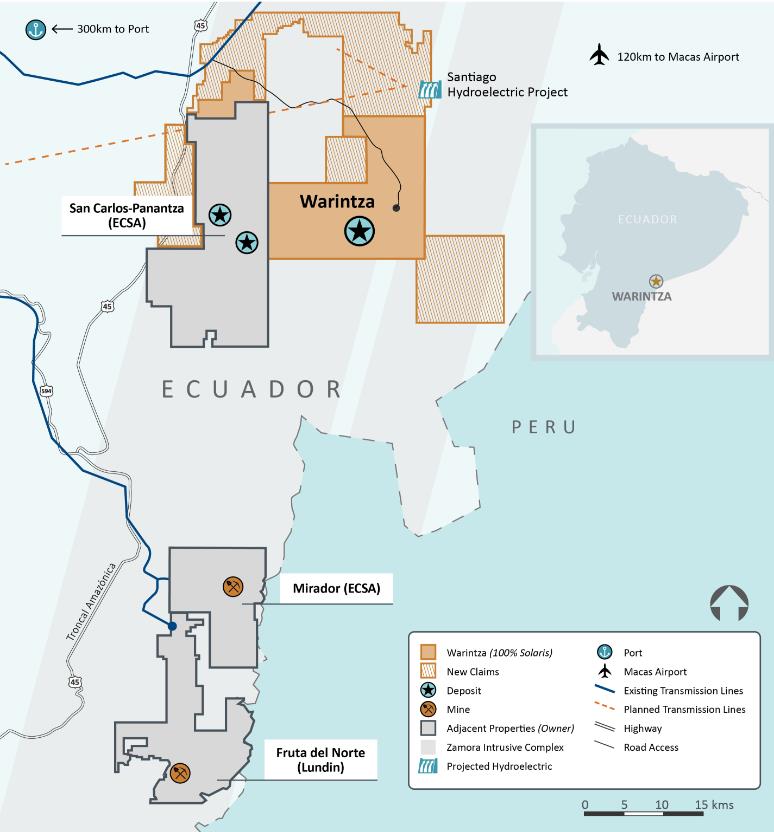
Solaris Resources (TSX:SLS) (NYSEAmerican:SLSR) has announced the termination of a previously proposed minority equity investment aimed at expanding the company’s Warintza Project in Ecuador.
The proposed investment, which would have supported both the growth of existing operations and the potential acquisition of a neighboring property, was initially announced four months ago. However, despite the anticipation of timely approval due to the minority nature of the investment and its focus on critical minerals, the transaction has not yet received the necessary regulatory clearance from Canadian authorities.
Solaris’ share price has also risen by over 35% since the initial announcement, making the terms of the investment, which included a 14% premium at the time, no longer financially advantageous for the company. This price increase, while positive in isolation, has been outpaced by similar companies in the sector due to the ongoing uncertainty surrounding the regulatory process in Canada.
The company has expressed disappointment in the delay, citing the evolved regulatory environment and heightened political sensitivity surrounding Canadian investments in foreign assets. The combination of these factors, coupled with the increasingly unattractive terms of the deal, has led Solaris to conclude that terminating the investment is the most prudent course of action to protect shareholder interests.
Despite this setback, Solaris remains financially secure, with sufficient funds to support its planned activities at the Warintza Project through 2025. This includes the ongoing exploration of a recently acquired 40,000-hectare area adjacent to the existing project site, which has already shown promising geological and geophysical similarities to the mineral-rich Warintza cluster.
Furthermore, the company has access to an additional US$40 million in funding through an existing offtake financing agreement. With these resources, Solaris intends to focus on maximizing shareholder value through a targeted strategy that prioritizes long-term growth and flexibility.
Solaris has also reiterated its commitment to the Warintza Project timeline, with an Environmental Impact Assessment expected to be delivered in the second half of 2024 and a Pre-Feasibility Study in the second half of 2025. These milestones are crucial steps in the development of the project, and Solaris remains optimistic about the potential of Warintza to become a significant source of critical minerals.
The above references an opinion and is for information purposes only. It is not intended to be investment advice. Seek a licensed professional for investment advice. The author is not an insider or shareholder of any of the companies mentioned above.
Premium Nickel Resources Ltd. has released further assay results from its ongoing drilling program at the Selebi North underground mine in Botswana. This latest update follows ten previous news releases detailing results from 47 drillholes.
Keith Morrison, CEO of PNRL, commented in a press release: “The assays from the down plunge extension of the Selebi North historic resource continue to confirm the interpretation of up-side potential of the high-grade Ni-Cu-Co polymetallic nature of this deposit. These assays will be included in the first Selebi National Instrument 43-101 (“NI 43-101”) compliant Mineral Resource Estimate (“MRE”), that will combine drilling from both Selebi North and Selebi Main, which is expected this June. While there is geoscience data indicating that both orebodies continue down plunge from our current drilling, the underground drills will focus on upgrading the inferred resources to indicated resources, with the intent of incorporating the data into a NI 43-101 compliant Prefeasibility Study (“PFS”) optimizing initial mine life estimates.”
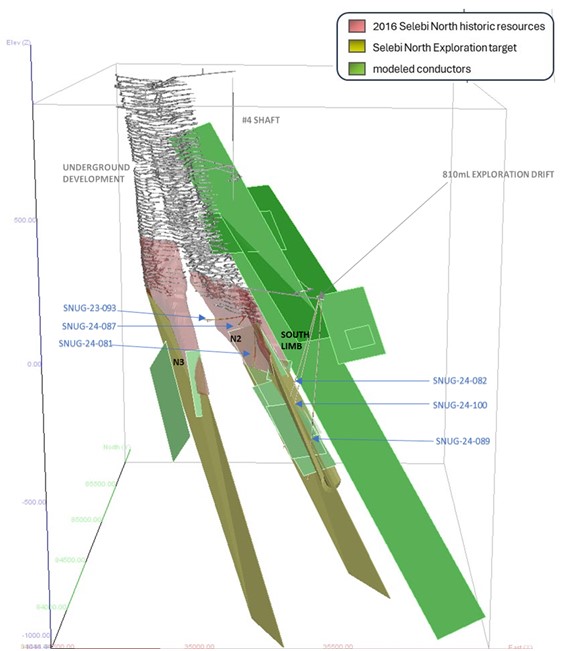
The current release focuses on six additional holes, further exploring the mineralized zones known as N2 Limb, N3 Limb, and South Limb. These zones were previously mined and theirnaming reflects their location on the folded mineralized horizon. Further drilling is required to determine the true width of mineralization and define the folded structure.
Ongoing Drilling and Electromagnetic Surveys
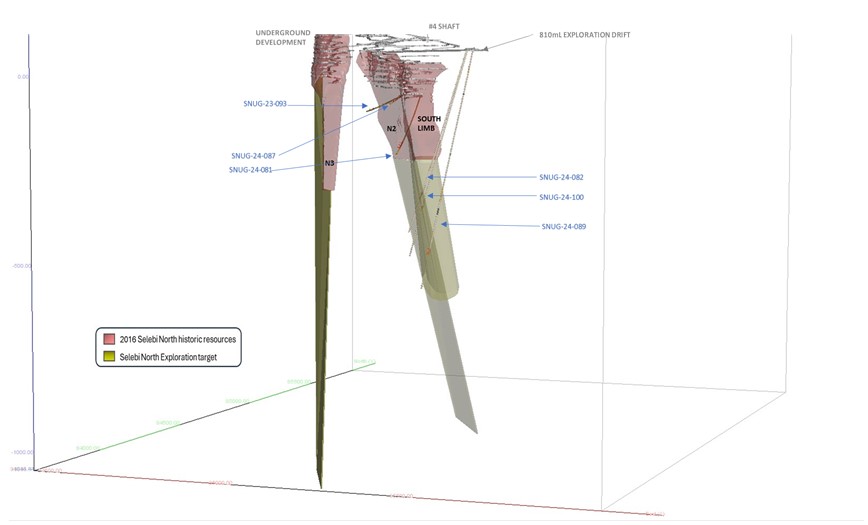
Three drills are currently active on the 810-meter level exploration drift. Two of these drills are evaluating areas down plunge and outside the known historic resource estimate. The third drill, located in newly completed development, is targeting the South Limb and N2 Limb.
Borehole electromagnetic (BHEM) surveys have been completed in 30 underground drillholes, including nine from 2024. Results indicate the mineralized zones continue down plunge, allowing for larger step-out intervals in future drilling.
As of May 14, 2024, a total of 35,246 meters have been drilled in 92 holes, with three holes still in progress. Assay results for completed holes will be released as they are received and confirmed.
Highlights from the results are as follows:
- SNUG-24-089 (South Limb, 403 metres down plunge of historic resource):
17.55 metres of 3.28% NiEq or 6.16% CuEq (2.07% Ni, 1.98% Cu, 0.11% Co)
- SNUG-24-081 (South Limb and N2 Limb, within historic resource):
28.60 metres of 1.95% NiEq or 3.66% CuEq (0.84% Ni, 1.96% Cu, 0.04% Co)
incl. 6.10 metres of 3.18% NiEq or 5.97% CuEq (0.91% Ni, 4.13% Cu, 0.05% Co)
Table 1: Assay Results Selebi North Deposit
| Hole-ID | From (m) |
To (m) |
*Length (m) |
Ni (%) |
Cu (%) |
Co (%) |
Limb | **NiEq (%) |
***CuEq (%) |
| SNUG-24-081 | 231.15 | 259.75 | 28.60 | 0.84 | 1.96 | 0.04 | South /N2 | 1.95 | 3.66 |
| including | 231.15 | 237.25 | 6.10 | 0.91 | 4.13 | 0.05 | South /N2 | 3.18 | 5.97 |
| and | 243.20 | 249.85 | 6.65 | 1.16 | 1.99 | 0.06 | South /N2 | 2.31 | 4.33 |
| and | 253.05 | 259.75 | 6.70 | 1.28 | 1.93 | 0.07 | South /N2 | 2.41 | 4.52 |
| SNUG-24-082 | 418.00 | 435.65 | 17.65 | 1.08 | 1.22 | 0.06 | South | 1.81 | 3.40 |
| including | 427.65 | 435.65 | 8.00 | 1.26 | 1.67 | 0.07 | South | 2.25 | 4.23 |
| SNUG-24-087 | 6.90 | 19.00 | 12.10 | 0.81 | 0.89 | 0.04 | South | 1.35 | 2.53 |
| including | 10.60 | 14.80 | 4.20 | 1.71 | 2.18 | 0.09 | South | 3.00 | 5.64 |
| SNUG-24-089 | 591.95 | 609.50 | 17.55 | 2.07 | 1.98 | 0.11 | South | 3.28 | 6.16 |
| SNUG-24-093 | 206.10 | 224.35 | 18.25 | 0.88 | 0.63 | 0.04 | N2 | 1.28 | 2.40 |
| including | 206.10 | 209.25 | 3.15 | 2.06 | 1.54 | 0.09 | N2 | 3.01 | 5.65 |
| and | 218.00 | 220.60 | 2.60 | 2.17 | 0.59 | 0.10 | N2 | 2.63 | 4.94 |
| SNUG-24-100 | 451.75 | 464.40 | 12.65 | 0.96 | 1.65 | 0.05 | South | 1.91 | 3.59 |
| including | 451.75 | 455.35 | 3.60 | 1.37 | 0.63 | 0.08 | South | 1.82 | 3.42 |
| including | 461.95 | 464.40 | 2.45 | 2.17 | 2.59 | 0.11 | South | 3.70 | 6.96 |
*Length refers to drillhole length and not true width. True widths are unknown.
**NiEq was calculated assuming a price of $US 8.67/lb for Ni, $US 4.61/lb for Cu and $US 12.62/lb for Co with no adjustments for recoveries or payabilities.
Table 2: Drill Collar Information Selebi North Deposit
| HOLE ID | Mine East | Mine North | Elevation | Dip | Mine Azimuth |
Hole Length | Comment |
| SNUG-24-081 | 35094.1 | 84759.0 | -51.8 | -34.7 | 172.1 | 293.6 | Rig #1 935mL |
| SNUG-24-082 | 35364.9 | 84407.5 | 81.3 | -73.3 | 235.6 | 536.8 | Rig #2 810mL |
| SNUG-24-087 | 35068.0 | 84686.0 | -45.7 | -37.0 | 176.0 | 59.6 | Rig #1 925mL |
| SNUG-24-089 | 35378.0 | 84423.1 | 81.2 | -64.43 | 185.7 | 707.6 | Rig #3 810mL |
| SNUG-24-093 | 35064.7 | 84692.2 | -44.4 | -17.41 | 306.1 | 248.6 | Rig #1 925mL |
| SNUG-24-100 | 35366.8 | 84407.7 | 81.3 | -72.13 | 220.7 | 599.6 | Rig #2 810mL |

Solitario Resources’ (TSX:SLR) share price soared to its highest point in over three years after the company announced the discovery of three new high-grade gold zones at its Golden Crest project in South Dakota. The zones, named Holland, Top Dollar, and Wildcat, yielded samples with gold values as high as 57.9 grams per tonne (g/t) gold, some of the highest-grade samples ever collected in a first-pass sampling program at the project.
Chris Herald, President and CEO of Solitario, commented in a press release: “These are among the highest-grade samples collected during a first pass sampling program at a newly discovered target zone in the history of Golden Crest. It’s amazing that after three field seasons, we are still discovering high-quality drilling targets displaying super high-grade gold values on the surface. We think there is a high probability that these three zones may coalesce into a single massive zone with additional work, just like the Geyser, Spur and Zig Zag zones came together. We now look forward to our drilling program at Golden Crest that is anticipated to begin in the first part of June.”
The Ponderosa area, a contiguous group of mineral claims separate from the original Golden Crest POO, falls under Solitario’s 100%-owned Golden Crest project area in South Dakota. The new Ponderosa POO proposes low-impact core drilling to assess these new gold targets.
Following this news, Solitario’s share price jumped 10.9% to C$1.22 per share, resulting in a market capitalization of C$100.3 million ($73.7 million USD). Earlier in the day, the stock hit a new 52-week high of C$1.25.
Golden Crest: A Target-Rich Project
Solitario acquired the Golden Crest project, a large land position in western South Dakota, in August 2021. The mineral claims include holdings in a district that has historically been productive, with multiple mines including the Homestake mine. The Homestake mine, classified as a rare “Super Giant” gold deposit containing over 58 million ounces of gold, was in operation for over 125 years between 1876 and 2001, producing over 42 million ounces of gold.
In the last two decades of Homestake’s operation, limited exploration by the previous owner identified five largely unexplored areas with anomalous gold in the western part of the district. Four of these anomalies had unexplained bedrock gold sources located outside of known historically mined areas.
Solitario currently controls all four of these potential gold sources and is conducting exploration to further define the gold distribution. The company’s land holdings extend along the western and southwestern parts of the Homestake-Wharf mining district, which has produced approximately 52 million ounces of gold and contains an additional 30 million ounces in historical resources.
Additional High-Grade Gold Zones Discovered at Golden Crest
Solitario Resources Corp. (NYSE American: XPL; TSX: SLR) also announced the discovery of three additional high-grade surface gold zones, named Holland, Top Dollar, and Wildcat, at its Golden Crest project. Assay results from reconnaissance rock sampling yielded gold values as high as 57.9 g/t gold, 50.2 g/t gold, 42.7 g/t gold, 32.3 g/t gold, and 21.1 g/t gold within these zones. These zones are located within a four-square-kilometer area between the Downpour and Sleeping Beauty targets.
The assay results, totaling 203 samples, represent the final surface grab rock samples collected in the 2023 field season. Notably, 51 of these samples contain >0.2 g/t Au while 27 contain >1 g/t Au.
These samples were collected from an arcuate belt of outcropping favorable Mission Canyon Limestone, 3.5 km long and up to 1.0 km across. This belt is interpreted to ring the northern flank of a central structural dome in the highly mineralized Geyser-Sleeping Beauty zone. Further mapping and sampling of this structural zone will be a priority in the 2024 field season as it appears to influence the distribution of very high-grade gold mineralization over eight kilometers of strike length.
The newly discovered Holland, Top Dollar, and Wildcat Gold zones, along with the Sleeping Beauty and Geyser gold zones, are located on Solitario’s new Ponderosa Plan of Operations (POO) in the easternmost part of the consolidated Golden Crest property. Solitario is proposing low-impact core drilling to test these new gold targets.
Highlights from the results are as follows:

The above references an opinion and is for information purposes only. It is not intended to be investment advice. Seek a licensed professional for investment advice. The author is not an insider or shareholder of any of the companies mentioned above.

Arras Minerals (TSXV:ARK) has announced the start of a regional field program across its 3,300 square-kilometer license package in Pavlodar, Kazakhstan. The exploration area is within the Bozshakol-Chingiz metallogenic belt, known for containing the Bozshakol Mine and the Beskauga copper-gold-silver deposit.
Tim Barry, CEO of Arras, commented on the upcoming 2024 Field Program in a press release: “We are very much looking forward to starting the 2024 field program. This will be our third exploration season in Kazakhstan. Over the previous couple of seasons, we have assembled an excellent team of young local geologists, gained hard won experience on how to effectively explore in Kazakhstan, and put in place robust systems which allows us to quickly assess projects and move them to the next stage. Furthermore in 2024, we are very pleased to also have our partner, Teck, working with us. They will provide invaluable additional support via their technical specialists. We are also excited to follow up on our Elemes and Tay prospects and expect to drill them later in the season after refining the targets with additional mapping and geophysics.
The 2024 field program has the potential to be transformative for Arras. We expect to drill at least three new porphyry prospects this year, which when combined with the Beskauga Project which we have under an option to purchase, means we potentially have at least four porphyry prospects controlled by the company. The project portfolio is close to incredible infrastructure and the country is quickly becoming a tier-one destination for copper and gold exploration globally as demonstrated by many of the copper and gold majors establishing a presence in Kazakhstan over the past 6-12 months.”
The program includes work under the Teck Strategic Alliance, focusing on two license packages covering 1,736 square kilometers. Activities planned for 2024 include airborne and ground geophysics, followed by mapping, soil sampling, and targeted drilling.
Additionally, the program will explore the Elemes Project, specifically the Berezski and Aimandai targets. The Berezski Target is an 8.8-kilometer-long copper anomaly with historical drilling showing promising results. The Aimandai Target is a 14-kilometer x 3.2-kilometer copper anomaly that has not yet been drilled. Both targets will undergo detailed mapping and ground geophysics to define drill targets for upcoming diamond drilling.
The Tay Project, specifically the Tay IP Target, will also be explored. This target is a 6.5-kilometer x 2.1-kilometer chargeability anomaly located 28 kilometers north of the Bozshakol mine. The prospect is covered with unconsolidated cover and has not been systematically explored using modern methods. The plan includes a KGK drill program to understand the geology, followed by diamond drilling to test the chargeability high.
The project area benefits from existing infrastructure, including a paved highway, power lines, and rail, all within close proximity to the targets.

Highlights from the results are as follows:
- The 2024 Exploration program will target licences associated with the Teck Strategic Alliance, and Arras’s 100% owned Elemes and Tay projects.
- An extensive airborne and ground geophysics program, followed by a mapping, soil sampling and drill program over the Package A and Package B Licences under the Strategic Alliance with Teck Resources Limited (“Teck”).
- A geophysics and detailed mapping program followed an initial diamond drill program targeting the Berezski and Aimandai copper targets located within the Elemes Project.
- An initial scout KGK program followed by an initial diamond drill program on the Tay Project, targeting the 6.5-kilometre x 2.1-kilometre Induced Polarization (“IP”) chargeability anomaly.
The above references an opinion and is for information purposes only. It is not intended to be investment advice. Seek a licensed professional for investment advice. The author is not an insider or shareholder of any of the companies mentioned above.

G2 Goldfields (TSX:GTWO) has released an update on its ongoing exploration program at the OKO-AREMU gold project, highlighting significant progress and promising results from recent drilling activities.
The company recently announced an updated Mineral Resource Estimate (MRE) for the OKO-AREMU project, totaling 922,000 ounces of indicated gold and 1,099,000 ounces of inferred gold. This substantial resource is situated along a prominent 2.5 km long north-south structure, anchored by the high-grade OMZ resource to the north and the Ghanie open pit and underground resource to the south.
Dan Noone, G2 Goldfields CEO, commented in a press release: These results continue to demonstrate that G2 remains very much a growth story, albeit one with an established high grade resource. Multiple gold bearing structures remain open along the +1 km Ghanie trend and in the coming months we look forward to continuing to expand our gold resources in the OKO district.
Focus on Ghanie District
G2 Goldfields Inc. is currently focusing its exploration efforts on the southern half of the structure within the Ghanie district. The ongoing 30,000-meter drill program has consistently intercepted new near-surface mineralization and high-grade shoots at depths between 200 and 400 meters, underscoring the area’s potential for resource expansion.
The latest results from thirteen drill holes in the Ghanie district have been released, demonstrating the down-plunge continuity of gold mineralization in the northern, central, and southern zones. Notably, hole GDD-110 intersected an emerging high-grade shoot in the Ghanie north area with two significant intercepts exceeding 15 g/t Au in a previously unexplored area approximately 150 meters below the surface.
Additionally, hole GDD-109, designed to target down-plunge mineralization, successfully intercepted a parallel zone of mineralization at a shallow depth of 32.5 meters, returning 9.2 g/t Au over 5.3 meters.

Further Definition of Central Zone
Drill holes GDD-98, 101, and 105 have further defined and extended the central zone. Hole 105 intersected three high-grade zones within a 100-meter core interval, opening up the central zone both to the north and at depth.
Exploration at Ghanie South
Drilling at Ghanie South targeted the down-plunge extension of high-grade mineralization reported in a previous drill hole. While lower-grade mineralization hosted in sandstones and andesites was encountered, further drilling at depth is expected to intersect mineralization hosted within magnetite-rich meta-basalts, which typically host higher-grade mineralization in the Ghanie Central and North zones.
Highlights from the results are as follows:
| Hole ID | From | To | Int (m) | Au g/t | |
| GDD-96 | 403.0 | 417.5 | 14.5 | 3.5 | |
| Incl. | 413.5 | 416.0 | 2.5 | 8.2 | |
| GDD-98 | 428.5 | 429.0 | 0.5 | 17.5 | |
| GDD-98 | 501.5 | 512.0 | 10.5 | 4.6 | |
| incl. | 509.0 | 510.5 | 1.5 | 14.2 | |
| GDD-101 | 321.5 | 340.0 | 18.5 | 2.2 | |
| Incl. | 337.2 | 340.0 | 2.8 | 9.7 | |
| GDD-105 | 451.0 | 453.0 | 2.0 | 20.9 | |
| GDD-105 | 497.5 | 500.4 | 2.9 | 19.8 | |
| GDD-105 | 544.5 | 553.9 | 9.4 | 5.5 | |
| Incl. | 546.0 | 549.0 | 3.0 | 11.7 | |
| GDD-109 | 36.5 | 41.8 | 5.3 | 9.2 | |
| Incl. | 40.9 | 41.8 | 0.9 | 45.0 | |
| GDD-109 | 200.7 | 224.5 | 23.8 | 1.9 | |
| Incl. | 215.5 | 223.0 | 7.5 | 4.2 | |
| GDD-110 | 198.0 | 216.0 | 18.0 | 6.7 | |
| Incl. | 201.0 | 204.0 | 3.0 | 15.9 | |
| Incl. | 211.5 | 214.5 | 3.0 | 21.5 |
The intercepts reported are down-hole widths. True widths are estimated between 75% and _85% of reported down-hole widths. Gold grades are uncapped.
Ghanie North
| GDD-109 | 9.2 g/t Au | over | 5.3 m | (36.5 m to 41.8 m) | ||
| and | 4.2 g/t Au | over | 7.5 m | (215.5 m to 223.0 m) | ||
| GDD-110 | 6.7 g/t Au | over | 18.0 m | (198.0 m to 216.0 m) | ||
| inc. | 15.9 g/t Au | over | 3.0 m | (201.0 m to 204.0 m) | ||
| inc. | 21.5 g/t Au | over | 3.0 m | (211.5 m to 214.5 m) |
| GDD-105 | 20.9 g/t Au | over | 2.0 m | (451.0 m to 453.0 m) | ||
| and | 19.8 g/t Au | over | 2.9 m | (497.5 m to 500.4 m) | ||
| and | 5.5 g/t Au | over | 9.4 m | (544.5 m to 553.9 m) |
The above references an opinion and is for information purposes only. It is not intended to be investment advice. Seek a licensed professional for investment advice. The author is not an insider or shareholder of any of the companies mentioned above.
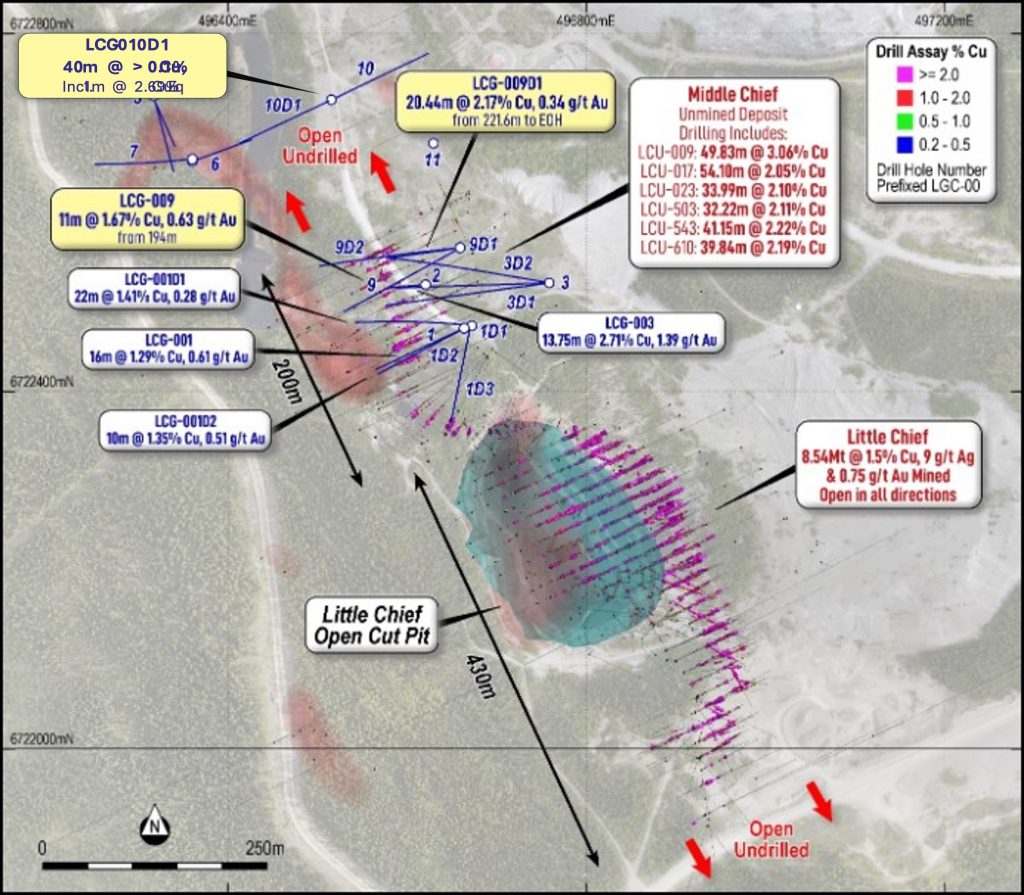
Gladiator Metals Corp. (TSXV:GLAD) has provided an update on drilling at the Whitehorse Copper Project, targeting significant widths of unmined, copper-gold skarns over more than 700m of strike at the historic Chiefs Trend.
Assay results have been returned from 20 holes, totaling 3,581m, at the Middle Chief and Big Chief Prospects within the Chiefs Trend. These results confirm the extensive high-grade mineralization previously highlighted by Gladiator’s data compilation of historical drilling. Copper-gold mineralization remains open in all directions, with some holes finishing in high-grade mineralization due to difficult ground conditions.
Gladiator CEO, Jason Bontempo commented in a press release: “Gladiator has received further assays from its ongoing, 10,000m diamond drill program at the Chiefs Trend. These results confirm and support the significant widths of high-grade copper skarn mineralization identified from Gladiator’s data compilation of historical datasets and point to further extensions of the defined mineralised bodies. Mineralization remains open in all directions with some holes finishing in high-grade copper-gold mineralization.
These results continue to confirm the extent of unmined mineralization and highlight the near-term, high-grade copper resource potential of the Chiefs Trend. Initial step out drilling on the Chiefs Trend, 200m to the north of Middle Chief has also encountered significant widths and grades of copper mineralization pointing to the exploration potential of the trend which is being followed up by ongoing drilling.
The significant gold assays coincident with high-grade copper mineralization identified in these initial assay results point to the upside potential of the Chiefs Trend with the historic drilling only assaying for copper”.
Some of the copper-gold intercept highlights include:
- LCG-009: 11m @ 1.67% Cu and 0.63 g/t Au from 194m
- LCG-009D1: 20.44m @ 2.17% Cu and 0.34 g/t Au from 221.6m to end of hole
- LCG-009D2: 8.7m @ 2.06% Cu and 0.13 g/t Au from 167m
In addition to these high-grade intercepts, significant exploration upside remains, with extensive widths of anomalous copper intersected in initial 200m spaced step-out drilling north of the known Middle Chief Mineralization. Drillhole LCG-010D1 intersected over 40m of anomalous copper (>0.1% Cu), including 1m @ 1.28% Cu and 1.61 g/t Au, which is interpreted as being immediately distal to the mineralized trend. Gladiator plans to complete Down-Hole Electromagnetic (DHEM) surveys prior to recommencing drilling targeting extensions to the known Middle Chief Mineralization.
The recent results are in addition to analytical results reported on March 5, 2024, which included:
- LCG-003: Recovered core @ 2.71% Cu and 1.39 g/t Au within a 13.75m mineralized zone from 256m to end of hole (approximately 270 m) that failed in 0.25m @ 2.76% Cu and 0.28 g/t Au
- LCG-001D1: 22m @ 1.41% Cu and 0.28 g/t Au from 208m
- LCG-001: 6m @ 1.56 % Cu and 1.06 g/t Au from 213m and 16m @ 1.29% Cu and 0.61 g/t Au from 249m
- LCG-001D2: 10m @ 0.83% Cu and 0.19 g/t Au from 62m, 4m @ 1.03 Cu and 0.19 g/t Au from 84m, and 10m @ 1.35% Cu and 0.51g/t Au from 196m
Drilling has now defined unmined, near-surface magnetite-copper skarn mineralization over more than 600m of strike north of the historical mining operations at Little Chief. The mineralization is associated with magnetite alteration, as indicated in the recently completed drone-borne magnetic survey, where magnetic anomalism is reported over 500 meters at Middle Chief extending into Big Chief.
Historical drilling at the Chiefs Trend prospects was selectively sampled for copper only. Given the recent significant gold intervals returned from these initial assay results, Gladiator intends to assay all future drilling and sampling for additional credits, including gold, silver, and molybdenum, which were proven significant contributors to the economics of historic operations at Little Chief.
Other highlights from the results are as follows:
- Results continue to confirm continuity of high-grade copper skarn mineralization at the Chiefs Trend with assays now received for 20 holes for 3,581m of drilling.
- High-grade copper skarn mineralization has now been intersected over at least 600m of strike at the Chiefs Trend and remains open in all directions.
- Assays returned significant copper and gold mineralization, including:
- LCG-009: 11m @ 1.67% Cu and 0.63 g/t Au from 194m.
- LCG-009D1: 20.44m @ 2.17% Cu and 0.34 g/t Au from 221.6m to EOH.
- LCG-009D2: 8.7m @ 2.06% Cu and 0.13 g/t Au from 167m.
- In addition, exploration upside indicated by significant widths of anomalous mineralization in initial, 200m spaced step out drilling north of Middle Chief in drillhole LCG-010D1.
- The above results are in addition to those previously reported on March 5, 2024, including:
- LCG-001D1: 22m @ 1.41% Cu and 0.28 g/t Au from 208m;
- LCG-001: 16m @ 1.29% Cu and 0.61 g/t Au from 249m and 6m @ 1.56 % Cu and 1.06 g/t Au from 213m;
- LCG-001D2: 10m @ 1.35% Cu and 0.51g/t Au from 196m, 10m @ 0.83% Cu and 0.19 g/t Au from 62m and 4m @ 1.03 Cu and 0.19 g/t Au from 84m; and
- LCG-003: Recovered core @ 2.71% Cu and 1.39 g/t Au within a 13.75m mineralised zone from 256m to end of hole (approximately 270m) that failed in 0.25m @ 2.76% Cu and 0.28 g/t Au.
| Hole ID | Target | Depth | East | North | Dip | Azim | Note | From | To | Interval (m) |
CuEq (%) |
Cu (%) |
Au (g/t) |
Ag (g/t) |
Mo (ppm) |
CuPCM (Cu* Int) |
Remarks |
| LCG-001 | MC | 338.33 | 496,665 | 6,722,472 | -68 | 245 | 67.00 | 69.00 | 2 | 2.08 | 0.01 | 2.66 | 0 | 6.0 | 0.02 | ||
| 183.00 | 221.00 | 38 | 0.98 | 0.66 | 0.35 | 5.32 | 11.0 | 25.08 | |||||||||
| Incl. | 185.00 | 193.00 | 8 | 1.64 | 1.16 | 0.51 | 8.63 | 2.0 | 9.28 | ||||||||
| And | 213.00 | 219.00 | 6 | 2.51 | 1.56 | 1.06 | 13.47 | 1.0 | 9.36 | ||||||||
| 237.00 | 241.00 | 4 | 0.61 | 0.59 | 0.01 | 1.15 | 34.0 | 2.36 | |||||||||
| 249.00 | 273.00 | 24 | 1.41 | 0.99 | 0.44 | 8.33 | 38.0 | 23.76 | |||||||||
| Incl. | 249.00 | 265.00 | 16 | 1.87 | 1.29 | 0.61 | 10.88 | 55.0 | 20.64 | ||||||||
| LCG-001D1 | MC | 273.19 | 496,671 | 6,722,474 | -66 | 245 | 204.00 | 236.00 | 32 | 1.41 | 1.11 | 0.27 | 9.24 | 113.0 | 35.52 | ||
| Incl. | 208.00 | 230.00 | 22 | 1.74 | 1.41 | 0.28 | 11.84 | 21.0 | 31.02 | ||||||||
| LCG-001D2 | MC | 301.75 | 496,671 | 6,722,473 | -65 | 275 | 62.00 | 76.00 | 14 | 0.85 | 0.69 | 0.15 | 5.14 | 179.0 | 9.66 | ||
| Incl. | 62.00 | 72.00 | 10 | 1.04 | 0.83 | 0.19 | 6.18 | 193.0 | 8.3 | ||||||||
| 84.00 | 88.00 | 4 | 1.23 | 1.03 | 0.19 | 5.35 | 0.0 | 4.12 | |||||||||
| 196.00 | 206.00 | 10 | 1.84 | 1.35 | 0.51 | 10 | 4.0 | 13.5 | |||||||||
| LCG-001D3 | MC | 215.8 | 496,671 | 6,722,473 | -58 | 190 | 147.00 | 149.00 | 2 | 1.13 | 0.66 | 0.5 | 8.9 | 1.0 | 1.32 | Hole Failed to reach Target | |
| LCG-002 | MC | 196.6 | 496,621 | 6,722,518 | -76 | 266 | 179.00 | 193.00 | 14 | 0.89 | 0.76 | 0.1 | 5.07 | 11.0 | 10.64 | Hole Failed in Fault Zone, prior to target | |
| LCG-003 | MC | 269.75 | 496,759 | 6,722,521 | -50 | 270 | 256.00 | 269.75 | 13.75 | 4.04 | 2.71 | 1.39 | 26.9 | 16.0 | 37.26 | EOH – Weighted Average Result – Calculated over the recovered Intervals, Includes 9m of core loss | |
| Incl. | 269.50 | 269.75 | 0.25 | 3.13 | 2.76 | 0.28 | 16.2 | 11.0 | 0.69 | EOH Sample | |||||||
| LCG-003D1 | MC | 301.75 | 496,759 | 6,722,521 | -55 | 271 | 249.00 | 251.00 | 2 | 0.91 | 0.70 | 0.14 | 10.9 | 7.0 | 1.41 | ||
| LCG-003D2 | MC | 265.18 | 496,759 | 6,722,521 | -55 | 262 | NSA | ||||||||||
| LCG-004 | MC | 205.74 | 496,296 | 6,722,773 | -60 | 155 | NSA | ||||||||||
| LCG-005 | BC | 169.16 | 496,318 | 6,722,727 | -60 | 165 | 6.10 | 9.00 | 2.9 | 0.95 | 0.54 | 0.51 | 1.83 | 1.0 | 1.57 | Big Chief | |
| 57.00 | 62.00 | 5 | 1.02 | 0.76 | 0.31 | 2.54 | 39.0 | 3.80 | |||||||||
| 97.00 | 106.00 | 9 | 0.42 | 0.35 | 0.08 | 1.28 | 431.0 | 3.15 | |||||||||
| LCG-006 | BC | 203 | 496,359 | 6,722,657 | -70 | 65 | 3.6 | 12.5 | 8.90 | 0.48 | 0.32 | 0.20 | 0.65 | 4.0 | 2.81 | ||
| LCG-007 | BC | 277.37 | 496,359 | 6,722,658 | -68 | 283 | NSA | ||||||||||
| LCG-008 | MC | 164.59 | 496,625 | 6,722,473 | -50 | 235 | NSA | ||||||||||
| LCG-008D1 | MC | 211.53 | 496,625 | 6,722,473 | -65 | 235 | 50.00 | 52.00 | 2 | 0.93 | 0.72 | 0.22 | 3.95 | 292.0 | 1.43 | ||
| LCG-008D2 | MC | 274.32 | 496,625 | 6,722,472 | -75 | 235 | 177.00 | 201.00 | 24 | 0.45 | 0.33 | 0.13 | 1.66 | 10.0 | 7.82 | Includes 0.3m of Core Loss | |
| LCG-009 | MC | 280.72 | 496,658 | 6,722,561 | -60 | 245 | 83.00 | 85.00 | 2 | 1.74 | 0.62 | 1.40 | 3.15 | 49.0 | 1.25 | ||
| 184.00 | 187.00 | 3 | 1.01 | 0.97 | 0.02 | 2.30 | 2.7 | 2.91 | |||||||||
| 194.00 | 223.00 | 29 | 1.14 | 0.83 | 0.32 | 6.60 | 8.5 | 24.09 | |||||||||
| Incl. | 194.00 | 205.00 | 11 | 2.29 | 1.67 | 0.63 | 13.98 | 6.0 | 18.36 | ||||||||
| Or | 199.00 | 205.00 | 6 | 2.89 | 2.02 | 0.91 | 17.71 | 10.4 | 12.13 | ||||||||
| LCG-009D1 | MC | 242.04 | 496,659 | 6,722,561 | -65 | 265 | 40.00 | 41.00 | 1 | 2.34 | 1.55 | 0.83 | 15.00 | 19.0 | 1.55 | ||
| 83.00 | 86.00 | 3 | 1.18 | 0.94 | 0.26 | 4.57 | 5.7 | 2.81 | |||||||||
| 206.20 | 242.04 | 35.84 | 1.59 | 1.35 | 0.21 | 8.01 | 14.7 | 48.33 | EOH | ||||||||
| Incl. | 221.60 | 242.04 | 20.44 | 2.55 | 2.17 | 0.34 | 12.84 | 13.3 | 44.41 | EOH | |||||||
| LCG-009D2 | MC | 248.72 | 496,659 | 6,722,561 | -55 | 261 | 65.00 | 67.00 | 2 | 0.76 | 0.66 | 0.09 | 2.8 | 39.0 | 1.32 | ||
| 134.70 | 138.00 | 3.3 | 0.62 | 0.50 | 0.13 | 1.6 | 44.0 | 1.64 | Includes 0.3m of Lost Core | ||||||||
| 167.00 | 175.70 | 8.7 | 2.36 | 2.06 | 0.13 | 20.97 | 5.0 | 17.96 | Ends in Core Loss from 175.7 to 180m | ||||||||
| 170.00 | 174.30 | 4.3 | 3.91 | 3.41 | 0.22 | 34.9 | 6.0 | 14.68 | |||||||||
| LCG-010 | MC | 156.06 | 496,514 | 6,722,726 | -45 | 246 | NSA | ||||||||||
| LCG-010D1 | MC | 198.12 | 496,514 | 6,722,726 | -55 | 65 | 188.00 | 189.00 | 1 | 2.69 | 1.28 | 1.61 | 16.9 | 14 | |||
| LCG-011 | MC | 86.26 | 496,631 | 6,722,678 | -60 | 245 | Assays Pending – Hole Suspended for Change of Season | ||||||||||
| 3,668 |
Table 1: Chief’s Trend Significant Intersections (Recent Drilling)
Copper Equivalent (CuEq) was based on the following assumed metal prices on the 21 April 2024 of $US 9.876 per tonne Cu, $2,390 per Ounce Au & US$28.69 per Ounce Ag. Mo was excluded from the calculation and recovery is assumed to be 100% as no metallurgical test work has been completed.
The above references an opinion and is for information purposes only. It is not intended to be investment advice. Seek a licensed professional for investment advice. The author is not an insider or shareholder of any of the companies mentioned above.
The above references an opinion and is for information purposes only. It is not intended to be investment advice. Seek a licensed professional for investment advice. The author is not an insider or shareholder of any of the companies mentioned above.
Solaris Resources Inc. (TSX:SLS)(NYSEAMERICAN:SLSR) has shared an operations update for its Warintza copper project in southeastern Ecuador. The update highlights improved productivity and cost savings under new Chief Operating Officer Javier Toro, as well as the appointment of top consultants to support the Environmental Impact Assessment (EIA) and Pre-Feasibility Study (PFS).
Mr. Javier Toro, COO, commented in a press release: “We are excited with the improvements we have made at site where our team is approaching record monthly drilling rates with significantly fewer rigs than at prior peaks. We are also pleased to be making progress in advancing studies and work programs to support the completion of the EIA in H2/24 and PFS in 2025. Warintza is a very unique project given its global scale and location in a mining district adjacent to infrastructure at low elevation.”
Drilling Ramps Up, Targeting 30km in 2024
Drilling at Warintza continues to accelerate, with six rigs completing over 5,400 meters in April, close to setting a new monthly record for the project. Solaris has budgeted a minimum of 30 kilometers of resource growth and infill drilling for 2024. Some of these holes will also provide technical data for mine design and planning to support upcoming technical studies.
The updated mineral resource estimate remains on track for completion at the end of June and release in early July. It will be completed by leading porphyry specialist Mr. Mario E. Rossi of Geosystems International Inc., who also conducted the previous estimate.
EIA Targeted for H2 2024, PFS for H2 2025
Solaris has engaged ESSAM Cía. Ltda., an Ecuadorian environmental consulting firm accredited by Ecuador’s Ministry of Environment, to finalize and submit the EIA for the Warintza exploitation phase. ESSAM has experience supporting Ecuador’s largest copper and gold mines. The EIA submission is targeted for the second half of 2024, building on over three years of baseline environmental monitoring, data collection and studies.
To support the PFS planned for the second half of 2025, Solaris has appointed leading international consulting firms:
– Ausenco Engineering for metallurgical studies, process plant design, and infrastructure assessments
– Knight Piésold Consulting for detailed technical studies and engineering designs for the pit, waste rock facility, and tailings management facility
– AMC Consultants and Minsys Mining Systems for mine scheduling and trade-off studies to optimize mine plans
Improved Site Productivity and Cost Savings
Infrastructure development, logistics optimization, and improved practices at the Warintza site have significantly increased productivity and efficiency. This has enabled a 26% reduction in drilling costs to US$229 per meter and generated substantial savings compared to the Q1 2024 budget.
Current Funding and Future Plans
As of March 31, Solaris held an unaudited cash balance of approximately US$29 million. An additional US$40 million is expected from the previously announced offtake financing package. These funds are expected to support the planned 2024 and 2025 work programs. Upon closing the strategic investment announced in January, Solaris plans to expand activities and continue the consolidation of the land package surrounding Warintza.
The above references an opinion and is for information purposes only. It is not intended to be investment advice. Seek a licensed professional for investment advice. The author is not an insider or shareholder of any of the companies mentioned above.

Onyx Gold (TSXV:ONYX) has announced additional gold results from its ongoing 3,000-meter Spring Drill Program at the Munro-Croesus Project in the Timmins gold camp, Ontario. The 14 drill holes reported were completed at the new GM Vein, located 350 meters from the past-producing Croesus Gold Mine, known for yielding some of Ontario’s highest-grade gold.
The drilling continues to intersect encouraging results from the GM Vein at an average vertical depth of 50-60 m, with visible gold observed in four of the 14 holes reported (MC24-152/154/156/162). The drilling has now defined a higher-grade shoot plunging to the southwest, and the GM Vein remains open for expansion in all directions.
Brock Colterjohn, President & CEO of Onyx Gold, commented in a press release: “We are very encouraged with the results from this year’s spring program so far. Our drilling efforts have successfully defined a higher-grade shoot, and the GM Vein remains open for expansion in all directions. We look forward to further expanding this high-grade lens and exploring for similarly plunging zones with future drill programs. We are now drilling over at the bulk-tonnage Argus zone target, with the objective of extending the zone further to the west. We’ve expanded the program by 10% to 3,300 meters, reflecting the positive results and our confidence in the project’s prospects. Our commanding land position and wealth of opportunities for new discoveries provides the potential for Onyx to become the go-to explorer in the Timmins Camp. We are looking forward to reporting further assays as they become available.”
Significant assay intersections include:
- MC24-154, a follow-up hole completed 10 m southwest from Hole MC23-132 (121.8 g/t Au over 0.9 m), returned 52.06 g/t Au over 0.5 m within a broader zone of 26.52 g/t Au over 1.0 m.
- MC24-151, a follow-up hole completed 10 m northeast from Hole MC23-132, returned 20.44 g/t Au over 0.4 m within a broader zone of 10.97 g/t Au over 0.8 m.
- MC24-152, a follow-up hole completed 20 m up-dip from Hole MC24-151, returned 32.31 g/t Au over 0.3 m within a broader zone of 7.68 g/t Au over 1.4 m.
- MC24-156, a follow-up hole completed 5 m up-dip from Hole MC24-154, returned 15.52 g/t Au over 0.4 m.
A total of 20 holes totaling 1,713 m were drilled on the GM Vein in March and April 2024. Seventeen short drill holes (MC24-143 to MC24-159) were completed across the GM Vein on three 10 meter-spaced drill fences. Two additional holes (MC24-160 and MC24-162) were completed 30 m down-plunge and 30 m up-plunge from the three main fences of holes. One hole, MC24-161, was drilled to the northeast to test for the prospective carbonaceous, sulfidic “flow top” breccia, which hosts the higher-grade portion of the Croesus Vein, 350 m to the southeast.

Approximately 84% of drill holes (16 of 19 holes drilled to date) intersected mineralization greater than 0.5 g/t Au, with ten drill holes intersecting mineralization over 10 g/t Au.
The diamond drill rig is now testing the bulk-tonnage Argus Zone located three kilometers west of the GM Vein. The remaining program meterage will be dedicated to expanding the Argus Zone beyond its current strike length of 525 m and 200 m thickness.
Given the encouraging results, the Spring Drill Program has been upsized by 10% to 3,300 m and is expected to conclude shortly. Assay results will be released on an ongoing basis pending review and compliance with the Company’s QA/QC protocols.
The GM Vein was first discovered in the 2023 fall drill program when drill hole MC23-132 intersected a 30 cm wide quartz vein with abundant visible gold that returned 363 g/t Au over 0.3 m, representing the single highest assay in the Company’s drill hole database for the Project. The high-grade vein occurs within a broader zone of mineralization averaging 121.8 g/t Au over 0.9 m and was intersected approximately 60 m vertically below surface. This discovery represents an entirely new bonanza-grade quartz vein in a geological setting comparable to the mined-out, very high-grade Croesus vein, located 350 m to the southeast, along the prospective Croesus pillowed mafic volcanic flow.
The Munro-Croesus Project covers 70 km2 of highly prospective geology within the influence of major gold-bearing structural breaks. The Project is located along Highway 101 in the heart of the Abitibi greenstone belt, Canada’s premier gold mining jurisdiction. Extensive land consolidation from 2020-2023 has unified the patchwork of patented and unpatented mining claims surrounding the Croesus Gold Mine into one coherent package, enhancing the project’s exploration potential.
Bulk-tonnage gold deposits located in the immediate region include the Fenn-Gib gold project being developed by Mayfair Gold Corp. that contains an Indicated Resource of 3.38 Moz at 0.93 g/t Au and an Inferred Resource of 157 koz at 0.85 g/t Au, and the Tower Gold Project being developed by Moneta Gold Inc. that contains an open pit Indicated Resource of 4.46 Moz at 0.92 g/t Au and an Inferred Resource of 8.29 Moz at 1.09 g/t Au.
Highlights from the results are as follows:
- 26.52 g/t Au over 1.0 m, including 52.06 g/t Au over 0.5 m in hole MC24-154
- 7.68 g/t Au over 1.4 m, including 32.31 g/t Au over 0.3 m in hole MC24-152
- 10.97 g/t Au over 0.8 m, including 20.44 g/t Au over 0.4 m in hole MC24-151
- 15.52 g/t Au over 0.4 m in hole MC24-156
- 4.40 g/t Au over 0.8 m in hole MC24-162
- 2.62 g/t Au over 0.8 m in hole MC24-155
- 2.45 g/t Au over 0.3 m in hole MC24-153
- 1.77 g/t Au over 1.2 m in hole MC24-150
- 1.75 g/t Au over 2.0 m in hole MC24-158
Table 1 – Significant Assay Results from Next 14 Holes Completed at The GM Vein
| Drill Hole | From (m) | To (m) | Length (m) | Au (g/t) |
| GM Vein Discovery | ||||
| MC24-149 | No Significant Assays | |||
| MC24-150 | 59.20 | 60.40 | 1.20 | 1.77 |
| Including | 59.60 | 60.00 | 0.40 | 3.74 |
| MC24-151 | 63.50 | 64.30 | 0.80 | 10.97 |
| Including | 63.50 | 63.90 | 0.40 | 20.44 |
| MC24-152 | 53.80 | 55.20 | 1.40 | 7.68 |
| Including | 53.80 | 54.10 | 0.30 | 32.31 |
| MC24-153 | 54.80 | 55.10 | 0.30 | 2.45 |
| MC24-154 | 63.60 | 64.60 | 1.00 | 26.52 |
| Including | 63.60 | 64.10 | 0.50 | 52.06 |
| MC24-155 | 67.20 | 68.00 | 0.80 | 2.62 |
| Including | 67.70 | 68.00 | 0.30 | 4.33 |
| MC24-156 | 62.60 | 63.00 | 0.40 | 15.52 |
| MC24-157 | 57.80 | 58.10 | 0.30 | 0.84 |
| MC24-158 | 56.60 | 58.60 | 2.00 | 1.75 |
| MC24-159 | No Significant Assays | |||
| MC24-160 | 60.00 | 60.30 | 0.30 | 0.98 |
| MC24-161 | No Significant Assays | |||
| MC24-162 | 50.30 | 51.10 | 0.80 | 4.40 |
| Including | 50.30 | 50.60 | 0.30 | 6.92 |
| *Note – Drill Intercepts are 70-100% of true width. Averages are length weighted using a 0.5 g/t gold cut-off and a maximum of 10m of internal dilution. Ian Cunningham-Dunlop, P.Eng., Executive VP for Onyx Gold and qualified person as defined by Canadian National Instrument 43-101, has reviewed and verified the information within this table. | ||||
The above references an opinion and is for information purposes only. It is not intended to be investment advice. Seek a licensed professional for investment advice. The author is not an insider or shareholder of any of the companies mentioned above.
In a recent interview, Hudbay Minerals CEO Peter Kukielski stated that he believes that BHP Group’s recently rejected $39 billion offer for Anglo American has increased the value of copper assets. This could signal a growing willingness among large miners to pay a premium for existing copper mines, and spark a potential bidding war.
Hudbay plans to initiate a formal sale process later this year for a minority stake in its Arizona Copper World project. The company has already engaged in preliminary discussions with interested parties.
Copper Demand and Prices
BHP’s offer for Anglo American, though ultimately rejected, highlights the industry’s focus on copper. Three-month copper prices on the London Metal Exchange recently peaked above $10,200 a metric ton, driven by expected demand for the metal in electrification technologies.
Hudbay’s Copper World project is currently under construction and projected to produce an average of 92,000 metric tons of copper annually over its first ten years. Phase 1 development has an estimated cost of C$1.3 billion ($950.6 million). Kukielski indicated that Hudbay will look for joint-venture partners once necessary permits have been obtained.
Canadian Miners as Targets
Analysts see Canadian copper miners as potential acquisition targets due to a global shortage of new copper mines. Hudbay itself has been active in domestic acquisitions, purchasing Copper Mountain last year for C$439 million. However, RBC Capital Markets has also suggested Hudbay could become a takeover target if copper prices decline.
BHP Group Ltd.’s proposed £31.1 billion ($38.8 billion) takeover of Anglo American aimed to create a mining giant with significantly increased copper production. The all-share deal would have required Anglo to first spin off its controlling interests in South African platinum and iron ore companies. Anglo American rejected the offer, deeming it an undervaluation.
A BHP-Anglo combination would have given BHP roughly 10% of the world’s copper mine supply. Market watchers anticipate a significant copper supply shortage, which is expected to drive prices higher. This deal, while unsuccessful, could spark interest from other major miners looking to increase their copper exposure.
Anglo American, with attractive South American copper operations, has been a long-considered takeover target. However, its complex structure involving commodities like platinum and diamonds, along with its significant South African holdings, has deterred potential suitors.
Anglo American has recently faced setbacks due to price drops in some of its key commodities and operational challenges. These factors have contributed to a decline in its valuation, potentially increasing its vulnerability to takeovers.
The BHP-Anglo proposal, despite its rejection, suggests a return to mega-deals in the mining sector after a decade of cautious activity. With larger cash reserves and a renewed focus on investor confidence, the industry appears ready for a potential wave of mergers and acquisitions.
Commodities giant Glencore is also reportedly considering an approach to acquire Anglo American, according to two sources familiar with the matter. This development suggests a potential bidding war could emerge for the 107-year-old mining company.
Discussions within Glencore are in preliminary stages, and it remains uncertain whether the company will formally approach Anglo with an offer. However, Glencore’s interest comes on the heels of BHP Group’s recently rejected $39 billion all-stock takeover proposal.
BHP May Still Be in the Running
A source familiar with BHP’s plans previously indicated that the Australian mining giant is exploring an improved offer for Anglo American. BHP has until May 22nd to make a formal bid, suggesting the company may remain in contention.
Anglo American’s appeal lies primarily in its prized Chilean and Peruvian copper assets. Demand for copper is projected to surge due to its widespread applications in electric vehicles, renewable energy infrastructure, and expanding AI technologies.
Anglo American and Glencore currently hold equal 44% stakes in Chile’s Collahuasi mine, which boasts some of the world’s largest copper reserves. Anglo’s diverse portfolio also includes platinum, iron ore, diamonds, steelmaking coal, and a fertilizer project, adding to its attractiveness.
Since BHP’s offer became public, Anglo American’s share price has climbed over 30%. The company had previously underperformed its mining peers after experiencing production downgrades and asset writedowns earlier this year.
Glencore’s Concurrent Acquisition, and the South Africa Factor
Glencore’s potential interest in Anglo comes as it finalizes a $6.9 billion acquisition of a 77% stake in Teck’s Canadian coal unit. The deal is anticipated to close by the third quarter of this year.
Anglo’s significant holdings in South Africa, including shares in Anglo Platinum (Amplats) and Kumba Iron Ore, could raise strategic considerations for potential buyers. BHP exited South Africa in 2015, but Glencore maintains coal and chrome operations in the country.
The above references an opinion and is for information purposes only. It is not intended to be investment advice. Seek a licensed professional for investment advice. The author is not an insider or shareholder of any of the companies mentioned above.
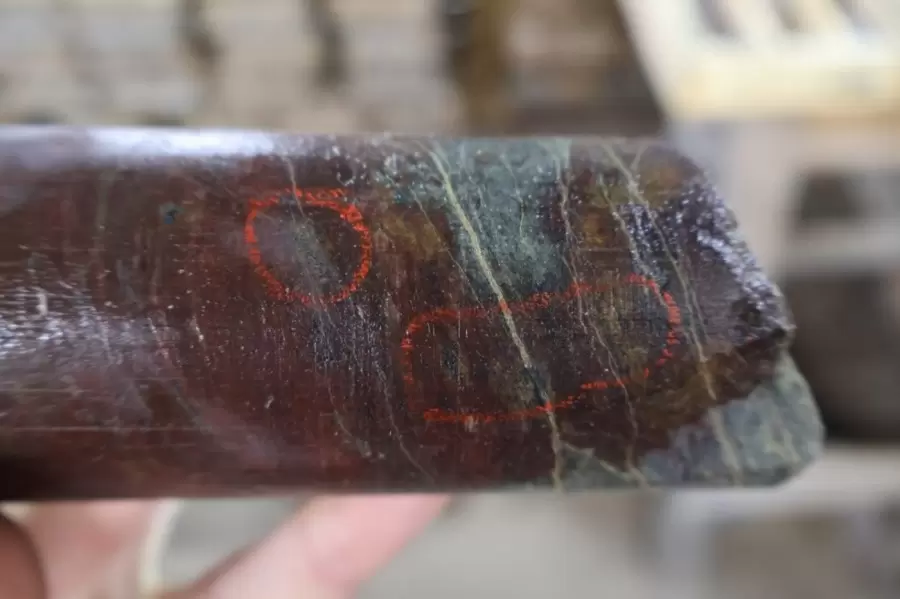
ALX Resources Corp. (TSXV: AL) has announced the completion of its 2024 winter drilling program at the 100%-owned Gibbons Creek Uranium Project, located in the northern Athabasca Basin near Stony Rapids, Saskatchewan. The program, which consisted of five holes totaling 849.44 metres, was designed to test for continuity of uranium mineralization first discovered in the area by Eldorado Nuclear in 1979 and by ALX in 2015.
Four of the five holes intersected uranium mineralization at or near the unconformity, based on hand-held scintillometer readings, downhole gamma probe results, and visual observation of uranium minerals by ALX’s geological team. The mineralization was found in two areas located 500 metres apart within a target area that ALX defined in late 2023 through high-resolution magnetic and Soil Gas Hydrocarbon (SGH) surveys.
Hole GC24-04 exhibited the strongest radiometric response of the program, with uranium mineralization intersected over 1.1 metres from 107.17 to 108.27 metres, beginning immediately at and below the unconformity at 107.18 metres. A Mount Sopris 2PGA-1000 downhole gamma probe measured a radioactive peak of 8,662 counts per second (cps) within the mineralized interval, which showed black blebs of uranium mineralization (likely pitchblende) within dark red hematite alteration and closely associated with lesser amounts of yellow limonite alteration.
Hole GC24-05, drilled from the same setup as GC24-04 but with a different tilt, also encountered fine-grained blebs of black uranium mineralization between approximately 103.4 to 103.5 metres. Several of the blebs have bleached haloes, and others appear within or adjacent to weak limonitic alteration haloes.
ALX recommends further drilling at the Project to search for fault offsets in the area of GC24-04, which can act as structural traps for the deposition of uranium mineralization. Core samples from the drilling program have been shipped to Saskatchewan Research Council Geoanalytical Laboratories (SRC) for geochemical analysis and to Rekasa Rocks Inc. for infrared spectroscopy analysis to determine the nature and quantity of clay alteration present. Analytical results will be released following their receipt, compilation, and interpretation.
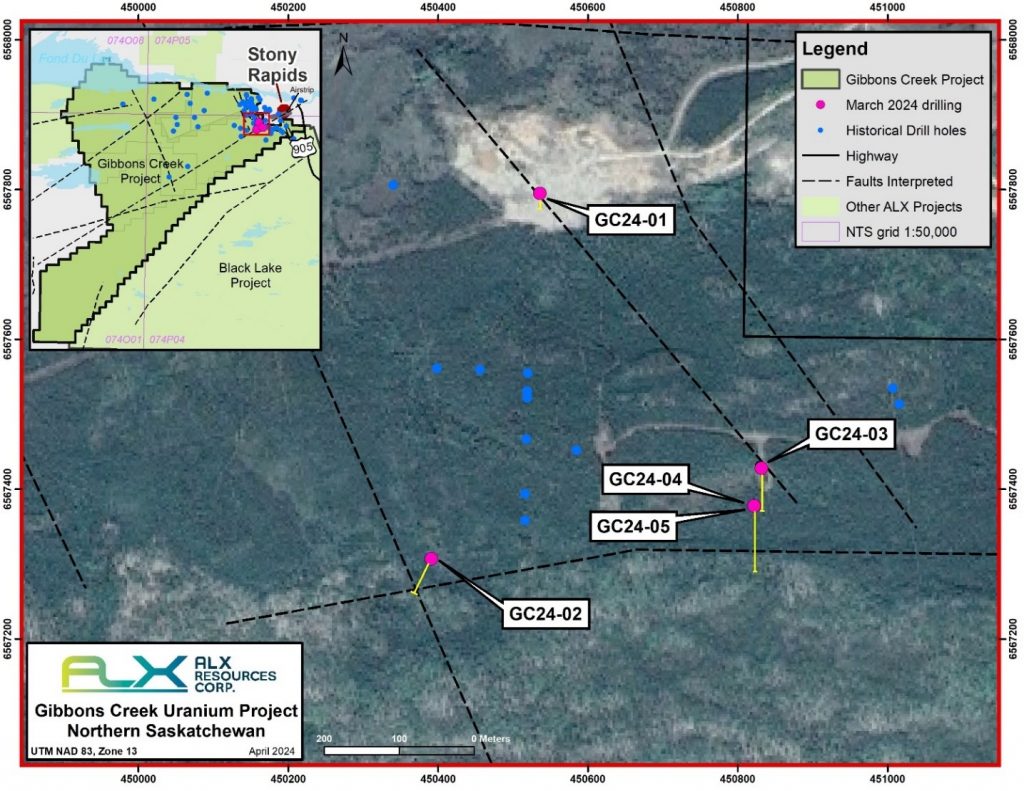
Gibbons Creek is currently the subject of an option earn-in transaction with Trinex Lithium Ltd., a wholly-owned subsidiary of Trinex Minerals Limited, a publicly-traded mineral exploration company listed on the Australian Securities Exchange. Under the terms of a binding letter agreement signed in February 2024, Trinex can earn an initial 51% interest and up to a 75% participating interest in the Project over a period of five years by making cash and common share payments to ALX, and by incurring exploration expenditures at the Project.
The Gibbons Creek Project consists of eight mineral claims comprising 13,864 hectares (34,258 acres) located along the northern margin of the Athabasca Basin. The region hosts numerous historical uranium occurrences, such as the Black Lake discoveries in several drill holes beginning in 2004 and the historical Nisto Mine, from which 500 tons of ore was shipped in 1950 to the historical Lorado Mill at Uranium City, SK, including 106 tons grading 1.6% U3O8.
ALX holds an exploration permit for Gibbons Creek, valid until October 2025, which allows for up to 20 diamond drill holes totaling approximately 5,000 metres, along with ground-based geophysics, prospecting, and geochemical sampling. The Project is accessible via roads and trails from the community of Stony Rapids, SK, which is connected to all-weather Highway 905, providing flexibility for both summer and winter exploration programs.
Highlights from the results are as follows:
Table 1. Gibbons Creek 2024 – Downhole Gamma Probe Measurements (Mount Sopris 2PGA-1000)
| Drill Hole Number |
Total Depth of Hole (m) |
Depth to Unconformity (m) |
Mineralized Zones | Average Gamma Probe Readings (cps at 0.1 m intervals) |
Maximum Gamma Probe Readings (cps) |
||
| From (m) |
To (m) |
Interval (m) |
|||||
| GC24-01* | 157.0 | 77.8 | n/a | n/a | n/a | n/a | n/a |
| GC24-02 | 212.0 | 108.4 | 109.1 | 109.7 | 0.6 | 1,803 | 3,281 |
| GC24-03 | 186.4 | 108.5 | 109.2 | 110.8 | 1.6 | 1,539 | 2,217 |
| GC24-04 | 177.0 | 107.18 | 107.17 | 108.27 | 1.1 | 2,880 | 8,662 |
| GC24-05 | 173.0 | 102.36 | 103.2 | 103.7 | 0.5 | 1,365 | 2,328 |
*The first hole of the 2024 program, GC24-01, showed a normal radioactive response from the conglomeratic sandstone at the unconformity and did not intersect significant uranium mineralization.
The above references an opinion and is for information purposes only. It is not intended to be investment advice. Seek a licensed professional for investment advice. The author is not an insider or shareholder of any of the companies mentioned above.
If you would like to receive our free newsletter via email, simply enter your email address below & click subscribe.
 Follow us on Twitter
 Become our facebook fan
CONNECT WITH US
Tweets
Tweet with hash tag #miningfeeds or @miningfeeds and your tweets will be displayed across this site.
MOST ACTIVE MINING STOCKS
Daily Gainers
 CMC Metals Ltd. CMC Metals Ltd. |
CMB.V | +900.00% |
 Eden Energy Ltd Eden Energy Ltd |
EDE.AX | +200.00% |
| GoviEx Uranium Inc. |
GXU.V | +42.86% |
| Eagle Nickel Ltd. |
ENL.AX | +41.67% |
| Citigold Corp. Limited |
CTO.AX | +33.33% |
| Mount Burgess Mining NL |
MTB.AX | +33.33% |
| Exalt Resources Limited |
ERD.AX | +31.94% |
| Casa Minerals Inc. |
CASA.V | +30.00% |
| Cariboo Rose Resources Ltd |
CRB.V | +28.57% |
| Belmont Resources Inc. |
BEA.V | +28.57% |