



Gold Hart Copper (TSXV: HART) has released details from recent exploration activities at two of its Chilean assets, including results from a geochemical survey at the Nessa gold-copper-silver complex and an update on drilling underway at its flagship Tolita gold-copper-molybdenum-silver project in the Vicuña District. The update was reported by Mr. Isaac Maresky in a disclosure dated February 2, 2026.
The Nessa complex, located immediately west of Kinross’ La Coipa Gold Mine and south of Codelco’s El Salvador–Potrerillos copper mining and smelting complex, has recently undergone a major expansion in land position. As announced previously on January 22, 2026, Gold Hart increased the size of the Nessa property from approximately 4,100 hectares to 13,500 hectares, or 135 square kilometres, representing a 3.3-fold increase.
Following this expansion, Gold Hart completed a follow-on geochemical survey designed to evaluate areas of known historical interest. The program focused on zones that contain clusters of historic mining pits and previously reported high-grade samples. According to the company, the objectives of the survey included mapping pit geology, confirming the locations of historic workings, ground-truthing reported grades from historical samples, and assessing additional undocumented pits identified through satellite imagery. The work was also intended to better understand the factors contributing to the widespread distribution of mining pits across the expanded property.
Geochemical Survey Results at Nessa
Laboratory results from the survey confirmed the presence of elevated gold, copper, and silver values across multiple sampled areas. Of the 51 samples collected, 12 returned gold values of at least 1 gram per tonne (g/t), with six samples grading 4 g/t gold or higher and two samples exceeding 9 g/t gold. Silver values were also significant, with four samples containing at least 100 g/t silver.
Copper results showed that 12 samples returned values of at least 3,000 parts per million (ppm), while nine samples exceeded 5,000 ppm copper. The company noted that these high-grade copper samples are being re-analyzed to determine precise values, with final results expected to be reported following completion of the additional laboratory work.
Gold Hart’s geological team interpreted the survey results as confirmation of high-grade mineralization previously reported at Nessa. Several samples returned gold grades between 4 g/t and 9.7 g/t, and multiple copper and silver assays exceeded laboratory detection limits of greater than 0.5% copper and greater than 400 g/t silver. Pulps from these samples are currently undergoing further analysis to obtain exact concentrations.
Geological Interpretation and Next Steps at Nessa
Beyond confirming grades, the survey provided additional geological insight. Gold Hart geologists identified multiple vein systems with consistent structural orientations, information that is already being incorporated into early-stage target generation for future exploration campaigns. The company stated that the dataset highlights the need for a broader and more systematic geological mapping and sampling program across the property.
Planned next steps at Nessa include expanding soil sampling coverage to establish a continuous geochemical dataset across the broader regional land package. These results are expected to guide targeted trenching programs aimed at exposing mineralized structures and validating surface geochemical trends. To complement surface work, induced polarization (IP) and magnetic geophysical surveys are planned to delineate subsurface chargeability, resistivity, and structural features. The integration of geological, geochemical, and geophysical data is intended to refine drill targeting ahead of a future reverse circulation drilling program designed to test the highest-priority targets generated by this work.
Regional Setting of the Nessa Assets
The Nessa properties are situated along the Domeyko Fault, a major structural corridor in Chile that hosts several world-class copper deposits, including the Escondida Copper Mine. The assets are also located near projects operated by major mining companies such as Newmont, Solaris, JX Nippon, Anglo American, and Rio2’s Fenix Gold Mine. The project area hosts a strong magnetic anomaly that aligns with known veins and historic mining activity, reinforcing the interpretation of a structurally controlled mineralized system with potential continuity along strike.
Historically, the Nessa area was known to host at least 13 artisanal gold and copper pits, some of which were mined using mules due to limited access. Historic sampling reported grades of up to 25 g/t gold, 3.25% copper, and 958 g/t silver. More recently, while constructing access roads across the Nessa, Ringo, and Manto Carolina areas, Gold Hart identified additional historic pits and copper showings with visible malachite and chrysocolla that were not previously documented.
Tolita Project: Drilling Progress and Geological Observations
In parallel with the Nessa work, Gold Hart provided an update on drilling at its Tolita project in the Vicuña District of Chile. The current diamond drill hole, DDHTOL01, has reached a depth of approximately 900 metres. Based on preliminary geological interpretation, the company reports that the hole remains within the mineralized system of interest.
Core logging has identified multiple intervals exhibiting hydrothermal alteration and mineralization consistent with a porphyry-style environment. Recent observations include veins containing pyrite, chalcopyrite, bornite, and covellite. These characteristics have been cited as supporting the decision to continue deepening the hole, with the drill rig capable of reaching depths between 1,100 and 1,200 metres.
Tolita Drill Program History and Targeting
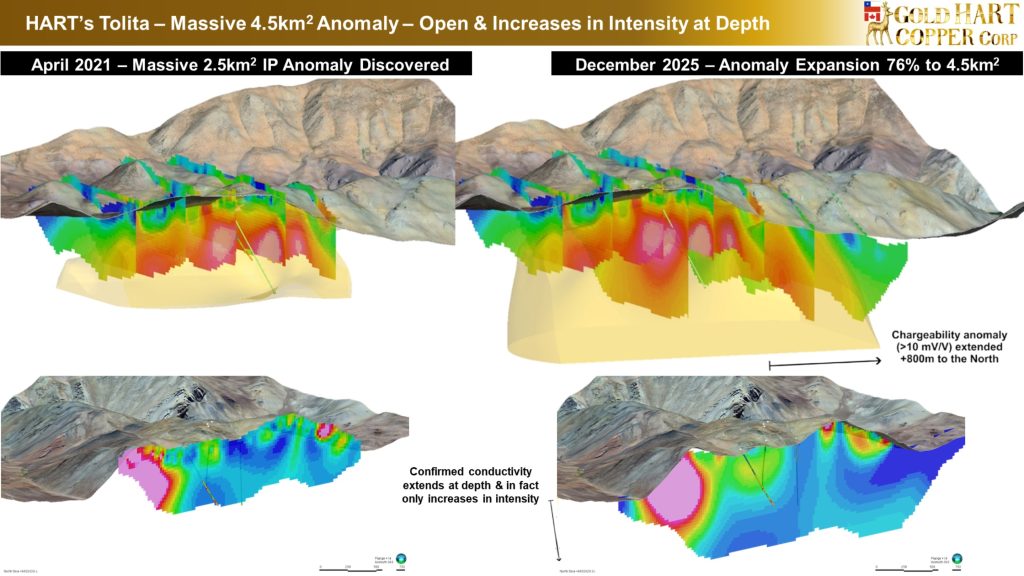
Tolita is a large porphyry target characterized by a geophysical anomaly that was originally interpreted to cover approximately 2.5 square kilometres and has since been expanded by 76% to roughly 4.5 square kilometres. The Tolita property itself covers 3,476 hectares, or approximately 34.8 square kilometres. Surface gold soil geochemistry outlines a halo of approximately 28 hectares with gold values above 0.1 g/t.
Gold Hart’s geological team, including senior geologists Professor Dr. Jose Frutos, Enrique Viteri, Jonathan Warner, and Rodrigo Díaz Tillería, designed a 10-hole diamond drilling program to test the porphyry target. In 2025, the company drilled holes DDHTOL02 and DDHTOL05 to depths of approximately 600 metres each, intersecting around 360 metres and 230 metres of gold, copper, and molybdenum porphyry mineralization, respectively. An earlier attempt to drill DDHTOL01 in March 2025 was suspended due to technical challenges, leading to the current re-entry with a more powerful rig.
At least seven additional diamond drill targets have been identified across the Tolita asset. These targets are supported by coincident geophysical chargeability and conductivity anomalies, geological and structural controls, and surface geochemical signatures.
Follow-up geophysical surveys at Tolita indicate that the conductive and chargeable anomaly increases in both size and intensity at depth. According to a third-party geophysicist involved in the survey, newly acquired deep lines better defined a steeply dipping conductor likely associated with a fault. The conductor’s strong contrast in resistivity relative to host rocks suggests it may have acted as a conduit for hydrothermal fluids, potentially enhancing mineralization at depth.
Plans for Reverse Circulation Drilling at Tolita
In addition to diamond drilling, Gold Hart plans to deploy a reverse circulation drill rig at Tolita to test higher-grade mineralization closer to surface. The planned RC drilling will target the project’s highest-grade trench, which returned 8.61 g/t gold equivalent over 10 metres, including 2 metres at 10.40 g/t gold, 20 g/t silver, and 2.88% copper. Grab samples from the same area returned up to 45.75 g/t gold, 28 g/t silver, and 3.99% copper, equivalent to approximately 52 g/t gold equivalent.
The trench has recently been re-opened using a bulldozer, exposing visible copper mineralization, including malachite and chrysocolla. The company noted that the broader geophysical anomaly at Tolita appears to reach surface near this high-grade trench.
Tolita was first recognized and staked in 1993 for its high-grade gold and copper mineralization. Historical trenching totaling approximately 5.6 kilometres outlined multiple mineralized zones, and early helicopter magnetic surveys identified four distinct anomalies. In 1996, a third-party operator drilled three short RC holes to depths of about 200 metres, intersecting gold and copper mineralization in all three holes. Due to market conditions at the time, no further drilling was carried out beyond this initial program.
Following Gold Hart’s acquisition of the property, a comprehensive geophysical survey identified a large, near-surface, high-chargeability and conductive anomaly interpreted as a copper-gold porphyry system. Subsequent diamond drilling in 2025 confirmed the presence of a fertile porphyry system, characterized by multi-generation stockwork veining, multiple alteration styles, and increasing potassic alteration at depth.
 Follow us on Twitter
 Become our facebook fan




Comments are closed.