Gold Hart Copper (TSXV: HART) has released details from recent exploration activities at two of its Chilean assets, including results from a geochemical survey at the Nessa gold-copper-silver complex and an update on drilling underway at its flagship Tolita gold-copper-molybdenum-silver project in the Vicuña District. The update was reported by Mr. Isaac Maresky in a disclosure dated February 2, 2026.
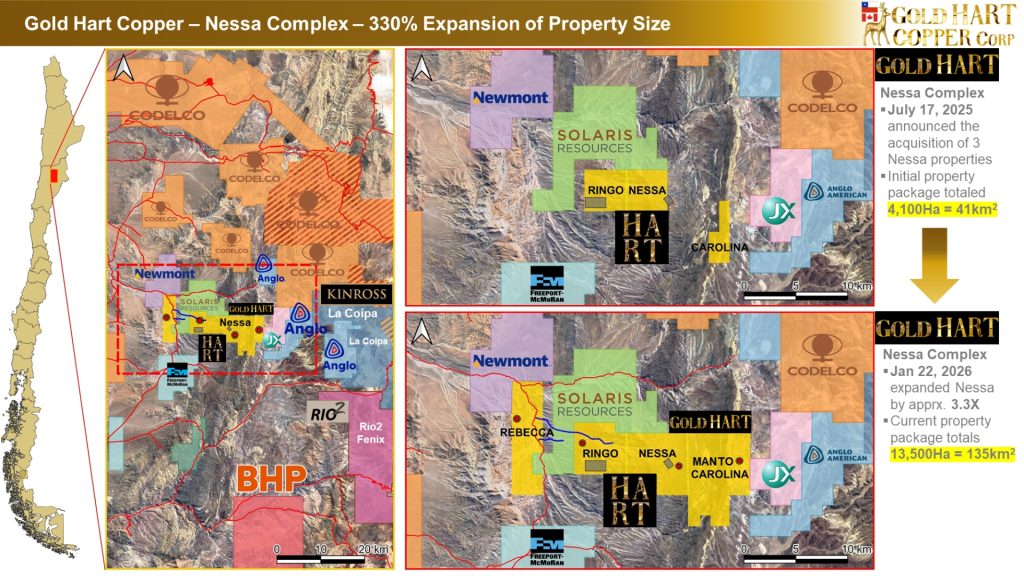
The Nessa complex, located immediately west of Kinross’ La Coipa Gold Mine and south of Codelco’s El Salvador–Potrerillos copper mining and smelting complex, has recently undergone a major expansion in land position. As announced previously on January 22, 2026, Gold Hart increased the size of the Nessa property from approximately 4,100 hectares to 13,500 hectares, or 135 square kilometres, representing a 3.3-fold increase.
Following this expansion, Gold Hart completed a follow-on geochemical survey designed to evaluate areas of known historical interest. The program focused on zones that contain clusters of historic mining pits and previously reported high-grade samples. According to the company, the objectives of the survey included mapping pit geology, confirming the locations of historic workings, ground-truthing reported grades from historical samples, and assessing additional undocumented pits identified through satellite imagery. The work was also intended to better understand the factors contributing to the widespread distribution of mining pits across the expanded property.
Geochemical Survey Results at Nessa
Laboratory results from the survey confirmed the presence of elevated gold, copper, and silver values across multiple sampled areas. Of the 51 samples collected, 12 returned gold values of at least 1 gram per tonne (g/t), with six samples grading 4 g/t gold or higher and two samples exceeding 9 g/t gold. Silver values were also significant, with four samples containing at least 100 g/t silver.
Copper results showed that 12 samples returned values of at least 3,000 parts per million (ppm), while nine samples exceeded 5,000 ppm copper. The company noted that these high-grade copper samples are being re-analyzed to determine precise values, with final results expected to be reported following completion of the additional laboratory work.
Gold Hart’s geological team interpreted the survey results as confirmation of high-grade mineralization previously reported at Nessa. Several samples returned gold grades between 4 g/t and 9.7 g/t, and multiple copper and silver assays exceeded laboratory detection limits of greater than 0.5% copper and greater than 400 g/t silver. Pulps from these samples are currently undergoing further analysis to obtain exact concentrations.
Geological Interpretation and Next Steps at Nessa
Beyond confirming grades, the survey provided additional geological insight. Gold Hart geologists identified multiple vein systems with consistent structural orientations, information that is already being incorporated into early-stage target generation for future exploration campaigns. The company stated that the dataset highlights the need for a broader and more systematic geological mapping and sampling program across the property.
Planned next steps at Nessa include expanding soil sampling coverage to establish a continuous geochemical dataset across the broader regional land package. These results are expected to guide targeted trenching programs aimed at exposing mineralized structures and validating surface geochemical trends. To complement surface work, induced polarization (IP) and magnetic geophysical surveys are planned to delineate subsurface chargeability, resistivity, and structural features. The integration of geological, geochemical, and geophysical data is intended to refine drill targeting ahead of a future reverse circulation drilling program designed to test the highest-priority targets generated by this work.
Regional Setting of the Nessa Assets
The Nessa properties are situated along the Domeyko Fault, a major structural corridor in Chile that hosts several world-class copper deposits, including the Escondida Copper Mine. The assets are also located near projects operated by major mining companies such as Newmont, Solaris, JX Nippon, Anglo American, and Rio2’s Fenix Gold Mine. The project area hosts a strong magnetic anomaly that aligns with known veins and historic mining activity, reinforcing the interpretation of a structurally controlled mineralized system with potential continuity along strike.
Historically, the Nessa area was known to host at least 13 artisanal gold and copper pits, some of which were mined using mules due to limited access. Historic sampling reported grades of up to 25 g/t gold, 3.25% copper, and 958 g/t silver. More recently, while constructing access roads across the Nessa, Ringo, and Manto Carolina areas, Gold Hart identified additional historic pits and copper showings with visible malachite and chrysocolla that were not previously documented.
Tolita Project: Drilling Progress and Geological Observations
In parallel with the Nessa work, Gold Hart provided an update on drilling at its Tolita project in the Vicuña District of Chile. The current diamond drill hole, DDHTOL01, has reached a depth of approximately 900 metres. Based on preliminary geological interpretation, the company reports that the hole remains within the mineralized system of interest.
Core logging has identified multiple intervals exhibiting hydrothermal alteration and mineralization consistent with a porphyry-style environment. Recent observations include veins containing pyrite, chalcopyrite, bornite, and covellite. These characteristics have been cited as supporting the decision to continue deepening the hole, with the drill rig capable of reaching depths between 1,100 and 1,200 metres.
Tolita Drill Program History and Targeting
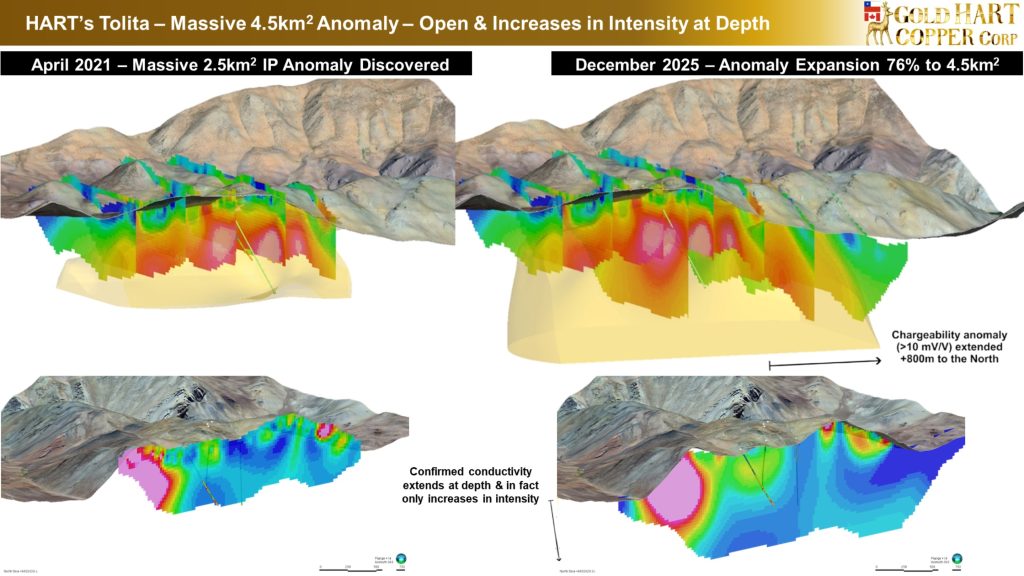
Tolita is a large porphyry target characterized by a geophysical anomaly that was originally interpreted to cover approximately 2.5 square kilometres and has since been expanded by 76% to roughly 4.5 square kilometres. The Tolita property itself covers 3,476 hectares, or approximately 34.8 square kilometres. Surface gold soil geochemistry outlines a halo of approximately 28 hectares with gold values above 0.1 g/t.
Gold Hart’s geological team, including senior geologists Professor Dr. Jose Frutos, Enrique Viteri, Jonathan Warner, and Rodrigo Díaz Tillería, designed a 10-hole diamond drilling program to test the porphyry target. In 2025, the company drilled holes DDHTOL02 and DDHTOL05 to depths of approximately 600 metres each, intersecting around 360 metres and 230 metres of gold, copper, and molybdenum porphyry mineralization, respectively. An earlier attempt to drill DDHTOL01 in March 2025 was suspended due to technical challenges, leading to the current re-entry with a more powerful rig.
At least seven additional diamond drill targets have been identified across the Tolita asset. These targets are supported by coincident geophysical chargeability and conductivity anomalies, geological and structural controls, and surface geochemical signatures.
Follow-up geophysical surveys at Tolita indicate that the conductive and chargeable anomaly increases in both size and intensity at depth. According to a third-party geophysicist involved in the survey, newly acquired deep lines better defined a steeply dipping conductor likely associated with a fault. The conductor’s strong contrast in resistivity relative to host rocks suggests it may have acted as a conduit for hydrothermal fluids, potentially enhancing mineralization at depth.
Plans for Reverse Circulation Drilling at Tolita
In addition to diamond drilling, Gold Hart plans to deploy a reverse circulation drill rig at Tolita to test higher-grade mineralization closer to surface. The planned RC drilling will target the project’s highest-grade trench, which returned 8.61 g/t gold equivalent over 10 metres, including 2 metres at 10.40 g/t gold, 20 g/t silver, and 2.88% copper. Grab samples from the same area returned up to 45.75 g/t gold, 28 g/t silver, and 3.99% copper, equivalent to approximately 52 g/t gold equivalent.
The trench has recently been re-opened using a bulldozer, exposing visible copper mineralization, including malachite and chrysocolla. The company noted that the broader geophysical anomaly at Tolita appears to reach surface near this high-grade trench.
Tolita was first recognized and staked in 1993 for its high-grade gold and copper mineralization. Historical trenching totaling approximately 5.6 kilometres outlined multiple mineralized zones, and early helicopter magnetic surveys identified four distinct anomalies. In 1996, a third-party operator drilled three short RC holes to depths of about 200 metres, intersecting gold and copper mineralization in all three holes. Due to market conditions at the time, no further drilling was carried out beyond this initial program.
Following Gold Hart’s acquisition of the property, a comprehensive geophysical survey identified a large, near-surface, high-chargeability and conductive anomaly interpreted as a copper-gold porphyry system. Subsequent diamond drilling in 2025 confirmed the presence of a fertile porphyry system, characterized by multi-generation stockwork veining, multiple alteration styles, and increasing potassic alteration at depth.
Gold Hart Copper Corp. (TSXV: HART) has provided an update on exploration activities at its Tolita gold-copper-molybdenum-silver project in Chile and announced a substantial expansion of its Nessa copper-gold-silver land position. The update outlines the current status of deep diamond drilling at Tolita, plans to introduce reverse circulation drilling to test higher-grade near-surface targets, and the enlargement of the Nessa property west of Kinross’ La Coipa gold mine.
Progress at Tolita Diamond Drill Program
Drilling is currently underway at Tolita, the company’s flagship asset in the emerging Vicuña Copper-Gold District of Chile. The active diamond drill hole, designated DDHTOL01, has reached a depth of approximately 700 metres. Geological logging has been completed to roughly 650 metres, and preliminary interpretations indicate the hole remains within the targeted mineralized system.
According to observations reported by Gold Hart, the drill core continues to exhibit characteristics associated with a porphyry-style mineral system. These include strong hydrothermal alteration and mineralization across multiple intervals. The core shows several generations of veinlets and stockworks of varying intensity extending over hundreds of metres, as well as banded veinlets several centimetres thick. Localized chalcopyrite and bornite mineralization has been identified within some of these veinlets.
Based on these observations, the company plans to continue advancing the drill hole until it either exits the mineralized system or reaches the maximum depth capacity of the drill rig. The current rig is expected to reach depths of between 1,100 and 1,200 metres.
Context of the Current Drill Target
The current hole, DDHTOL01, represents the first target in a broader 10-hole drill plan designed by Gold Hart’s geological team, which includes senior geologists Professor Dr. Jose Frutos, Enrique Viteri, Jonathan Warner, and Rodrigo Díaz Tillería. The objective of the program is to test Tolita as a potential gold-copper-molybdenum-silver porphyry system.
An initial attempt to drill DDHTOL01 in March 2025 was halted due to operational challenges under tight time constraints. As a result, the company elected to drill two alternative holes, DDHTOL02 and DDHTOL05. Each of these holes reached depths of approximately 600 metres and intersected about 360 metres and 230 metres, respectively, of gold, copper, and molybdenum porphyry mineralization. With the mobilization of a more powerful drill rig, Gold Hart has now returned to DDHTOL01 to test the target at greater depth.
Beyond the current hole, at least seven additional diamond drill targets have been identified across the Tolita property. These targets are supported by coincident geophysical features, including chargeability and conductivity anomalies, as well as geological, structural, and geochemical indicators.
Scale of the Tolita Target
Tolita represents a large exploration target within the Vicuña District. The original induced polarization geophysical anomaly covered approximately 2.5 square kilometres and has since been expanded by 76% to about 4.5 square kilometres. Surface geochemistry indicates a gold soil halo above 0.1 g/t covering nearly 28 hectares. The overall Tolita property spans 3,476 hectares, equivalent to roughly 34.8 square kilometres.
A follow-up geophysical survey has confirmed that the anomaly not only persists but expands in both size and intensity at depth. According to the third-party geophysicist who conducted the survey, new deep survey lines better defined the vertical extent of a steeply dipping conductive feature, likely related to a fault. The geophysicist noted that the strong conductivity contrast suggests the structure could act as a conduit for hydrothermal fluids, potentially supporting mineralization at depth. The survey also indicated that the alteration system may increase in intensity with depth.
Comparable examples from Chile and the Vicuña District were cited to illustrate how porphyry systems can become larger and higher grade at depth. These include Atex Resources’ drill hole ATXD25C in Chile, which reported 2.72% copper equivalent between 1,558 metres and 1,722 metres, and NGEX’s drill hole DPDH028 at Lunahuasi in the Vicuña District, which included multiple high-grade intercepts, including a 53.5-metre interval grading 7.79% copper equivalent between 1,219.5 metres and 1,273.0 metres.
Planned Reverse Circulation Drilling at Tolita
In addition to deep diamond drilling, Gold Hart plans to mobilize a reverse circulation (RC) drill rig to test higher-grade, shallower targets at Tolita. The RC program is intended to focus on a high-grade trench that has returned significant gold, silver, and copper values.
Results from this trench include 8.61 g/t gold equivalent over 10 metres, including a 2-metre interval grading 10.40 g/t gold, 20 g/t silver, and 2.88% copper. Grab samples from the same area returned values of 45.75 g/t gold, 28 g/t silver, and 3.99% copper, corresponding to approximately 52 g/t gold equivalent.
The trench was recently expanded using a bulldozer, exposing visible green and turquoise copper mineralization typical of malachite and chrysocolla. The company noted that the broader geophysical anomaly at Tolita appears to reach surface at or near this trench location.
Gold Hart recently hosted a site visit that included tours of both the Tolita and Nessa properties. Attendees included members of the company’s board and advisory board, such as the Honourable John R. Baird, Mark Kucher, and Aleta Shiff. During the visit, a 360-degree immersive video was produced in which Gold Hart co-founder Jonathan Warner explains the diamond drilling process.
Expansion of the Nessa Copper-Gold-Silver Complex
Separately, Gold Hart announced a significant expansion of its Nessa copper-gold-silver complex. The land position has increased by approximately 330%, from an initial 4,100 hectares to a total of 13,500 hectares, equivalent to 135 square kilometres.
The Nessa complex is located just south of Codelco’s El Salvador–Potrerillos copper mining and smelting complex, one of Chile’s oldest copper smelting operations. The expanded land package is surrounded by properties held by major mining companies, including Newmont, Solaris, JX Nippon, and Anglo American. Nessa is situated northwest of Rio2’s Fenix gold deposit and west of Kinross’ La Coipa gold mine.
As previously reported, Gold Hart completed a follow-up geochemical survey at Nessa to test areas of interest identified across the expanded property. The company expects assay results from this survey in the coming week. During road construction at the Nessa, Ringo, and Manto Carolina assets, the company identified additional historic mining pits with visible copper mineralization, including malachite and chrysocolla. These pits and surface copper showings were not previously known to the company and were not included in earlier documentation for the assets.
The update reflects continued exploration activity across Gold Hart’s Chilean portfolio, with work focused on both deep porphyry targets at Tolita and expanded surface and near-surface opportunities at Nessa. Drilling at Tolita is ongoing, with the current hole planned to reach depths of up to 1,200 metres, while preparations are underway to add RC drilling to test high-grade surface expressions. At Nessa, expanded land coverage and recent geochemical and field observations are informing the next stages of exploration across the enlarged property.

Gold Hart Copper Corp. (TSXV:HART) has released the results from the first diamond drill hole at its flagship Tolita gold-copper-molybdenum project, located in the Vicuña District of northern Chile. The company’s initial drill results confirm the presence of porphyry-style mineralization and mark the conclusion of the hole in mineralized rock, suggesting a potentially large mineralized system at depth.
Enrique Viter-Aldunate, Vicuña pioneer and Tolita discoverer commented in a press release: “I could not be happier with the first drill hole at Tolita, as 320m+ of 0.24-0.25g/t is highly indicative of a potentially very large gold system. I recall from my personal experience drilling Cerro Casale that the first several holes did not return such an extensive and continuous presence of gold, and of course that asset has now become the largest gold-copper deposit on the continent. In fact, from around 130m to the end of the hole at 610m (nearly 480m), it would appear that there is nearly consistent mineralization except for the 150m sterile zone which we now believe to be a major geological fault. This drill hole has also significantly advanced our geological understanding of the asset, as Dr. Professor Jose Frutos and I now both strongly believe that this fault may have caused the higher-chargeability and higher-conductivity anomaly to land closer to surface on the eastern side of the property, which could potentially host higher grades. I believe this first hole (DDHTOL02) should lay to rest any questions around whether or not Tolita has potential to be a porphyry, because the drill hole clearly proves we intercepted porphyry-style mineralization typical of the Vicuña. Like this first diamond drill hole, all historic RC holes were also drilled into the western side of Tolita; so the eastern side remains completely untested, and drilling the near-surface high-chargeability high-conductivity zone must be priority number one, as was our original plan with DDHTOL01. I am extremely excited about the future as Gold Hart advances further drilling particularly on the eastern side of the asset.”
Isaac Maresky, Co-founder & CEO of Gold Hart, also commented: “We are thrilled to have encountered such long intervals of gold, copper, and molybdenum particularly so early on in our first drill hole ever at Tolita. I am more excited than ever about the potential of Tolita and to continue the drill campaign in September. Now that we have been fortunate enough to return porphyry-style intercepts so early, with good correlation between geophysical anomalies and gold-copper-molybdenum, we can focus on honing in on the top-tier drill targets where we might find grades. Interestingly, the eastern side of the property – totally open and untested – is exactly where the chargeable geophysical anomaly is highest and also where the highest conductive zone overlaps as well.”
Drill Hole DDHTOL02: Intercepts 360 Meters of Mineralization
The first diamond drill hole, DDHTOL02, was drilled to a depth of 610 meters, intersecting porphyry-style mineralization consistent with geological models for the Vicuña District. Gold Hart reports that the hole encountered near-continuous gold, copper, and molybdenum mineralization beginning at approximately 137.5 meters downhole and continuing through to the end of the hole. The mineralized interval was interrupted by a 150-meter sterile zone interpreted to be associated with a major fault structure.
The company notes that the drill hole ended in mineralization, suggesting the system remains open at depth.
Pending Results from Second Drill Hole
Gold Hart’s initial 2025 drill program at Tolita consisted of approximately 1,200 meters. A second and final hole, DDHTOL05, has been completed, and results are expected to be announced in the coming two weeks. The company has not yet provided details on the depth or visual mineralization of this second hole.
Historical and Geological Context of Tolita
The Tolita property is located at the junction of the Maricunga Gold Belt and the emerging Vicuña Copper Belt, a region known for large-scale porphyry and epithermal deposits. First staked in 1993 by one of the geologists credited with early discoveries in the area, the project was originally recognized for its high surface grades of gold and copper.
Due to unfavorable commodity prices at the time — gold around $300/oz and copper under $1/lb — and limited investor interest in large-scale sulphide deposits, the planned eight-hole drill program was not completed. Only three holes were drilled, and the project remained largely untested at depth for nearly three decades.
Exploration Strategy and Land Position
Gold Hart Copper holds one of the largest independent land positions surrounding producing and major exploration-stage copper and gold projects in Chile. In addition to its holdings in the Vicuña District, the company recently acquired three new properties to the west, along the Paleocene-Eocene Belt near the Domeyko Fault — a zone that hosts some of Chile’s largest copper and gold operations.
These new properties include historical mines with surface mineralization and large-scale alteration and magnetic anomalies extending approximately 6 kilometers. The company’s technical team has indicated that these anomalies are under evaluation for future drill targeting.
Technical Team and Project Oversight
Gold Hart’s technical team includes senior geologists involved in some of Chile’s major discoveries. Among them is Dr. José Frutos, the country’s former Deputy Manager of the Geological Survey.
Several of Gold Hart’s current properties were staked in the 1990s by members of this team and remain under the company’s control with no royalty encumbrances.
Porphyry Targeting and Ongoing Campaign
The Tolita drill program is intended to test a large, preserved porphyry system with strong surface mineralization and geophysical anomalies. Gold Hart describes Tolita as one of the only untested, large-scale porphyry targets in the Vicuña District that has not undergone significant modern drilling despite early positive results.
In contrast to oxide-dominated deposits that received more attention in the 1990s, Tolita hosts a sulphide-dominant system, often less attractive to junior companies in past low commodity price cycles. Gold Hart has stated that, given the improved market environment for copper and gold, and the demand for long-life copper-gold assets, the project has become a focus of renewed exploration.
Gold Hart plans to release the assay results from DDHTOL05 in the near term. The company has not announced any additional drilling beyond this two-hole program but has indicated that the results will inform the next stage of exploration across the broader Tolita project area.
If you would like to receive our free newsletter via email, simply enter your email address below & click subscribe.
 Follow us on Twitter
 Become our facebook fan
CONNECT WITH US
Tweets
Tweet with hash tag #miningfeeds or @miningfeeds and your tweets will be displayed across this site.
MOST ACTIVE MINING STOCKS
Daily Gainers
 CMC Metals Ltd. CMC Metals Ltd. |
CMB.V | +900.00% |
 Eden Energy Ltd Eden Energy Ltd |
EDE.AX | +200.00% |
| GoviEx Uranium Inc. |
GXU.V | +42.86% |
| Eagle Nickel Ltd. |
ENL.AX | +41.67% |
| Citigold Corp. Limited |
CTO.AX | +33.33% |
| Mount Burgess Mining NL |
MTB.AX | +33.33% |
| Exalt Resources Limited |
ERD.AX | +31.94% |
| Casa Minerals Inc. |
CASA.V | +30.00% |
| Cariboo Rose Resources Ltd |
CRB.V | +28.57% |
| Belmont Resources Inc. |
BEA.V | +28.57% |