



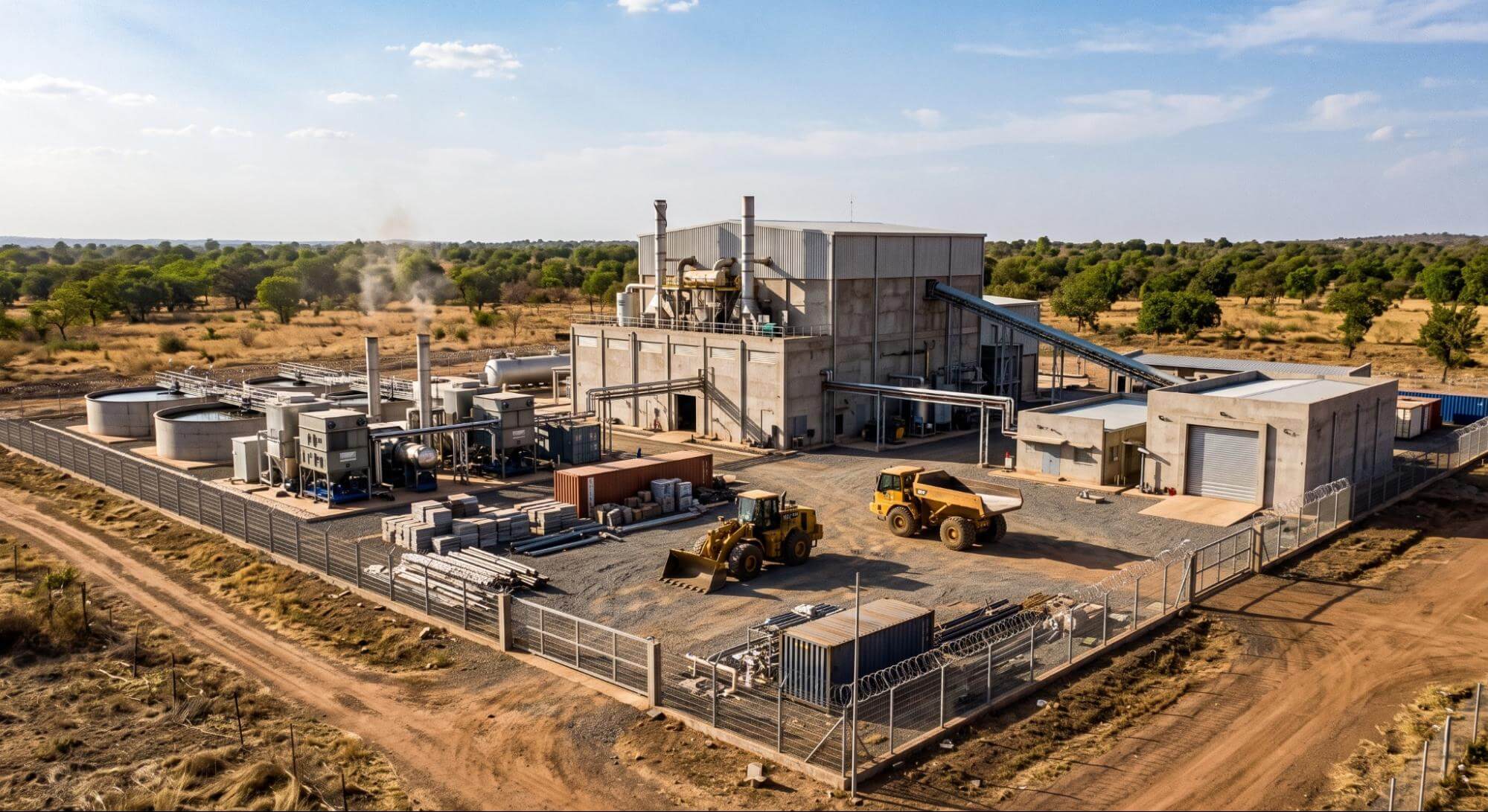
Burkina Faso has commissioned its first gold refinery, giving the country domestic capacity to refine, assay, certify, and store bullion from industrial and artisanal production.
The Raffinor-BF facility in Ouagadougou cost more than 11 billion CFA francs, equivalent to about US$19 million. Its first processing lines are designed for 164 tonnes of gold per year. A planned second phase would lift annual capacity to 515 tonnes, far above current national mine output and large enough to accommodate additional feed from elsewhere in West Africa.
The refinery was financed through public funding, including the National Precious Metals Company (SONASP), together with investment from Burkina Faso’s private sector.
Refining Capacity Exceeds Current Production
Burkina Faso produced between 94 tonnes and 100.7 tonnes of gold in 2025.
Around 58 tonnes came from 15 industrial mines, while artisanal and semi-mechanized operations contributed more than 42 tonnes.
The production profile leaves Raffinor-BF with initial capacity well above recent domestic output. The planned expansion to 515 tonnes a year would give the refinery room to process considerably larger volumes if production rises or if material is sourced from neighbouring countries.
The plant occupies roughly five hectares in Ouagadougou, with its services including refining, laboratory assessment, certification, and secure storage, bringing more stages of gold processing into a domestic facility.
Gold remains Burkina Faso’s most important export commodity. During the first seven months of 2026, it accounted for nearly 94% of national export earnings.
Mining Policy Gives the State a Larger Role
The refinery forms part of a series of mining policy changes introduced since President Ibrahim Traoré took power in September 2022.
The government has increased the state’s free-carried interest in mining projects from 10% to 15%, established the state mining company SOPAMIB, and expanded public involvement in buying and managing precious metals.
Gold exports from artisanal and semi-mechanized operations were suspended in 2024 as authorities tightened control over informal trading and smuggling.
Illegal gold trading has also been linked to financing for armed Islamist groups operating in the country. Burkina Faso has faced years of attacks by groups connected to al-Qaeda and the Islamic State, with insecurity affecting several mining areas and limiting state control in parts of the country.
West African Governments Expand Domestic Processing
Burkina Faso is part of a regional push to expand domestic mineral processing.
Guinea has prohibited raw gold exports, Ghana has restricted exports of unrefined material produced by small-scale miners, Mali is developing its first refinery, and Ivory Coast plans to commission a refinery next year.
Raffinor-BF is expected to create about 100 direct jobs and more than 5,000 indirect jobs.
The project adds domestic processing capacity to an industry accounting for most of Burkina Faso’s export revenue and significantly increases the state’s role in the country’s gold trade.
 Follow us on Twitter
 Become our facebook fan




Comments are closed.