



Gold Hart Copper Corp. (TSXV: HART) has provided an update on exploration activities at its Tolita gold-copper-molybdenum-silver project in Chile and announced a substantial expansion of its Nessa copper-gold-silver land position. The update outlines the current status of deep diamond drilling at Tolita, plans to introduce reverse circulation drilling to test higher-grade near-surface targets, and the enlargement of the Nessa property west of Kinross’ La Coipa gold mine.
Progress at Tolita Diamond Drill Program
Drilling is currently underway at Tolita, the company’s flagship asset in the emerging Vicuña Copper-Gold District of Chile. The active diamond drill hole, designated DDHTOL01, has reached a depth of approximately 700 metres. Geological logging has been completed to roughly 650 metres, and preliminary interpretations indicate the hole remains within the targeted mineralized system.
According to observations reported by Gold Hart, the drill core continues to exhibit characteristics associated with a porphyry-style mineral system. These include strong hydrothermal alteration and mineralization across multiple intervals. The core shows several generations of veinlets and stockworks of varying intensity extending over hundreds of metres, as well as banded veinlets several centimetres thick. Localized chalcopyrite and bornite mineralization has been identified within some of these veinlets.
Based on these observations, the company plans to continue advancing the drill hole until it either exits the mineralized system or reaches the maximum depth capacity of the drill rig. The current rig is expected to reach depths of between 1,100 and 1,200 metres.
Context of the Current Drill Target
The current hole, DDHTOL01, represents the first target in a broader 10-hole drill plan designed by Gold Hart’s geological team, which includes senior geologists Professor Dr. Jose Frutos, Enrique Viteri, Jonathan Warner, and Rodrigo Díaz Tillería. The objective of the program is to test Tolita as a potential gold-copper-molybdenum-silver porphyry system.
An initial attempt to drill DDHTOL01 in March 2025 was halted due to operational challenges under tight time constraints. As a result, the company elected to drill two alternative holes, DDHTOL02 and DDHTOL05. Each of these holes reached depths of approximately 600 metres and intersected about 360 metres and 230 metres, respectively, of gold, copper, and molybdenum porphyry mineralization. With the mobilization of a more powerful drill rig, Gold Hart has now returned to DDHTOL01 to test the target at greater depth.
Beyond the current hole, at least seven additional diamond drill targets have been identified across the Tolita property. These targets are supported by coincident geophysical features, including chargeability and conductivity anomalies, as well as geological, structural, and geochemical indicators.
Scale of the Tolita Target
Tolita represents a large exploration target within the Vicuña District. The original induced polarization geophysical anomaly covered approximately 2.5 square kilometres and has since been expanded by 76% to about 4.5 square kilometres. Surface geochemistry indicates a gold soil halo above 0.1 g/t covering nearly 28 hectares. The overall Tolita property spans 3,476 hectares, equivalent to roughly 34.8 square kilometres.
A follow-up geophysical survey has confirmed that the anomaly not only persists but expands in both size and intensity at depth. According to the third-party geophysicist who conducted the survey, new deep survey lines better defined the vertical extent of a steeply dipping conductive feature, likely related to a fault. The geophysicist noted that the strong conductivity contrast suggests the structure could act as a conduit for hydrothermal fluids, potentially supporting mineralization at depth. The survey also indicated that the alteration system may increase in intensity with depth.
Comparable examples from Chile and the Vicuña District were cited to illustrate how porphyry systems can become larger and higher grade at depth. These include Atex Resources’ drill hole ATXD25C in Chile, which reported 2.72% copper equivalent between 1,558 metres and 1,722 metres, and NGEX’s drill hole DPDH028 at Lunahuasi in the Vicuña District, which included multiple high-grade intercepts, including a 53.5-metre interval grading 7.79% copper equivalent between 1,219.5 metres and 1,273.0 metres.
Planned Reverse Circulation Drilling at Tolita
In addition to deep diamond drilling, Gold Hart plans to mobilize a reverse circulation (RC) drill rig to test higher-grade, shallower targets at Tolita. The RC program is intended to focus on a high-grade trench that has returned significant gold, silver, and copper values.
Results from this trench include 8.61 g/t gold equivalent over 10 metres, including a 2-metre interval grading 10.40 g/t gold, 20 g/t silver, and 2.88% copper. Grab samples from the same area returned values of 45.75 g/t gold, 28 g/t silver, and 3.99% copper, corresponding to approximately 52 g/t gold equivalent.
The trench was recently expanded using a bulldozer, exposing visible green and turquoise copper mineralization typical of malachite and chrysocolla. The company noted that the broader geophysical anomaly at Tolita appears to reach surface at or near this trench location.
Gold Hart recently hosted a site visit that included tours of both the Tolita and Nessa properties. Attendees included members of the company’s board and advisory board, such as the Honourable John R. Baird, Mark Kucher, and Aleta Shiff. During the visit, a 360-degree immersive video was produced in which Gold Hart co-founder Jonathan Warner explains the diamond drilling process.
Expansion of the Nessa Copper-Gold-Silver Complex
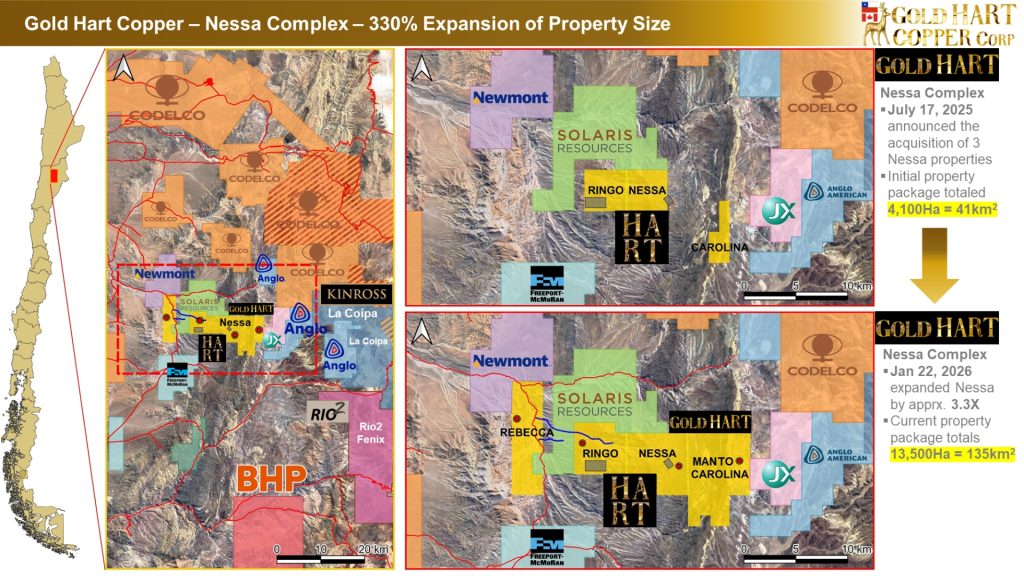
Separately, Gold Hart announced a significant expansion of its Nessa copper-gold-silver complex. The land position has increased by approximately 330%, from an initial 4,100 hectares to a total of 13,500 hectares, equivalent to 135 square kilometres.
The Nessa complex is located just south of Codelco’s El Salvador–Potrerillos copper mining and smelting complex, one of Chile’s oldest copper smelting operations. The expanded land package is surrounded by properties held by major mining companies, including Newmont, Solaris, JX Nippon, and Anglo American. Nessa is situated northwest of Rio2’s Fenix gold deposit and west of Kinross’ La Coipa gold mine.
As previously reported, Gold Hart completed a follow-up geochemical survey at Nessa to test areas of interest identified across the expanded property. The company expects assay results from this survey in the coming week. During road construction at the Nessa, Ringo, and Manto Carolina assets, the company identified additional historic mining pits with visible copper mineralization, including malachite and chrysocolla. These pits and surface copper showings were not previously known to the company and were not included in earlier documentation for the assets.
The update reflects continued exploration activity across Gold Hart’s Chilean portfolio, with work focused on both deep porphyry targets at Tolita and expanded surface and near-surface opportunities at Nessa. Drilling at Tolita is ongoing, with the current hole planned to reach depths of up to 1,200 metres, while preparations are underway to add RC drilling to test high-grade surface expressions. At Nessa, expanded land coverage and recent geochemical and field observations are informing the next stages of exploration across the enlarged property.
 Follow us on Twitter
 Become our facebook fan





Comments are closed.